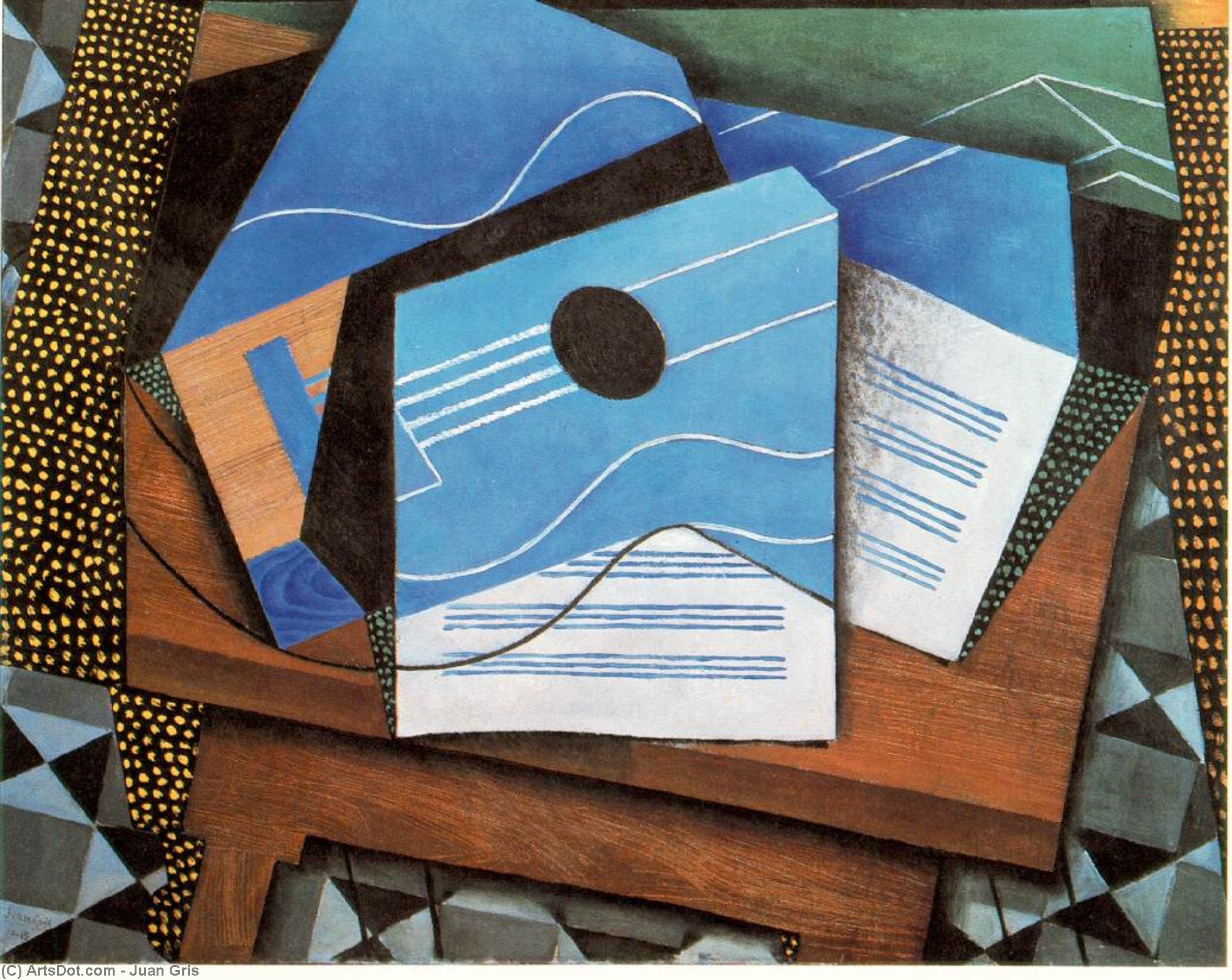
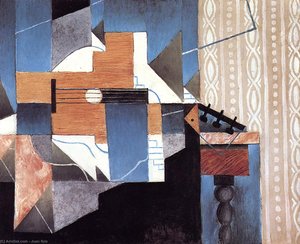
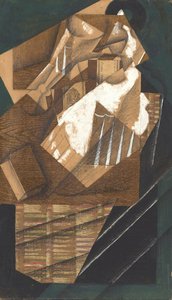
Portrait of Juan Gris

The 100 Most Famous Juan Gris Paintings, Each One of a Kind

Updated November 2026 · ranked by our popularity score (searches, visits and orders for each work) · 411 works by Juan Gris in our catalogue

In short

Portrait of Madame Josette Gris (1916) is the Juan Gris painting that draws the most eyes. After it, the eye goes to Pears and grapes on a table (1913) and Still Life before an Open Window aka Place Ravignan (1915). Among the 411 works of Juan Gris in our catalog, these 100 are the most famous, each a unique original presented with its year, its museum and the reason it endures.

1887 – 1927, Madrid Cubism Most works: Museo Nacional Centro de Arte Reina Sofía

Top 10 paintings by Juan Gris, through the gallery's eye

1
Portrait of Madame Josette Gris (1916) by Juan Gris

Portrait of Madame Josette Gris

1916 · Oil On Canvas

"Portrait of Madame Josette Gris" (1916) is a captivating masterpiece by Juan Gris, a leading figure in the Cubist movement. This artwork invites viewers into a world where form and perspective are deconstructed, offering a fresh and dynamic interpretation of portraiture.

2
Pears and grapes on a table (1913) by Juan Gris

Pears and grapes on a table

1913 · Oil On Canvas

Juan Gris' 1913 masterpiece, "Pears and grapes on a table," isn’t merely a depiction of fruit; it is a bold declaration of a new visual language. Emerging from the fertile ground of early 20th-century Paris, this painting embodies the core tenets of Synthetic Cubism, yet possesses a unique vibrancy that sets it apart. Gris doesn't attempt to replicate reality as we perceive it, but rather dissects and reassembles it, presenting…

3
Still Life before an Open Window aka Place Ravignan (1915) by Juan Gris

Still Life before an Open Window aka Place Ravignan

1915 · Oil On Canvas · Philadelphia Museum of Art, Philadelphia

A Masterpiece of Cubist Innovation Juan Gris's "Still Life before an Open Window aka Place Ravignan" is a captivating example of Synthetic Cubism, showcasing the artist's unique ability to blend geometric abstraction with everyday objects. Created in 1915, this artwork exemplifies Gris's mature style, characterized by its intricate compositions and harmonious color palettes. Subject and Composition The painting depicts a still life scene set before an open window, offering a…
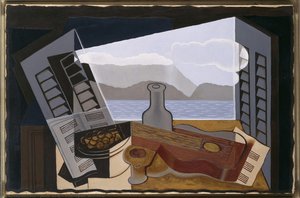
4
Breakfast (1915) by Juan Gris

Breakfast

1915 · Oil On Canvas

Exploring the Subject and Composition This captivating artwork presents a dynamic still life reimagined through the lens of Cubism. Featuring everyday objects such as a newspaper labeled "JOURNAL," a bottle, and other household items, the composition is fragmented into geometric facets that invite viewers to see familiar scenes from multiple perspectives simultaneously. The interplay of these objects, reassembled into a layered mosaic, challenges traditional notions of representation and encourages a…

5
Guitar on a table - - (1915) by Juan Gris

Guitar on a table - -

1915 · Oil On Canvas

To stand before Juan Gris’s Guitar on a Table is to step directly into the intellectual fervor of the early twentieth century, a moment when art dared to dismantle and reassemble reality. This seminal work from 1915 is not merely a depiction of musical instruments and scattered books; it is a meticulously constructed meditation on form, perspective, and the very nature of representation itself. Gris, ever the analytical mind, approaches…

6
Still Life with Newspaper (1916) by Juan Gris

Still Life with Newspaper

1916 · Oil On Canvas

To stand before Juan Gris’s Still Life with Newspaper is to step directly into the vibrant, intellectual crucible of early twentieth-century art. This painting from 1916 is far more than a mere arrangement of objects; it is a meticulously constructed visual argument about perception itself. Gris, a master craftsman who navigated the revolutionary currents of Cubism, presents us with a seemingly simple still life—a bowl, scattered cups, and perhaps a…

7
The Smoker (1913) by Juan Gris

The Smoker

1913 · Acrylic On Paper · Thyssen-Bornemisza Museum, Madrid

Juan Gris’s “The Smoker,” painted in 1913, isn't merely a depiction of a man enjoying a cigarette; it’s a meticulously constructed meditation on perception, fragmentation, and the burgeoning anxieties of early 20th-century modernity. Created during his pivotal period as a pioneer of Synthetic Cubism alongside Pablo Picasso, this work embodies the movement’s radical departure from traditional representation, offering instead a fractured, multi-faceted view of its subject – a Spanish painter…

8
The painters window - - (1925) by Juan Gris

The painters window - -

1925 · Oil On Canvas

Juan Gris’s The Painter's Window is not merely a depiction of an interior scene; it is a meticulously constructed intellectual puzzle rendered in oil on canvas. Created in 1925, this work stands as a quintessential testament to the principles of Synthetic Cubism. To gaze upon it is to look through a multifaceted lens, where reality itself has been disassembled and reassembled according to the artist's rigorous geometric vision. The composition…

9
Landscape at Beaulieu (1918) by Juan Gris

Landscape at Beaulieu

1918 · Acrylic On Canvas · Kröller-Müller Museum, Otterlo

José Victoriano González-Pérez, known universally as Juan Gris (1887–1927), stands as a cornerstone figure in the genesis of Cubist art. Born in Madrid and nurtured by an analytical mind honed at the School of Arts and Sciences—a formative experience that foreshadowed his distinctive artistic approach—Gris embarked on a journey that would propel him to prominence within the vanguard of early 20th-century visual culture.

10
The Miller (1918) by Juan Gris

The Miller

1918 · Oil On Canvas

To stand before Juan Gris’s The Miller is not merely to observe a painting; it is to step into a meticulously constructed intellectual space where reality itself has been disassembled and reassembled. Created in 1918, this seminal work stands as a profound testament to the power of Cubism—an art movement that dared to shatter the polished veneer of traditional representation. Gris, deeply influenced by the revolutionary breakthroughs of Picasso and…

Juan Gris's famous paintings, numbers 11 to 100

11Lamp (1916) by Juan GrisLamp1916 · Philadelphia Museum of Art 12Open Window with Hills (1923) by Juan GrisOpen Window with Hills1923 13Abstraction (Guitar and Glass) (1913) by Juan GrisAbstraction (Guitar and Glass)1913 · Art Institute of Chicago 14Fruit Bowl and Fruit (1916) by Juan GrisFruit Bowl and Fruit1916 15Open Window (1917) by Juan GrisOpen Window1917 · Philadelphia Museum of Art 16Harlequin (1917) by Juan GrisHarlequin1917 · Philadelphia Museum of Art 17Guitar on a Table (1915) by Juan GrisGuitar on a Table1915 · Kröller-Müller Museum 18Bottles and Knife (1912) by Juan GrisBottles and Knife1912 19Portrait of Josette Gris (1916) by Juan GrisPortrait of Josette Gris1916 · Museo Nacional Centro de Arte Reina Sofía 20Still Life with Newspaper (1916) by Juan GrisStill Life with Newspaper1916 21Still Life with White Tablecloth (1916) by Juan GrisStill Life with White Tablecloth1916 · Museum of Fine Arts 22The Dice (1922) by Juan GrisThe Dice1922 · Centre Pompidou 23Three lamps - - (1911) by Juan GrisThree lamps - -1911 24Guitar on a chair - - (1913) by Juan GrisGuitar on a chair - -1913 25The guitar - - (1918) by Juan GrisThe guitar - -1918 · Museo Nacional Centro de Arte Reina Sofía 26Bottle and glass on a table - - (1914) by Juan GrisBottle and glass on a table - -1914 27Still life with oil lamp - - (1912) by Juan GrisStill life with oil lamp - -1912 28The Glass (1914) by Juan GrisThe Glass1914 29The Guitar with Inlay (1925) by Juan GrisThe Guitar with Inlay1925 30Glass and Ace of Clubs (1917) by Juan GrisGlass and Ace of Clubs1917 · Tel Aviv Museum of Art 31Fantomas (Pipe and Newspaper) - - (1915) by Juan GrisFantomas (Pipe and Newspaper) - -1915 32Guitar on the Table (1913) by Juan GrisGuitar on the Table1913 · Museo Nacional Centro de Arte Reina Sofía 33Portrait of the Artist s Mother (1912) by Juan GrisPortrait of the Artist s Mother1912 34The Open Window (1921) by Juan GrisThe Open Window1921 · Museo Nacional Centro de Arte Reina Sofía 35Guitar in Front of the Sea (1925) by Juan GrisGuitar in Front of the Sea1925 · Museo Nacional Centro de Arte Reina Sofía 36Still Life with Flowers (1912) by Juan GrisStill Life with Flowers1912 · MOMA - Museum of Modern Art 37Carafe, Glass, and Packet of Tobacco (1914) by Juan GrisCarafe, Glass, and Packet of Tobacco1914 · Virginia Museum of Fine Arts 38The Sunblind (1914) by Juan GrisThe Sunblind1914 39Violin (1913) by Juan GrisViolin1913 · Philadelphia Museum of Art 40Harlequin with Guitar (1919) by Juan GrisHarlequin with Guitar1919 41Pipe and Fruit Dish with Grapes (1918) by Juan GrisPipe and Fruit Dish with Grapes1918 · Kröller-Müller Museum 42Still Life on a Chair (1917) by Juan GrisStill Life on a Chair1917 · Centre Pompidou 43Cup, Glasses, and Bottle (Le Journal) (1914) by Juan GrisCup, Glasses, and Bottle (Le Journal)1914 44Violin and guitar - - (1913) by Juan GrisViolin and guitar - -1913 45A Pot of Geraniums (1915) by Juan GrisA Pot of Geraniums1915 46Violin and Guitar (1913) by Juan GrisViolin and Guitar1913 · Museo Nacional Centro de Arte Reina Sofía 47The Table in Front of the Window (1921) by Juan GrisThe Table in Front of the Window1921 48Coffee Grinder, Cup and Glass on a Table (1916) by Juan GrisCoffee Grinder, Cup and Glass on a Table1916 · Museo Nacional Centro de Arte Reina Sofía 49Glass and Water Bottle (1917) by Juan GrisGlass and Water Bottle1917 · Ohara Museum of Art 50Still life with checked tablecloth - - (1915) by Juan GrisStill life with checked tablecloth - -1915 51Pierrot (1922) by Juan GrisPierrot1922 · National Gallery of Ireland 52The Glass (also known as The Fruit Bowl) (1914) by Juan GrisThe Glass (also known as The Fruit Bowl)1914 53Grapes (1916) by Juan GrisGrapes1916 · Museo Nacional Centro de Arte Reina Sofía 54Landscape with Houses at Ceret (1913) by Juan GrisLandscape with Houses at Ceret1913 55View across the Bay (1921) by Juan GrisView across the Bay1921 · Centre Pompidou 56L by Juan GrisLBiennale Internazionale dell'Antiquariato di Firenze 57Seated Harlequin (1920) by Juan GrisSeated Harlequin1920 · Minneapolis Institute of Art 58The Guitar Player (1926) by Juan GrisThe Guitar Player1926 · Statens Museum For Kunst 59Landscape with house at Ceret (1913) by Juan GrisLandscape with house at Ceret1913 60The violin (1916) by Juan GrisThe violin1916 61Bottle and Glass (1917) by Juan GrisBottle and Glass1917 62Grapes (1913) by Juan GrisGrapes1913 · MOMA - Museum of Modern Art 63Newspaper and Fruit Dish (1916) by Juan GrisNewspaper and Fruit Dish1916 · Yale University Art Gallery 64Still Life with Newspaper 02 (1916) by Juan GrisStill Life with Newspaper 021916 65The Coffee Grinder (1916) by Juan GrisThe Coffee Grinder1916 66Guitar and Music Paper (1927) by Juan GrisGuitar and Music Paper1927 67The fruit bowl (1914) by Juan GrisThe fruit bowl1914 · Kröller-Müller Museum 68Abstraction (1915) by Juan GrisAbstraction1915 · The Phillips Collection 69Still Life (1917) by Juan GrisStill Life1917 · Minneapolis Institute of Art 70Tobacco, Newspaper and Bottle of Wine (1914) by Juan GrisTobacco, Newspaper and Bottle of Wine1914 71The Smoker (1913) by Juan GrisThe Smoker1913 · Metropolitan Museum of Art 72Portrait of Picasso - - (1912) by Juan GrisPortrait of Picasso - -1912 73Water-Bottle and Lemon (1916) by Juan GrisWater-Bottle and Lemon1916 · Kröller-Müller Museum 74The Glass of Beer (1914) by Juan GrisThe Glass of Beer1914 · Art Institute of Chicago 75Portrait Daniel Henry Kahnweiler (1921) by Juan GrisPortrait Daniel Henry Kahnweiler1921 76Harlequin (1918) by Juan GrisHarlequin1918 77Harlequin in Front of a Table (1924) by Juan GrisHarlequin in Front of a Table1924 78Pierrot with Book (1924) by Juan GrisPierrot with Book1924 79Pierrot at the Curtain (1924) by Juan GrisPierrot at the Curtain1924 · Harvard Art Museums 80Harlequin at a Table (1919) by Juan GrisHarlequin at a Table1919 81The Bottle of Anis del Mono (1914) by Juan GrisThe Bottle of Anis del Mono1914 82Coffeepot (1916) by Juan GrisCoffeepot1916 · Philadelphia Museum of Art 83A Dish of Grapes and a Pipe on a Table (1918) by Juan GrisA Dish of Grapes and a Pipe on a Table1918 · Philadelphia Museum of Art 84Glass and Playing Cards (1915) by Juan GrisGlass and Playing Cards1915 · Art Institute of Chicago 85Newspaper and Fruit Dish (1916) by Juan GrisNewspaper and Fruit Dish1916 · Yale University Art Gallery 86Glass, Cup and Bottle (1914) by Juan GrisGlass, Cup and Bottle1914 87Siphon and Fruitdish (1920) by Juan GrisSiphon and Fruitdish1920 · Kröller-Müller Museum 88Bowl and Book (1927) by Juan GrisBowl and Book1927 89The Singer (1926) by Juan GrisThe Singer1926 · Museo Nacional Centro de Arte Reina Sofía 90Checkerboard and Playing Cards (1915) by Juan GrisCheckerboard and Playing Cards1915 · National Gallery of Australia 91Pipe, Bowl and Spoon (1920) by Juan GrisPipe, Bowl and Spoon1920 · Kröller-Müller Museum 92Still Life with a Glass (1917) by Juan GrisStill Life with a Glass1917 · Philadelphia Museum of Art 93Harlequin with guitar - - (1919) by Juan GrisHarlequin with guitar - -1919 94Photograph of Violin and Checkerboard (1913) by Juan GrisPhotograph of Violin and Checkerboard1913 95Water-bottle, Bottle, and Fruit-dish - - (1915) by Juan GrisWater-bottle, Bottle, and Fruit-dish - -1915 96Pitcher and Glass on a Table (1916) by Juan GrisPitcher and Glass on a Table1916 · Bavarian State Painting Collections 97Man with Opera Hat (1912) by Juan GrisMan with Opera Hat1912 98The Garden (1916) by Juan GrisThe Garden1916 99Seated Harlequin (1920) by Juan GrisSeated Harlequin1920 · Los Angeles County Museum of Art 100A Bottle and Fruit (1923) by Juan GrisA Bottle and Fruit1923 · Philadelphia Museum of Art

Juan Gris's famous paintings, period by period

The subjects that held Juan Gris's eye

The four subjects that come back most often in these originals, each with its finest example.

The museums that keep Juan Gris's originals

The 8 museums that hold the most of the paintings on this page.

Museum City Works by Juan Gris Paintings from this list
Museo Nacional Centro de Arte Reina Sofía, MadridMuseo Nacional Centro de Arte Reina Sofía Madrid 23 Portrait of Josette Gris, The guitar - -, Guitar on the Table
Philadelphia Museum of Art, PhiladelphiaPhiladelphia Museum of Art Philadelphia 13 Still Life before an Open Window aka Place Ravignan, Lamp, Open Window
Kröller-Müller Museum, OtterloKröller-Müller Museum Otterlo 16 Landscape at Beaulieu, Guitar on a Table, Pipe and Fruit Dish with Grapes
Centre Pompidou, ParisCentre Pompidou Paris 13 The Dice, Still Life on a Chair, View across the Bay
Art Institute of Chicago, ChicagoArt Institute of Chicago Chicago 7 Abstraction (Guitar and Glass), The Glass of Beer, Glass and Playing Cards
MOMA - Museum of Modern Art, New York CityMOMA - Museum of Modern Art New York City 4 Still Life with Flowers, Grapes
Minneapolis Institute of Art, MinneapolisMinneapolis Institute of Art Minneapolis 2 Seated Harlequin, Still Life
Metropolitan Museum of Art, New YorkMetropolitan Museum of Art New York 6 The Smoker

Juan Gris across the years: the unique originals of each

A long career of 17 years, 1911 to 1927: Juan Gris's most famous originals, shown year by year.

Works per year

Pick a year to see its originals.

Juan Gris's paintings: questions for the gallery

What is the single most famous work of Juan Gris?Reveal the answer

Portrait of Madame Josette Gris (1916). Pears and grapes on a table (1913) and Still Life before an Open Window aka Place Ravignan (1915) come next.

At what age did Juan Gris create Portrait of Madame Josette Gris?Reveal the answer

29 years old: Portrait of Madame Josette Gris dates from 1916, and Juan Gris was born in 1887.

Which ten paintings by Juan Gris are the most famous?Reveal the answer

Portrait of Madame Josette Gris, Pears and grapes on a table, Still Life before an Open Window aka Place Ravignan, Breakfast, Guitar on a table - -, Still Life with Newspaper, The Smoker, The painters window - -, Landscape at Beaulieu and The Miller. The ranking above gives each one's year and museum.

How many works by Juan Gris are known?Reveal the answer

Our catalog holds 411 works by Juan Gris, dated from 1911 to 1927.

Where can the most famous Juan Gris originals be seen?Reveal the answer

Mostly in Museo Nacional Centro de Arte Reina Sofía (Madrid), Philadelphia Museum of Art (Philadelphia) and Kröller-Müller Museum (Otterlo). The museum table above lists them all.

During which period did Juan Gris create the best-known paintings?Reveal the answer

In 1916: 18 of the 100 works on this page were made then, Portrait of Madame Josette Gris among them.

Which famous Juan Gris painting is the earliest, and which the latest?Reveal the answer

On this page, the earliest is Three lamps - - (1911) and the latest Guitar and Music Paper (1927).

What subjects did Juan Gris favour?Reveal the answer

Geometric shapes (29), Still life (26) and Guitar (19), across the 100 works on this page.

What materials did Juan Gris paint with most?Reveal the answer

Oil On Canvas, for 72 of the 100 works on this page.

Which movement does the work of Juan Gris belong to?Reveal the answer

Cubism, judging by the originals on this page.

What Juan Gris originals can I see at the Museo Nacional Centro de Arte Reina Sofía?Reveal the answer

Portrait of Josette Gris, The guitar - - and Guitar on the Table: the Museo Nacional Centro de Arte Reina Sofía, Madrid holds 9 of the works on this page.

Juan Gris: a portrait of the artist

Early Life, Family and Training

Born José Victoriano González-Pérez on March 23, 1887, in Madrid, Spain, the man who would become known as Juan Gris grew up in a large, busy household. He was the thirteenth of fourteen children. His father, Gregorio Gonzalez, was a prosperous businessman, and the family environment provided a stable foundation during his formative years in the Spanish capital.

His early education took a technical turn at the Madrid School of Arts and Sciences, where he studied engineering. This period of study instilled a sense of structural logic that would later surface in his visual work. While his focus was on the mechanics of design, a creative impulse was already present. Between 1904 and 1905, he began to formalize his artistic training by studying painting under the academic artist José Moreno Carbonero. This brief but significant period of instruction helped bridge the gap between his technical studies and his developing visual language.

By 1905, a shift in identity occurred when he adopted the name Juan Gris. This change marked a departure from his origins as José Victoriano González-Pérez and signaled a new direction for his life. He moved away from the rigid requirements of engineering toward the more fluid, though no less structured, world of visual representation.

The Parisian Awakening and Cubism

The move to Paris in 1906 changed the direction of his life. By 1909, he was living in the Bateau-Lavoir at 13 Rue Ravignan. This was a place of constant movement and shared spaces. He spent those years working as a satirical cartoonist, but the shift toward painting began in earnest around 1911. He left the world of illustration behind to focus on the canvas, seeking a more structured way to see the objects around him.

His presence in the Parisian art scene became official in 1912. He showed his work for the first time at the Salon des Indépendants that year. This was a period of rapid development, as he moved away from the expressive qualities of Fauvism toward the fragmented logic of Cubism. His work reached beyond France, appearing at the Exposició d'art cubista at the Galeries Dalmau in Barcelona. By 1912, he had also signed a contract with Daniel-Henry Kahnweiler, a move that solidified his place within the circle of artists redefining pictorial space.

Technique and Artistic Style

There is a certain mathematical logic to how he builds a canvas. His background in engineering shows in the way he handles geometric shapes and fragmented forms, treating the composition with a quiet, calculated precision. He does not simply break an object apart; he reconstructs it through a series of intersecting planes. In many of his works, he moves away from the chaotic, shattering abstraction seen in earlier Cubism, opting instead for a more organized and legible structure. This clarity often comes through a disciplined palette of grays, blacks, and whites, which forces the eye to focus on the weight and placement of each shape.

His hands were particularly skilled at working with the textures of everyday life. He was a virtuoso with materials that most would overlook, incorporating newspaper, wallpaper, and other commercially printed or found objects directly into his compositions. He had a specific way of handling these pieces, using black media at the intersections of various papers to disguise the seams. This technique allowed him to create the illusion of seamlessness, making the different layers appear as a single, unified surface rather than a collection of scraps. He would even carefully line up patterns in printed paper to ensure the edges disappeared into the work.

Key Works and Masterpieces

In 1914, the work Flowers emerged, alongside The Sunblind, showing a focus on how light and objects occupy a space. By June 1915, the composition Still Life before an Open Window, Place Ravignan was finished. This piece uses intersecting planes to build a sense of depth, pulling the viewer into a structured, quiet scene. The way the shapes overlap creates a specific kind of order, where the window and the objects within it are reconstructed through a series of sharp, geometric angles.

The years that followed saw a shift toward more personal subjects and complex textures. In October 1916, the Portrait of Josette Gris was painted, capturing a subject through a disciplined, almost monochromatic lens. This approach strips away unnecessary detail to focus on the rhythm of the lines. Later, in 1919, Harlequin at a Table brought a different energy to the canvas, using the fragmented language of the movement to organize the scene. Toward the end of his life, around 1927, Guitar and Music Paper was created, a work that relies on the interplay of simple forms and the tactile suggestion of paper.

Circle, Rivals and Influences

Gris moved through the tight-knit circles of the Parisian avant-garde, a world of shared ideas and shifting perspectives. His work grew from the foundations laid by Paul Cézanne, specifically the way the older painter explored the underlying structure of form and space. This intellectual approach allowed Gris to find his own footing alongside the movement's primary innovators. He was one of the three leading figures of Cubism, working in the same orbit as Pablo Picasso and Georges Braque. While he looked to them for direction, his path was not a simple imitation. He brought a mathematical precision to the canvas that felt distinct from the more intuitive experiments of his peers.

The relationships within this circle were often complicated. Although he was deeply influenced by Picasso, there was a palpable tension between them. One observer noted that Gris was the only person Picasso wished away, a detail that speaks to the competitive and intense nature of the era. Despite this, Gris remained a central part of the development of the genre, helping to push Cubism from its early analytical stages into the more structured, synthetic compositions that defined the later years. He did not merely follow the lead of others; he helped steer the movement toward a more organized, readable logic.

Legacy and Lasting Influence

Juan Gris did more than follow the paths cleared by others. While he built upon the foundations of early Cubism, he steered the movement in new directions, moving away from the shattering abstraction of his peers. His paintings possess a bold, graphic look that makes them immediately distinguishable from the works of Picasso and Braque. There is a specific, calculated clarity in how he handles a composition, a quality that stems from his earlier studies in engineering. He did not merely break objects apart; he reassembled them with a sense of order and structural logic.

His influence is felt in the way he transitioned the movement from the analytical phase toward a more synthetic approach. By incorporating textures and patterns, he helped define a way of seeing that emphasized the flatness of the canvas rather than the illusion of deep space. This method turned the act of painting into a precise arrangement of geometric planes and color. His work remains a study in how to balance fragmentation with a sense of cohesive design.

Where to See the Works Today

Tracing the physical presence of his work requires a trip through several major collections. In Madrid, the Museo Nacional Centro de Arte Reina Sofía holds thirteen of his pieces, providing a significant look at his development. The Thyssen-Bornemisza Museum in the same city maintains two works. These Spanish collections offer a way to see how his roots in Madrid eventually transitioned into the radical structures of his later years.

Much of his output remains in France, reflecting the years he spent in Paris. The Centre Pompidou holds four works, while the Kröller-Müller Museum in Otterlo contains nine. These pieces often show the way he layered paper and paint to create depth. You can find his experiments with texture and color in these halls, where the sharp edges of his geometric forms are preserved.

Across the Atlantic, the Philadelphia Museum of Art keeps three works. Seeing his paintings in these different settings reveals how his approach to space and light changed depending on the materials he chose to use. Some of these works are quite large, while others focus on the quiet arrangement of everyday objects.