Switch to Print
 Read More







































 For artworks or reproductions larger than 105 cm (approximately 41 inches) on any side, the frame will be shipped as a kit, disassembled. This method ensures safe delivery and prevents damage during transport.


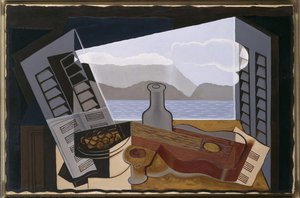
A Fractured Reality: Exploring Juan Gris's "The Checkerboard"
Juan Gris’s “The Checkerboard,” painted in 1915, isn’t merely a depiction of a familiar domestic scene; it’s a radical declaration of artistic intent. Created during the nascent years of Synthetic Cubism, this work embodies the movement's core tenets – a deliberate dismantling of traditional perspective and representation to reveal an underlying geometric structure. The painting’s power lies not in its subject matter—a checkerboard adorned with everyday objects like a bottle, a cup, a knife, and scissors—but in Gris’s masterful manipulation of form and color to evoke a sense of fragmented space and heightened visual complexity.
- Synthetic Cubism's Radical Shift: Born from the earlier Analytical Cubism, Synthetic Cubism sought to move beyond simply analyzing objects into their component parts. Instead, artists like Gris aimed to create composite images that blended fragments of reality with invented forms and decorative elements.
- Geometric Harmony: The checkerboard itself is a key element, providing a structured framework for the arrangement of the other objects. Each square contributes to a dynamic interplay of color and shape, creating a visual rhythm that draws the eye across the canvas.
- Oil on Canvas – A Rich Texture: Executed in oil on canvas, “The Checkerboard” boasts a rich texture and depth of color, allowing Gris to build up layers of paint and create subtle variations in tone and hue. This technique is crucial to conveying the solidity and materiality of the objects within the composition.
The Artist's Vision: Juan Gris and the Cubist Movement
Juan Gris (1887-1927), born José Victoriano González-Pérez in Madrid, Spain, was a pivotal figure in the development of Cubism. His early life, marked by studies in engineering before embracing art, reflects a mind accustomed to analytical thinking – a quality that profoundly shaped his artistic approach. Gris’s connection to Pablo Picasso and Georges Braque cemented his place at the forefront of this revolutionary movement. He wasn't simply copying what others were doing; he was developing a distinct visual language characterized by its precise geometric forms and bold color combinations.
Gris’s work is deeply rooted in the intellectual currents of the time, reflecting a fascination with modern technology and urban life. The inclusion of objects like the bottle and knife suggests a concern with industrialization and the changing role of man within society. His dedication to Cubism earned him recognition as one of the movement's most distinctive artists, alongside Picasso and Braque.
Decoding the Symbolism: Checkerboards and Beyond
The checkerboard motif itself carries significant symbolic weight. Historically, it has represented order, logic, and control – concepts that are deliberately disrupted within Gris’s composition. The juxtaposition of these ordered squares with seemingly random objects creates a tension between structure and chaos, reflecting the anxieties and uncertainties of the early 20th century. The specific arrangement of the bottle, cup, knife, and scissors adds to this complexity, inviting viewers to contemplate their individual meanings and their collective relationship within the overall design.
Beyond its immediate visual impact, “The Checkerboard” invites us to consider the nature of perception itself. Gris challenges our traditional ways of seeing, forcing us to confront a world where objects are no longer presented in a fixed or unified manner.
A Legacy of Innovation: "The Checkerboard" Today
"The Checkerboard" stands as a testament to Juan Gris’s artistic genius and his pivotal role in shaping the course of modern art. Its influence can be seen in countless subsequent works, and its enduring appeal lies in its ability to provoke thought and inspire wonder. A hand-painted reproduction offers an unparalleled opportunity to experience this iconic masterpiece firsthand, bringing its fractured beauty into your home or studio.
Questions & Answers
When was "The Checkerboard" created, and to which movement does it belong?
"The Checkerboard" was made in 1915, within the Synthetic Cubism movement.
Where can I buy a print of "The Checkerboard" by Juan Gris?
"The Checkerboard" is available as a fine art print on cotton canvas or archival canvas paper. Orders are placed on its Fine Art Print page, in the size of your choice.
Did "The Checkerboard" stay in its artist's homeland?
No - the artwork is kept abroad. The birth country of Juan Gris is Spain, and the museum holding the original of "The Checkerboard" is in United States of America.
More about this painting
 Preview
 Send
Send Share
Share
 Details
 Guide
Guide

 Download
 Similars
 X-Ray
X-Ray Diaporama
 Q&A
Q&A Stats
Stats