Text size

() ·

A painting made for you, by hand

The fruit bowl

Hand Made Oil Reproduction

Hand-painted oil on canvas in your size and frame, made to order by our artists. ( Switch to Print Switch to Digital Image)

Collectible Description

Juan Gris' 'The Fruit Bowl' (1914) is a revolutionary Cubist masterpiece blending reality and abstraction with newspaper collage, showcasing geometric forms & vibrant colors.

Artist Biography

Explore Juan Gris (1887-1927), the Spanish Cubist master! Discover his geometric style, Synthetic Cubism & lasting influence on modern art. View artworks now.

from ·

Chapter 1

How large should it be?

Slide to change the size; the picture on the left shows the frame at its real width. The proportions of the original are kept.

Standard
custom
CM
INCH

Pick from our preset sizes that match the artwork's original proportions.

width
height

Type the width and the height you need, to fit your frame or your wall. This is hand-painted, so for a size with a different shape the artist can paint a bit more around the picture, or cut a bit — you choose. We send you a digital mockup to approve before the painting starts. The picture shown on this page does not show the real result — only the mockup does.

Chapter 2

How should it arrive?

Choose the edges of the stretched canvas

Choose your frame

Corner sample of the WhiteWrap canvas edge finish, stretched on solid wood bars
White $1
Corner sample of the BlurSideWrap canvas edge finish, stretched on solid wood bars
Blurside $1
Corner sample of the ExtendedWrap canvas edge finish, stretched on solid wood bars
Extended $1
Corner sample of the P118B picture frame: moulded polystyrene, 5 cm wide and 3 cm thick
P118B $10
Corner sample of the P118H picture frame: moulded polystyrene, 5 cm wide and 3 cm thick
P118H $10
Corner sample of the P118W picture frame: moulded polystyrene, 5 cm wide and 3 cm thick
P118W $10
Corner sample of the P438Z picture frame: moulded polystyrene, 5.5 cm wide and 3.5 cm thick
P438Z $10
Corner sample of the P508JH picture frame: moulded polystyrene, 7 cm wide and 3.5 cm thick
P508JH $12
Corner sample of the P508YH picture frame: moulded polystyrene, 7 cm wide and 3.5 cm thick
P508YH $12
Corner sample of the P805H picture frame: moulded polystyrene, 5 cm wide and 3.5 cm thick
P805H $10
Corner sample of the P805Z picture frame: moulded polystyrene, 5 cm wide and 3.5 cm thick
P805Z $10
Corner sample of the P919BZ picture frame: moulded polystyrene, 7 cm wide and 3.5 cm thick
P919BZ $10
Corner sample of the P919G picture frame: moulded polystyrene, 7 cm wide and 3.5 cm thick
P919G $10
Corner sample of the P919XJ picture frame: moulded polystyrene, 7 cm wide and 3.5 cm thick
P919XJ $10
Corner sample of the P959ZH picture frame: moulded polystyrene, 5 cm wide and 3 cm thick
P959ZH $10
Corner sample of the P968JZ picture frame: moulded polystyrene, 6 cm wide and 4 cm thick
P968JZ $12
Corner sample of the W106C picture frame: solid wood, 5 cm wide and 3 cm thick
W106C $8
Corner sample of the W218G picture frame: solid wood, 5 cm wide and 3 cm thick
W218G $10
Corner sample of the W218JH picture frame: solid wood, 5 cm wide and 3 cm thick
W218JH $8
Corner sample of the W218Y picture frame: solid wood, 5 cm wide and 3 cm thick
W218Y $10
Corner sample of the W307PJ picture frame: solid wood, 6 cm wide and 3 cm thick
W307PJ $10
Corner sample of the W316G picture frame: solid wood, 6 cm wide and 3 cm thick
W316G $10
Corner sample of the W316PJ picture frame: solid wood, 6 cm wide and 3 cm thick
W316PJ $8
Corner sample of the W316Y picture frame: solid wood, 6 cm wide and 3 cm thick
W316Y $10
Corner sample of the W398PJ picture frame: solid wood, 5 cm wide and 3 cm thick
W398PJ $8
Corner sample of the W4111J picture frame: solid wood, 6.5 cm wide and 3.5 cm thick
W4111J $10
Corner sample of the W500HY picture frame: solid wood, 7 cm wide and 5 cm thick
W500HY $15
Corner sample of the W500JH picture frame: solid wood, 7 cm wide and 5 cm thick
W500JH $15
Corner sample of the W692G picture frame: solid wood, 8 cm wide and 4 cm thick
W692G $12
Corner sample of the W849H picture frame: solid wood, 5 cm wide and 3 cm thick
W849H $8
Corner sample of the W940BG picture frame: solid wood, 7.5 cm wide and 4.5 cm thick
W940BG $15
Corner sample of the W953PJ picture frame: solid wood, 6 cm wide and 3.5 cm thick
W953PJ $8
Corner sample of the H24-GOLD picture frame: carved wood with gesso, 10 cm wide and 6 cm thick
H24-GOLD $30
Corner sample of the H24-SILVER picture frame: carved wood with gesso, 10 cm wide and 6 cm thick
H24-SILVER $30
Corner sample of the H36-GOLD picture frame: carved wood with gesso, 15 cm wide and 6.5 cm thick
H36-GOLD $45
Corner sample of the H36-SILVER picture frame: carved wood with gesso, 15 cm wide and 6.5 cm thick
H36-SILVER $45
Frame preview
Framed

Moulding: . Overall size with the frame: .

Chapter 3

Who paints it, and should anything change?

Examples of what can be changed: Replace face with customer photo; Add pet (e.g., replace cat with dog); Include hidden message in background; Change background landscape or elements.
After order, OriginalUniqueArt.com team will email client for instructions and provide a mockup preview

Worldwide Delivery () in 3/4 weeks instead of standard 5 weeks. (2 November). No compromise on quality.

Chapter 4

The finishing touches

A nameplate, as in a museum?

Engraved Bronze Plaque Details

This elegant plaque features the artist's name and the title of the artwork, finely engraved for a timeless presentation.

It is made from bronze with a refined, elegant finish. The text is precisely laser-engraved for a sharp and permanent result. Measuring 9x2 cm, the plaque is compact yet easy to read. It's built to be durable and scratch-resistant, offering a professional, museum-quality look. Mounting is simple thanks to the included adhesive backing.

Transparent Acrylic Plaque Details

The plaque includes essential engraved details such as the artist's name, the title of the artwork, the date it was created, the type of media used-like oil on canvas or watercolor-a brief description of the piece, and a QR code that links to the complete artwork information.

It is crafted from clear acrylic, offering a sleek, modern appearance. The text is UV-engraved in black to ensure strong visual contrast. With a size of 10x15 cm, it ensures optimal readability. It comes equipped with two metal hooks for secure wall mounting. The plaque is designed to be weather-resistant, making it suitable for various environments, and it includes interactive features that work seamlessly with smartphone scanning.

Black Acrylic Plaque Details

This elegant plaque includes engraved information such as the artist's name, the title of the artwork, the date it was created, the type of media used (like oil on canvas or watercolor), a short description of the artwork, and a QR code for quick access to more information.

The plaque itself is made from refined black acrylic with a premium finish. The text is laser-engraved in white for high contrast and readability. Its size is 10x15 cm, designed to be easy to read. It comes with two metal hooks for professional mounting. The design is sleek and fits any interior style. It is also weather-resistant and durable, with built-in digital integration for mobile compatibility.

A protective varnish?

When do you need it?

Chapter 5

Your painting, as you ordered it

The fruit bowl

Reproduction Medium

Reproduction Size

-

Elite Senior Artist

More detail, finesse, and extra production time

-

Reproduction Frame

-

-

For artworks or reproductions larger than 105 cm (approximately 41 inches) on any side, the frame will be shipped as a kit, disassembled. This method ensures safe delivery and prevents damage during transport.

Professional assembly required - this is not a DIY product.
The kit must be assembled and the canvas stretched by an experienced professional framer, using wood glue (not supplied), a canvas stretching plier and clamps to hold the bars square while the glue dries. Incorrect assembly or uneven canvas tension can permanently damage the artwork and is not covered by our warranty.

  • All solid wood bars are included, precisely cut to size.

  • Assembled with the screws provided, plus wood glue for the corner joints, which is not supplied and must be sourced by your framer.

  • Professional tools are required and not included: a canvas stretching plier (tensioner) and clamps to hold the bars square while the glue dries.

Important:
The corner joints require wood glue, the bars must be held with clamps until the glue is fully dry, and tightening the canvas on the assembled frame requires a canvas stretching plier. None of these are included in the kit. Please arrange an experienced professional framer before ordering this size.

Nameplate

-

-

Protective Varnish

Glossy Varnish (enhances colors, protects against light/moisture)

-

Customize My Artwork

Examples of what can be changed: Replace face with customer photo; Add pet (e.g., replace cat with dog); Include hidden message in background; Change background landscape or elements.

-

Urgent

Worldwide Delivery () in 3/4 weeks instead of standard 5 weeks. (2 November). No compromise on quality.

-

Express Shipping

Worldwide Delivery () in 5 weeks. (9 November).

Included

Total Price

$ 300

Total Price $ 300

Glass option is only available in size under 110 CM

Included with every order

  • Free Worldwide Express Shipping
  • High-Quality Linen Canvas
  • Full Shipping Insurance
  • Customs Tax Refund Guarantee
  • True Color Matching Guarantee
  • 100-Day Return Policy (Defects Only)
  • 100% Money-Back Guarantee
  • Bulk Discount Offer

Juan Gris’s “The Fruit Bowl”: A Symphony of Cubist Fragmentation

Juan Gris's "The Fruit Bowl," painted in 1914, isn’t merely a still life; it’s a meticulously constructed meditation on perception and reality. Emerging from the vibrant crucible of early 20th-century Paris, this work embodies the radical innovations of Cubism while simultaneously hinting at a profound exploration of visual language. Gris, deeply influenced by the geometric explorations of Picasso and Braque, yet forging his own distinct path, presents us with an image that deliberately disrupts traditional notions of representation, inviting the viewer to actively participate in its construction.

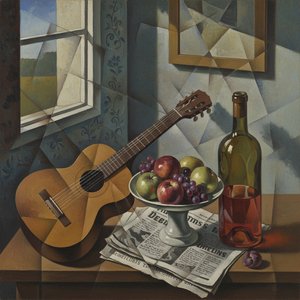
The painting’s subject – a humble fruit bowl overflowing with apples, oranges, and grapes – is rendered through a process of deliberate fragmentation. Rather than offering a faithful depiction of form, Gris breaks down each object into its constituent geometric shapes: cylinders, spheres, planes, and sharp angles. These elements are then reassembled on the canvas in an arrangement that prioritizes structure and spatial relationships over literal accuracy. The bowl itself is not presented as a solid volume but rather as a collection of overlapping planes, creating a sense of depth and dynamism within the confined space of the painting.

The Language of Collage and “Le Vrai et Le Faux”

What truly distinguishes "The Fruit Bowl" is Gris’s masterful incorporation of collage. He meticulously pasted fragments of newspaper – a deliberate choice reflecting the burgeoning interest in mass media at the time – onto the canvas, layering them with painted elements. This technique wasn't simply decorative; it was a conscious effort to blur the boundaries between reality and representation. The inclusion of the phrase “Le vrai et le faux” (The real and the false) on one of the newspaper fragments directly addresses this tension, acknowledging the inherent artificiality of painting itself – the act of creating an illusion of reality. This bold statement underscores Gris’s commitment to exposing the constructed nature of visual perception.

The use of white paint on the canvas—particularly within the bowl's frame—further emphasizes this concept. The untreated, raw material of the canvas becomes a crucial element, visually merging with the painted reality and creating a palpable sense of layering and ambiguity. It’s as if Gris is inviting us to question what constitutes “real” – is it the tangible objects before us, or the representation we perceive through the act of looking?

A Synthesis of Color and Form

Despite the fragmented composition, "The Fruit Bowl" isn't a study in monochrome austerity. Gris employs a carefully considered palette of muted reds, yellows, and browns, punctuated by vibrant splashes of color within the fruit itself. This restrained use of color contributes to the painting’s overall sense of balance and harmony, while simultaneously drawing attention to the individual elements within the still life. The interplay between these colors creates a subtle visual rhythm that guides the viewer's eye through the composition.

Gris’s meticulous attention to detail—the precise rendering of each geometric shape, the careful placement of every newspaper fragment—demonstrates his commitment to both formal innovation and technical mastery. “The Fruit Bowl” is not just a product of Cubist experimentation; it's a testament to Gris’s exceptional skill as an artist and his profound understanding of the power of visual language.

A Legacy of Geometric Vision

Painted in 1914, "The Fruit Bowl" stands as a pivotal work in the development of Cubism. It exemplifies the movement's core principles – fragmentation, abstraction, and the exploration of multiple perspectives—while simultaneously establishing Gris’s unique artistic voice. His innovative use of collage, combined with his masterful control of color and form, cemented his place among the most influential artists of the 20th century. Reproductions of this captivating artwork offer a glimpse into a world where reality is deconstructed, reassembled, and ultimately redefined through the power of art.

Questions & Answers

Can I see "The fruit bowl" by Juan Gris on my own wall before buying?

The AR Preview page of "The fruit bowl" by Juan Gris uses augmented reality to show the artwork in your own space, on a compatible device.

Is there a slideshow for "The fruit bowl" by Juan Gris?

"The fruit bowl" by Juan Gris can be viewed as a slideshow on the artwork's Diaporama page.

What feeling is "The fruit bowl" associated with?

"The fruit bowl" by Juan Gris conveys a reflective emotional tone.

More about this painting

Preview AR preview Switch to Print Switch to Digital Image Send
Details Guide Add to favorites Download Similars X-Ray Diaporama Q&A Stats

In numbers

  • 1914the year it was painted
  • 29frames to choose from
  • standard sizes, in its own proportions
  • 5weeks to paint and deliver it
Juan Gris

Juan Gris

1887 - 1927, Spain

Quick facts about Juan Gris

  • Full Name: José Victoriano González-Pérez
  • Nationality: Spanish
  • Date Of Birth: 1887
  • Date Of Death: 1927
  • Place Of Birth: Madrid, Spain
  • Notable Artworks:
    • Guitar in front of the sea
    • Homage à Pablo Picasso
    • The Miller
    • Portrait of Madame Josette Gris
  • Artistic Movement Or Style: Cubism, Synthetic Cubism
  • Artists Who Influenced This Artist:
    • Pablo Picasso
    • Henri Matisse
    • Georges Braque
  • Artists Or Movements Influenced By This Artist:
    • Purism
    • Amédée Ozenfant
    • Le Corbusier

Artist Biography

A Spanish Visionary of Cubism: The Life and Art of Juan Gris

Born José Victoriano González-Pérez in Madrid in 1887, the artist who would become known as Juan Gris embarked on a journey that would place him among the most significant figures of early 20th-century art. His initial path wasn’t one immediately leading to canvas and brush; he pursued engineering at the School of Arts and Sciences, demonstrating an analytical mind that would later profoundly influence his artistic approach. Even during these formative years, a creative spark flickered – contributing drawings to local periodicals hinted at a burgeoning visual talent. It was in 1905 that he adopted the pseudonym Juan Gris, a name resonating with a newfound sense of identity and purpose as he began formal painting studies under José Moreno Carbonero. This marked a pivotal shift, setting him on a course toward artistic innovation.

Parisian Awakening and the Embrace of Cubism

The year 1906 witnessed a transformative relocation to Paris, a city then pulsating with artistic energy. Gris immersed himself in this vibrant milieu, forging friendships with luminaries like Henri Matisse, Georges Braque, and Fernand Léger. He initially engaged in satirical illustration for publications such as *L'Assiette au Beurre*, honing his observational skills and developing a keen sense of visual wit. However, the magnetic pull of Pablo Picasso proved particularly influential. Around 1910, Gris began to seriously dedicate himself to painting, moving away from caricature towards the burgeoning language of Cubism. This wasn’t mere imitation; he embarked on a quest to distill the essence of form and space, seeking a new visual order. His early explorations were marked by a deliberate departure from traditional representation, embracing abstraction as a means of capturing reality's underlying structure.

The Geometry of Perception: Style and Key Works

Juan Gris’s artistic output is characterized by an exceptional clarity and intellectual rigor. He didn’t simply deconstruct objects; he reconstructed them with deliberate precision, emphasizing geometric forms and a carefully considered palette. This approach led to what became known as his “crystal period,” exemplified in masterpieces like *Still Life Before an Open Window* and *Place Ravignan* (1915). These works showcase a remarkable interplay of planes and angles, creating a sense of depth and solidity while simultaneously challenging conventional notions of perspective. After 1913, Gris wholeheartedly embraced Synthetic Cubism, pioneering the use of *papier collé* – collage – incorporating real-world materials like newspaper clippings and textured papers into his compositions. This technique added another layer of complexity and tactility to his work, blurring the boundaries between painting and sculpture. Notable examples include *Guitar in front of the sea* (1925), a testament to his simplified forms and adherence to cubist principles, and *Homage à Pablo Picasso* (1912), which signaled his growing recognition within the avant-garde art world.

Legacy and Lasting Influence

Juan Gris’s contribution to Cubism extends beyond mere stylistic innovation; he brought a unique intellectual depth and structural clarity to the movement. He moved past the analytical phase, towards a more organized and synthetic approach, emphasizing order and precision. His work profoundly influenced the Purist style championed by Amédée Ozenfant and Charles Edouard Jeanneret (Le Corbusier), advocating for a return to classical principles of form and composition. Gris’s emphasis on geometric forms, harmonious color palettes, and the integration of everyday objects into his art established him as a pivotal figure in 20th-century art. His legacy continues to inspire artists today, demonstrating the enduring power of Cubism and the visionary genius of Juan Gris – a Spanish master who reshaped our understanding of perception and representation.

Quick Facts

  • Artistic style: Geometric abstraction
  • Subject or theme: Still life fruit bowl
  • Year: 1914
  • Influences:
    • Picasso
    • Braque
  • Dimensions: 36 1/10 × 25 1/2 in
  • Artist: Juan Gris

Art Quiz

There is only one correct answer for each question.

Question 1:
What artistic movement is most closely associated with Juan Gris’s ‘The Fruit Bowl’?
Question 2:
In ‘The Fruit Bowl’, what technique is prominently used to integrate reality and depiction?
Question 3:
The painting’s composition features a flattened perspective. What does this suggest about Gris's approach to space?
Question 4:
What is the significance of the white cloth with red stripes in ‘The Fruit Bowl’?
Question 5:
Juan Gris created ‘The Fruit Bowl’ in which year?