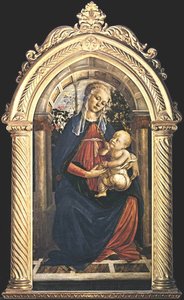
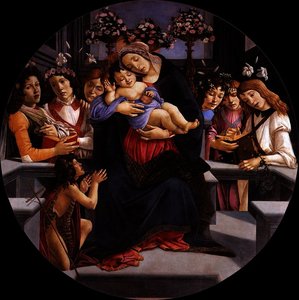
Portrait of Sandro Botticelli

The 100 Most Famous Sandro Botticelli Paintings, a Gallery Selection

Updated October 2026 · ranked by our popularity score (searches, visits and orders for each work) · 733 works by Sandro Botticelli in our catalogue

In short

Of all the originals Sandro Botticelli left, the most famous is The Birth Of Venus (1485), in the collection of the Galleria degli Uffizi, Florence. Close behind it come Primavera (1482) and Venus and Mars (1483). Our catalog holds 733 works by Sandro Botticelli; the gallery has kept the 100 the world admires most, each shown with its date, its museum and its story.

1445 – 1510, Florence Early renaissance Most works: Galleria degli Uffizi

Sandro Botticelli's top 10 paintings: the gallery's choice

1
The Birth Of Venus (1485) by Sandro Botticelli

The Birth Of Venus

1485 · Tempera On Panel · Galleria degli Uffizi, Florence

A Goddess Emerges from the Sea Spray The air carries the scent of salt and blooming roses as a giant scallop shell drifts toward the shore. At the center of this movement, Venus stands upon the pearl-like surface of her vessel, her form defined by soft, flowing lines that seem to ripple like the water itself. She is caught in a moment of profound transition, her long, golden hair clinging…

2
Primavera (1482) by Sandro Botticelli

Primavera

1482 · Oil On Canvas · Galleria degli Uffizi, Florence

Sandro Botticelli's "Primavera" is one of the most celebrated masterpieces of the Italian Renaissance, embodying the era's fascination with classical mythology and natural beauty. Painted in 1482, this exquisite work is a testament to Botticelli's mastery of composition, line, and color, making it a must-have for art lovers and collectors alike.

3
Venus and Mars (1483) by Sandro Botticelli

Venus and Mars

1483 · Oil On Canvas · National Gallery, London

A Mythological Masterpiece Sandro Botticelli's "Venus and Mars" is a captivating Renaissance painting that brings to life the timeless mythological tale of love and war. Created around 1483, this masterpiece exemplifies Botticelli's signature style, blending elegant linearity with rich symbolism. The artwork features the goddess Venus, embodying love and beauty, alongside Mars, the god of war, creating a dynamic interplay between these contrasting forces. Renaissance Elegance Botticelli's distinctive style bridges…

4
Adoration Of The Magi by Sandro Botticelli

Adoration Of The Magi

Tempera On Panel

Immerse yourself in the captivating world of Sandro Botticelli’s “Adoration of the Magi,” a quintessential masterpiece of the Early Renaissance. This richly detailed painting transports viewers to the moment of profound reverence when the Three Wise Men presented their gifts to the infant Jesus, marking a pivotal event in Christian history.

5
Calumny of Apelles (1495) by Sandro Botticelli

Calumny of Apelles

1495 · Oil On Canvas · Galleria degli Uffizi, Florence

Subject and Composition Experience a captivating depiction of a profound allegorical scene rooted in classical and biblical symbolism. This masterful work illustrates the famous "Calumny of Apelles," a narrative inspired by ancient Greek literature, portraying personifications of virtues and vices engaged in a dramatic tableau. The composition is meticulously organized, with figures arranged to guide the viewer’s eye through a complex story of truth, slander, envy, and repentance. Central to…

6
Madonna of the Magnificat (1481) by Sandro Botticelli

Madonna of the Magnificat

1481 · Tempera On Panel · Musée Fabre, Montpellier

A Renaissance Ode to Family & Faith Sandro Botticelli’s *Madonna of the Magnificat*, painted in 1481, is more than a devotional image; it's a captivating glimpse into Florentine society and a testament to the artist’s mastery of Early Renaissance aesthetics. Executed with tempera on panel and now residing in Florence’s Uffizi Gallery, this circular composition radiates serenity and grace, embodying the spirit of its time. The painting depicts the Virgin…

7
The Mystical Nativity (1500) by Sandro Botticelli

The Mystical Nativity

1500 · Oil On Canvas

, created by Sandro Botticelli around 1500, is a captivating and spiritually rich artwork that beautifully blends earthly and heavenly elements. This masterpiece, executed in oil on canvas, is renowned for its intricate detailing, vibrant colors, and profound symbolism.

8
The Cestello Annunciation by Sandro Botticelli

The Cestello Annunciation

Acrylic On Canvas

Sandro Botticelli's Cestello Annunciation, painted around 1489, is not merely a depiction of a biblical event; it’s an intimate and profoundly moving encounter frozen in time. The scene unfolds with a quiet grace that defines Botticelli’s signature style – the Archangel Gabriel delivering his momentous news to Mary, poised on the cusp of accepting her divine destiny. The painting, originally created for the chapel of the Florentine monastery of Cestello…

9
allegory - Primavera by Sandro Botticelli

allegory - Primavera

Tempera On Panel

Immerse yourself in the enchanting world of Sandro Botticelli’s Primavera, an iconic panel painting that embodies the spirit of the Italian Renaissance. This large-scale work is not merely a depiction of spring; it's a complex allegorical poem rendered in exquisite detail and vibrant color, inviting contemplation on themes of love, beauty, fertility, and renewal.

10
Madonna and Child with an Angel (1470) by Sandro Botticelli

Madonna and Child with an Angel

1470 · Oil On Canvas · Isabella Stewart Gardner Museum, Boston

A Masterpiece of Renaissance Devotion Immerse yourself in the serene beauty of this exquisite Renaissance painting, "Madonna and Child with an Angel." Created around 1470, this artwork embodies the grace and spiritual depth characteristic of the Florentine Renaissance. The composition captures a tender moment between the Madonna and the Christ Child, accompanied by an angel, evoking themes of divine love, protection, and maternal bond. Composition and Style The painting follows…

The Sandro Botticelli selection continues, 11 to 100

11Venus and Mars by Sandro BotticelliVenus and Mars 12The Virgin and Child with Four Angels and Six Saints (Pala di San Barnaba) (1488) by Sandro BotticelliThe Virgin and Child with Four Angels and Six Saints (Pala di San Barnaba)1488 · Galleria degli Uffizi 13Sadro adoration of the magi (1470) by Sandro BotticelliSadro adoration of the magi1470 · National Gallery 14Mystic Nativity (1501) by Sandro BotticelliMystic Nativity1501 · National Gallery 15Last Miracle and the Death of St. Zenobius (1500) by Sandro BotticelliLast Miracle and the Death of St. Zenobius1500 · National Gallery 16Madonna of the Rosengarden (also known as Madonna del Roseto) (1469) by Sandro BotticelliMadonna of the Rosengarden (also known as Madonna del Roseto)1469 · Galleria degli Uffizi 17The Abyss of Hell (1480) by Sandro BotticelliThe Abyss of Hell1480 · Biblioteca Apostolica 18Allegory of Abundance (1480) by Sandro BotticelliAllegory of Abundance1480 · British Museum 19Madonna of the Magnificat (Madonna del Magnificat) (1480) by Sandro BotticelliMadonna of the Magnificat (Madonna del Magnificat)1480 · Galleria degli Uffizi 20Pallas and the Centaur (1482) by Sandro BotticelliPallas and the Centaur1482 · Galleria degli Uffizi 21The Story of Nastagio degli Onesti (second episode) (1483) by Sandro BotticelliThe Story of Nastagio degli Onesti (second episode)1483 · Museo del Prado 22Portrait of a Young Man (1483) by Sandro BotticelliPortrait of a Young Man1483 · National Gallery 23The Virgin and Child Enthroned (Bardi Altarpiece) (1484) by Sandro BotticelliThe Virgin and Child Enthroned (Bardi Altarpiece)1484 · Staatliche Museen zu Berlin 24Primavera (detail) (1482) by Sandro BotticelliPrimavera (detail)1482 · Galleria degli Uffizi 25Portrait of a Young Woman (1480) by Sandro BotticelliPortrait of a Young Woman1480 · Städelsche Kunstinstitut Und Städtische Galerie 26Cestello Annunciation (in frame) (1489) by Sandro BotticelliCestello Annunciation (in frame)1489 · Galleria degli Uffizi 27Venus and the Three Graces presenting Gifts to a Young Woman by Sandro BotticelliVenus and the Three Graces presenting Gifts to a Young Woman 28The Birth of Venus (detail) (11) (1485) by Sandro BotticelliThe Birth of Venus (detail) (11)1485 · Galleria degli Uffizi 29Portrait of a Young Man (1482) by Sandro BotticelliPortrait of a Young Man1482 · National Gallery of Art 30Venus and the Graces offering gifts to a young girl (1486) by Sandro BotticelliVenus and the Graces offering gifts to a young girl1486 · The Louvre 31The Story of Nastagio degli Onesti (first episode) (1483) by Sandro BotticelliThe Story of Nastagio degli Onesti (first episode)1483 · Museo del Prado 32Adoration of the Magi (detail) (1465) by Sandro BotticelliAdoration of the Magi (detail)1465 · National Gallery 33Madonna of the Pomegranate (Madonna della Melagrana) (1487) by Sandro BotticelliMadonna of the Pomegranate (Madonna della Melagrana)1487 · Galleria degli Uffizi 34Inferno, Canto XVIII (1480) by Sandro BotticelliInferno, Canto XVIII1480 · Staatliche Museen zu Berlin 35Illustration to the Divine Comedy (Inferno) (1480) by Sandro BotticelliIllustration to the Divine Comedy (Inferno)1480 · Biblioteca Apostolica 36Primavera (detail) (16) (1482) by Sandro BotticelliPrimavera (detail) (16)1482 · Galleria degli Uffizi 37Calumny of Apelles (detail) (8) (1494) by Sandro BotticelliCalumny of Apelles (detail) (8)1494 · Galleria degli Uffizi 38A Young Man Being Introduced to the Seven Liberal Arts (1484) by Sandro BotticelliA Young Man Being Introduced to the Seven Liberal Arts1484 · The Louvre 39The Trials and Calling of Moses (1481) by Sandro BotticelliThe Trials and Calling of Moses1481 · Sistine Chapel 40Virgin and Child with an Angel (1480) by Sandro BotticelliVirgin and Child with an Angel1480 · Art Institute of Chicago 41Illustration to the Divine Comedy (Inferno) (1480) by Sandro BotticelliIllustration to the Divine Comedy (Inferno)1480 · Biblioteca Apostolica 42The Story of Nastagio degli Onesti (detail of the second episode) (1483) by Sandro BotticelliThe Story of Nastagio degli Onesti (detail of the second episode)1483 · Museo del Prado 43Madonna and Child with Eight Angels (1478) by Sandro BotticelliMadonna and Child with Eight Angels1478 · Staatliche Museen zu Berlin 44Primavera (detail) (14) (1482) by Sandro BotticelliPrimavera (detail) (14)1482 · Galleria degli Uffizi 45Three Miracles of St Zenobius (detail) (1500) by Sandro BotticelliThree Miracles of St Zenobius (detail)1500 · Metropolitan Museum of Art 46Adoration of the Magi (14) (1481) by Sandro BotticelliAdoration of the Magi (14)1481 · National Gallery of Art 47Judith Leaving the Tent of Holofernes (1495) by Sandro BotticelliJudith Leaving the Tent of Holofernes1495 · Rijksmuseum 48Cestello Annunciation (1489) by Sandro BotticelliCestello Annunciation1489 · Galleria degli Uffizi 49Portrait of Giuliano de' Medici (1476) by Sandro BotticelliPortrait of Giuliano de' Medici1476 · National Gallery of Art 50Virgin and Child with Two Angels (detail) (1490) by Sandro BotticelliVirgin and Child with Two Angels (detail)1490 · Academy of Fine Arts Vienna 51Mystic Nativity (1500) by Sandro BotticelliMystic Nativity1500 · National Gallery 52Primavera (detail) (18) (1482) by Sandro BotticelliPrimavera (detail) (18)1482 · Galleria degli Uffizi 53The Virgin Adoring the Child (1490) by Sandro BotticelliThe Virgin Adoring the Child1490 · National Gallery of Art 54The Birth of Venus (detail) (12) (1485) by Sandro BotticelliThe Birth of Venus (detail) (12)1485 · Galleria degli Uffizi 55The Last Communion of St Jerome (detail) (1495) by Sandro BotticelliThe Last Communion of St Jerome (detail)1495 · Metropolitan Museum of Art 56Madonna of the Pomegranate (1487) by Sandro BotticelliMadonna of the Pomegranate1487 57Lamentation over the Dead Christ with Saints (1490) by Sandro BotticelliLamentation over the Dead Christ with Saints1490 · Alte Pinakothek 58Cestello Annunciation (detail) (1489) by Sandro BotticelliCestello Annunciation (detail)1489 · Galleria degli Uffizi 59Portrait of Giuliano de' Medici (1476) by Sandro BotticelliPortrait of Giuliano de' Medici1476 · National Gallery of Art 60Madonna and Child and Two Angels (1470) by Sandro BotticelliMadonna and Child and Two Angels1470 · Museo di Capodimonte 61Portrait of a Man with a Medal of Cosimo the Elder (1474) by Sandro BotticelliPortrait of a Man with a Medal of Cosimo the Elder1474 · Galleria degli Uffizi 62Primavera (detail) (15) (1482) by Sandro BotticelliPrimavera (detail) (15)1482 · Galleria degli Uffizi 63La Divina Commedia, Inferno XIX. Vergil and Dante in the Eighth Circle of Hell (Malebolge), 3. Bolgia: Corrupt in ecclesiastical offices, punishment of the Simonists by Sandro BotticelliLa Divina Commedia, Inferno XIX. Vergil and Dante in the Eighth Circle of Hell (Malebolge), 3. Bolgia: Corrupt in ecclesiastical offices, punishment of the SimonistsKupferstichkabinett 64Portrait of a Man with the Medal of Cosimo (1474) by Sandro BotticelliPortrait of a Man with the Medal of Cosimo1474 · Galleria degli Uffizi 65Madonna and Child (1467) by Sandro BotticelliMadonna and Child1467 · Galleria degli Uffizi 66The Virgin and Saint John the Baptist Adoring the Infant Christ (1477) by Sandro BotticelliThe Virgin and Saint John the Baptist Adoring the Infant Christ1477 · Scottish National Gallery 67The Virgin and Child Enthroned (1484) by Sandro BotticelliThe Virgin and Child Enthroned1484 68The Annunciation (1485) by Sandro BotticelliThe Annunciation1485 · Metropolitan Museum of Art 69The Story of Nastagio degli Onesti (detail of the second episode) (1483) by Sandro BotticelliThe Story of Nastagio degli Onesti (detail of the second episode)1483 · Museo del Prado 70Portrait of a Young Man (1487) by Sandro BotticelliPortrait of a Young Man1487 71The Annunciation (detail) (1485) by Sandro BotticelliThe Annunciation (detail)1485 · Metropolitan Museum of Art 72Lamentation over the Dead Christ by Sandro BotticelliLamentation over the Dead Christ 73The Virgin and Child (1490) by Sandro BotticelliThe Virgin and Child1490 · Harvard Art Museums 74The Adoration of the Magi (detail) (1475) by Sandro BotticelliThe Adoration of the Magi (detail)1475 · Galleria degli Uffizi 75Cestello Annunciation (detail) (11) (1489) by Sandro BotticelliCestello Annunciation (detail) (11)1489 · Galleria degli Uffizi 76Virgin and Child with Six Angels and the Baptist (1485) by Sandro BotticelliVirgin and Child with Six Angels and the Baptist1485 · Galleria Borghese 77The Trials and Calling of Moses (detail) (19) (1481) by Sandro BotticelliThe Trials and Calling of Moses (detail) (19)1481 · Sistine Chapel 78Bardi Altarpiece (detail) (1484) by Sandro BotticelliBardi Altarpiece (detail)1484 · Staatliche Museen zu Berlin 79Madonna and Child with St. John the Baptist (1490) by Sandro BotticelliMadonna and Child with St. John the Baptist1490 · Indianapolis Museum of Art 80Lamentation over the Dead Christ (1490) by Sandro BotticelliLamentation over the Dead Christ1490 81The Mystical Nativity (detail) (1500) by Sandro BotticelliThe Mystical Nativity (detail)1500 · National Gallery 82The Punishment of Korah and the Stoning of Moses and Aaron (detail) (12) (1481) by Sandro BotticelliThe Punishment of Korah and the Stoning of Moses and Aaron (detail) (12)1481 · Sistine Chapel 83Madonna of the Magnificat (1480) by Sandro BotticelliMadonna of the Magnificat1480 84The Punishment of Korah and the Stoning of Moses and Aaron (1481) by Sandro BotticelliThe Punishment of Korah and the Stoning of Moses and Aaron1481 · Sistine Chapel 85Annunciation (1495) by Sandro BotticelliAnnunciation1495 · Pushkin State Museum 86Primavera - (8) by Sandro BotticelliPrimavera - (8) 87Virgin and Child with a Pomegranate (1500) by Sandro BotticelliVirgin and Child with a Pomegranate1500 · National Museum Cardiff 88The Youth Of Moses, In The Sistine Chapel by Sandro BotticelliThe Youth Of Moses, In The Sistine Chapel 89The Temptation of Christ by Sandro BotticelliThe Temptation of Christ 90Madonna and Child with an Angel by Sandro BotticelliMadonna and Child with an AngelMusée du Petit Palais 91untitled (5768) by Sandro Botticelliuntitled (5768) 92The Adoration of the Magi (detail) (1475) by Sandro BotticelliThe Adoration of the Magi (detail)1475 · Galleria degli Uffizi 93Adoration of the Child (1495) by Sandro BotticelliAdoration of the Child1495 · Galleria degli Uffizi 94The Virgin and Child (The Madonna of the Book) (1480) by Sandro BotticelliThe Virgin and Child (The Madonna of the Book)1480 · Museo Poldi Pezzoli 95The Virgin and Child with the Young Saint John the Baptist (1497) by Sandro BotticelliThe Virgin and Child with the Young Saint John the Baptist1497 · Staatliche Kunstsammlungen Dresden 96Madonna and Child (1490) by Sandro BotticelliMadonna and Child1490 · Galleria Sabauda 97The Mystical Nativity (detail) (1500) by Sandro BotticelliThe Mystical Nativity (detail)1500 · National Gallery 98The Punishment of Korah and the Stoning of Moses and Aaron (detail) (17) (1481) by Sandro BotticelliThe Punishment of Korah and the Stoning of Moses and Aaron (detail) (17)1481 · Sistine Chapel 99Primavera, Detail Of Venus by Sandro BotticelliPrimavera, Detail Of Venus 100Lamentation over the Dead Christ by Sandro BotticelliLamentation over the Dead Christ

Sandro Botticelli's famous paintings, period by period

The subjects that held Sandro Botticelli's eye

The four subjects that come back most often in these originals, each with its finest example.

The museums that keep Sandro Botticelli's originals

The 8 museums that hold the most of the paintings on this page.

Museum City Works by Sandro Botticelli Paintings from this list
Galleria degli Uffizi, FlorenceGalleria degli Uffizi Florence 51 The Birth Of Venus, Primavera, Calumny of Apelles
National Gallery, LondonNational Gallery London 18 Venus and Mars, Sadro adoration of the magi, Mystic Nativity
Sistine Chapel, Vatican CitySistine Chapel Vatican City 15 The Trials and Calling of Moses, The Trials and Calling of Moses (detail) (19), The Punishment of Korah and the Stoning of Moses and Aaron (detail) (12)
National Gallery of Art, WashingtonNational Gallery of Art Washington 11 Portrait of a Young Man, Adoration of the Magi (14), Portrait of Giuliano de' Medici
Staatliche Museen zu Berlin, BerlinStaatliche Museen zu Berlin Berlin 11 The Virgin and Child Enthroned (Bardi Altarpiece), Inferno, Canto XVIII, Madonna and Child with Eight Angels
Metropolitan Museum of Art, New YorkMetropolitan Museum of Art New York 10 Three Miracles of St Zenobius (detail), The Last Communion of St Jerome (detail), The Annunciation
Museo del Prado, MadridMuseo del Prado Madrid 7 The Story of Nastagio degli Onesti (second episode), The Story of Nastagio degli Onesti (first episode), The Story of Nastagio degli Onesti (detail of the second episode)
Biblioteca Apostolica, Vatican CityBiblioteca Apostolica Vatican City 3 The Abyss of Hell, Illustration to the Divine Comedy (Inferno), Illustration to the Divine Comedy (Inferno)

Sandro Botticelli decade by decade: the original that defines each

Works per decade

Pick a decade to see the original that defines it.

Collectors' questions about Sandro Botticelli's paintings

Which work is Sandro Botticelli most famous for?Reveal the answer

The Birth Of Venus (1485), Galleria degli Uffizi, Florence. Primavera (1482) and Venus and Mars (1483) come next.

What age was Sandro Botticelli when The Birth Of Venus was made?Reveal the answer

40 years old: The Birth Of Venus dates from 1485, and Sandro Botticelli was born in 1445.

What are the ten most famous Sandro Botticelli paintings?Reveal the answer

The Birth Of Venus, Primavera, Venus and Mars, Adoration Of The Magi, Calumny of Apelles, Madonna of the Magnificat, The Mystical Nativity, The Cestello Annunciation, allegory - Primavera and Madonna and Child with an Angel. The ranking above gives each one's year and museum.

How many paintings did Sandro Botticelli leave?Reveal the answer

Our catalog holds 733 works by Sandro Botticelli, dated from 1465 to 1501.

In which museums do Sandro Botticelli's masterpieces hang?Reveal the answer

Mostly in Galleria degli Uffizi (Florence), National Gallery (London) and Sistine Chapel (Vatican City). The museum table above lists them all.

In which years did Sandro Botticelli paint the most famous works?Reveal the answer

In 1480s: 50 of the 100 works on this page were made then, The Birth Of Venus among them.

What are the first and the last famous originals of Sandro Botticelli?Reveal the answer

On this page, the earliest is Adoration of the Magi (detail) (1465) and the latest Mystic Nativity (1501).

Which subjects did Sandro Botticelli choose most often?Reveal the answer

Virgin mary (25), Religious iconography (13) and Biblical narrative (13), across the 100 works on this page.

Which technique did Sandro Botticelli use most?Reveal the answer

Tempera On Panel, for 47 of the 100 works on this page.

To which art movement does Sandro Botticelli belong?Reveal the answer

Early renaissance, judging by the originals on this page.

Which Sandro Botticelli works hang at the Galleria degli Uffizi?Reveal the answer

The Birth Of Venus, Primavera and Calumny of Apelles: the Galleria degli Uffizi, Florence holds 26 of the works on this page.

Sandro Botticelli: life and work

The Life of Sandro Botticelli

Sandro Botticelli lived his life within the narrow, busy streets of Florence, Italy. Born Alessandro di Mariano di Vanni Filipepi around 1445, he was the son of a tanner. His family lived in the neighborhood of Ognissanti, a place he remained close to throughout his years. He eventually became known by the name Botticelli, a nickname taken from the word botticello, which refers to a small wine cask or little barrel.

His presence in the city was constant. He moved through the same Florentine air for decades, working from his early training until his death on May 17, 1510. His work emerged during the Early Renaissance, a time when the city was a center of intense creative activity. He was an Italian painter who focused his hands on the wood and plaster of his home city.

His life was tied to the local rhythms of trade and faith. He was a man of the Florentine streets, from his early days as an apprentice to his final years. His existence was defined by the light and the shadows of the Italian Renaissance.

Early Life, Family and Training

Born Alessandro di Mariano di Vanni Filipepi, he was the youngest of four surviving children. His father, Mariano Filipepi, worked as a goldsmith and later as a tanner. This background in craftsmanship likely shaped the way he approached the fine details of his later work. Before finding his way into painting, he was thought to have first trained with Maso Finiguerra, a goldsmith. This early exposure to the precision of metalwork provided a foundation for the meticulous lines that would define his hand.

Around 1460, he entered the studio of Fra Filippo Lippi. This apprenticeship was the most significant period of his formation, where he learned the specific techniques of the Florentine school. He studied the way to handle panel painting and the application of fresco. He remained under Lippi's guidance for several years, likely leaving the workshop by April 1467. During these years, he absorbed the ability to create intimate compositions and a certain way of rendering figures that felt both graceful and slightly melancholic.

Patrons, Workshop and Commissions

The circles of Florence provided much of the work that filled his studio. He worked closely with the Medici family, including Lorenzo de' Medici and Giuliano de' Medici, whose influence shaped much of his professional life. Beyond the Medici, the Vespucci family commissioned his fresco Saint Augustine in his Study. His reach extended to the religious and civic centers of Italy as well. In Rome, he was invited by Pope Sixtus IV to paint frescoes for the Sistine Chapel. Back in Florence, he completed the Adoration of the Magi for the altar in the funerary chapel of Gaspare di Zanobi del Lama.

His workshop functioned as a place of continuity and shared skill. He employed Filippino Lippi, the son of his former teacher, as an apprentice. This connection kept the traditions of his training alive within his own space. The studio was a place of steady production, where the demands of patrons dictated the rhythm of the day. He moved between the private commissions of wealthy families and the large-scale requirements of the church, often working within the established social structures of the city.

Artistic Technique and Style

His hand moved with a specific, rhythmic grace. There is a lyrical quality to the way he defines a shape, using elegant linearity and flowing contours to guide the eye across the panel. He often began his compositions with a silverpoint drawing, a method that required a steady, controlled touch to lay down the initial underpainting. This precision allowed him to build up layers of tempera paint, which provided a way to render fine details and maintain a clear, bright color palette. He did not rely on heavy shadows to create form; instead, he used the strength of the line itself to define the presence of his subjects.

The figures he painted possess an ethereal quality. They often feature elongated proportions and graceful, almost weightless poses that suggest a sense of movement without the need for heavy physical mass. He found a way to marry the decorative use of line with the classical traditions of his time, creating a visual language that felt both ancient and uniquely his own. This approach allowed him to depict complex mythological scenes with a sense of calm and poetic rhythm.

Key Works and Masterpieces

The Birth of Venus captures a goddess emerging from a seashell, a scene that embodies the Renaissance ideals of beauty. In Primavera, the subject turns to a complex and enigmatic celebration of spring and love, populated by figures from classical mythology. These works show a focus on the rhythmic movement of lines and the grace of the human form.

Earlier in his career, his brush moved toward different subjects. He painted Saint Sebastian before January 1474. Around 1475, he produced the Adoration of the Magi, which includes members of the Medici family and a self-portrait. As his interests shifted, his work took on a different tone. The Mystic Nativity, created in 1501, reflects this change in focus.

Later Years and Spiritual Shift

The 1490s brought a change to the way he approached the panel. The ornamental charm that defined his earlier years began to fade. He moved away from the decorative grace of his youth, opting instead for a more simplistic approach. This shift was not merely a change in technique but a response to the changing atmosphere in Florence. He became a follower of the Dominican friar Savonarola, whose fervent preaching influenced the city's spiritual direction. This connection marked a departure from the humanist interests that had previously guided his brush.

His work during this period took on a different character. The figures lost some of their rhythmic, flowing quality, moving instead toward a more archaic or Gothic style. The compositions became more austere, reflecting a growing spiritual intensity. This period of his life shows a man turning inward, trading the lightness of mythological scenes for a more heavy-handed, religious focus. The paintings from these years carry a different weight, stripped of the previous elegance in favor of something more direct and emotionally charged.

Legacy and Artistic Rediscovery

After his death in 1510, the name Botticelli largely slipped from the public eye. For nearly three centuries, his paintings sat in quiet corners, overshadowed by the heavy presence of High Renaissance figures. The specific, rhythmic lines and the way he handled color were left to the dust of history, forgotten by a world moving toward different ideals of form and perspective.

This silence ended in the late 19th century. A group known as the Pre-Raphaelite Brotherhood began looking backward, seeking a different kind of clarity. They found it in his work. They were drawn to the way his figures moved with a certain linear grace and the specific, bright quality of his colors. This interest sparked a slow, steady reassessment of his place in history. What was once obscured began to emerge again, moving from the shadows of obscurity back into the light of the Florentine tradition.

Today, he is recognized as a central figure of the Early Renaissance. His ability to blend classical myth with a sense of spiritual longing remains a key part of his identity. His influence persists in the way later generations approached the intersection of beauty and emotion.

Where to See His Works Today

Walking through the halls of the Galleria degli Uffizi in Florence, one finds his most famous subjects. The Birth of Venus and Primavera occupy space here, alongside the Adoration of the Magi. These works show the way he handled color and the way figures move through a garden or across a sea shell.

His presence extends beyond the borders of Italy. In France, the Musée du Petit Palais in Avignon holds a Madonna and Child. The painting shows the Virgin Mary with the infant Jesus, a quiet scene that reflects his earlier training. In Berlin, the Gemäldegalerie houses his Saint Sebastian, a work that captures a sense of repose in the figure.