Portrait of Jules Dupré

The 100 Most Famous Jules Dupré Paintings, Each One of a Kind

Updated October 2026 · ranked by our popularity score (searches, visits and orders for each work) · 156 works by Jules Dupré in our catalogue

In short

L'Automne is the Jules Dupré painting that draws the most eyes. After it, the eye goes to Forest View (1850) and Un orage en mer (fin des années 1880). Among the 156 works of Jules Dupré in our catalog, these 100 are the most famous, each a unique original presented with its year, its museum and the reason it endures.

1811 – 1889, Nantes Barbizon school Most works: The Louvre

Top 10 paintings by Jules Dupré, through the gallery's eye

1
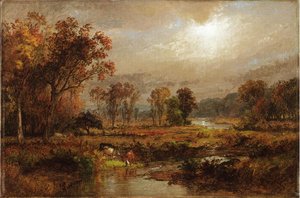
L'Automne by Jules Dupré

L'Automne

Oil On Canvas

A dirt road winds through a wooded landscape, drawing the eye toward a distant, hazy horizon. The scene captures a moment of seasonal transition, where the foliage of the trees has turned to shades of yellow and brown. Along the path, figures and animals move through the landscape, suggesting the rhythmic, everyday labor of countryside life. The atmosphere is heavy with the stillness of an overcast day, where light filters…

2
Forest View (1850) by Jules Dupré

Forest View

1850 · Oil · Museum Boijmans Van Beuningen, Rotterdam

Forest View is a moody and atmospheric landscape painting that captures a dramatic forest scene under a turbulent sky. The composition is dominated by a large, detailed tree positioned slightly left of center, which anchors the foreground. To the right, a small stream or pool reflects the light from the sky, creating a focal point in the lower portion of the work. The color palette is somber and earthy, consisting…

4
Portrait de l'artiste by Jules Dupré

Portrait de l'artiste

Oil On Canvas · The Louvre, Paris

Portrait de l'artiste au soleil couchant : Une Ode à la Nature Dramatique La peinture "Portrait de l’artiste au soleil couchant" attribuée à Jules Dupré représente une œuvre emblématique du mouvement Barbizon, incarnant les préoccupations esthétiques et émotionnelles qui définissent cette période artistique française. Datée probablement vers 1875, cette huile sur toile témoigne d'une maîtrise exceptionnelle de la couleur et d’une sensibilité profonde pour capturer la puissance brute et la…

5
Autumn (1865) by Jules Dupré

Autumn

1865 · Oil On Canvas · Van Gogh Museum, Amsterdam

In this 1865 oil on canvas, we find ourselves standing before a landscape that feels heavy with the scent of damp earth and approaching rain. The composition is anchored by a gnarled, skeletal tree, its dark limbs reaching upward like veins against a turbulent sky. There is a profound sense of stillness here, yet it is a restless quiet, the kind that precedes a storm. The palette is muted, leaning…

6
Village Landscape (1840) by Jules Dupré

Village Landscape

1840 · Oil On Canvas · Hermitage Museum, Saint Petersburg

A cluster of thatched-roof cottages occupies the center of this 1840 landscape, nestled between mature, heavy-limbed trees. A dirt path cuts through the foreground, leading the eye toward a horse-drawn carriage moving through the village. The scene is defined by a dramatic, cloud-filled sky that casts dappled light across the uneven, muddy terrain. Earthy tones of ochre and sienna ground the composition, while cool blues and bright whites emerge from…

7
Landscape with Cattle at Limousin (1837) by Jules Dupré

Landscape with Cattle at Limousin

1837 · Oil On Canvas · Metropolitan Museum of Art, New York

To stand before Jules Dupré’s Landscape with Cattle at Limousin is to be enveloped by a moment suspended between tranquility and impending drama. This magnificent oil on canvas, dating from 1837, transports the viewer deep into the heart of rural France. It is more than just a depiction of grazing cattle beneath an expansive sky; it is a masterful study in atmospheric tension. Duppré captures that fleeting energy inherent in…

8
Willows, with a Man Fishing (1864) by Jules Dupré

Willows, with a Man Fishing

1864 · Oil On Canvas · National Gallery, London

The air feels heavy and damp, thick with the scent of river water and the soft rustle of willow leaves. A lone figure stands waist-deep in the still, dark water, his silhouette breaking the surface as he holds a fishing rod with patient intent. Around him, the willow trees stretch toward the sky, their long, leafy branches dipping low to touch the water's edge. The scene is one of profound…

10
Oak pool (1850) by Jules Dupré

Oak pool

1850 · Oil On Canvas · Musée d'Orsay, Paris

A massive, dark silhouette of an oak tree dominates the left side of this oil on canvas painting, extending vertically toward the upper edge of the frame. To the right, a secondary cluster of darker trees creates a boundary for a central opening in the sky. Within this gap, bright, turbulent clouds are illuminated from behind, casting light that reflects upon the surface of a pool below. The color palette…

Jules Dupré's famous paintings, numbers 11 to 100

11The Cottage by the Roadside, Stormy Sky (1860) by Jules DupréThe Cottage by the Roadside, Stormy Sky1860 · Art Institute of Chicago 12On the Road (1856) by Jules DupréOn the Road1856 · Art Institute of Chicago 13Le chêne by Jules DupréLe chêne 14Two Boats in a Storm (1872) by Jules DupréTwo Boats in a Storm1872 · Art Institute of Chicago 15Autumn Landscape (1850) by Jules DupréAutumn Landscape1850 · Hermitage Museum 16Pointe de dunes (1831) by Jules DupréPointe de dunes1831 · Kelvingrove Art Gallery and Museum 17The Estuary Farm (1830) by Jules DupréThe Estuary Farm1830 · Art Institute of Chicago 18Evening on the French Coast near Dieppe (1830) by Jules DupréEvening on the French Coast near Dieppe1830 · Reading Public Museum 19Setting Sun over a Marsh (1837) by Jules DupréSetting Sun over a Marsh1837 20Landscape (1832) by Jules DupréLandscape1832 21Marsh at Setting Sun (1832) by Jules DupréMarsh at Setting Sun1832 · The Mesdag Collection 22View of the Pastures of the Limousin (France) (1835) by Jules DupréView of the Pastures of the Limousin (France)1835 · Minneapolis Institute of Art 23A Bright Day (1837) by Jules DupréA Bright Day1837 · Walters Art Museum 24The Pond (1837) by Jules DupréThe Pond1837 · Minneapolis Institute of Art 25In the Landes, France (1841) by Jules DupréIn the Landes, France1841 · Leeds Art Gallery 26Fontainebleau Oaks (1840) by Jules DupréFontainebleau Oaks1840 · Minneapolis Institute of Art 27Setting Sun After the Storm (1851) by Jules DupréSetting Sun After the Storm1851 28Cows near a Pond (1850) by Jules DupréCows near a Pond1850 · Musée Hyacinthe Rigaud 29The Path of Cayeux-sur-Mer (1850) by Jules DupréThe Path of Cayeux-sur-Mer1850 30The Pond (1850) by Jules DupréThe Pond1850 31Sunset (1850) by Jules DupréSunset1850 32Wooded Path (1850) by Jules DupréWooded Path1850 · Musée des Beaux-Arts de Caen 33Cows in a Pond (1852) by Jules DupréCows in a Pond1852 · National Gallery of Ireland 34The Windmill (1850) by Jules DupréThe Windmill1850 · Cleveland Museum of Art 35On the river (1850) by Jules DupréOn the river1850 · National Museum of Fine Arts 36Landscape with a pond. (1850) by Jules DupréLandscape with a pond.1850 · National Museum in Warsaw 37Untitled (Landscape) (1850) by Jules DupréUntitled (Landscape)1850 · Minneapolis Institute of Art 38On the Marsh (1850) by Jules DupréOn the Marsh1850 · Brooklyn Museum 39Landscape with a pond (1855) by Jules DupréLandscape with a pond1855 · National Museum in Warsaw 40Landscape with Cows near a Pool of Water (1857) by Jules DupréLandscape with Cows near a Pool of Water1857 · Rijksmuseum Twenthe 41The Windmill (1857) by Jules DupréThe Windmill1857 · Scottish National Gallery 42Still Life with a grey Jug (1862) by Jules DupréStill Life with a grey Jug1862 · Nationalmuseum 43Riverbanks (1870) by Jules DupréRiverbanks1870 44Evening (1865) by Jules DupréEvening1865 · Musée d'Arts de Nantes 45The Morning (1865) by Jules DupréThe Morning1865 · Musée d'Arts de Nantes 46Choppy Sea (1870) by Jules DupréChoppy Sea1870 · Hamburger Kunsthalle 47Marshland (1870) by Jules DupréMarshland1870 · Cleveland Museum of Art 48A Fisherman (1867) by Jules DupréA Fisherman1867 · Scottish National Gallery 49Village Scene, Sunset (1870) by Jules DupréVillage Scene, Sunset1870 · Minneapolis Institute of Art 50Barks Fleeing Before the Storm (1870) by Jules DupréBarks Fleeing Before the Storm1870 · Art Institute of Chicago 51Sunset on the Coast (1870) by Jules DupréSunset on the Coast1870 · Walters Art Museum 52At Sea (1870) by Jules DupréAt Sea1870 · Walters Art Museum 53Le Crotoy (1868) by Jules DupréLe Crotoy1868 · The Mesdag Collection 54Calm before the storm (1870) by Jules DupréCalm before the storm1870 55Landscape with Cattle (1865) by Jules DupréLandscape with Cattle1865 56The Old Oak (1870) by Jules DupréThe Old Oak1870 · National Gallery of Art 57Open Sea (1868) by Jules DupréOpen Sea1868 58Landscape (with cow at the water). (1877) by Jules DupréLandscape (with cow at the water).1877 · Museum Gouda 59Landscape with Cow (1872) by Jules DupréLandscape with Cow1872 · Saint Louis Art Museum 60Evening (1877) by Jules DupréEvening1877 · The Mesdag Collection 61Sunset (1877) by Jules DupréSunset1877 · The Mesdag Collection 62Bridge to L'Isle-Adam (1872) by Jules DupréBridge to L'Isle-Adam1872 · The Mesdag Collection 63Sunset over the Forest (1875) by Jules DupréSunset over the Forest1875 64Landscape with River (1884) by Jules DupréLandscape with River1884 65Sunset (Coucher du soleil) (1884) by Jules DupréSunset (Coucher du soleil)1884 66A Stiff Breeze (1879) by Jules DupréA Stiff Breeze1879 67Sunset (1879) by Jules DupréSunset1879 · Museum Boijmans Van Beuningen 68View in the Woods, Jules Dupré, 1840 - 1889 (1889) by Jules DupréView in the Woods, Jules Dupré, 1840 - 18891889 · Rijksmuseum 69A Village by Night, Jules Dupré, 1840 - 1889 (1889) by Jules DupréA Village by Night, Jules Dupré, 1840 - 18891889 · Rijksmuseum 70Cattle Watering (1888) by Jules DupréCattle Watering1888 71Scenery with farmhouses under trees by Jules DupréScenery with farmhouses under trees 72Forest-landscape, wash-women at the brook by Jules DupréForest-landscape, wash-women at the brook 73Portrait Of Guillaume Roumy, Uncle Of Pauline Ono by Jules DupréPortrait Of Guillaume Roumy, Uncle Of Pauline Ono 74Portrait of Jean-Victor Schnetz by Jules DupréPortrait of Jean-Victor Schnetz 75Autoportrait de l'artiste à son chevalet by Jules DupréAutoportrait de l'artiste à son chevalet 76Le vieux chêne à l'abreuvoir après 1880 by Jules DupréLe vieux chêne à l'abreuvoir après 1880 77Marine by Jules DupréMarine 78Paysanne assise sous un chêne et son chien by Jules DupréPaysanne assise sous un chêne et son chien 79Le port Saint Nicolas à Paris by Jules DupréLe port Saint Nicolas à ParisCondé Museum 80La vanne by Jules DupréLa vanne 81Landscape by moonlight (1852) by Jules DupréLandscape by moonlight1852 · National Museum in Warsaw 82VACHES AU BORD DE L'EAU by Jules DupréVACHES AU BORD DE L'EAUThe Louvre 83Forest Landscape (1840) by Jules DupréForest Landscape1840 · Hermitage Museum 84Landscape with Cows (1870) by Jules DupréLandscape with Cows1870 · Hermitage Museum 85La petite charrette by Jules DupréLa petite charretteThe Louvre 86SOLEIL COUCHANT SUR UN MARAIS by Jules DupréSOLEIL COUCHANT SUR UN MARAISThe Louvre 87Marine by Jules DupréMarineThe Louvre 88Landscape with Cattle Watering by Jules DupréLandscape with Cattle WateringNorfolk Museums 89A Country Cottage by Jules DupréA Country CottageLeeds Art Gallery 90A Seascape by Jules DupréA SeascapeNational Gallery of Ireland 91Landscape by Jules DupréLandscapeDetroit Institute of Arts 92Cows Drinking by Jules DupréCows DrinkingRhode Island School of Design Museum of Art 93The Old Windmill by Jules DupréThe Old WindmillRhode Island School of Design Museum of Art 94Landscape by Jules DupréLandscapeRhode Island School of Design Museum of Art 95Shipping in a breeze by Jules DupréShipping in a breezeFitzwilliam Museum 96Watering Place by Jules DupréWatering PlaceMuseum of Fine Arts 97Cottages by the Sea by Jules DupréCottages by the SeaMuseum of Fine Arts 98Cattle on the Dunes by Jules DupréCattle on the DunesMuseum of Fine Arts 99Landscape by Jules DupréLandscapeFine Arts Museums of San Francisco 100The River by Jules DupréThe RiverThe Frick Collection

The subjects that held Jules Dupré's eye

The four subjects that come back most often in these originals, each with its finest example.

The museums that keep Jules Dupré's originals

The 8 museums that hold the most of the paintings on this page.

Museum City Works by Jules Dupré Paintings from this list
The Louvre, ParisThe Louvre Paris 12 Portrait de l'artiste, VACHES AU BORD DE L'EAU, La petite charrette
Art Institute of Chicago, ChicagoArt Institute of Chicago Chicago 5 The Cottage by the Roadside, Stormy Sky, On the Road, Two Boats in a Storm
The Mesdag Collection, The HagueThe Mesdag Collection The Hague 5 Marsh at Setting Sun, Le Crotoy, Evening
Minneapolis Institute of Art, MinneapolisMinneapolis Institute of Art Minneapolis 5 View of the Pastures of the Limousin (France), The Pond, Fontainebleau Oaks
Hermitage Museum, Saint PetersburgHermitage Museum Saint Petersburg 4 Village Landscape, Autumn Landscape, Forest Landscape
Walters Art Museum, BaltimoreWalters Art Museum Baltimore 3 A Bright Day, Sunset on the Coast, At Sea
National Museum in Warsaw, WarsawNational Museum in Warsaw Warsaw 3 Landscape with a pond., Landscape with a pond, Landscape by moonlight
Rhode Island School of Design Museum of Art, ProvidenceRhode Island School of Design Museum of Art Providence 3 Cows Drinking, The Old Windmill, Landscape

Jules Dupré across the decades: one unique original for each

Works per decade

Pick a decade to see the original that defines it.

Jules Dupré's paintings: questions for the gallery

What is the single most famous work of Jules Dupré?Reveal the answer

L'Automne. Forest View (1850) and Un orage en mer (fin des années 1880) come next.

Which ten paintings by Jules Dupré are the most famous?Reveal the answer

L'Automne, Forest View, Un orage en mer (fin des années 1880), Portrait de l'artiste, Autumn, Village Landscape, Landscape with Cattle at Limousin, Willows, with a Man Fishing, Valley of the River Loire and Oak pool. The ranking above gives each one's year and museum.

How many works by Jules Dupré are known?Reveal the answer

Our catalog holds 156 works by Jules Dupré, dated from 1830 to 1889.

Where can the most famous Jules Dupré originals be seen?Reveal the answer

Mostly in The Louvre (Paris), Art Institute of Chicago (Chicago) and The Mesdag Collection (The Hague). The museum table above lists them all.

During which period did Jules Dupré create the best-known paintings?Reveal the answer

In 1850s: 20 of the 100 works on this page were made then, Forest View among them.

Which famous Jules Dupré painting is the earliest, and which the latest?Reveal the answer

On this page, the earliest is The Estuary Farm (1830) and the latest View in the Woods, Jules Dupré, 1840 - 1889 (1889).

What subjects did Jules Dupré favour?Reveal the answer

Landscape (9), Sky (8) and Clouds (8), across the 100 works on this page.

What materials did Jules Dupré paint with most?Reveal the answer

Oil On Canvas, for 17 of the 100 works on this page.

Which movement does the work of Jules Dupré belong to?Reveal the answer

Barbizon school, judging by the originals on this page.

What Jules Dupré originals can I see at the The Louvre?Reveal the answer

Portrait de l'artiste, VACHES AU BORD DE L'EAU and La petite charrette: the The Louvre, Paris holds 5 of the works on this page.

Jules Dupré: a portrait of the artist

The Dramatic Soul of Barbizon

Jules Dupré (1811–1889) stands as a cornerstone figure within the Barbizon School, an artistic movement that championed raw observation and emotional resonance in landscape painting. Unlike his contemporaries like Corot who often sought lyrical beauty and tranquil stillness, Dupré wrestled with the darker, more tempestuous side of nature. He possessed a unique ability to capture the fury of storms, the melancholic grandeur of twilight, and the relentless energy of the elements, conveying these experiences with unparalleled intensity. Born in Nantes, France, Dupré’s artistic journey began amidst a burgeoning fascination for the natural world and its capacity to evoke profound, often turbulent, human feelings.

His early life provided a foundation of meticulous attention to detail and an appreciation for craftsmanship, qualities honed by his father’s porcelain manufacturing business. This formative experience would later translate into his own artistic endeavors, particularly evident in his early works exploring the intricacies of ceramic decoration. As an apprentice porcelain decorator, he learned the discipline of fine lines and textures, a skill set that would eventually evolve into his masterful handling of atmospheric depth and organic forms.

A Vision Shaped by Storm and Sky

The trajectory of Dupré’s career was irrevocably shaped by his encounter with the groundbreaking canvases of John Constable. This exposure to English landscape traditions ignited a desire to capture the essence of nature’s dynamism—the relentless push and pull of wind-driven foliage and the dramatic interplay of light and shadow during the most volatile hours of the day. Traveling to Great Britain in 1831, Dupré made profound studies of these English masters, returning to France with a portfolio of imagery that would redefine his approach to the landscape.

He found particular inspiration in the coastal districts around Southampton and Plymouth. These vast expanses of water, reflecting turbulent skies, provided him with the perfect laboratory to study the tempestuous motion of storm clouds and the movement of seas. His paintings from this period are not merely depictions of scenery; they are visceral expressions of mood and feeling, imbued with a palpable sense of drama and even sorrow. By embracing the Barbizon aesthetic, Dupré prioritized expressive color palettes and bold brushstrokes over idealized or polished representations, allowing the texture of the paint itself to mirror the ruggedness of the earth.

Legacy of the Barbizon Master

As a key figure in the Barbizon group, Dupré developed close ties with other legendary painters, including Théodore Rousseau. His rise within the French art establishment was marked by significant milestones, such as his acceptance into the Salon and receiving official recognition through medals for his landscapes. His work became synonymous with a certain sonorous and resonant color harmony, where the light of a setting sun or the gloom of an approaching gale could be felt by the viewer as much as seen.

Today, Jules Dupré is remembered as one of the most influential 19th-century French landscape artists. His contribution to art lies in his ability to bridge the gap between pure observation and romantic emotion. Through works such as La Petite Charrette, Cows Crossing a Ford, and his evocative depictions of river landscapes, he taught generations of artists that nature is not just a subject to be painted, but a powerful force to be experienced. His legacy remains etched in the heavy, atmospheric textures and the dramatic, breathing skies that continue to captivate the modern imagination.