Preview
 Send
Send Share
Share
 Details
 Guide
Guide

 Download
 Similars
 X-Ray
X-Ray Diaporama
 Q&A
Q&A Stats
StatsHuman Fragility

- 199.0 x 134.0 cm


 Read More
Giclée / Art Print
Museum-quality giclée or canvas print with fast production and flexible finish options. ( Buy Hand Made Painting Switch to Digital Image)




P118B $10

P118H $10

P118W $10

P438Z $10

P508JH $12

P508YH $12

P805H $10

P805Z $10

P919BZ $10

P919G $10

P919XJ $10

P959ZH $10

P968JZ $12

W106C $8

W218G $10

W218JH $8

W218Y $10

W307PJ $10

W316G $10

W316PJ $8

W316Y $10

W398PJ $8

W4111J $10

W500HY $15

W500JH $15

W692G $12

W849H $8

W940BG $15

W953PJ $8




Pick from our preset sizes that match the artwork's original proportions.

Type the width and the height you need, to fit your frame or your wall. A print can only be cut, never made bigger than the picture, so a size with a different shape loses a part of the image. We send you a digital mockup to approve before we print anything. The picture shown on this page does not show the real cut — only the mockup does.
Worldwide Delivery () in 2 weeks instead of standard 4/5 weeks. (10 November)

Free Worldwide Express Shipping

High-Quality Linen Canvas

Full Shipping Insurance

Customs Tax Refund Guarantee

True Color Matching Guarantee

100-Day Return Policy (Defects Only)

100% Money-Back Guarantee

Bulk Discount Offer
 Glass option is only available in size under 110 CM

Human Fragility
Giclée / Art Print
Reproduction Size
-


Total Price
$ 81
A Portrait of Mortality: Salvator Rosa’s “Human Fragility”
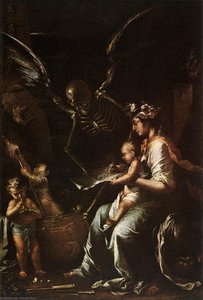
Salvator Rosa's "Human Fragility," painted in 1656 during the devastating Naples plague, is more than just a depiction of a somber scene; it’s a profound meditation on life, death, and the precariousness of human existence. Housed within the hallowed halls of the Fitzwilliam Museum in Cambridge, this oil-on-canvas masterpiece transcends its historical context to resonate powerfully with viewers today. Measuring an imposing 199 x 134 cm, the painting immediately commands attention with its dramatic chiaroscuro – a masterful manipulation of light and shadow characteristic of the Baroque period, yet imbued with Rosa’s distinctly personal vision.
At first glance, the composition appears straightforward: a woman seated with her child, a skeletal figure looming in the background. However, a closer examination reveals a complex tapestry of symbolism woven into every element. The central figures – Lucrezia, Rosa's mistress and mother to his son Rosalvo – are rendered with an unsettling stillness, their faces betraying neither joy nor sorrow, reflecting perhaps the acceptance of fate that accompanies profound loss. The child’s clenched wrist, gripped by the skeletal hand of Death, is a potent memento mori, a stark reminder of the fleeting nature of youth and vitality. The angel of death, not depicted as a terrifying demon but rather as a subtly manipulative force, guides the boy's hand to write the chilling inscription: “Conceptio Culpa, Nasci Pena, Labor Vita, Necesse Mori” – ‘Conception is a sin, Birth is pain, Life is toil, Death a necessity.’ This concise yet devastating phrase encapsulates the entire painting’s theme, highlighting the inherent burdens of existence.
Baroque Drama and Personal Vision
Rosa's artistic style in “Human Fragility” seamlessly blends elements of Baroque drama with his own intensely personal vision. He was deeply influenced by the naturalism of Italian painter Carlo Dolci, particularly in his use of light and shadow to create a sense of depth and atmosphere. Yet, unlike Dolci’s often serene depictions of religious subjects, Rosa injects a palpable sense of unease and melancholy into his work. The dark, almost claustrophobic background, punctuated by the stark white of the skeleton, creates a dramatic contrast with the figures in the foreground, drawing the viewer's eye to their plight. His brushwork is loose and expressive, conveying both meticulous detail and an underlying sense of urgency – as if he were attempting to capture a fleeting moment before it vanished entirely.
Rosa’s decision to depict this particular scene during a period of immense personal tragedy adds another layer of complexity to the painting. The plague that ravaged Naples in 1655 claimed the lives of his son, brother, sister, and her husband – a devastating loss that undoubtedly informed the work's somber tone. The inclusion of elements like the ring of pale roses around Lucrezia’s head—a reference to her family name—suggests a deeply personal connection to the subject matter, transforming the painting from a generic allegory into a poignant portrait of grief and acceptance.
Symbolism Beyond Mortality
Beyond its immediate message about mortality, “Human Fragility” is rich in symbolic detail. The bubbles floating upwards from the child’s hand represent the brevity of human life – a fleeting existence compared to the vastness of eternity. The statue of Terminus, the Roman god of death, positioned at the left edge of the painting, further reinforces this theme. Rosa's inclusion of his own initials on the blade of a knife—a symbol of death—adds a layer of self-awareness and perhaps even regret to the composition. The painting is not simply about death; it’s about confronting the inevitability of loss and finding meaning in the face of suffering.
A Legacy of Influence
Salvator Rosa's “Human Fragility” stands as a pivotal work in the history of art, influencing generations of artists with its dramatic intensity and profound exploration of human themes. His innovative landscapes, often depicting wild and untamed nature, paved the way for the Romantic movement, inspiring artists to embrace emotion and individualism. Today, reproductions of this powerful painting continue to captivate audiences worldwide, serving as a timeless reminder of our shared mortality and the enduring beauty of the human spirit.
Questions & Answers
What national origin stands behind the Baroque Painting of "Human Fragility"?
"Human Fragility" was created by Salvator Rosa, born in Italy, within the Baroque Painting movement. The artist's origin links the work to Baroque Painting as practiced by artists from Italy.
Which palette and lead color define "Human Fragility"?
"Human Fragility" is defined by an earthy palette led by black (#1d150e).
Which museum holds the original "Human Fragility"?
The original "Human Fragility" by Salvator Rosa is held at the Fitzwilliam College, Cambridge, United Kingdom. A reproduction allows the work to be displayed at home.
Artist Biography
Early Life, Family and Training
In the outskirts of Naples, specifically in Arenella, Salvator Rosa enters the world. The date of his birth remains a point of historical debate, falling on either June 20 or July 21, 1615. He is born into a family of distinct lineages; his mother, Giulia Greca Rosa, belongs to one of the Greek families of Sicily, while his father, Vito Antonio de Rosa, works as a land surveyor. The shadow of Vesuvius looms over his early years, a geological presence that will eventually shape his visual language.
Conflict defines his path toward a vocation. His father, seeking a more stable and traditional life for his son, intends for Salvator Rosa to enter the priesthood or pursue a career as a lawyer. The convent of the Somaschi Fathers is the destination prepared for him. However, the boy's interests pull elsewhere. He turns away from the religious life to pursue the arts in secret. Under the quiet tutelage of his maternal uncle, Paolo Greco, he begins to master the fundamentals of his craft. This clandestine training continues as he moves toward the guidance of Francesco Fracanzano, absorbing the technical foundations that will later allow him to challenge the established aesthetic norms of the Baroque era.
Artistic Career in Naples, Rome and Florence
The trajectory of Rosa's career shifts with the political and social tides of 17th-century Italy. In 1635, he leaves his native Naples for Rome, entering the undisputed art center of the era. He returns to Naples in 1637, but his presence in the city becomes increasingly volatile. By 1648, the artist is forced to flee Naples entirely after becoming involved in a failed uprising against the Spanish rulers. This period of rebellion marks a definitive break from his early years.
His subsequent movement takes him to Florence. This second period in the city offers a different kind of engagement. Beyond the studio, Rosa immerses himself in the intellectual and sensory life of the Florentine circles. He spends his hours playing music, writing poetry, and studying Stoic philosophy. This multifaceted existence informs the depth of his later output, as his interests in the written word and philosophical thought begin to intersect with his visual practice.
Technique and Style
Rosa’s brushwork rejects the polished surfaces and idealized forms that defined much of the Baroque era. Instead, he embraces an unorthodox and extravagant style, favoring the raw and the untamed. He masters chiaroscuro, utilizing the dramatic interplay of light and shadow to sculpt form and mood. This technique does more than define shapes; it creates a sense of tension across the canvas. His landscapes are not idyllic retreats for contemplation but are instead characterized as wild and rugged. Turbulent skies and jagged, rocky terrain dominate his compositions, reflecting a fascination with the volatile power of nature.
The subject matter often moves away from the common religious scenes of his contemporaries. He frequently selects obscure and esoteric subjects drawn from the Bible, mythology, and the lives of philosophers. This intellectual rigor transforms the landscape from a mere backdrop into a central, active participant in the narrative. In his hands, the environment becomes a stage for moral and philosophical inquiry. He often depicts the human figure as marginal, dwarfed by the immense and often hostile scale of the natural world.
- Pythagoras Emerging from the Underworld (1662)
- Democrito E Protagora (1664)
- Self-Portrait as Philosopher of Silence (1641)
Key Works and Masterpieces
The canvas often becomes a site of intense psychological inquiry. In the 1641 work Self-Portrait as Philosopher of Silence, held at the National Gallery, London, the artist confronts the viewer through a lens of quietude. This piece functions as a meditation on wisdom, utilizing a dark, contemplative atmosphere to establish his identity. Similarly, his 1645 Self-Portrait as a Philosopher at the National Gallery, London, reinforces this persona of the thinking man, moving away from mere representation toward an expression of intellectual rigor.
Nature in Rosa's hands is rarely a peaceful backdrop; it is a turbulent force. Around 1640, Ruins in a Rocky Landscape emerged, a work now in the Cleveland Museum of Art that utilizes classical ruins and iridescent light to suggest a world in flux. This ruggedness extends into his mythological and allegorical compositions. The 1662 Pythagoras Emerging from the Underworld, located at the Kimbell Art Museum, Fort Worth, uses dramatic landscape composition to bridge the gap between the physical and the metaphysical. In the same vein, the 1664 Democrito E Protagora at the Hermitage Museum, Saint Petersburg, employs a philosophical allegory set within a dramatic landscape.
Even religious narratives undergo a transformation under his brush. The Baptism of the Eunuch, created in 1660 and held at the Chrysler Museum of Art, Norfolk, infuses the biblical scene with high drama. His ability to navigate these diverse subjects—from the mythological to the sacred—defines his output.
- Self-Portrait as Philosopher of Silence (1641)
- Pythagoras Emerging from the Underworld (1662)
- Democrito E Protagora (1664)
- The Baptism of the Eunuch (1660)
- Ruins in a Rocky Landscape (about 1640)
Legacy and Influence
The impact of Salvator Rosa ripples through the evolution of Baroque art. His departure from the idealized, orderly landscapes of his contemporaries creates a friction that shifts the direction of 17th-century painting. This influence moves through the decades, reaching into the works of later artists like Luca Giordano. He does not merely paint scenery; he constructs a visual language of turbulence that persists long after his death.
His romanticised landscapes and history paintings exert a heavy presence from the 17th century well into the early 19th century. These works act as prototypes for the romantic landscape, trading the "picturesque" classical views for something far more volatile. Instead of calm, pastoral retreats, he presents a wild and often hostile nature. This shift in perspective anticipates the emotional intensity that would later define the Romantic movement.
The legacy of his vision is found in the tension between the human figure and the untamed wilderness. By centering the landscape as a primary subject rather than a mere backdrop for religious or mythological narratives, he alters the hierarchy of genres. His rugged, rocky terrains and stormy skies provide a blueprint for an aesthetic of the sublime, where nature is a force of awe and introspection rather than a controlled garden.
Where to See the Works Today
The physical remnants of Rosa’s restless career are scattered across the major art capitals of Europe and the Americas. In Saint Petersburg, the Hermitage Museum preserves his early precision in the 1640 Portrait of a Man. Across the continent, the Louvre in Paris maintains a presence through his 1652 Heroic Battle. These works anchor his presence in the great institutional collections of the 17th century.
The artist's philosophical and mythological preoccupations find their way into specialized collections as well. The National Gallery in London holds his 1645 Self-Portrait as a Philosopher, a work that captures his intense engagement with intellectual thought. In Fort Worth, the Kimbell Art Museum houses Pythagoras Emerging from the Underworld, a 1662 composition that highlights his ability to merge myth with dramatic landscape. Meanwhile, the Metropolitan Museum of Art in New York contains his 1656 Bandits on a Rocky Coast, a piece that reflects the rugged, untamed nature he favored.
- Art Gallery of South Australia, Adelaide
- Kunsthistorisches Museum, Vienna
- Musée Des Beaux, Strasbourg
- Chrysler Museum of Art, Norfolk

Salvator Rosa
1615 - 1673 , Italy
Quick Facts
- Artistic Movement Or Style: Baroque
- Artists Or Movements Influenced By This Artist: ['Luca Giordano']
- Artists Who Influenced This Artist:
- Ribera
- Poussin
- Full Name: Salvator Rosa
- Nationality: Italian
- Notable Artworks:
- Pythagoras Emerging from the Underworld
- The Baptism of the Eunuch
- Place Of Birth: Arenella, Italy
- Date Of Birth: 1615
- Date Of Death: 1673
Related Articles

Baroque Masterpieces: 10 Paintings That Defined an Era |
Journey through the drama & grandeur of Baroque art! Explore 10 masterpieces by Caravaggio, Rembrandt, Rubens & more. Discover stunning oil paintings, rich colors & timeless stories. Find museum-quality reproductions at .

Salvator Rosa: A Baroque Rebel's Vision of Landscape, Allegory & the Human Condition
Explore the captivating world of Salvator Rosa, a rebellious Baroque master. Discover his dramatic landscapes, allegorical paintings & lasting influence on Romanticism. Hand-painted reproductions available at OriginalUniqueArt.

The Enduring Power of Painting: A Historical & Contemporary Exploration of Form and Emotion
Explore the rich history & enduring techniques of oil painting with OriginalUniqueArt. Discover masterpieces, learn about art collecting, and find authentic handmade reproductions crafted by skilled artists.

Baroque Drama: Bringing Opulence & Emotion into Contemporary Interiors
Explore the opulent world of Baroque interior design! Discover key elements, modern applications & how to bring dramatic elegance into your home with OriginalUniqueArt.com's authentic reproductions.

The Enduring Legacy of Oil on Canvas: Technique, History & Aesthetic Impact
Explore the rich history & techniques of oil painting – from Renaissance masters to Impressionism. Discover pigments, layering methods, and why this timeless medium endures. Expert insights for artists & art enthusiasts.