Switch to Print
 Read More







































 For artworks or reproductions larger than 105 cm (approximately 41 inches) on any side, the frame will be shipped as a kit, disassembled. This method ensures safe delivery and prevents damage during transport.


A Portrait of Mortality: Salvator Rosa’s “Human Fragility”
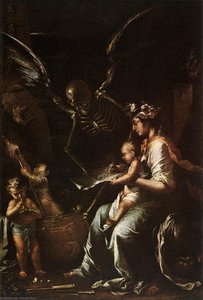
Salvator Rosa's "Human Fragility," painted in 1656 during the devastating Naples plague, is more than just a depiction of a somber scene; it’s a profound meditation on life, death, and the precariousness of human existence. Housed within the hallowed halls of the Fitzwilliam Museum in Cambridge, this oil-on-canvas masterpiece transcends its historical context to resonate powerfully with viewers today. Measuring an imposing 199 x 134 cm, the painting immediately commands attention with its dramatic chiaroscuro – a masterful manipulation of light and shadow characteristic of the Baroque period, yet imbued with Rosa’s distinctly personal vision.
At first glance, the composition appears straightforward: a woman seated with her child, a skeletal figure looming in the background. However, a closer examination reveals a complex tapestry of symbolism woven into every element. The central figures – Lucrezia, Rosa's mistress and mother to his son Rosalvo – are rendered with an unsettling stillness, their faces betraying neither joy nor sorrow, reflecting perhaps the acceptance of fate that accompanies profound loss. The child’s clenched wrist, gripped by the skeletal hand of Death, is a potent memento mori, a stark reminder of the fleeting nature of youth and vitality. The angel of death, not depicted as a terrifying demon but rather as a subtly manipulative force, guides the boy's hand to write the chilling inscription: “Conceptio Culpa, Nasci Pena, Labor Vita, Necesse Mori” – ‘Conception is a sin, Birth is pain, Life is toil, Death a necessity.’ This concise yet devastating phrase encapsulates the entire painting’s theme, highlighting the inherent burdens of existence.
Baroque Drama and Personal Vision
Rosa's artistic style in “Human Fragility” seamlessly blends elements of Baroque drama with his own intensely personal vision. He was deeply influenced by the naturalism of Italian painter Carlo Dolci, particularly in his use of light and shadow to create a sense of depth and atmosphere. Yet, unlike Dolci’s often serene depictions of religious subjects, Rosa injects a palpable sense of unease and melancholy into his work. The dark, almost claustrophobic background, punctuated by the stark white of the skeleton, creates a dramatic contrast with the figures in the foreground, drawing the viewer's eye to their plight. His brushwork is loose and expressive, conveying both meticulous detail and an underlying sense of urgency – as if he were attempting to capture a fleeting moment before it vanished entirely.
Rosa’s decision to depict this particular scene during a period of immense personal tragedy adds another layer of complexity to the painting. The plague that ravaged Naples in 1655 claimed the lives of his son, brother, sister, and her husband – a devastating loss that undoubtedly informed the work's somber tone. The inclusion of elements like the ring of pale roses around Lucrezia’s head—a reference to her family name—suggests a deeply personal connection to the subject matter, transforming the painting from a generic allegory into a poignant portrait of grief and acceptance.
Symbolism Beyond Mortality
Beyond its immediate message about mortality, “Human Fragility” is rich in symbolic detail. The bubbles floating upwards from the child’s hand represent the brevity of human life – a fleeting existence compared to the vastness of eternity. The statue of Terminus, the Roman god of death, positioned at the left edge of the painting, further reinforces this theme. Rosa's inclusion of his own initials on the blade of a knife—a symbol of death—adds a layer of self-awareness and perhaps even regret to the composition. The painting is not simply about death; it’s about confronting the inevitability of loss and finding meaning in the face of suffering.
A Legacy of Influence
Salvator Rosa's “Human Fragility” stands as a pivotal work in the history of art, influencing generations of artists with its dramatic intensity and profound exploration of human themes. His innovative landscapes, often depicting wild and untamed nature, paved the way for the Romantic movement, inspiring artists to embrace emotion and individualism. Today, reproductions of this powerful painting continue to captivate audiences worldwide, serving as a timeless reminder of our shared mortality and the enduring beauty of the human spirit.
Questions & Answers
What national origin stands behind the Baroque Painting of "Human Fragility"?
"Human Fragility" was created by Salvator Rosa, born in Italy, within the Baroque Painting movement. The artist's origin links the work to Baroque Painting as practiced by artists from Italy.
Which palette and lead color define "Human Fragility"?
"Human Fragility" is defined by an earthy palette led by black (#1d150e).
Which museum holds the original "Human Fragility"?
The original "Human Fragility" by Salvator Rosa is held at the Fitzwilliam College, Cambridge, United Kingdom. A reproduction allows the work to be displayed at home.
More about this painting
 Preview
 Send
Send Share
Share
 Details
 Guide
Guide

 Download
 Similars
 X-Ray
X-Ray Diaporama
 Q&A
Q&A Stats
Stats