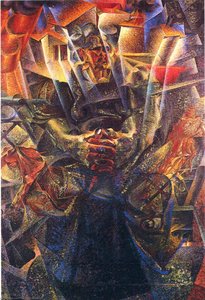
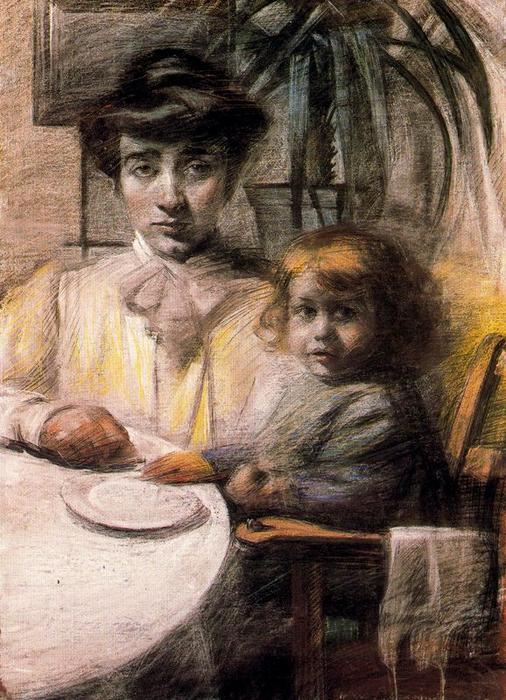
Portrait of Umberto Boccioni

The 100 Most Famous Umberto Boccioni Paintings, a Gallery Selection

Updated November 2026 · ranked by our popularity score (searches, visits and orders for each work) · 117 works by Umberto Boccioni in our catalogue

In short

Of all the originals Umberto Boccioni left, the most famous is Three Women (1910). Close behind it come The city rises (1910) and Dynamism of a Soccer Player (1913). Our catalog holds 117 works by Umberto Boccioni; the gallery has kept the 100 the world admires most, each shown with its date, its museum and its story.

1882 – 1916, Reggio Calabria Futurism Most works: MOMA - Museum of Modern Art

Umberto Boccioni's top 10 paintings: the gallery's choice

1
Three Women (1910) by Umberto Boccioni

Three Women

1910 · Oil On Canvas

Immerse yourself in the serene beauty of this captivating artwork, "Three Women," created by the visionary Italian artist Umberto Boccioni in 1910. This exquisite piece is a testament to Boccioni's artistic evolution and his pivotal role in shaping the Futurism movement.

2
The city rises (1910) by Umberto Boccioni

The city rises

1910 · Oil On Canvas · MOMA - Museum of Modern Art, New York City

Subject and Composition This captivating artwork vividly captures the energetic pulse of early 20th-century urban life through a dynamic construction scene. Depicting men and horses in a state of vigorous effort, the composition emphasizes the relentless movement and progress that define modern city development. The scene is a celebration of human labor and technological advancement, illustrating the bustling activity that fuels the growth of new urban landscapes. Its powerful imagery…

3
Dynamism of a Soccer Player (1913) by Umberto Boccioni

Dynamism of a Soccer Player

1913 · Oil On Canvas

In the annals of modern art, few works capture the electric pulse of the twentieth century as viscerally as Umberto Boccioni’s “Dynamism of a Soccer Player.” Completed in 1913, this masterpiece serves as a breathtaking window into the heart of Italian Futurism, a movement that sought to shatter the stagnant traditions of the past in favor of a world defined by velocity, technology, and industrial vigor. Rather than presenting a…

4
Modern Idol (1911) by Umberto Boccioni

Modern Idol

1911 · Oil On Panel · Estorick Collection of Modern Italian Art, London

"Modern Idol," created by Umberto Boccioni in 1911, is a captivating masterpiece that blends portraiture with surreal and symbolic elements. This striking artwork presents a face adorned with an elaborate floral headdress, set against a dynamic background of radiating lines and celestial motifs. The rich color palette, featuring deep blues contrasted with vibrant reds, yellows, oranges, and purples, creates a visually stunning and emotionally resonant piece.

5
States of Mind II - Those Who Go (1912) by Umberto Boccioni

States of Mind II - Those Who Go

1912 · Oil On Canvas · MOMA - Museum of Modern Art, New York City

A Tempest of Motion and SpiritIn the heart of a turbulent night, Umberto Boccioni’s States of Mind II - Those Who Go emerges not merely as a painting, but as a visceral experience of pure energy. The canvas vibrates with the raw power of a storm, where figures—perhaps riders caught in a sudden deluge—struggle against the elements. There is no stillness here; instead, we find ourselves immersed in a world…

6
Unique Forms of Continuity in Space (1913) by Umberto Boccioni

Unique Forms of Continuity in Space

1913 · Bronze

Dynamic Expression of Movement Umberto Boccioni's "Unique Forms of Continuity in Space" is a seminal work of the Futurist movement, capturing the essence of motion and dynamism in bronze. Created in 1913, this abstract sculpture features two intertwined human figures that seem to merge into one another, embodying themes of connection, unity, and the fluidity of existence. The piece's aerodynamic form and lack of discernible facial features or arms emphasize…

7
The City Rises (1910) by Umberto Boccioni

The City Rises

1910 · Oil On Canvas · MOMA - Museum of Modern Art, New York City

Umberto Boccioni's The City Rises (1910) is more than a painting; it’s an energetic declaration of the modern age, a visual explosion embodying the dynamism and transformative power of early 20th-century urban life. This seminal work of Italian Futurism doesn’t merely depict construction—it *is* construction, rendered in swirling forms and vibrant color, offering viewers an immersive experience of progress and change.

8
The Drinker (1914) by Umberto Boccioni

The Drinker

1914 · Acrylic On Canvas

The painting titled The Drinker by the renowned Italian artist Umberto Boccioni is a quintessential representation of the Futurist movement. Created in 1914, this oil on canvas artwork measures 88 x 87 cm and is currently housed at the Von Der Heydt Museum in Wuppertal, Germany.

9
States of Mind II - Those Who Stay (1912) by Umberto Boccioni

States of Mind II - Those Who Stay

1912 · Oil On Canvas · MOMA - Museum of Modern Art, New York City

In the heart of the early twentieth century, as the roar of engines began to redefine the human experience, Umberto Boccioni captured a profound psychological threshold in his 1912 masterpiece, States of Mind II - Those Who Stay. This is not merely a depiction of a train station; it is a visceral exploration of the Futurist soul. The canvas serves as a window into a world where stability and departure…

10
Dynamism of a Cyclist (1913) by Umberto Boccioni

Dynamism of a Cyclist

1913 · Oil On Canvas · Museo del Novecento, Milan

Painted in 1913, this captivating artwork embodies the core tenets of Futurism – a revolutionary Italian artistic and social movement that celebrated technology, speed, and modernity. Rather than depicting a cyclist in static realism, Umberto Boccioni presents a dynamic fragmentation of form, capturing the *sensation* of motion itself.

The Umberto Boccioni selection continues, 11 to 100

11The Street Pavers (1914) by Umberto BoccioniThe Street Pavers1914 · Metropolitan Museum of Art 12Under the Pergola at Naples (1914) by Umberto BoccioniUnder the Pergola at Naples1914 13States of Mind: The Farewells (1911) by Umberto BoccioniStates of Mind: The Farewells1911 14The Strengths of a Street (1911) by Umberto BoccioniThe Strengths of a Street1911 15Dimensional shapes of a horse (1913) by Umberto BoccioniDimensional shapes of a horse1913 16The Ungraceful One (1912) by Umberto BoccioniThe Ungraceful One1912 17Horizontal Construction (1912) by Umberto BoccioniHorizontal Construction1912 · Bavarian State Painting Collections 18Materia (also known as Portrait of the artist's mother) (1912) by Umberto BoccioniMateria (also known as Portrait of the artist's mother)1912 19Dynamism of a Human Body (1913) by Umberto BoccioniDynamism of a Human Body1913 20States Of Mind (Study): Those Who Stay (1911) by Umberto BoccioniStates Of Mind (Study): Those Who Stay1911 21Costruzione spiralica (1913) by Umberto BoccioniCostruzione spiralica1913 · Museo del Novecento 22Pianist and Listener (1908) by Umberto BoccioniPianist and Listener1908 23Dynamism of a Human Body by Umberto BoccioniDynamism of a Human Body 24Plastic synthesis - seated person (1915) by Umberto BoccioniPlastic synthesis - seated person1915 25Dynamism of the Human Body (1913) by Umberto BoccioniDynamism of the Human Body1913 26Passing Train (1908) by Umberto BoccioniPassing Train1908 27Ferruccio Busoni (1916) by Umberto BoccioniFerruccio Busoni1916 28April Evening (1908) by Umberto BoccioniApril Evening1908 29Dynamic Decomposition (1913) by Umberto BoccioniDynamic Decomposition1913 30Riot in the Galleria (1909) by Umberto BoccioniRiot in the Galleria1909 31Glass and Syphon (1913) by Umberto BoccioniGlass and Syphon1913 32Nude (complementary model of form-color) (1913) by Umberto BoccioniNude (complementary model of form-color)1913 33Figure (1912) by Umberto BoccioniFigure1912 34States of Mind III: Those Who Stay (1911) by Umberto BoccioniStates of Mind III: Those Who Stay1911 35Dynamism of a biker (1913) by Umberto BoccioniDynamism of a biker1913 36Cyclist (1913) by Umberto BoccioniCyclist1913 37Analytical Study of a Woman's Head Against Buildings (1911) by Umberto BoccioniAnalytical Study of a Woman's Head Against Buildings1911 · Metropolitan Museum of Art 38The Athlete by Umberto BoccioniThe AthleteHammer Museum 39Self-portrait (1905) by Umberto BoccioniSelf-portrait1905 40The Mother (1909) by Umberto BoccioniThe Mother1909 41Woman in a Café: Compenetrations of Lights and Planes (1912) by Umberto BoccioniWoman in a Café: Compenetrations of Lights and Planes1912 42Interior with Two Female Figures by Umberto BoccioniInterior with Two Female Figures 43The Reaper by Umberto BoccioniThe Reaper 44Romanzo di una cucitrice (Boccioni) (1908) by Umberto BoccioniRomanzo di una cucitrice (Boccioni)1908 45Dynamism of a man's head (1913) by Umberto BoccioniDynamism of a man's head1913 46States of Mind II: Those Who Go (1911) by Umberto BoccioniStates of Mind II: Those Who Go1911 47Cloister of S. Onofrio (1904) by Umberto BoccioniCloister of S. Onofrio1904 48Abstract Dimensions (1912) by Umberto BoccioniAbstract Dimensions1912 49Moorland (1908) by Umberto BoccioniMoorland1908 50The dream (Paolo and Francesca) (1909) by Umberto BoccioniThe dream (Paolo and Francesca)1909 51Study for sculpture 'Empty and full abstracts of a head' (1912) by Umberto BoccioniStudy for sculpture 'Empty and full abstracts of a head'1912 52Silvia (1915) by Umberto BoccioniSilvia1915 53Boats in Venice (1910) by Umberto BoccioniBoats in Venice1910 54María Sacchi Reading (1907) by Umberto BoccioniMaría Sacchi Reading1907 55Study of a Feminine Face (1910) by Umberto BoccioniStudy of a Feminine Face1910 56Mother and Child (1906) by Umberto BoccioniMother and Child1906 57Farmers at work (Risaiole) (1908) by Umberto BoccioniFarmers at work (Risaiole)1908 58Mourning (1910) by Umberto BoccioniMourning1910 59Nocturne (1911) by Umberto BoccioniNocturne1911 60Boats in Sunlight (1907) by Umberto BoccioniBoats in Sunlight1907 61Countryside with Trees (1908) by Umberto BoccioniCountryside with Trees1908 62The Grand Canal in Venice (1907) by Umberto BoccioniThe Grand Canal in Venice1907 63Plastic Dynamism: Horse+House (1914) by Umberto BoccioniPlastic Dynamism: Horse+House1914 64Car and Hunting Fox (1904) by Umberto BoccioniCar and Hunting Fox1904 65Signora Massimino (1908) by Umberto BoccioniSignora Massimino1908 66Lombard countryside (1908) by Umberto BoccioniLombard countryside1908 67Self-portrait (1905) by Umberto BoccioniSelf-portrait1905 · Metropolitan Museum of Art 68Seated woman (1908) by Umberto BoccioniSeated woman1908 69Simultaneous Nude (1915) by Umberto BoccioniSimultaneous Nude1915 70Trees (1908) by Umberto BoccioniTrees1908 71Portrait of a Young Woman (1909) by Umberto BoccioniPortrait of a Young Woman1909 72Factory Foltzer (1909) by Umberto BoccioniFactory Foltzer1909 73Horizontal Volumes (1912) by Umberto BoccioniHorizontal Volumes1912 74Antigraceful (1913) by Umberto BoccioniAntigraceful1913 75Development of a Bottle in Space (1913) by Umberto BoccioniDevelopment of a Bottle in Space1913 · Galleria d'Arte Moderna 76Campagna (1908) by Umberto BoccioniCampagna1908 77The antigraceful (1912) by Umberto BoccioniThe antigraceful1912 78Kneeling Allegorical Figure by Umberto BoccioniKneeling Allegorical Figure 79A Futurist Evening in Milan by Umberto BoccioniA Futurist Evening in Milan 80Adriana Bisi Fabbri (1907) by Umberto BoccioniAdriana Bisi Fabbri1907 81Virgilio Brocchi (1907) by Umberto BoccioniVirgilio Brocchi1907 82Carlo Carrá by Umberto BoccioniCarlo Carrá 83Dynamism of a Woman's Head (1914) by Umberto BoccioniDynamism of a Woman's Head1914 84Landscape (mountains) (1916) by Umberto BoccioniLandscape (mountains)1916 85Self Portrait (also known as As a Young Man) by Umberto BoccioniSelf Portrait (also known as As a Young Man) 86Drawing After 'States of Mind: The Farewells' by Umberto BoccioniDrawing After 'States of Mind: The Farewells' 87Horse+Rider+Houses by Umberto BoccioniHorse+Rider+Houses 88Simultaneous Visions (1911) by Umberto BoccioniSimultaneous Visions1911 · Von der Heydt Museum 89The Mother by Umberto BoccioniThe Mother 90Carlo Carrá by Umberto BoccioniCarlo Carrá 91Study from Pontormo by Umberto BoccioniStudy from Pontormo 92Elasticity (1912) by Umberto BoccioniElasticity1912 · Civica Galleria d'Arte Moderna 93Riot (also known as Riot in the Galleria) (1910) by Umberto BoccioniRiot (also known as Riot in the Galleria)1910 · Pinacoteca di Brera 94The Street Enters the House (1911) by Umberto BoccioniThe Street Enters the House1911 95States of Mind I: The Farewells (1911) by Umberto BoccioniStates of Mind I: The Farewells1911 · MOMA - Museum of Modern Art 96Factories At Porta Romana by Umberto BoccioniFactories At Porta RomanaGallerie d'Italia – Milano 97The Laugh (1911) by Umberto BoccioniThe Laugh1911 · MOMA - Museum of Modern Art 98Borgo di Milano (1910) by Umberto BoccioniBorgo di Milano1910 99Materia (1912) by Umberto BoccioniMateria1912 · Peggy Guggenheim Collection 100Twilight (1909) by Umberto BoccioniTwilight1909

Umberto Boccioni's famous paintings, period by period

The subjects that held Umberto Boccioni's eye

The four subjects that come back most often in these originals, each with its finest example.

The museums that keep Umberto Boccioni's originals

The 8 museums that hold the most of the paintings on this page.

Museum City Works by Umberto Boccioni Paintings from this list
MOMA - Museum of Modern Art, New York CityMOMA - Museum of Modern Art New York City 8 The city rises, States of Mind II - Those Who Go, The City Rises
Metropolitan Museum of Art, New YorkMetropolitan Museum of Art New York 3 The Street Pavers, Analytical Study of a Woman's Head Against Buildings, Self-portrait
Museo del Novecento, MilanMuseo del Novecento Milan 4 Dynamism of a Cyclist, Costruzione spiralica
Estorick Collection of Modern Italian Art, LondonEstorick Collection of Modern Italian Art London 1 Modern Idol
Bavarian State Painting Collections, MunichBavarian State Painting Collections Munich 1 Horizontal Construction
Hammer Museum, Los AngelesHammer Museum Los Angeles 1 The Athlete
Galleria d'Arte Moderna, MilanGalleria d'Arte Moderna Milan 1 Development of a Bottle in Space
Von der Heydt Museum, WuppertalVon der Heydt Museum Wuppertal 1 Simultaneous Visions

Umberto Boccioni year by year: the originals that define each

The selection follows Umberto Boccioni over 13 years, from 1904 to 1916, keeping the finest originals of each year.

Works per year

Pick a year to see its originals.

Collectors' questions about Umberto Boccioni's paintings

Which work is Umberto Boccioni most famous for?Reveal the answer

Three Women (1910). The city rises (1910) and Dynamism of a Soccer Player (1913) come next.

What age was Umberto Boccioni when Three Women was made?Reveal the answer

28 years old: Three Women dates from 1910, and Umberto Boccioni was born in 1882.

What are the ten most famous Umberto Boccioni paintings?Reveal the answer

Three Women, The city rises, Dynamism of a Soccer Player, Modern Idol, States of Mind II - Those Who Go, Unique Forms of Continuity in Space, The City Rises, The Drinker, States of Mind II - Those Who Stay and Dynamism of a Cyclist. The ranking above gives each one's year and museum.

How many paintings did Umberto Boccioni leave?Reveal the answer

Our catalog holds 117 works by Umberto Boccioni, dated from 1904 to 1916.

In which museums do Umberto Boccioni's masterpieces hang?Reveal the answer

Mostly in MOMA - Museum of Modern Art (New York City), Metropolitan Museum of Art (New York) and Museo del Novecento (Milan). The museum table above lists them all.

In which years did Umberto Boccioni paint the most famous works?Reveal the answer

In 1913: 15 of the 100 works on this page were made then, Dynamism of a Soccer Player among them.

What are the first and the last famous originals of Umberto Boccioni?Reveal the answer

On this page, the earliest is Cloister of S. Onofrio (1904) and the latest Ferruccio Busoni (1916).

Which subjects did Umberto Boccioni choose most often?Reveal the answer

Italian art (18), Urban landscape (16) and Speed (16), across the 100 works on this page.

Which technique did Umberto Boccioni use most?Reveal the answer

Oil On Canvas, for 43 of the 100 works on this page.

To which art movement does Umberto Boccioni belong?Reveal the answer

Futurism, judging by the originals on this page.

Which Umberto Boccioni works hang at the MOMA - Museum of Modern Art?Reveal the answer

The city rises, States of Mind II - Those Who Go and The City Rises: the MOMA - Museum of Modern Art, New York City holds 6 of the works on this page.

Umberto Boccioni: life and work

Early Life and Artistic Training

To understand the kinetic energy of Umberto Boccioni, one must look at the disciplined, almost scientific foundation he built before the chaos of Futurism took hold. Born in Reggio Calabria, Italy, on October 19, 1882, his early development was defined by a rigorous technical education. He did not simply stumble into art; he built his skill through a structured progression that began in the studio of Giacomo Balla. Between 1898 and 1902, Boccioni operated within this specific environment, absorbing the Divisionist technique. This period was crucial. He learned to apply color in the manner of the pointillists, a method that prioritized the separation of individual strokes to create a sense of light and vibration. This technical precision would later provide the structural logic needed to deconstruct form.

His move to Rome in 1899 marked a significant shift toward formal academic training. By attending the Scuola Libera del Nudo and the Accademia di Belle Arti di Roma, Boccioni moved beyond the private studio setting into the heart of Italian artistic institutions. This dual education—the specialized, technique-heavy instruction under Balla and the broader academic rigor of the Roman academies—created a tension in his work. He possessed the ability to handle traditional subjects while simultaneously developing the tools to dismantle them. His early training was not about capturing a static moment, but about mastering the mechanics of light and color that would eventually allow him to represent the very sensation of movement.

The Rise of Italian Futurism

Boccioni did not merely participate in Italian Futurism; he defined its visual logic. His encounter with the poet F. T. Marinetti in Milan in 1907 provided the spark for this transformation. While Marinetti provided the literary fire, Boccioni translated those aggressive, anti-traditionalist ideas into a concrete visual language. He became the movement's leading theoretician, moving beyond simple painting to establish the philosophical framework for an entire era of modernism.

The movement gained its first formal footing in 1910. That year, Boccioni and a group of fellow painters published the Manifesto of the Futurist Painters. This document was a direct assault on the weight of tradition. It demanded an art that embraced the violence, speed, and power of the machine age. Boccioni’s contribution was the successful adaptation of these literary provocations into a rigorous aesthetic system. He moved the conversation from mere words to the actual mechanics of how a canvas or a sculpture could represent the frantic energy of modern life.

Technique and Artistic Style

Boccioni’s approach to the canvas was a calculated assault on the static nature of traditional representation. In his early Futurist period, he utilized Divisionist techniques, applying strokes of color to build up the surface. This method allowed him to move beyond mere depiction toward the representation of psychological states and the chaotic energy of urban scenes. He was not interested in the surface-level appearance of a city, but in the internal tension it generated. His work sought to capture the experience of flux and the inter-penetration of objects, where boundaries between a subject and its environment begin to dissolve.

The artist’s evolution was driven by a rejection of the rational, descriptive methods found in Cubism. Instead, he leaned into the philosophies of Henri Bergson, prioritizing intuition and the subjective experience of reality. This focus on the "interior force" of objects meant that his compositions often felt fragmented and explosive. He integrated influences from Symbolism and Expressionism to ensure that his depictions of modern life were not merely visual records, but expressions of a restless, moving reality. He moved away from the "cinematographic" approach of dividing motion into sequential stages, opting instead to depict the continuity of movement itself.

In sculpture, Boccioni’s theories were even more disruptive. He pushed for a total break from traditional bronze and marble, advocating for the use of nontraditional materials like glass, wood, cement, cloth, and even electric lights. He wanted sculpture to mold and enclose the space around it, rather than simply occupying it. This was a direct attempt to create a sculptural environment that mirrored the dynamism of the modern age.

Key Works and Masterpieces

Looking back from the modern era, Boccioni’s output reveals a relentless drive to translate speed into physical form. His 1909 work, Riot in the Gallery, remains a critical point of transition; it clings to pointillist techniques while adopting a dynamic composition that signals the arrival of Futurist energy. By the time he produced The City Rises (1910–11), the shift was complete. This painting is widely recognized as the first truly Futurist work, using a massive scale to capture the chaotic, swirling movement of urban labor and light.

His ability to deconstruct reality reached its peak through the integration of diverse European influences. The Street Enters the House demonstrates a clear debt to both Expressionism and Cubism, using geometric distortion to simulate the sensory overload of a city rushing into a domestic space. He also explored psychological states through his series of paintings, beginning with States of Mind I: The Farewells, which sought to map internal emotions onto the external world.

In the realm of three-dimensional form, 1913 produced a definitive shift in how space is occupied. Unique Forms of Continuity in Space functions as a primary example of early modern sculpture, moving beyond static representation to depict a figure in a state of constant, fluid motion. This work does not merely represent a body; it represents the movement of a body through space.

Later Years and Untimely Death

The trajectory of Boccioni’s career was abruptly severed by the onset of World War I. He enlisted in the army, moving from the theoretical debates of the studio to the physical realities of military service. This transition from the intellectual construction of motion to the literal violence of modern warfare marked the final chapter of his life. He died in Verona on August 16, 1916, following a fall from a horse during cavalry exercises. He was only thirty-three years old.

This sudden end occurred just as his theories on sculpture were reaching their most radical application. The physical accident was a stark, unpoetic conclusion to a life spent attempting to capture the fluid essence of movement. His death effectively signaled the conclusion of the most intense period of the Futurist movement. The energy he sought to represent in bronze and oil was cut short by a singular, accidental moment of impact.

Legacy and Lasting Impact

Boccioni’s death in 1916 effectively signaled the end of the Futurist movement. His absence left a void that the movement struggled to fill, yet his theoretical and visual breakthroughs continued to exert pressure on the trajectory of modern art. He did not merely depict movement; he provided a framework for how art could interact with the speed of the machine age. This shift from static representation to the depiction of flux changed the fundamental goals of many subsequent creators.

His influence extends far beyond the initial Futurist circle. The fragmentation of form and the emphasis on dynamism helped shape the foundations of Constructivism and later informed the developments of Abstract Expressionism. By deconstructing the physical object to reveal its internal energy, he forced a confrontation between the viewer and the perceived reality of motion. This approach moved art away from the descriptive and toward the experiential.

The lasting weight of his work is found in the way it challenged the necessity of a fixed perspective. His experiments with non-traditional materials and the integration of space into three-dimensional forms anticipated much of the sculptural evolution in the twentieth century. He remains a central figure for anyone studying the transition from traditional representation to the radical abstraction of the modern era.