Portrait of Joachim Wtewael

The 77 Most Famous Joachim Wtewael Paintings, a Gallery Selection

Updated October 2026 · ranked by our popularity score (searches, visits and orders for each work) · 82 works by Joachim Wtewael in our catalogue

In short

Of all the originals Joachim Wtewael left, the most famous is Actaeon is changed into a stag and killed by his own dogs (1607), in the collection of the Kunsthistorisches Museum, Vienna. Close behind it come Mars and Venus Surprised by Vulcan (1610) and Adoration by the Shepherds (1625). Our catalog holds 82 works by Joachim Wtewael; the gallery has kept the 77 the world admires most, each shown with its date, its museum and its story.

1566 – 1638, Utrecht Northern renaissance Most works: Centraal Museum

Joachim Wtewael's top 10 paintings: the gallery's choice

1
Actaeon is changed into a stag and killed by his own dogs (1607) by Joachim Wtewael

Actaeon is changed into a stag and killed by his own dogs

1607 · Oil On Panel · Kunsthistorisches Museum, Vienna

The air in the wooded landscape feels heavy with the scent of damp earth and sudden, sharp terror. Actaeon, once a hunter of men and beasts, now finds himself the prey, caught in a moment of agonizing metamorphosis. His limbs, once sturdy and human, seem to ripple and shift under a skin that is no longer his own. The transformation into a stag is not a quiet change; it is…

2
Mars and Venus Surprised by Vulcan (1610) by Joachim Wtewael

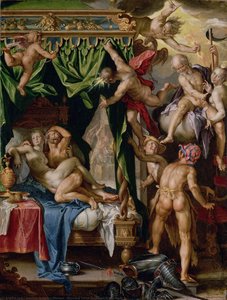
Mars and Venus Surprised by Vulcan

1610 · Oil On Copper · Rijksmuseum, Amsterdam

Mars and Venus Surprised by Vulcan is a mythological painting by Joachim Wtewael. Executed in 1610, the work captures a moment of divine discovery. The scene centers on the theme of mythological adultery, specifically the instant Vulcan interrupts the illicit affair between Mars and Venus.

3
Adoration by the Shepherds (1625) by Joachim Wtewael

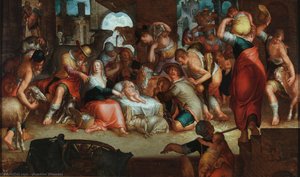
Adoration by the Shepherds

1625 · Oil On Canvas · Museo del Prado, Madrid

The scene unfolds within a courtyard where a group of thirteen figures has assembled around a central infant. This child lies in a manger, the focal point of the composition. Mary and Joseph are positioned near the baby, their bodies oriented toward the center of the event. Surrounding the holy family, several shepherds and onlookers are arranged in various states of standing and leaning. The figures are rendered with a…

4
Adoration of the Shepherds (1622) by Joachim Wtewael

Adoration of the Shepherds

1622 · Oil On Canvas · Kunsthistorisches Museum, Vienna

The Adoration of the Shepherds by Joachim Wtewael brings a sacred moment into sharp, immediate focus. This religious painting emerges from the Netherlands, capturing a scene of profound spiritual presence. Joachim Wtewael, who was born in 1566 in Utrecht, Netherlands, infuses the work with a sense of immediate, lived experience. The figures cluster together in a tight, intimate space, their gazes and gestures pulling the viewer into the center of…

5
St John the Evangelist (1591) by Joachim Wtewael

St John the Evangelist

1591 · Oil

The artwork titled St John the Evangelist is a painting by the artist Joachim Wtewael. This specific work is dated 1591. The subject is depicted in a vertical composition, presented as a close-up portrait that focuses on the figure of the saint.

6
Banquet of the Gods (1602) by Joachim Wtewael

Banquet of the Gods

1602 · Oil On Copper · Centraal Museum, Utrecht

is an oil on copper by Joachim Wtewael. The work measures 15.8 by 20.4 cm. This small-scale painting exemplifies the technical precision required for such a compact medium.

7
The Apulian Shepherd (1603) by Joachim Wtewael

The Apulian Shepherd

1603 · Oil On Copper · Yale University Art Gallery, New Haven

In this oil on copper work from 1603, we find ourselves drawn into a lush, wooded landscape where the boundaries between the pastoral and the mythological blur. A group of nymphs dances in a rhythmic ring around a pond, their movements fluid and sinuous. This circular arrangement creates a sense of continuous motion, pulling the viewer's gaze toward the center of the composition. To the left, a muscular male figure…

8
The Wedding of Peleus and Thetis (1596) by Joachim Wtewael

The Wedding of Peleus and Thetis

1596 · Oil On Panel · Bavarian State Painting Collections, Munich

The Wedding of Peleus and Thetis is a work by Joachim Wtewael. Born in Utrecht, Netherlands, in 1566, the artist remained tied to this city throughout his life until his death in 1638. His hand moved with a precision that mirrored the intricate details of his early training as a glassmaker and engraver. In this specific composition, he captures a moment of celestial gathering, where the air is thick with…

9
Portrait of Steven de Witt (?-1571) (1604) by Joachim Wtewael

Portrait of Steven de Witt (?-1571)

1604 · Engraving · Centraal Museum, Utrecht

The work reflects the disciplined hand of a man trained in the traditions of engraving. There is a porcelain-like polish to the rendering of the skin, even within this monochromatic medium. The composition relies on the tension between the subject's worldly status—signified by the ornate armor—and his spiritual focus. The lines are sharp, defining the shape of the man against the receding, hazy hills. It is a portrait of a…

10
Adoration of the Shepherds (1598) by Joachim Wtewael

Adoration of the Shepherds

1598 · Oil On Canvas · Centraal Museum, Utrecht

In "Adoration of the Shepherds" by Joachim Wtewael, the Nativity unfolds within a crowded, intimate space. Painted about 1598, the work centers on the Christ child, a small figure of light amidst the shadows. This divine presence acts as the anchor for the surrounding figures. Shepherds gather close, their bodies leaning toward the manger in a moment of quiet reverence. The scene is thick with the presence of others, creating…

The Joachim Wtewael selection continues, 11 to 77

11Judith and the Head of Holofernes (1597) by Joachim WtewaelJudith and the Head of Holofernes1597 12The judgement of Paris (1605) by Joachim WtewaelThe judgement of Paris1605 · Staatliche Kunsthalle Karlsruhe 13Mars and Venus Surprised by Vulcan (1601) by Joachim WtewaelMars and Venus Surprised by Vulcan1601 · Mauritshuis Royal Picture Gallery 14Mars, Venus and Cupid (1601) by Joachim WtewaelMars, Venus and Cupid1601 15The Marriage of Peleus and Thetis (1610) by Joachim WtewaelThe Marriage of Peleus and Thetis1610 · Rhode Island School of Design Museum of Art 16judgement of Paris (1614) by Joachim Wtewaeljudgement of Paris1614 · Royal Museum of Fine Arts Antwerp 17Actaeon Watching Diana and Her Nymphs Bathing (1612) by Joachim WtewaelActaeon Watching Diana and Her Nymphs Bathing1612 · Museum of Fine Arts 18John the Baptist Preaching in the Forest (1618) by Joachim WtewaelJohn the Baptist Preaching in the Forest1618 · Statens Museum For Kunst 19Saint Matthew (1616) by Joachim WtewaelSaint Matthew1616 · Walters Art Museum 20Susanna harassed by the Elders (Daniel 13:1-63) (1612) by Joachim WtewaelSusanna harassed by the Elders (Daniel 13:1-63)1612 · Museum Gouda 21The Wedding of Peleus and Thetis (1612) by Joachim WtewaelThe Wedding of Peleus and Thetis1612 22Portrait of Johan Pater, husband of Antonetta Wtewael, daughter of Joachim Wtewael (1626) by Joachim WtewaelPortrait of Johan Pater, husband of Antonetta Wtewael, daughter of Joachim Wtewael1626 · Centraal Museum 23Portrait of Johan Wtewael (1598-1652) (1628) by Joachim WtewaelPortrait of Johan Wtewael (1598-1652)1628 · Centraal Museum 24The Meeting of David and Abigail (1597) by Joachim WtewaelThe Meeting of David and Abigail1597 · Rijksmuseum 25Lot and his daughters (Gen. 19:31-38) (1700) by Joachim WtewaelLot and his daughters (Gen. 19:31-38)1700 · Centraal Museum 26A Shepherd (1623) by Joachim WtewaelA Shepherd1623 · Harvard Art Museums 27A Shepherdess (1623) by Joachim WtewaelA Shepherdess1623 · Harvard Art Museums 28Lot and his Daughters (1600) by Joachim WtewaelLot and his Daughters1600 · Hermitage Museum 29The Judgment of Paris (1615) by Joachim WtewaelThe Judgment of Paris1615 · National Gallery 30The Battle Between the Gods and the Titans (1600) by Joachim WtewaelThe Battle Between the Gods and the Titans1600 · Art Institute of Chicago 31The Golden Age (1605) by Joachim WtewaelThe Golden Age1605 · Metropolitan Museum of Art 32The Golden Age (detail) (1605) by Joachim WtewaelThe Golden Age (detail)1605 · Metropolitan Museum of Art 33The Fruit and Vegetable Seller (1618) by Joachim WtewaelThe Fruit and Vegetable Seller1618 · Centraal Museum 34Portrait of a lady (1605) by Joachim WtewaelPortrait of a lady1605 · Pushkin State Museum 35Mars and Venus Discovered by the Gods (1603) by Joachim WtewaelMars and Venus Discovered by the Gods1603 36Portrait Of The Artist's Wife (1601) by Joachim WtewaelPortrait Of The Artist's Wife1601 · Centraal Museum 37Martyrdom of Saint Sebastian (1600) by Joachim WtewaelMartyrdom of Saint Sebastian1600 · Nelson 38The Judgment of Paris (1605) by Joachim WtewaelThe Judgment of Paris1605 39Cephalus and Procris (The Death of Procris) (1600) by Joachim WtewaelCephalus and Procris (The Death of Procris)1600 · Saint Louis Art Museum 40Mars and Venus Surprised by Vulcan (1601) by Joachim WtewaelMars and Venus Surprised by Vulcan1601 41The Annunciation to the Shepherds (1606) by Joachim WtewaelThe Annunciation to the Shepherds1606 · Rijksmuseum 42The Tribute Money (1616) by Joachim WtewaelThe Tribute Money1616 43The Temptation of Adam and Eve (1614) by Joachim WtewaelThe Temptation of Adam and Eve1614 44Mars and Venus Surprised by Vulcan (1611) by Joachim WtewaelMars and Venus Surprised by Vulcan1611 45The Judgement of Paris (1615) by Joachim WtewaelThe Judgement of Paris1615 46Mars and Venus Surprised by the Gods (1610) by Joachim WtewaelMars and Venus Surprised by the Gods1610 · J. Paul Getty Museum 47Charity (1627) by Joachim WtewaelCharity1627 48A Kitchenmaid (1625) by Joachim WtewaelA Kitchenmaid1625 · Centraal Museum 49Moses Striking the Rock (1624) by Joachim WtewaelMoses Striking the Rock1624 50Moses Striking the Rock (1624) by Joachim WtewaelMoses Striking the Rock1624 · National Gallery 51Portrait of Eva Wtewael (1628) by Joachim WtewaelPortrait of Eva Wtewael1628 · Centraal Museum 52Peter Wtewael (1628) by Joachim WtewaelPeter Wtewael1628 · Centraal Museum 53The Adoration of the Shepherds (1606) by Joachim WtewaelThe Adoration of the Shepherds1606 · The Ashmolean Museum of Art And Archaeology 54JUPITER ET DANAE by Joachim WtewaelJUPITER ET DANAEThe Louvre 55The Judgement of Paris by Joachim WtewaelThe Judgement of ParisFitzwilliam Museum 56Diana and Actaeon by Joachim WtewaelDiana and Actaeon 57Bacchus by Joachim WtewaelBacchus 58Antonetta Wtewael by Joachim WtewaelAntonetta WtewaelCentraal Museum 59LA RESURRECTION DE LAZARE by Joachim WtewaelLA RESURRECTION DE LAZAREPalais des Beaux-Arts de Lille 60Venus and Cupid by Joachim WtewaelVenus and Cupid 61Persée secourant Andromède by Joachim WtewaelPersée secourant AndromèdeThe Louvre 62Lot and his Daughters (1600) by Joachim WtewaelLot and his Daughters1600 · Gemäldegalerie 63The Golden Age (1605) by Joachim WtewaelThe Golden Age1605 · Metropolitan Museum of Art 64Self portrait (1601) by Joachim WtewaelSelf portrait1601 · Centraal Museum 65Charity (1627) by Joachim WtewaelCharity1627 66Kitchen Scene (1605) by Joachim WtewaelKitchen Scene1605 · Gemäldegalerie 67Supper at Emmaus by Joachim WtewaelSupper at Emmaus 68Adoration of the Shepherds (detail) by Joachim WtewaelAdoration of the Shepherds (detail) 69Aphrodite Ares and Eros Sun by Joachim WtewaelAphrodite Ares and Eros Sun 70Adoration by the Shepherds by Joachim WtewaelAdoration by the Shepherds 71Bacchus between Ceres and Venus by Joachim WtewaelBacchus between Ceres and Venus 72Diana by Joachim WtewaelDiana 73Danaë by Joachim WtewaelDanaëStaatliche Graphische Sammlung 74Adam and Eve by Joachim WtewaelAdam and Eve 75The Raising of Lazarus by Joachim WtewaelThe Raising of Lazarus 76Lot and His Daughters by Joachim WtewaelLot and His Daughters 77Perseus and Andromeda (1611) by Joachim WtewaelPerseus and Andromeda1611 · The Louvre

Joachim Wtewael's famous paintings, period by period

The subjects that held Joachim Wtewael's eye

The four subjects that come back most often in these originals, each with its finest example.

The museums that keep Joachim Wtewael's originals

The 8 museums that hold the most of the paintings on this page.

Museum City Works by Joachim Wtewael Paintings from this list
Centraal Museum, UtrechtCentraal Museum Utrecht 13 Banquet of the Gods, Portrait of Steven de Witt (?-1571), Adoration of the Shepherds
Rijksmuseum, AmsterdamRijksmuseum Amsterdam 3 Mars and Venus Surprised by Vulcan, The Meeting of David and Abigail, The Annunciation to the Shepherds
Metropolitan Museum of Art, New YorkMetropolitan Museum of Art New York 3 The Golden Age, The Golden Age (detail), The Golden Age
The Louvre, ParisThe Louvre Paris 3 JUPITER ET DANAE, Persée secourant Andromède, Perseus and Andromeda
Kunsthistorisches Museum, ViennaKunsthistorisches Museum Vienna 2 Actaeon is changed into a stag and killed by his own dogs, Adoration of the Shepherds
Harvard Art Museums, CambridgeHarvard Art Museums Cambridge 2 A Shepherd, A Shepherdess
National Gallery, LondonNational Gallery London 2 The Judgment of Paris, Moses Striking the Rock
Gemäldegalerie, BerlinGemäldegalerie Berlin 2 Lot and his Daughters, Kitchen Scene

Joachim Wtewael decade by decade: the original that defines each

Works per decade

Pick a decade to see the original that defines it.

Collectors' questions about Joachim Wtewael's paintings

Which work is Joachim Wtewael most famous for?Reveal the answer

Actaeon is changed into a stag and killed by his own dogs (1607), Kunsthistorisches Museum, Vienna. Mars and Venus Surprised by Vulcan (1610) and Adoration by the Shepherds (1625) come next.

What age was Joachim Wtewael when Actaeon is changed into a stag and killed by his own dogs was made?Reveal the answer

41 years old: Actaeon is changed into a stag and killed by his own dogs dates from 1607, and Joachim Wtewael was born in 1566.

What are the ten most famous Joachim Wtewael paintings?Reveal the answer

Actaeon is changed into a stag and killed by his own dogs, Mars and Venus Surprised by Vulcan, Adoration by the Shepherds, Adoration of the Shepherds, St John the Evangelist, Banquet of the Gods, The Apulian Shepherd, The Wedding of Peleus and Thetis, Portrait of Steven de Witt (?-1571) and Adoration of the Shepherds. The ranking above gives each one's year and museum.

How many paintings did Joachim Wtewael leave?Reveal the answer

Our catalog holds 82 works by Joachim Wtewael, dated from 1591 to 1628.

In which museums do Joachim Wtewael's masterpieces hang?Reveal the answer

Mostly in Centraal Museum (Utrecht), Rijksmuseum (Amsterdam) and Metropolitan Museum of Art (New York). The museum table above lists them all.

In which years did Joachim Wtewael paint the most famous works?Reveal the answer

In 1600s: 24 of the 77 works on this page were made then, Actaeon is changed into a stag and killed by his own dogs among them.

What are the first and the last famous originals of Joachim Wtewael?Reveal the answer

On this page, the earliest is St John the Evangelist (1591) and the latest Portrait of Johan Wtewael (1598-1652) (1628).

Which subjects did Joachim Wtewael choose most often?Reveal the answer

Man (11), Mythology (11) and Gods (10), across the 77 works on this page.

Which technique did Joachim Wtewael use most?Reveal the answer

Oil On Canvas, for 13 of the 77 works on this page.

To which art movement does Joachim Wtewael belong?Reveal the answer

Northern renaissance and Mannerism, judging by the originals on this page.

Which Joachim Wtewael works hang at the Centraal Museum?Reveal the answer

Banquet of the Gods, Portrait of Steven de Witt (?-1571) and Adoration of the Shepherds: the Centraal Museum, Utrecht holds 13 of the works on this page.

Joachim Wtewael: life and work

The Enduring Polish of a Mannerist Master

Joachim Anthonisz Wtewael, a name whispered among connoisseurs of the Dutch Golden Age, remains a captivating figure whose art defies easy categorization. Born in 1566 and passing away in 1638, his life was as multifaceted as his canvases. While his artistic genius shone brightly, it is equally notable that he was also a successful flax merchant and an active town councillor of Utrecht. This dual existence—the meticulous artisan alongside the pillar of civic society—suggests a man whose life demanded both worldly acumen and profound creative focus. Wtewael’s signature style, however, possessed a remarkable consistency; it remained largely untouched by the sweeping naturalistic currents that were reshaping art across Europe during his lifetime.

A Journey Through Style and Influence

Wtewael's early training rooted him deeply in the sophisticated vocabulary of late 16th-century Haarlem Mannerism. His initial professional life saw him working as a glassmaker and engraver within his father’s workshop, an apprenticeship that undoubtedly honed his hand for intricate detail. A pivotal period arrived when he embarked on travels through Italy and France starting in 1586. These sojourns were crucial, exposing him to the rich artistic currents of the Second School of Fontainebleau. Yet, despite these influences, Wtewael possessed a unique internal compass. His work is characterized by figures that are masterfully drawn, possessing an almost porcelain-like polish, often arranged in poses that feel wonderfully capricious and dramatically charged.

Thematic Depth: Myth Meets Devotion

The body of his surviving work—comprising around one hundred paintings, alongside numerous drawings and stained glass designs—reveals a fascinating thematic duality. He was equally at home depicting profound religious narratives as he was celebrating the lush drama of classical mythology. Consider works such as Adoration of the Shepherds juxtaposed with Venus and Mars Surprised by Vulcan. These pieces showcase his remarkable ability to weave together conventional sacred subjects with pagan lore, often imbuing both realms with a palpable, sometimes strong erotic undercurrent that draws the viewer into its narrative embrace. His attention to detail is breathtaking; in works like Perseus and Andromeda, housed notably at the Mauritshuis museum in Utrecht, one can trace his unparalleled skill.

Historical Significance and Legacy

What makes Wtewael’s contribution so significant is precisely that resistance to change. While naturalism beckoned artists toward greater realism, Wtewael held fast to a polished, idealized aesthetic, creating a body of work that feels both historically situated and eternally vibrant. His cabinet paintings, executed on copper plates, are particularly distinctive and numerous, offering intimate glimpses into his artistic process. Though the final decade of his life saw him retreat from painting—a period possibly marked by personal sorrow following the passing of his wife—the impact of his vision endures. He gifted art history a style that remains both highly polished and wonderfully unpredictable.