Portrait of Jacob van Ruisdael

Jacob van Ruisdael Paintings: The 100 Most Famous, Through a Gallery's Eye

Updated November 2026 · ranked by our popularity score (searches, visits and orders for each work) · 530 works by Jacob van Ruisdael in our catalogue

In short

To the gallery's eye, Jacob van Ruisdael's most famous painting is The Windmill at Wijk bij Duurstede, whose original hangs in the Rijksmuseum, Amsterdam. The Large Forest and The Windmill at Wijk bij Duurstede (detail) (1670) complete the trio every eye recognises. Of the 530 works by Jacob van Ruisdael in our catalog, the gallery presents the 100 most famous below, each original with its year, its museum and what makes it unique.

1628 – 1682, Haarlem Dutch golden age Most works: National Gallery

The gallery's top 10 Jacob van Ruisdael paintings

1
The Windmill at Wijk bij Duurstede by Jacob van Ruisdael

The Windmill at Wijk bij Duurstede

Oil On Canvas · Rijksmuseum, Amsterdam

The Windmill at Wijk bij Duurstede is an oil on canvas painted by Jacob van Ruisdael. This work emerged in 1670, a period when the Dutch Golden Age was defining the visual language of the Netherlands. The artist, born in Haarlem, captured a specific slice of the Dutch landscape through a lens of quiet intensity.

2
The Large Forest by Jacob van Ruisdael

The Large Forest

Oil On Canvas · Kunsthistorisches Museum, Vienna

Captivating Natural Majesty Immerse yourself in the tranquil beauty of this expansive forest scene, where nature’s grandeur is captured with meticulous detail and a realistic approach. The composition centers around a majestic, mature tree with sprawling branches, inviting viewers to explore the depth and serenity of the woodland environment. The scene evokes a sense of peaceful solitude, highlighting the untouched splendor of nature and inspiring a contemplative mood. The artist’s…

3
The Windmill at Wijk bij Duurstede (detail) (1670) by Jacob van Ruisdael

The Windmill at Wijk bij Duurstede (detail)

1670 · Oil On Canvas · Rijksmuseum, Amsterdam

Jacob Isaackszoon van Ruysdael’s “The Windmill at Wijk bij Duurstede” isn't merely a depiction of a rural scene; it’s a profound meditation on light, space, and the enduring spirit of the Netherlands. Painted around 1670 during the height of the Dutch Golden Age, this iconic work transcends its subject matter to become a timeless emblem of tranquility, industry, and the subtle beauty of the natural world. It's a painting that…

4
Two Watermills and an Open Sluice near Singraven (1650) by Jacob van Ruisdael

Two Watermills and an Open Sluice near Singraven

1650 · Oil On Canvas · National Gallery, London

In the heart of the seventeenth century, during the zenith of the Dutch Golden Age, Jacob van Ruisdael captured a moment of profound tranquility and industrious grace in his seminal work, “Two Watermills and an Open Sluice near Singraven.” This painting is far more than a mere topographical record of the Netherlands; it is a poetic meditation on the harmony between human endeavor and the untamed rhythms of nature. As…

5
Landscape with a Village in the Distance (1646) by Jacob van Ruisdael

Landscape with a Village in the Distance

1646 · Oil On Canvas · Metropolitan Museum of Art, New York

To gaze upon Jacob Isaackszoon van Ruisdael's "Landscape with a Village in the Distance" is to step directly into the heart of the Dutch Golden Age. This painting, executed in 1646, is more than just a depiction of rolling hills and distant structures; it is a profound meditation on nature’s enduring tranquility set against the backdrop of burgeoning human civilization. Van Ruisdael, the pre-eminent landscape painter of his era, possessed…

6
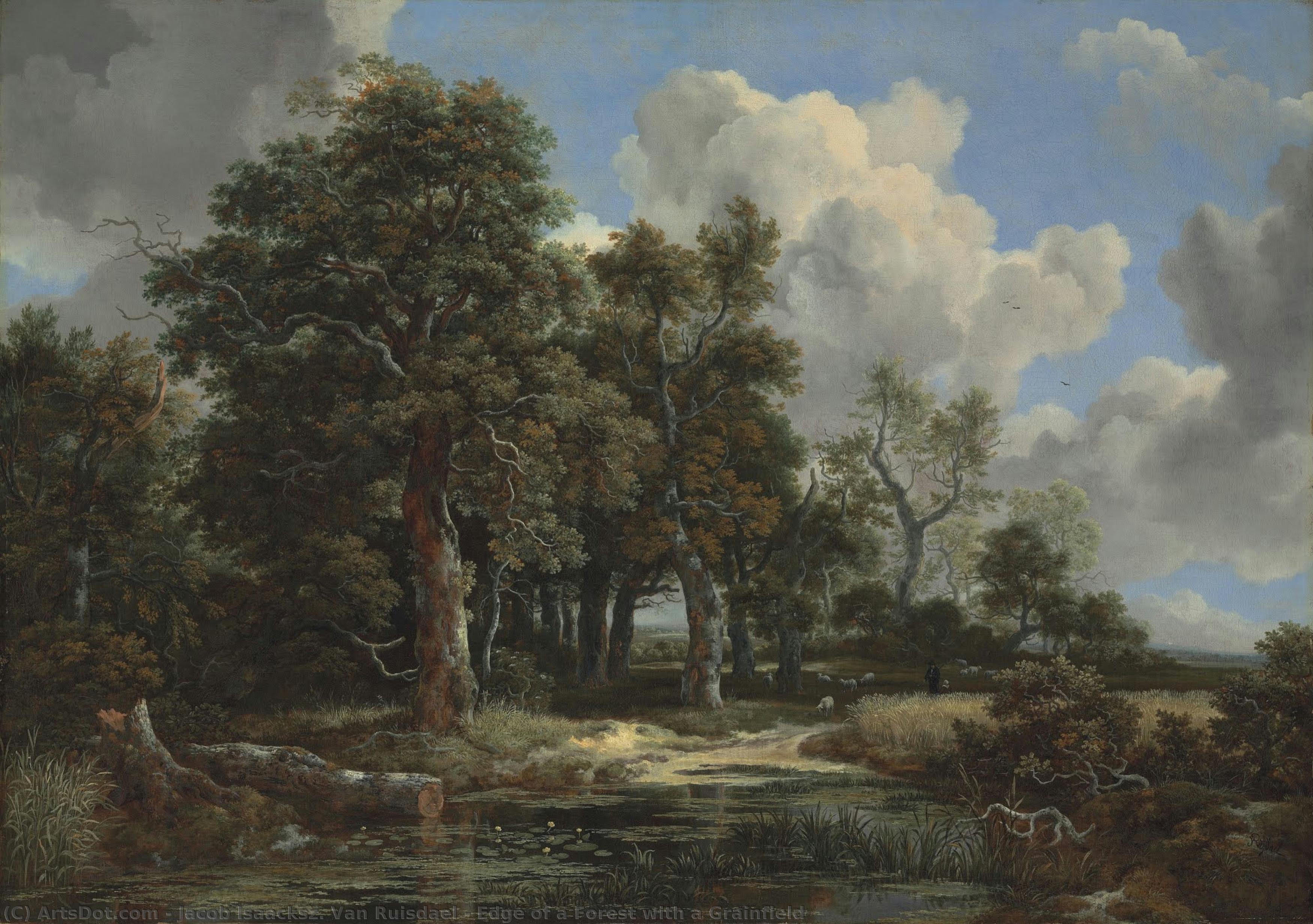
Edge of a Forest with a Grainfield (1656) by Jacob van Ruisdael

Edge of a Forest with a Grainfield

1656 · Oil On Canvas · Kimbell Art Museum, Fort Worth

A Symphony of Light and Shadow: Exploring Jacob van Ruisdael’s “Edge of a Forest with a Grainfield” Jacob van Ruisdael's "Edge of a Forest with a Grainfield," painted around 1656, isn’t merely a landscape; it’s an immersive experience. Born in Haarlem and flourishing during the Dutch Golden Age, Ruisdael possessed a singular ability to capture not just the visual appearance of nature, but its very essence – its quiet power,…

7
Beach View (1675) by Jacob van Ruisdael

Beach View

1675 · Oil On Canvas · Mauritshuis, The Hague

Jacob Isaackszoon van Ruisdael produced Beach View about 1675. This oil on canvas work is categorized as marine art, focusing on a coastal landscape. The composition centers on a beach scene where the shoreline meets the sea under an overcast sky.

8
Landscape with a Farm House and Windmill (1680) by Jacob van Ruisdael

Landscape with a Farm House and Windmill

1680 · Oil On Canvas · Detroit Institute of Arts, Detroit

The sky occupies the majority of the canvas, a vast vault of white, gray, and soft blue. Voluminous clouds, rendered with thick, impasto-like textures, suggest a weather pattern in constant flux. Below this heavy atmosphere, a windmill rises with vertical strength, its white sails cutting sharp, diagonal lines against the shifting light. The farmhouse sits low to the earth, its reddish-brown roof providing a grounded contrast to the airy expanse…

9
View of Haarlem with Bleaching Grounds (1675) by Jacob van Ruisdael

View of Haarlem with Bleaching Grounds

1675 · Oil On Canvas · Mauritshuis, The Hague

To gaze upon Van Ruisdael's View of Haarlem with Bleaching Grounds is to step directly into the heart of the Dutch Golden Age, a time when the very land itself became a subject worthy of profound artistic contemplation. This painting is far more than a mere depiction of a town and its surrounding fields; it is an atmospheric meditation on light, industry, and the enduring relationship between humanity and nature.…

10
A Landscape with a Ruined Building (1655) by Jacob van Ruisdael

A Landscape with a Ruined Building

1655 · National Gallery, London

In this oil on wood composition from approximately 1655, we find ourselves standing before a scene of profound quietude and slow decay. The landscape is dominated by a sense of melancholy, where the natural world has begun to reclaim what was once built by human hands. On the left, a ruined, roofless nave—likely once a church—sits nestled at the foot of a hill. Its stone walls are broken, and gravestones…

Jacob van Ruisdael paintings, ranked 11 to 100

11Landscape with Shepherds and Peasants (1660) by Jacob van RuisdaelLandscape with Shepherds and Peasants1660 · Galleria degli Uffizi 12The Cloister (1650) by Jacob van RuisdaelThe Cloister1650 · Gemäldegalerie 13A Waterfall (1670) by Jacob van RuisdaelA Waterfall1670 · Dulwich Picture Gallery 14Rocky landscape (1660) by Jacob van RuisdaelRocky landscape1660 · Rijksmuseum 15The Forest Stream (1660) by Jacob van RuisdaelThe Forest Stream1660 · Metropolitan Museum of Art 16Glade in a Wood (1646) by Jacob van RuisdaelGlade in a Wood1646 · Academy of Fine Arts Vienna 17Norwegian Landscape with Waterfall (1650) by Jacob van RuisdaelNorwegian Landscape with Waterfall1650 · Residenzgalerie 18Winter Landscape (1670) by Jacob van RuisdaelWinter Landscape1670 · Rijksmuseum 19Landscape with a Waterfall (1660) by Jacob van RuisdaelLandscape with a Waterfall1660 · Philadelphia Museum of Art 20Landscape with Ruined Castle and Church (1670) by Jacob van RuisdaelLandscape with Ruined Castle and Church1670 · National Gallery 21The Jewish Cemetery (detail) by Jacob van RuisdaelThe Jewish Cemetery (detail)Detroit Institute of Arts 22Castle on a Mountain with a Waterfall and Pine trees (1660) by Jacob van RuisdaelCastle on a Mountain with a Waterfall and Pine trees1660 · Museum of Fine Arts of Lyon 23The Jewish Cemetery1 by Jacob van RuisdaelThe Jewish Cemetery1 24Landscape with Church and Village (1665) by Jacob van RuisdaelLandscape with Church and Village1665 · Alte Pinakothek 25Marine, oil on wood, Metropolitan Museum of A (1650) by Jacob van RuisdaelMarine, oil on wood, Metropolitan Museum of A1650 26Wheat Fields (1670) by Jacob van RuisdaelWheat Fields1670 · Metropolitan Museum of Art 27Waterfall in a Rocky and Mountainous Landscape by Jacob van RuisdaelWaterfall in a Rocky and Mountainous LandscapeMuseum of Fine Arts 28The Windmill at Wijk bij Duurstede (1670) by Jacob van RuisdaelThe Windmill at Wijk bij Duurstede1670 · Rijksmuseum 29Storm on the Dunes (1648) by Jacob van RuisdaelStorm on the Dunes1648 · Philadelphia Museum of Art 30Sloping Field (1660) by Jacob van RuisdaelSloping Field1660 · Philadelphia Museum of Art 31Ford in Wooded Landscape (1655) by Jacob van RuisdaelFord in Wooded Landscape1655 · Calouste Gulbenkian Foundation 32Hilly wooded landscape with a half-timbered house by a water fall (1655) by Jacob van RuisdaelHilly wooded landscape with a half-timbered house by a water fall1655 · Städel Museum 33Landscape with a Hunting Scene (1670) by Jacob van RuisdaelLandscape with a Hunting Scene1670 · Statens Museum For Kunst 34A Pool surrounded by Trees (1665) by Jacob van RuisdaelA Pool surrounded by Trees1665 · National Gallery 35Landscape with Waterfall1 by Jacob van RuisdaelLandscape with Waterfall1 36View of a Forest (1647) by Jacob van RuisdaelView of a Forest1647 · Museum Boijmans Van Beuningen 37Landscape with Waterfall (St. Louis) (1665) by Jacob van RuisdaelLandscape with Waterfall (St. Louis)1665 · Saint Louis Art Museum 38Landscape with a Waterfall and a Hut (1660) by Jacob van RuisdaelLandscape with a Waterfall and a Hut1660 · Statens Museum For Kunst 39Road through a Grove (1660) by Jacob van RuisdaelRoad through a Grove1660 · Nationalmuseum 40A Rocky Hill with Three Cottages, a Stream at its Foot (1655) by Jacob van RuisdaelA Rocky Hill with Three Cottages, a Stream at its Foot1655 · National Gallery 41Small Woodland Landscape (1660) by Jacob van RuisdaelSmall Woodland Landscape1660 · Kunsthistorisches Museum 42The Dam Square in Amsterdam (detail) (1670) by Jacob van RuisdaelThe Dam Square in Amsterdam (detail)1670 · Staatliche Museen zu Berlin 43Landscape with Dunes (1649) by Jacob van RuisdaelLandscape with Dunes1649 · Los Angeles County Museum of Art 44Ruins of Brederode (1655) by Jacob van RuisdaelRuins of Brederode1655 · Philadelphia Museum of Art 45Ruins in a Dune Landscape (1652) by Jacob van RuisdaelRuins in a Dune Landscape1652 · National Gallery 46Mountain Landscape with Waterfall (1670) by Jacob van RuisdaelMountain Landscape with Waterfall1670 · Kunsthistorisches Museum 47Village in Winter by Moonlight by Jacob van RuisdaelVillage in Winter by MoonlightStaatsgalerie Stuttgart 48Landscape with Waterfall (1665) by Jacob van RuisdaelLandscape with Waterfall1665 · Baltimore Museum of Art 49A Road leading into a Wood (1657) by Jacob van RuisdaelA Road leading into a Wood1657 · National Gallery 50Sandy Road between Trees (1662) by Jacob van RuisdaelSandy Road between Trees1662 · Museum Boijmans Van Beuningen 51Landscape of a Forest with a Wooden Bridge (1670) by Jacob van RuisdaelLandscape of a Forest with a Wooden Bridge1670 · Philadelphia Museum of Art 52Wild Duck Shooting (1655) by Jacob van RuisdaelWild Duck Shooting1655 · Wallace Collection 53Landscape with river and cellar entrance (1649) by Jacob van RuisdaelLandscape with river and cellar entrance1649 · Kunsthistorisches Museum 54Dunes (1650) by Jacob van RuisdaelDunes1650 · Philadelphia Museum of Art 55A road through a wood (1660) by Jacob van RuisdaelA road through a wood1660 · Staatliche Kunstsammlungen Dresden 56Winter Landscape with a Dead Tree (1670) by Jacob van RuisdaelWinter Landscape with a Dead Tree1670 · Hermitage Museum 57Landscape with a Waterfall (1655) by Jacob van RuisdaelLandscape with a Waterfall1655 · Ashmolean Museum 58The Old Oak (1648) by Jacob van RuisdaelThe Old Oak1648 · Musée Cognacq-Jay 59Dune Landscape with Fence, ca. 1647 (1647) by Jacob van RuisdaelDune Landscape with Fence, ca. 16471647 · Städel Museum 60The Watermill at the Edge of the Wood (1650) by Jacob van RuisdaelThe Watermill at the Edge of the Wood1650 · Toledo Museum of Art 61Forest scene (1653) by Jacob van RuisdaelForest scene1653 · Rijksmuseum 62A waterfall with a wooden bridge (1670) by Jacob van RuisdaelA waterfall with a wooden bridge1670 · Staatliche Kunstsammlungen Dresden 63Landscape with Tall Trees (1670) by Jacob van RuisdaelLandscape with Tall Trees1670 · Hamburger Kunsthalle 64Landscape with Mountain Stream (1670) by Jacob van RuisdaelLandscape with Mountain Stream1670 · Kunsthistorisches Museum 65A Cottage and a Hayrick by a River by Jacob van RuisdaelA Cottage and a Hayrick by a RiverNational Gallery 66Wooded Landscape (1660) by Jacob van RuisdaelWooded Landscape1660 · Museum Boijmans Van Beuningen 67A Mountain Landscape with a Chapel (1655) by Jacob van RuisdaelA Mountain Landscape with a Chapel1655 · Hamburger Kunsthalle 68Rocky Landscape (1650) by Jacob van RuisdaelRocky Landscape1650 · Wallace Collection 69Ideal Landscape (1655) by Jacob van RuisdaelIdeal Landscape1655 · Bavarian State Painting Collections 70Landscape with a Church by a Torrent (1670) by Jacob van RuisdaelLandscape with a Church by a Torrent1670 · Cleveland Museum of Art 71Winter Landscape with Houses and Frozen Canal (1670) by Jacob van RuisdaelWinter Landscape with Houses and Frozen Canal1670 · Hamburger Kunsthalle 72Winter landscape with a harbour (1660) by Jacob van RuisdaelWinter landscape with a harbour1660 · Mauritshuis 73Landscape, ca. 1646 (1646) by Jacob van RuisdaelLandscape, ca. 16461646 · Detroit Institute of Arts 74A hill with an oak wood and a little waterfall (1654) by Jacob van RuisdaelA hill with an oak wood and a little waterfall1654 · Staatliche Kunstsammlungen Dresden 75Wooded mountainous landscape with fishermen and resting travellers near a waterfall (1660) by Jacob van RuisdaelWooded mountainous landscape with fishermen and resting travellers near a waterfall1660 · Museum de Lakenhal 76Rough Sea at a Jetty (1650) by Jacob van RuisdaelRough Sea at a Jetty1650 · Kimbell Art Museum 77Wooded Landscape with a Stream (1670) by Jacob van RuisdaelWooded Landscape with a Stream1670 · Detroit Institute of Arts 78Landscape with dead tree and an oncoming storm (1649) by Jacob van RuisdaelLandscape with dead tree and an oncoming storm1649 · Musée Fabre 79Stormy Sea (1650) by Jacob van RuisdaelStormy Sea1650 · Nationalmuseum 80View Of Ootmarsum by Jacob van RuisdaelView Of Ootmarsum 81Hilly Landscape by Jacob van RuisdaelHilly Landscape 82The Waterfall (1665) by Jacob van RuisdaelThe Waterfall1665 · Staatliche Museen 83Farm and Hayrick on a River (1640) by Jacob van RuisdaelFarm and Hayrick on a River1640 · Detroit Institute of Arts 84Forest Path with People Strolling (1646) by Jacob van RuisdaelForest Path with People Strolling1646 · Städel Museum 85Landscape with a Blasted Tree near a House (1645) by Jacob van RuisdaelLandscape with a Blasted Tree near a House1645 · Fitzwilliam Museum 86A hunter in a wooded landscape (1640) by Jacob van RuisdaelA hunter in a wooded landscape1640 87Road in the Dunes (1648) by Jacob van RuisdaelRoad in the Dunes1648 · Frans Hals Museum 88Wooded Dune Landscape (1648) by Jacob van RuisdaelWooded Dune Landscape1648 89A Landscape with Two Figures on a Rise and a Stream at Right (1647) by Jacob van RuisdaelA Landscape with Two Figures on a Rise and a Stream at Right1647 90A Wooded Landscape with a Pond (1648) by Jacob van RuisdaelA Wooded Landscape with a Pond1648 · Museum of Fine Arts 91Landscape with a Cottage and a Windmill (1646) by Jacob van RuisdaelLandscape with a Cottage and a Windmill1646 92Dune landscape with a man and a boy walking towards a town (1647) by Jacob van RuisdaelDune landscape with a man and a boy walking towards a town1647 · Pushkin State Museum 93Dune Landscape near Haarlem (1647) by Jacob van RuisdaelDune Landscape near Haarlem1647 94Stone Bridge (1648) by Jacob van RuisdaelStone Bridge1648 · Philadelphia Museum of Art 95Sandbank (1647) by Jacob van RuisdaelSandbank1647 · Nivaagaards Malerisamling 96Blasted Oak near a Pond (1647) by Jacob van RuisdaelBlasted Oak near a Pond1647 · Szépművészeti Múzeum 97Cabin under high oaks (1643) by Jacob van RuisdaelCabin under high oaks1643 · Gemäldegalerie 98Oaks at a lake with Water Lilies (1652) by Jacob van RuisdaelOaks at a lake with Water Lilies1652 · Gemäldegalerie 99Landscape by a Lake (1650) by Jacob van RuisdaelLandscape by a Lake1650 · Bratislava City Gallery 100Mountain Stream (1655) by Jacob van RuisdaelMountain Stream1655 · Bavarian State Painting Collections

Jacob van Ruisdael's famous paintings, period by period

The subjects that held Jacob van Ruisdael's eye

The four subjects that come back most often in these originals, each with its finest example.

The museums that keep Jacob van Ruisdael's originals

The 8 museums that hold the most of the paintings on this page.

Museum City Works by Jacob van Ruisdael Paintings from this list
National Gallery, LondonNational Gallery London 22 Two Watermills and an Open Sluice near Singraven, A Landscape with a Ruined Building, Landscape with Ruined Castle and Church
Philadelphia Museum of Art, PhiladelphiaPhiladelphia Museum of Art Philadelphia 10 Landscape with a Waterfall, Storm on the Dunes, Sloping Field
Rijksmuseum, AmsterdamRijksmuseum Amsterdam 17 The Windmill at Wijk bij Duurstede, The Windmill at Wijk bij Duurstede (detail), Rocky landscape
Detroit Institute of Arts, DetroitDetroit Institute of Arts Detroit 8 Landscape with a Farm House and Windmill, The Jewish Cemetery (detail), Landscape, ca. 1646
Kunsthistorisches Museum, ViennaKunsthistorisches Museum Vienna 5 The Large Forest, Small Woodland Landscape, Mountain Landscape with Waterfall
Museum Boijmans Van Beuningen, RotterdamMuseum Boijmans Van Beuningen Rotterdam 11 View of a Forest, Sandy Road between Trees, Wooded Landscape
Staatliche Kunstsammlungen Dresden, DresdenStaatliche Kunstsammlungen Dresden Dresden 8 A road through a wood, A waterfall with a wooden bridge, A hill with an oak wood and a little waterfall
Mauritshuis, The HagueMauritshuis The Hague 7 Beach View, View of Haarlem with Bleaching Grounds, Winter landscape with a harbour

Jacob van Ruisdael, one signature painting per decade

Works per decade

Pick a decade to see the original that defines it.

Jacob van Ruisdael's paintings: the gallery answers

Which Jacob van Ruisdael painting is the most famous of all?Reveal the answer

The Windmill at Wijk bij Duurstede, Rijksmuseum, Amsterdam. The Large Forest and The Windmill at Wijk bij Duurstede (detail) (1670) come next.

Which are Jacob van Ruisdael's top 10 paintings?Reveal the answer

The Windmill at Wijk bij Duurstede, The Large Forest, The Windmill at Wijk bij Duurstede (detail), Two Watermills and an Open Sluice near Singraven, Landscape with a Village in the Distance, Edge of a Forest with a Grainfield, Beach View, Landscape with a Farm House and Windmill, View of Haarlem with Bleaching Grounds and A Landscape with a Ruined Building. The ranking above gives each one's year and museum.

How many works did Jacob van Ruisdael create?Reveal the answer

Our catalog holds 530 works by Jacob van Ruisdael, dated from 1640 to 1680.

Where do Jacob van Ruisdael's most famous originals hang?Reveal the answer

Mostly in National Gallery (London), Philadelphia Museum of Art (Philadelphia) and Rijksmuseum (Amsterdam). The museum table above lists them all.

When did Jacob van Ruisdael create the most famous paintings?Reveal the answer

In 1650s: 26 of the 100 works on this page were made then, Two Watermills and an Open Sluice near Singraven among them.

Which are Jacob van Ruisdael's earliest and latest famous works?Reveal the answer

On this page, the earliest is Farm and Hayrick on a River (1640) and the latest Landscape with a Farm House and Windmill (1680).

Which subjects did Jacob van Ruisdael return to most?Reveal the answer

Sky (51), Clouds (45) and Trees (42), across the 100 works on this page.

Which medium did Jacob van Ruisdael work in most?Reveal the answer

Oil On Canvas, for 63 of the 100 works on this page.

Which movement is Jacob van Ruisdael associated with?Reveal the answer

Dutch golden age, judging by the originals on this page.

Which Jacob van Ruisdael originals does the National Gallery hold?Reveal the answer

Two Watermills and an Open Sluice near Singraven, A Landscape with a Ruined Building and Landscape with Ruined Castle and Church: the National Gallery, London holds 8 of the works on this page.

Jacob van Ruisdael: the artist

Early Life, Family and Training

Born in Haarlem, Netherlands, in 1628, Jacob Isaackszoon Van Ruisdael entered a world where art was a family trade. He was the son of Isaack van Ruisdael and Maycken Cornelisdochter, growing up within a lineage of skilled makers. His grandfather, Jacob de Goyer, worked as a furniture maker, establishing a domestic environment defined by craftsmanship and technical precision. This heritage of making provided the foundation for a life dedicated to the visual arts.

The trajectory of his development was likely shaped by those closest to him. He was the nephew of Salomon van Ruysdael, a prominent landscape artist of the era. It is widely believed that Jacob Isaackszoon Van Ruisdael received his formal training under the guidance of his uncle, absorbing the nuances of the Dutch landscape through direct apprenticeship. This familial connection offered more than just instruction; it provided a direct link to the established traditions of the Haarlem school.

By 1648, his professional standing was formalized when he became a member of the Haarlem painters' guild. This membership marked his transition from a student of his family's craft to a recognized practitioner in his own right. His early years were spent establishing a presence in this competitive artistic hub, preparing for the broader career that would eventually lead him away from his birthplace.

Life and Career in Amsterdam

The transition from the quietude of Haarlem to the bustling commerce of Amsterdam marked a definitive shift in Ruisdael's life. He moved to the city around 1656 or 1657, seeking the broader markets offered by the Dutch Republic's commercial heart. This period of relocation was accompanied by personal milestones, including his baptism on 17 June 1657 in Ankeveen, near Naarden. Once settled, he remained in Amsterdam for the rest of his life, establishing himself within the urban landscape he would so frequently document.

His professional life in the city was characterized by a steady output of diverse subjects, ranging from expansive cityscapes to the intricate details of the Damrak. As he matured, his interests appeared to expand beyond the canvas. In his later years, he is said to have practiced as a physician, a pursuit that suggests a life of intellectual variety alongside his visual observations. This dual existence in the city reflects the multifaceted nature of a man deeply embedded in the social and professional fabric of the Dutch Golden Age.

Technique and Artistic Style

Ruisdael’s approach to the canvas was defined by a restless versatility. He did not settle into a single mode, instead producing a prolific body of work that shifted from quiet countryside scenes to more heroic, expansive landscapes. His technical precision relied heavily on the layering of thin glazes of oil paint. This method allowed him to achieve subtle gradations of color and tone, building a sense of depth that felt lived-in rather than merely painted. Through this patient application, he mastered atmospheric perspective, using the hazy quality of the air to push distant hills and forests into a soft, silvery recession.

The mood of his work often carried a weight that transcended simple topography. He possessed a particular ability to instill a poetic, sometimes brooding or tragic quality into his compositions. This was achieved through a masterful command of light and shadow. Rather than relying on harsh, jarring contrasts, he used light to shape the emotional temperature of a scene. His compositions were often dramatic, utilizing the vastness of the sky to dwarf the terrestrial elements below. In many of his later works, the sky occupies a significant portion of the frame, acting as a primary driver of the work's internal tension and atmosphere.

Notable and Key Works

The early output of his career reveals a painter already deeply engaged with the textures of the Dutch countryside. In 1646, he produced Glade in a Wood and Landscape with a Village in the Distance, works that established his ability to organize natural elements into coherent, atmospheric scenes. By 1649, his focus shifted toward the specific topography of his home region, as seen in The Thicket (Path in the Haarlem Dunes). These early years were marked by a growing command over the interplay of light and shadow within dense foliage and open vistas.

As his technical proficiency matured, his subject matter expanded to include more dramatic and varied environments. The year 1650 proved particularly prolific, yielding works such as The Cloister and the more turbulent Rough Sea at a Jetty. During this period, he also explored the intersection of human industry and nature in Two Watermills and an Open Sluice near Singraven, and captured the quiet solitude of the landscape in Landscape with a Traveller. These compositions demonstrate a sophisticated understanding of scale and the way light defines a specific moment in time.

His later compositions often emphasized the structural beauty of the natural world. In 1656, Edge of a Forest with a Grainfield showcased his skill in balancing the heavy presence of woodland with the openness of agricultural land. His ability to render these shifting perspectives helped define the visual language of the Dutch Golden Age.

Legacy and Influence

The reach of Ruisdael’s vision extended far beyond the borders of the Netherlands, reaching into the very foundations of later landscape traditions. He was a Romantic before Romanticism, imbuing the natural world with a sense of moral weight and a brooding, poetic mood that anticipated the emotional intensity of later centuries. This ability to infuse a scene with a specific psychological atmosphere allowed his work to resonate with movements long after his death. His influence helped shape the English Romantics and the Barbizon school in France, and his impact crossed the Atlantic to inform the Hudson River school in the United States.

Within his own country, he inspired generations of Dutch landscape artists, setting a standard for how the countryside could be interpreted through light and shadow. His approach to the environment was never merely topographical; he sought to capture the essence of the land, often using dramatic skies and heavy textures to convey a sense of the sublime. This focus on the atmospheric qualities of nature ensured that his stylistic choices became a cornerstone for those who followed in his footsteps.

Where to See the Works Today

The physical presence of his canvases remains scattered across the major repositories of European and American art. In the Netherlands, the Rijksmuseum in Amsterdam maintains a significant collection of his output, offering a concentrated look at his development. Nearby, the Mauritshuis in The Hague also holds several of his paintings, providing a window into the landscapes that defined his career. His reach extends to the National Gallery in London, where his works are held alongside other significant Dutch masters.

Beyond the borders of the Netherlands, his influence is visible in the permanent collections of several international institutions. The Louvre in Paris and the Hermitage Museum in St. Petersburg both contain his works, ensuring his visual language remains part of the global canon. In the United States, the Metropolitan Museum of Art in New York preserves his paintings, allowing for a continued study of his approach to light and atmosphere.