Portrait of Guido Reni

The 100 Most Famous Guido Reni Paintings, Each One of a Kind

Updated November 2026 · ranked by our popularity score (searches, visits and orders for each work) · 357 works by Guido Reni in our catalogue

In short

Massacre of the Innocents (1611) is the Guido Reni painting that draws the most eyes; the original belongs to the Pinacoteca Nazionale, Bologna. After it, the eye goes to Ecce Homo (1639) and St Filippo Neri in Ecstasy (1614). Among the 357 works of Guido Reni in our catalog, these 100 are the most famous, each a unique original presented with its year, its museum and the reason it endures.

1575 – 1642, Bologna Baroque Most works: Bavarian State Painting Collections

Top 10 paintings by Guido Reni, through the gallery's eye

1
Massacre of the Innocents (1611) by Guido Reni

Massacre of the Innocents

1611 · Oil On Canvas · Pinacoteca Nazionale, Bologna

Guido Reni’s “Massacre of the Innocents,” completed in 1611, is not merely a depiction of a biblical tragedy; it's a profoundly moving meditation on suffering, innocence lost, and the chilling consequences of unchecked power. Executed during a period of intense religious fervor and artistic innovation within the Bolognese school, this painting transcends its historical context to resonate with an enduring emotional truth. Measuring 268 x 170 cm, the scale of…

2
Ecce Homo (1639) by Guido Reni

Ecce Homo

1639 · Oil On Canvas · The Louvre, Paris

In the profound stillness of Guido Reni’s Ecce Homo, viewers are invited into a moment of unparalleled spiritual intensity. Completed around 1639 to 1640, this Baroque masterpiece captures the pivotal biblical instant when Jesus Christ is presented by Pontius Pilate to a hostile crowd. The painting transcends mere historical illustration, serving instead as a window into the very soul of Christian iconography. Reni presents a figure of striking realism; Christ’s…

3
St Filippo Neri in Ecstasy (1614) by Guido Reni

St Filippo Neri in Ecstasy

1614 · Oil On Canvas · Chiesa di Santa Maria in Vallicella, Rome

Guido Reni’s “St. Filippo Neri in Ecstasy,” painted in 1614, is more than just a depiction of a religious scene; it's a profound meditation on faith, humility, and the transformative power of divine grace. Executed during the height of the Baroque period, this work exemplifies Reni’s signature style – a masterful blend of classical restraint and deeply felt emotion. Measuring 180 x 110 cm, the painting invites viewers into a…

4
Saint Roch (1617) by Guido Reni

Saint Roch

1617 · Oil On Canvas

To gaze upon this magnificent Baroque canvas is to step directly into a moment suspended between earthly suffering and heavenly grace. Depicting the saint, Saint Roch, the scene unfolds with an almost palpable sense of quietude, yet it pulses with profound spiritual energy. The central figure lies reclined, his posture suggesting both vulnerability and ultimate repose. His head, gently supported by his hand, directs our gaze outward, inviting contemplation on…

5
Assumption (1617) by Guido Reni

Assumption

1617 · Oil On Canvas

In the grand tapestry of the Baroque era, few images capture the profound intersection of human devotion and divine glory as exquisitely as Guido Reni’s Assumption. Painted in 1617, this monumental oil on canvas serves as a breathtaking window into the heavens, transporting the viewer from the earthly realm to a state of spiritual transcendence. The composition centers on the Virgin Mary, caught in the miraculous moment of her ascent.…

6
Saint Jerome (1625) by Guido Reni

Saint Jerome

1625 · Oil On Canvas · National Gallery, London

A single beam of light strikes from the upper left, carving an elderly man out of the heavy shadows. This is Saint Jerome, caught in a moment of intense religious penitence. His weathered face and long, flowing white beard emerge from the dark, illuminated by a directional glow that highlights the muscular tension in his shoulder. A deep, crimson-red cloak wraps around his torso, providing a sharp contrast to the…

7
Judith Beheads Holofernes (1608) by Guido Reni

Judith Beheads Holofernes

The composition is defined by a violent, diagonal movement that pulls the viewer into the immediate struggle between Judith and Holofernes. Light emerges from the upper left, casting deep shadows across the scene and highlighting the pale skin of the protagonists against an indistinct, dark background. This chiaroscuro effect emphasizes the physical strain in the figures, particularly the musculature of the bodies caught in the act of decapitation. The brushstrokes…

8
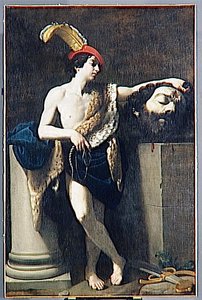
David (1608) by Guido Reni

David

1608 · Oil On Canvas · Bavarian State Painting Collections, Munich

is an oil painting by the Italian artist Guido Reni. Executed about 1608, the work captures a pivotal moment from biblical history. The composition focuses on the figure of David, who is depicted holding the severed head of Goliath.

9
St Jerome (1635) by Guido Reni

St Jerome

1635 · Oil On Canvas · Kunsthistorisches Museum, Vienna

Guido Reni's "St. Jerome," painted around 1635, is more than just a depiction of a revered biblical figure; it’s an immersive experience in solemnity and profound introspection. Rendered with the meticulous detail characteristic of the Baroque period, this oil on canvas work transports the viewer into the heart of St. Jerome's solitary existence – a life dedicated to prayer, translation, and wrestling with the weighty questions of faith and mortality.…

10
Ecce Homo (1639) by Guido Reni

Ecce Homo

1639 · Oil On Canvas · Städel Museum, Frankfurt

Ecce Homo is an oil on canvas painting by the artist Guido Reni. The work is dated 1639 and focuses on religious iconography. The composition centers on the Christ figure, presenting a depiction of the crucifixion of Jesus. This specific subject matter places the work within the tradition of biblical narrative painting.

Guido Reni's famous paintings, numbers 11 to 100

11The Four Seasons (1617) by Guido ReniThe Four Seasons1617 · Museo di Capodimonte 12St. Peter Penitent (1600) by Guido ReniSt. Peter Penitent1600 13The circumcision of the Child Jesus (1640) by Guido ReniThe circumcision of the Child Jesus1640 14Saint Paul (1634) by Guido ReniSaint Paul1634 · Museo del Prado 15St Mary Magdalene (1633) by Guido ReniSt Mary Magdalene1633 · Galleria Nazional d Art Antica 16Self Portrait (1604) by Guido ReniSelf Portrait1604 17David with the Head of Goliath (1605) by Guido ReniDavid with the Head of Goliath1605 · Galleria degli Uffizi 18Moses with the Tables of the Law (detail) (1624) by Guido ReniMoses with the Tables of the Law (detail)1624 · Galleria Borghese 19Salome with the Head of Saint John the Baptist (1639) by Guido ReniSalome with the Head of Saint John the Baptist1639 · Art Institute of Chicago 20DAVID VAINQUEUR DE GOLIATH by Guido ReniDAVID VAINQUEUR DE GOLIATHThe Louvre 21Assumption (1600) by Guido ReniAssumption1600 22David with the head of Goliath (1606) by Guido ReniDavid with the head of Goliath1606 23Lucretia (1626) by Guido ReniLucretia1626 24David with the Head of Goliath (1605) by Guido ReniDavid with the Head of Goliath1605 · The Louvre 25The Glory of St Dominic (1613) by Guido ReniThe Glory of St Dominic1613 · San Domenico 26Martyrdom of Saint Catherine of Alexandria (1607) by Guido ReniMartyrdom of Saint Catherine of Alexandria1607 27The Madonna Sewing (1611) by Guido ReniThe Madonna Sewing1611 · Quirinal Palace 28Assumption of the Virgin (1590) by Guido ReniAssumption of the Virgin1590 · Städel Museum 29Atalanta and Hippomenes (1612) by Guido ReniAtalanta and Hippomenes1612 · Museo del Prado 30The Sleeping Christ Child (1700) by Guido ReniThe Sleeping Christ Child1700 · Bavarian State Painting Collections 31Apollo Flays Marsyas (1608) by Guido ReniApollo Flays Marsyas1608 · Bavarian State Painting Collections 32Venus and Cupid (1626) by Guido ReniVenus and Cupid1626 · Toledo Museum of Art 33Saint Ursula (1642) by Guido ReniSaint Ursula1642 · Saltram House 34Saint Jerome (1634) by Guido ReniSaint Jerome1634 · Kunsthistorisches Museum 35Aurora (1614) by Guido ReniAurora1614 36David (1620) by Guido ReniDavid1620 · Kunsthistorisches Museum 37Maria Magdalena (1637) by Guido ReniMaria Magdalena1637 · Kunsthistorisches Museum 38Massacre of the Innocents in Bethlehem (1608) by Guido ReniMassacre of the Innocents in Bethlehem1608 · Bavarian State Painting Collections 39Christ at the Column (1604) by Guido ReniChrist at the Column1604 · Städel Museum 40Self-portrait (1635) by Guido ReniSelf-portrait1635 · Galleria degli Uffizi 41Saint John (1621) by Guido ReniSaint John1621 42Saint Matthew (1621) by Guido ReniSaint Matthew1621 43Lucretia Killing Herself (1601) by Guido ReniLucretia Killing Herself1601 · Museo del Prado 44Head of Christ Crowned with Thorns (1620) by Guido ReniHead of Christ Crowned with Thorns1620 · Detroit Institute of Arts 45Drinking Bacchus (1623) by Guido ReniDrinking Bacchus1623 · Gemäldegalerie 46Portrait of a Woman (1638) by Guido ReniPortrait of a Woman1638 · Birmingham Museum and Art Gallery 47The Coronation of the Virgin (1607) by Guido ReniThe Coronation of the Virgin1607 · National Gallery 48Bust of a Woman Wearing a Turban (1640) by Guido ReniBust of a Woman Wearing a Turban1640 · Minneapolis Institute of Art 49The death of Lucretia (1638) by Guido ReniThe death of Lucretia1638 · Galleria Sabauda 50Saint Jerome (1608) by Guido ReniSaint Jerome1608 · Bavarian State Painting Collections 51Saint Jerome (1608) by Guido ReniSaint Jerome1608 · Bavarian State Painting Collections 52Christ embracing Saint John the Baptist (1600) by Guido ReniChrist embracing Saint John the Baptist1600 · National Gallery 53The Union of Drawing and Color (1620) by Guido ReniThe Union of Drawing and Color1620 · Städel Museum 54Saint Jerome (1636) by Guido ReniSaint Jerome1636 · Staatliche Kunstsammlungen Dresden 55The Madonna (1616) by Guido ReniThe Madonna1616 · Statens Museum For Kunst 56The Rape of Helen (1631) by Guido ReniThe Rape of Helen1631 57Madonna with St. Lucia and St. Mary Magdalene by Guido ReniMadonna with St. Lucia and St. Mary Magdalene 58Mary with Child (1608) by Guido ReniMary with Child1608 · Bavarian State Painting Collections 59Hercules as a Child (1608) by Guido ReniHercules as a Child1608 · Bavarian State Painting Collections 60The Penitent Saint Peter (1608) by Guido ReniThe Penitent Saint Peter1608 · Bavarian State Painting Collections 61Flight into Egypt (1608) by Guido ReniFlight into Egypt1608 · Bavarian State Painting Collections 62Bacchus as Child (1608) by Guido ReniBacchus as Child1608 · Bavarian State Painting Collections 63Sleeping Christ Child (oval) (1608) by Guido ReniSleeping Christ Child (oval)1608 · Bavarian State Painting Collections 64Sorrowful Madonna (1608) by Guido ReniSorrowful Madonna1608 · Bavarian State Painting Collections 65Child with Goldfinch (1608) by Guido ReniChild with Goldfinch1608 · Bavarian State Painting Collections 66Saint Magdalene (1608) by Guido ReniSaint Magdalene1608 · Bavarian State Painting Collections 67Saint Margaret (1606) by Guido ReniSaint Margaret1606 · Westfälishes Landesmuseum 68The Separation of Night from Day (1598) by Guido ReniThe Separation of Night from Day1598 · Kingston Lacy 69Christ appearing to the Virgin (1608) by Guido ReniChrist appearing to the Virgin1608 · Fitzwilliam Museum 70Madonna and Child with St. John the Baptist (1606) by Guido ReniMadonna and Child with St. John the Baptist1606 71Medallions Depicting the Life and Passion of Jesus (1597) by Guido ReniMedallions Depicting the Life and Passion of Jesus1597 72St. Margarete (1600) by Guido ReniSt. Margarete1600 73Death of Cleopatra (1598) by Guido ReniDeath of Cleopatra1598 74St. Sebastian (1615) by Guido ReniSt. Sebastian1615 · Rhode Island School of Design Museum of Art 75Madonna in Estasi (1610) by Guido ReniMadonna in Estasi1610 76The Penitent Mary Magdalene (1616) by Guido ReniThe Penitent Mary Magdalene1616 · Statens Museum For Kunst 77Troen. Allegorisk kvindefigur (1616) by Guido ReniTroen. Allegorisk kvindefigur1616 · Statens Museum For Kunst 78Portrait of Pope Gregory XV (1622) by Guido ReniPortrait of Pope Gregory XV1622 · Corsham Court 79The hermits Paul and Antonius in the desert (1620) by Guido ReniThe hermits Paul and Antonius in the desert1620 · Gemäldegalerie 80Crucifixion (1619) by Guido ReniCrucifixion1619 81Jesus Christ Crucified between St. Catherine of Alexandria and St. Julius, (1622) by Guido ReniJesus Christ Crucified between St. Catherine of Alexandria and St. Julius,1622 82Mary and angels (1611) by Guido ReniMary and angels1611 83Sibylle (1636) by Guido ReniSibylle1636 84Ninus Delivers His Crown to Semiramis (1625) by Guido ReniNinus Delivers His Crown to Semiramis1625 · Staatliche Kunstsammlungen Dresden 85Madonna and Child with angels (1631) by Guido ReniMadonna and Child with angels1631 · Condé Museum 86Lucretia (1625) by Guido ReniLucretia1625 · Rhode Island School of Design Museum of Art 87The Penitent Magdalene (1635) by Guido ReniThe Penitent Magdalene1635 · Walters Art Museum 88Dido and Aeneas (1630) by Guido ReniDido and Aeneas1630 89The Coronation of the Virgin (1626) by Guido ReniThe Coronation of the Virgin1626 90Self-portrait (1635) by Guido ReniSelf-portrait1635 91Portrait of Cardinal Bernardino Spada (1631) by Guido ReniPortrait of Cardinal Bernardino Spada1631 92Crowned love and profane Love (1623) by Guido ReniCrowned love and profane Love1623 93Adoration of the Magi (1642) by Guido ReniAdoration of the Magi1642 · Cleveland Museum of Art 94Ecce Homo (1639) by Guido ReniEcce Homo1639 · Fitzwilliam Museum 95Blessed Soul (1640) by Guido ReniBlessed Soul1640 · Capitoline Museums 96The infant Jesus and St. John (1640) by Guido ReniThe infant Jesus and St. John1640 · Capitoline Museums 97Saint John the Baptist in the Desert (1638) by Guido ReniSaint John the Baptist in the Desert1638 · Royal Collection 98The Mourning Virgin (1608) by Guido ReniThe Mourning Virgin1608 · Walters Art Museum 99Judith (1620) by Guido ReniJudith1620 · Birmingham Museum of Art 100Mary Magdalene Between Two Angels (1600) by Guido ReniMary Magdalene Between Two Angels1600 · Dayton Art Institute

Guido Reni's famous paintings, period by period

The subjects that held Guido Reni's eye

The four subjects that come back most often in these originals, each with its finest example.

The museums that keep Guido Reni's originals

The 8 museums that hold the most of the paintings on this page.

Museum City Works by Guido Reni Paintings from this list
Bavarian State Painting Collections, MunichBavarian State Painting Collections Munich 24 Judith Beheads Holofernes, David, The Sleeping Christ Child
Kunsthistorisches Museum, ViennaKunsthistorisches Museum Vienna 9 St Jerome, Saint Jerome, David
Städel Museum, FrankfurtStädel Museum Frankfurt 4 Ecce Homo, Assumption of the Virgin, Christ at the Column
The Louvre, ParisThe Louvre Paris 19 Ecce Homo, DAVID VAINQUEUR DE GOLIATH, David with the Head of Goliath
Museo del Prado, MadridMuseo del Prado Madrid 17 Saint Paul, Atalanta and Hippomenes, Lucretia Killing Herself
National Gallery, LondonNational Gallery London 8 Saint Jerome, The Coronation of the Virgin, Christ embracing Saint John the Baptist
Statens Museum For Kunst, CopenhagenStatens Museum For Kunst Copenhagen 6 The Madonna, The Penitent Mary Magdalene, Troen. Allegorisk kvindefigur
Capitoline Museums, RomeCapitoline Museums Rome 8 Blessed Soul, The infant Jesus and St. John

Guido Reni across the decades: one unique original for each

Works per decade

Pick a decade to see the original that defines it.

Guido Reni's paintings: questions for the gallery

What is the single most famous work of Guido Reni?Reveal the answer

Massacre of the Innocents (1611), Pinacoteca Nazionale, Bologna. Ecce Homo (1639) and St Filippo Neri in Ecstasy (1614) come next.

At what age did Guido Reni create Massacre of the Innocents?Reveal the answer

36 years old: Massacre of the Innocents dates from 1611, and Guido Reni was born in 1575.

Which ten paintings by Guido Reni are the most famous?Reveal the answer

Massacre of the Innocents, Ecce Homo, St Filippo Neri in Ecstasy, Saint Roch, Assumption, Saint Jerome, Judith Beheads Holofernes, David, St Jerome and Ecce Homo. The ranking above gives each one's year and museum.

How many works by Guido Reni are known?Reveal the answer

Our catalog holds 357 works by Guido Reni, dated from 1590 to 1642.

Where can the most famous Guido Reni originals be seen?Reveal the answer

Mostly in Bavarian State Painting Collections (Munich), Kunsthistorisches Museum (Vienna) and Städel Museum (Frankfurt). The museum table above lists them all.

During which period did Guido Reni create the best-known paintings?Reveal the answer

In 1600s: 32 of the 100 works on this page were made then, Judith Beheads Holofernes among them.

Which famous Guido Reni painting is the earliest, and which the latest?Reveal the answer

On this page, the earliest is Assumption of the Virgin (1590) and the latest Saint Ursula (1642).

What subjects did Guido Reni favour?Reveal the answer

Woman (38), Man (32) and Drapery (28), across the 100 works on this page.

What materials did Guido Reni paint with most?Reveal the answer

Oil On Canvas, for 72 of the 100 works on this page.

Which movement does the work of Guido Reni belong to?Reveal the answer

Baroque, judging by the originals on this page.

What Guido Reni originals can I see at the Bavarian State Painting Collections?Reveal the answer

Judith Beheads Holofernes, David and The Sleeping Christ Child: the Bavarian State Painting Collections, Munich holds 16 of the works on this page.

Guido Reni: a portrait of the artist

Early Life, Family and Training

In the year 1575, the city of Bologna welcomed Reni Guido (Le Guide), a child born into a household where melody and rhythm were part of the daily air. He was the only child of Daniele Reni, a man dedicated to music, and Ginevra Pozzi. This musical lineage, extending back to his grandparents, meant that his earliest years were steeped in a tradition of harmony. One can sense how this early immersion in the structured beauty of sound might later inform the grace of his brushwork.

The boy’s path took a turn toward the visual arts when he was only nine years old. He entered the studio of Denis Calvaert, a master from Flanders who brought his own disciplined techniques to the Italian soil. Under Calvaert’s watchful eye, the young apprentice began to master the complexities of form and light. This foundation proved vital as he moved toward the Carracci Academy. There, he studied alongside other ambitious souls like Albani and Domenichino, learning to navigate the tension between naturalism and the ideal beauty that the academy championed.

Artistic Career and Major Cities

After his early training, the artist's path led him away from his native Bologna toward the great centers of Italian art. In 1601, he moved to Rome, a city that would command his attention for fifteen years. During this long residence, he found himself deeply drawn to the grace of Raphael and the silent dignity of classical sculptures. He did not sever his ties to his home, however, as he visited Bologna constantly, maintaining a presence in the city that had first nurtured his talent.

The pull of Rome was strong, yet the tides of his career eventually turned back toward his origins. Around 1614, he returned to Bologna, arriving at a time of significant transition for the local school. With the passing of Annibale Carracci, the artist stepped into a position of leadership, becoming the figurehead of the Bolognese school. His presence in the city helped define the direction of its artistic tradition for years to come.

His travels were not limited to these two cities, as his reputation carried him to Naples as well. Through these movements between Bologna, Rome, and Naples, he established himself as a painter of great reach. His work followed him across these landscapes, finding favor in various courts and chapels.

Technique and Artistic Style

His hand moved with a peculiar grace that sought to marry the precision of classical antiquity with the sudden, surging emotion of the Baroque. This eclectic classicism allowed him to capture a sense of idealized beauty, where figures appeared to possess a serene composure even amidst movement. He sought a harmony of form that felt both natural and elevated, often imbuing his subjects with a graceful, almost weightless quality. This pursuit of an ideal beauty was not a static endeavor; his approach shifted as the years passed and his own vision matured.

During the 1620s, his brushwork became increasingly refined, and he favored a bright palette that brought a certain clarity to his compositions. He could render the folds of drapery and the softness of skin with a meticulous touch that drew the eye to the elegance of the human form. However, as he reached the mid-1630s, his manner underwent a notable transformation. He moved away from that earlier brightness, instead embracing a more muted and limited palette. His compositions became simpler and more restrained, trading the expansive energy of his youth for a more subdued and quieted expression.

Notable Works and Subjects

The hand of Reni Guido (Le Guide) moved with equal grace across many different realms, finding expression in religious scenes, mythological narratives, and allegorical representations. In his early years, he sought to capture the weight of human struggle, as seen in his execution of David with the Head of Goliath about 1605. This work reveals a burgeoning command over the dramatic tension that would define his later years. As his reputation grew, he turned his attention to the heavens and the myths of old, moving from the heavy shadows of his youth toward a more luminous clarity.

His ability to handle light was perhaps most evident in the grand frescoes he painted for the Palazzo Farnese. Between 1613 and 1614, he composed the Aurora, a work where the goddess of dawn guides Apollo’s golden chariot through the sky. This celestial scene demonstrates how he could translate the movement of light into a sense of divine order. Such large-scale commissions allowed him to command vast spaces, turning walls into windows for the viewer to witness the passage of time and the grace of the gods.

Even in more intimate settings, his touch remained distinct. In the Museo del Prado, Madrid, one finds the Girl with a Rose, a piece that highlights his ability to focus on a single, quiet subject. This penchant for grace is also found in his mythological storytelling, such as the figures in Atalanta and Hippomenes, currently held in the Museo di Capodimonte, Naples. Whether depicting the fervor of a saint or the poise of a mythological hero, he sought a harmony that balanced the physical form with an inner, quiet dignity.

Legacy and Historical Significance

The influence of Guido Reni spread far beyond the walls of his own studio, reaching into the very fabric of the High Baroque style in Italy. He possessed a rare ability to shape the visual language of his era, leaving a mark that subsequent generations of painters sought to emulate. His talent was not a solitary thing; it was nurtured and passed down through a massive, productive workshop that at its height housed up to eighty students. Through this institution, his methods and his pursuit of grace were disseminated to many who would go on to define the next era of painting.

Many artists found their own paths through the shadow of his greatness. Giovanni Francesco Barbieri, known as il Guercino, and the Flemish painter Anthony van Dyck both drew from the well of his refined technique and classical ideals. His presence in the artistic landscape was so profound that his style became a standard for those seeking to balance emotion with a sense of order. Even as he moved between the great centers of Rome and Bologna, his reputation grew, ensuring that his approach to the human form would be studied by many who followed.

When he passed away in Bologna in 1642, he left behind a vast body of work that continued to command respect. His life was one of significant achievement, marked by the ability to satisfy the most demanding patrons of the age. The legacy he left was not merely one of finished canvases, but of a structured way of seeing the world through the lens of idealized beauty and grace.