Portrait of Eugène Verboeckhoven

Eugène Verboeckhoven Paintings: The 88 Most Famous, Through a Gallery's Eye

Updated November 2026 · ranked by our popularity score (searches, visits and orders for each work) · 91 works by Eugène Verboeckhoven in our catalogue

In short

To the gallery's eye, Eugène Verboeckhoven's most famous painting is Good Friends (1878), whose original hangs in the Nottingham Castle Museum And Art Gallery, Nottingham. Still-Life with a Hare (1844) and Sheep (1840) complete the trio every eye recognises. Of the 91 works by Eugène Verboeckhoven in our catalog, the gallery presents the 88 most famous below, each original with its year, its museum and what makes it unique.

1799 – 1881, Warneton Realism Most works: Nottingham Castle Museum And Art Gallery

The gallery's top 10 Eugène Verboeckhoven paintings

1
Good Friends (1878) by Eugène Verboeckhoven

Good Friends

1878 · Oil On Canvas · Nottingham Castle Museum And Art Gallery, Nottingham

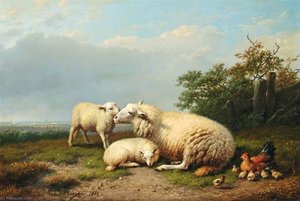
Good Friends is an oil on canvas work by Eugène Verboeckhoven, executed in 1878. The painting is part of the collection at the Nottingham Castle Museum And Art Gallery. It reflects the artist's focus on the quietude of pastoral existence and the specific interactions between livestock and the landscape.

2
Still-Life with a Hare (1844) by Eugène Verboeckhoven

Still-Life with a Hare

1844 · Oil On Canvas · Hermitage Museum, Saint Petersburg

Eugène Joseph Verboeckhoven's "Still-Life with a Hare," painted in 1844, is more than just a depiction of animals and hunting paraphernalia; it’s a poignant meditation on mortality, the fleeting beauty of nature, and the inherent sadness within the pursuit of life. This remarkable work, now housed at the Hermitage Museum in St. Petersburg, offers a glimpse into the final flowering of a particular artistic tradition – the idyllic landscapes and…

3
Sheep (1840) by Eugène Verboeckhoven

Sheep

1840 · Oil On Canvas · Grundy Art Gallery, Blackpool

The quietude of a rustic barn settles over the viewer through Sheep, an oil on canvas painted by Eugène Verboeckhoven. Created in 1840, the work captures a specific moment of stillness within a wooden stable. The scene feels immediate, as if the air inside the shelter is still heavy with the scent of hay and the warmth of the animals gathered within.

4
Flock of Sheep Surprised by Thunderstorm (1823) by Eugène Verboeckhoven

Flock of Sheep Surprised by Thunderstorm

1823 · Lithograph

A heavy, gray sky presses down upon the landscape, thick with the scent of impending rain. The clouds are not merely shapes but turbulent, swirling masses that churn with a restless energy. Beneath this celestial upheaval, a flock of sheep moves with sudden, agitated purpose. Their woolly bodies, rendered with meticulous detail, catch the sharp, directional light breaking through the storm. A shepherd moves among them, a small figure caught…

5
Landschap met herder en vee bij een boom (1824) by Eugène Verboeckhoven

Landschap met herder en vee bij een boom

1824 · Oil · Rijksmuseum, Amsterdam

A weathered tree trunk anchors the right side of this 1824 oil painting, providing a vertical counterpoint to the vast, horizontal expanse of a Belgian meadow. Beneath an expansive, cloudy sky, a small herd of cattle—rendered in shades of brown, white, and black—grazes across the grassy plain. A lone shepherd rests at the base of the tree, a quiet human presence amidst the livestock. The composition utilizes a low horizon…

6
goats (1830) by Eugène Verboeckhoven

goats

1830 · Oil

We are looking at goats, an oil painting by the Belgian artist Eugène Verboeckhoven. This work dates to about 1830, a period when the artist was establishing his presence within the European art landscape. It is a quiet, intimate study that captures a specific moment of pastoral stillness.

7
Peasant Asking His Way (1837) by Eugène Verboeckhoven

Peasant Asking His Way

1837 · Ink On Paper

In "Peasant Asking His Way" by Eugène Verboeckhoven, the composition is defined by a vast, expansive sky that occupies the upper two-thirds of the frame. This large area of space creates a sense of openness above the terrestrial scene. In the lower third of the work, the focal point consists of three figures: a man mounted on a white horse, a standing man facing him, and a small dog positioned…

8
Sheep in a Forest (1840) by Eugène Verboeckhoven

Sheep in a Forest

1840 · Oil · Amsterdam Museum, Amsterdam

In "Sheep in a Forest" by Eugène Verboeckhoven, a quiet stillness settles over a dense woodland clearing. The scene unfolds at eye-level with the animals, pulling the viewer directly into this secluded, shaded sanctuary. A small group of sheep rests within the heart of the forest, their presence grounding the composition. In the mid-ground, a single sheep stands in profile, facing right, its body angled slightly toward the observer as…

9
Landscape with animals (1846) by Eugène Verboeckhoven

Landscape with animals

1846 · Oil On Canvas · Museum of Fine Arts Ghent (MSK), Ghent

Landscape with animals is a painting by the Belgian artist Eugène Verboeckhoven. Created about 1846, this work depicts a pastoral scene set within a lush meadow. The composition focuses on a group of livestock positioned in the landscape, including cows, sheep, and goats. A shepherd is situated near these animals, providing a human presence within the rural setting.

10
Self Portrait (1854) by Eugène Verboeckhoven

Self Portrait

1854 · Oil On Canvas · Royal Museum of Fine Arts Antwerp, Antwerp

is an oil on canvas work by the Belgian painter Eugène Verboeckhoven. Executed in 1854, the painting captures the artist during a period of significant professional activity in the mid-nineteenth century. Verboeckhoven, born in 1799, was a central figure in the development of Belgian animal and landscape painting, bridging the gap between seventeenth-century traditions and the emerging realism of his era.

Eugène Verboeckhoven paintings, ranked 11 to 88

11Een rustend schaap en een lam (1840) by Eugène VerboeckhovenEen rustend schaap en een lam1840 · Amsterdam Museum 12sheep and ducks (1849) by Eugène Verboeckhovensheep and ducks1849 · Museum Tongerlohuys 13Leaving for the Market (1854) by Eugène VerboeckhovenLeaving for the Market1854 · Royal Museum of Fine Arts Antwerp 14Shepherd (1855) by Eugène VerboeckhovenShepherd1855 · Finnish National Gallery 15A Cavalier at Rest (1849) by Eugène VerboeckhovenA Cavalier at Rest1849 16Outbound herd (1856) by Eugène VerboeckhovenOutbound herd1856 · Alte Nationalgalerie 17Scotch Sheep (1868) by Eugène VerboeckhovenScotch Sheep1868 · New York Historical Society 18Sheep in a Byre (1856) by Eugène VerboeckhovenSheep in a Byre1856 · Laing Art Gallery 19Wood Landscape with Animals (1836) by Eugène VerboeckhovenWood Landscape with Animals1836 · National Museum of Art, Architecture and Design 20Hungry Wolves Attack a Group of Riders (1836) by Eugène VerboeckhovenHungry Wolves Attack a Group of Riders1836 · Rijksmuseum 21Landscape (1836) by Eugène VerboeckhovenLandscape1836 22Gathering the Flock (1839) by Eugène VerboeckhovenGathering the Flock1839 · The New Art Gallery Walsall 23Dutch Sheepfold (1844) by Eugène VerboeckhovenDutch Sheepfold1844 · Bavarian State Painting Collections 24Donkey and Sheep (1845) by Eugène VerboeckhovenDonkey and Sheep1845 · Amsterdam Museum 25A Mountainous Landscape with Resting Cattle (1840) by Eugène VerboeckhovenA Mountainous Landscape with Resting Cattle1840 · Amsterdam Museum 26Goats and Sheep (1843) by Eugène VerboeckhovenGoats and Sheep1843 · Royal Collection 27Bull (1847) by Eugène VerboeckhovenBull1847 · Royal Museum of Fine Arts Antwerp 28Cattle near a Lake (1842) by Eugène VerboeckhovenCattle near a Lake1842 29The Sign Post (1848) by Eugène VerboeckhovenThe Sign Post1848 30Sheep and Cattle (1843) by Eugène VerboeckhovenSheep and Cattle1843 31Sheep and Cows (1844) by Eugène VerboeckhovenSheep and Cows1844 · Wallace Collection 32Watering Cattle (1845) by Eugène VerboeckhovenWatering Cattle1845 33Goats (1840) by Eugène VerboeckhovenGoats1840 · The New Art Gallery Walsall 34The Twins (1846) by Eugène VerboeckhovenThe Twins1846 · Nottingham Castle Museum And Art Gallery 35Sheep, Goat, and Chickens (1851) by Eugène VerboeckhovenSheep, Goat, and Chickens1851 · New York Historical Society 36Cow in a Pool (1850) by Eugène VerboeckhovenCow in a Pool1850 · New York Historical Society 37Donkey and Lambs (1849) by Eugène VerboeckhovenDonkey and Lambs1849 38A Bull Leaping a Fence (1849) by Eugène VerboeckhovenA Bull Leaping a Fence1849 · Національний траст 39Sheep and Dogs (1861) by Eugène VerboeckhovenSheep and Dogs1861 40Bull's Head (1857) by Eugène VerboeckhovenBull's Head1857 41After the Hunt (1865) by Eugène VerboeckhovenAfter the Hunt1865 · Museum aan de Stroom 42Landscape with Sheep (1868) by Eugène VerboeckhovenLandscape with Sheep1868 · Auckland Art Gallery Toi o Tāmaki 43Dune Landscape with Resting Sheep (1871) by Eugène VerboeckhovenDune Landscape with Resting Sheep1871 · Nationalmuseum 44Startled (1864) by Eugène VerboeckhovenStartled1864 45An Extensive Wooded Rocky Landscape with Shepherds and Flock, Cows and a Traveller on a Horseback (1868) by Eugène VerboeckhovenAn Extensive Wooded Rocky Landscape with Shepherds and Flock, Cows and a Traveller on a Horseback1868 46In the Highlands (1869) by Eugène VerboeckhovenIn the Highlands1869 47Sheep, Hen and Chicks in a Landscape (1865) by Eugène VerboeckhovenSheep, Hen and Chicks in a Landscape1865 48Landscape with Sheep and Ducks (1865) by Eugène VerboeckhovenLandscape with Sheep and Ducks1865 49Cattle and Sheep in a Landscape (1874) by Eugène VerboeckhovenCattle and Sheep in a Landscape1874 50Sheep (1876) by Eugène VerboeckhovenSheep1876 · Nottingham Castle Museum And Art Gallery 51A Sheep, Two Lambs, a Cock and a Hen in a Landscape (1876) by Eugène VerboeckhovenA Sheep, Two Lambs, a Cock and a Hen in a Landscape1876 52Landscape with a Herd (1862) by Eugène VerboeckhovenLandscape with a Herd1862 · Hermitage Museum 53bulls on the meadow by Eugène Verboeckhovenbulls on the meadow 54cows + goat in landscape by Eugène Verboeckhovencows + goat in landscape 55white horse before a stable by Eugène Verboeckhovenwhite horse before a stable 56Sheep, Lamb and Ducks by a pond by Eugène VerboeckhovenSheep, Lamb and Ducks by a pond 57Cows in the pasture by Eugène VerboeckhovenCows in the pastureNational Museum in Warsaw 58A Sunlit Barn with Ewes, Lambs and Chickens by Eugène VerboeckhovenA Sunlit Barn with Ewes, Lambs and ChickensHaworth Art Gallery 59Group of Sheep (1863) by Eugène VerboeckhovenGroup of Sheep1863 · Towneley Hall Art Gallery - Museum 60Sheep and Hens in a Barn (1874) by Eugène VerboeckhovenSheep and Hens in a Barn1874 · Walker Art Gallery 61Landscape with Sheep (1867) by Eugène VerboeckhovenLandscape with Sheep1867 62Landscape with Sheep by Eugène VerboeckhovenLandscape with SheepDetroit Institute of Arts 63Head of a Horse by Eugène VerboeckhovenHead of a HorseNational Museum of Art, Architecture and Design 64Buck's Head by Eugène VerboeckhovenBuck's HeadMusée Alphonse-georges Poulain 65Cows and Sheep by Eugène VerboeckhovenCows and SheepRoyal Museum of Fine Arts Antwerp 66Schafe auf der Weide by Eugène VerboeckhovenSchafe auf der Weide 67sheep in a stable by Eugène Verboeckhovensheep in a stable 68Sheep and Chicken in a Landscape by Eugène VerboeckhovenSheep and Chicken in a Landscape 69A gathering in the pasture by Eugène VerboeckhovenA gathering in the pasture 70Mountainous Landscape with Bridge by Eugène VerboeckhovenMountainous Landscape with Bridge 71Guarding the flock by the coast by Eugène VerboeckhovenGuarding the flock by the coast 72Un pâturage by Eugène VerboeckhovenUn pâturage 73Rider Conversing with a Shepherdess in an Extensive Landscape by Eugène VerboeckhovenRider Conversing with a Shepherdess in an Extensive Landscape 74Sheep grazing by the coast by Eugène VerboeckhovenSheep grazing by the coast 75Sheep in a Scottish landscape by Eugène VerboeckhovenSheep in a Scottish landscape 76Sheep and Chicken in a Landscape by Eugène VerboeckhovenSheep and Chicken in a Landscape 77Crossing the marsh by Eugène VerboeckhovenCrossing the marsh 78A white stallion in a landscape by Eugène VerboeckhovenA white stallion in a landscape 79Guarding the Lamb by Eugène VerboeckhovenGuarding the Lamb 80At the Stable Door by Eugène VerboeckhovenAt the Stable Door 81A farmer at rest with his stock by Eugène VerboeckhovenA farmer at rest with his stock 82A Horse, Sheep and a Goat in a Landscape by Eugène VerboeckhovenA Horse, Sheep and a Goat in a Landscape 83a shepherd and his flock by Eugène Verboeckhovena shepherd and his flock 84The Sheep by Eugène VerboeckhovenThe SheepNottingham Castle Museum And Art Gallery 85A Shepherdess with her Flock by Eugène VerboeckhovenA Shepherdess with her Flock 86Sheep with chickens and a goat in a barn by Eugène VerboeckhovenSheep with chickens and a goat in a barn 87A Horse Feeding in a Stable by Eugène VerboeckhovenA Horse Feeding in a StableUsher Gallery 88Farmhand with Horse and Dog in Landscape by Eugène VerboeckhovenFarmhand with Horse and Dog in Landscape

The subjects that held Eugène Verboeckhoven's eye

The four subjects that come back most often in these originals, each with its finest example.

The museums that keep Eugène Verboeckhoven's originals

The 8 museums that hold the most of the paintings on this page.

Museum City Works by Eugène Verboeckhoven Paintings from this list
Nottingham Castle Museum And Art Gallery, NottinghamNottingham Castle Museum And Art Gallery Nottingham 4 Good Friends, The Twins, Sheep
Amsterdam Museum, AmsterdamAmsterdam Museum Amsterdam 4 Sheep in a Forest, Een rustend schaap en een lam, Donkey and Sheep
Royal Museum of Fine Arts Antwerp, AntwerpRoyal Museum of Fine Arts Antwerp Antwerp 4 Self Portrait, Leaving for the Market, Bull
New York Historical Society, New York CityNew York Historical Society New York City 3 Scotch Sheep, Sheep, Goat, and Chickens, Cow in a Pool
Hermitage Museum, Saint PetersburgHermitage Museum Saint Petersburg 2 Still-Life with a Hare, Landscape with a Herd
Rijksmuseum, AmsterdamRijksmuseum Amsterdam 2 Landschap met herder en vee bij een boom, Hungry Wolves Attack a Group of Riders
National Museum of Art, Architecture and Design, OsloNational Museum of Art, Architecture and Design Oslo 2 Wood Landscape with Animals, Head of a Horse
The New Art Gallery Walsall, WalsallThe New Art Gallery Walsall Walsall 2 Gathering the Flock, Goats

Eugène Verboeckhoven, one signature painting per decade

Works per decade

Pick a decade to see the original that defines it.

Eugène Verboeckhoven's paintings: the gallery answers

Which Eugène Verboeckhoven painting is the most famous of all?Reveal the answer

Good Friends (1878), Nottingham Castle Museum And Art Gallery, Nottingham. Still-Life with a Hare (1844) and Sheep (1840) come next.

How old was Eugène Verboeckhoven on completing Good Friends?Reveal the answer

79 years old: Good Friends dates from 1878, and Eugène Verboeckhoven was born in 1799.

Which are Eugène Verboeckhoven's top 10 paintings?Reveal the answer

Good Friends, Still-Life with a Hare, Sheep, Flock of Sheep Surprised by Thunderstorm, Landschap met herder en vee bij een boom, goats, Peasant Asking His Way, Sheep in a Forest, Landscape with animals and Self Portrait. The ranking above gives each one's year and museum.

How many works did Eugène Verboeckhoven create?Reveal the answer

Our catalog holds 91 works by Eugène Verboeckhoven, dated from 1823 to 1878.

Where do Eugène Verboeckhoven's most famous originals hang?Reveal the answer

Mostly in Nottingham Castle Museum And Art Gallery (Nottingham), Amsterdam Museum (Amsterdam) and Royal Museum of Fine Arts Antwerp (Antwerp). The museum table above lists them all.

When did Eugène Verboeckhoven create the most famous paintings?Reveal the answer

In 1840s: 21 of the 88 works on this page were made then, Still-Life with a Hare among them.

Which are Eugène Verboeckhoven's earliest and latest famous works?Reveal the answer

On this page, the earliest is Flock of Sheep Surprised by Thunderstorm (1823) and the latest Good Friends (1878).

Which subjects did Eugène Verboeckhoven return to most?Reveal the answer

Sheep (13), Sky (9) and Grass (8), across the 88 works on this page.

Which medium did Eugène Verboeckhoven work in most?Reveal the answer

Oil On Canvas, for 11 of the 88 works on this page.

Which movement is Eugène Verboeckhoven associated with?Reveal the answer

Realism and Romanticism, judging by the originals on this page.

Which Eugène Verboeckhoven originals does the Nottingham Castle Museum And Art Gallery hold?Reveal the answer

Good Friends, The Twins and Sheep: the Nottingham Castle Museum And Art Gallery, Nottingham holds 4 of the works on this page.

Eugène Verboeckhoven: the artist

The Master of Pastoral Tranquility

In the grand tapestry of nineteenth-century European art, few threads are as delicately woven as those spun by Eugène Joseph Verboeckhoven. Born in 1798 in the Belgian town of Warneton, Verbockhoven emerged as a painter who could bridge the gap between the fading echoes of the seventeenth-century pastoral tradition and the burgeoning, sharp-eyed realism of his own era. His life was set against a period of profound transformation; he witnessed the Belgian Revolution of 1830 and saw his nation find its identity, much as he helped define a specific aesthetic identity for Belgian landscape and animal painting. To look upon a Verboeckhoven canvas is to step into a world where time slows down, where the rhythmic grazing of sheep and the quiet dignity of cattle serve as anchors in an ever-changing world.

His artistic foundation was built upon a legacy of meticulous craftsmanship. Initially studying under his father, Barthélemy Verboeckhoven—a sculptor—he gained an early appreciation for form and anatomical precision. This training was further refined in the vibrant artistic hubs of Ghent and Antwerp, where he worked under masters such as Louis-Pierre Verwee and Voituron. These formative years instilled in him a reverence for the Old Masters, particularly the Dutch and Flemish traditions of Paulus Potter and Rembrandt. He did not merely seek to imitate them; rather, he sought to breathe new life into their techniques, using their mastery of light and texture to elevate the humble subjects of farm life to the level of high art.

A Journey Through Light and Landscape

Verboeckhoven’s artistry was profoundly shaped by his restless spirit and his desire to capture the atmospheric nuances of the natural world. Between 1826 and 1841, he embarked on extensive travels that would become the lifeblood of his compositions. From the rugged beauty of the Ardennes to the sun-drenched landscapes of Italy, and through the forests of Germany and France, each region left an indelible mark on his palette. These expeditions allowed him to observe how light interacts with different terrains—how it softens a misty morning in a Belgian meadow or casts dramatic shadows across a mountain pass. This sensitivity to atmosphere is what elevates his work from mere documentation to evocative storytelling.

His technical prowess was most evident in his ability to render the textures of the animal kingdom. Whether it was the coarse wool of a sheep, the sleek coat of a horse, or the delicate features of a hare, Verboeckhoven approached every subject with an almost scientific accuracy paired with a romantic soul. His skill was so highly regarded that he became a sought-after collaborator; many contemporary landscape painters would specifically commission him to provide the staffage—the lively animals and figures—that breathed life into their scenery. This collaborative spirit highlights his central role in the nineteenth-century art market, where his ability to populate a scene with realistic, emotive creatures was unparalleled.

Legacy of the Belgian Realist

As his career progressed, Verboeckhoven became a pillar of the European art establishment. His frequent presence at the prestigious Salons of Brussels and Ghent, as well as his membership in the academies of Antwerp, St. Petersburg, and Amsterdam, speaks to a reputation that transcended national borders. He was not merely a local talent but an international figure whose works were collected by royalty and connoisseurs alike. Even as art movements shifted toward more radical forms of expression, Verboeckhoven remained a steadfast guardian of the idyllic, providing a sense of continuity and comfort through his beautifully rendered scenes of rural peace.

The historical significance of Eugène Joseph Verboeckhoven lies in his role as a stylistic bridge. He successfully synthesized the classical ideals of composition and idealized beauty with a modern commitment to observational realism. His paintings, which continue to grace museums worldwide, serve as a poignant reminder of a lost era of pastoral harmony. Through his brush, the simple act of sheep grazing or a quiet moment in a barn becomes a profound meditation on the enduring beauty of the natural world, ensuring that his name remains etched in the annals of art history as one of the most accomplished animal painters to ever live.