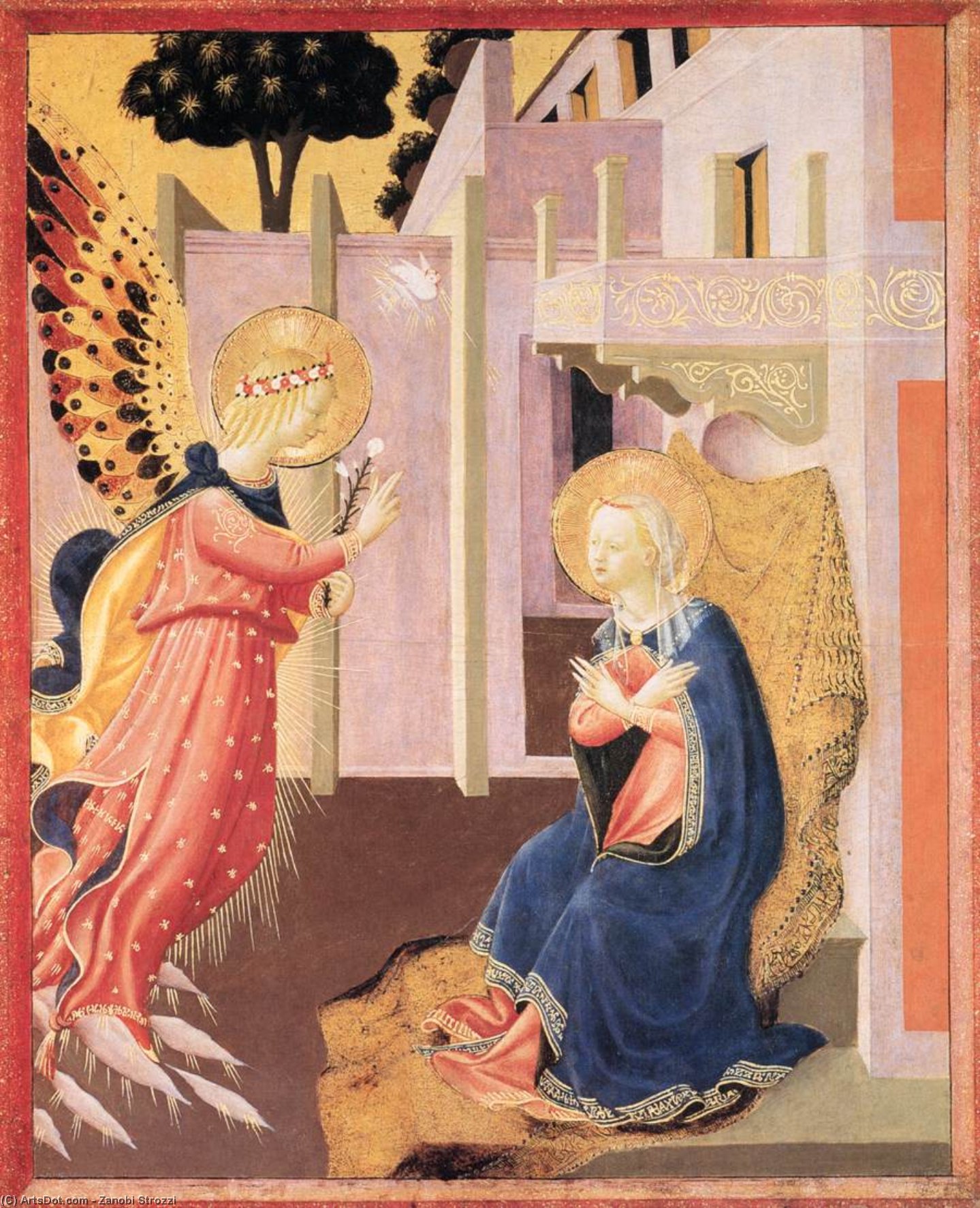
Portrait of Zanobi Strozzi

The 25 Most Famous Zanobi Strozzi Paintings, a Gallery Selection

Updated October 2026 · ranked by our popularity score (searches, visits and orders for each work) · 26 works by Zanobi Strozzi in our catalogue

In short

Of all the originals Zanobi Strozzi left, the most famous is Madonna and Child with Angels (1434), in the collection of the Convent of San Marco, Florence. Close behind it come Camaldolese Friars in Choir (1450) and The Annunciation (1442). Our catalog holds 26 works by Zanobi Strozzi; the gallery has kept the 25 the world admires most, each shown with its date, its museum and its story.

1412 – 1468, Florence Early renaissance Most works: National Gallery

Zanobi Strozzi's top 10 paintings: the gallery's choice

1
Madonna and Child with Angels (1434) by Zanobi Strozzi

Madonna and Child with Angels

1434 · Oil On Canvas · Convent of San Marco, Florence

A Vision of Divine Grace: Zanobi Strozzi's Madonna and Child with Angels To gaze upon this masterpiece by Zanobi Strozzi is to step directly into the luminous heart of the Early Renaissance. The scene unfolds with an almost palpable sense of sacred tranquility, centering on the Virgin Mary cradling the divine presence of the Christ Child. It is more than a mere portrait; it is a profound meditation on motherhood,…

2
Camaldolese Friars in Choir (1450) by Zanobi Strozzi

Camaldolese Friars in Choir

1450 · Tempera On Panel

In this 1450 composition, we find ourselves drawn into a quiet, sacred space where time seems to have slowed. A group of Camaldolese friars is gathered in a choir, their figures arranged with a sense of rhythmic unity. Some monks stand at the forefront, while others recede into the background, creating a subtle depth within the square format. They are dressed in heavy robes that signal their religious devotion, their…

3
The Annunciation (1442) by Zanobi Strozzi

The Annunciation

1442 · Tempera On Panel · National Gallery, London

The Annunciation by Zanobi Strozzi captures a suspended moment of divine interruption. Created about 1440-5, the painting depicts the Archangel Gabriel arriving to deliver a celestial message to the Virgin Mary. A single dove, representing the Holy Ghost, descends with a gilded halo above the angel's head. The scene is framed by the quiet weight of classical columns, separating the celestial messenger from the woman receiving the news.

4
Virgin and Child with Four Angels and the Redeemer (1450) by Zanobi Strozzi

Virgin and Child with Four Angels and the Redeemer

1450 · Tempera On Panel · Brooklyn Museum, Brooklyn

The air within the sacred space feels heavy with the scent of old wood and the silent weight of devotion. At the center of this celestial assembly, the Virgin Mary sits with a quiet, solemn grace, her presence anchoring the entire composition. She holds the Christ Child, whose small form is framed by the deep, ultramarine blue of her mantle and the rich crimson of her tunic. Around them, four…

5
Scenes from the Story of Susanna: Susanna and the Elders (1450) by Zanobi Strozzi

Scenes from the Story of Susanna: Susanna and the Elders

1450 · Tempera On Panel · Musée du Petit Palais, Avignon

The panel stretches wide, a long horizontal sequence of moments captured in tempera. It unfolds like a silent play, divided into three distinct stages of a biblical drama. On the far left, the heavy lines of an interior architectural setting frame the beginning of the tension. The center shifts to an outdoor garden, where a circular structure anchors the composition. Finally, the eye moves to the right, toward a landscape…

6
Saints Zenobius, Francis and Anthony of Padua (1450) by Zanobi Strozzi

Saints Zenobius, Francis and Anthony of Padua

1450 · Tempera On Panel · Yale University Art Gallery, New Haven

This Renaissance-era religious panel painting presents three saints arranged side-by-side in a vertical, frontal composition. The figures occupy a shallow space against a background of patterned gold leaf, which creates a flat, celestial setting. On the left, a figure is dressed in episcopal regalia, including a mitre, and holds a book. The central figure is depicted in a brown monastic habit with hands clasped in prayer. To the right, the…

7
Altarpiece of Saint Jerome (1460) by Zanobi Strozzi

Altarpiece of Saint Jerome

1460 · Tempera On Panel · Musée du Petit Palais, Avignon

The Altarpiece of Saint Jerome is a significant work by the Florentine painter Zanobi Strozzi. Created about 1460, this large-scale panel was originally commissioned for the convent of San Girolamo in Fiesole. The commission for this religious work was awarded by the Medici, reflecting the close ties between the artist and the influential family during the Quattrocento.

8
The Last Judgement (1456) by Zanobi Strozzi

The Last Judgement

1456 · Tempera On Panel · Gemäldegalerie, Berlin

The Last Judgement, also known as Das Jüngste Gericht, is a work by Zanobi Strozzi. Created in 1456, the painting emerged from the hands of Zanobi di Benedetto di Caroccio degli Strozzi. This Florentine artist, born in Florence, Italy, brought a specific precision to the panel. The wood of the support is poplar.

9
The Annunciation (1453) by Zanobi Strozzi

The Annunciation

1453 · Tempera On Panel · Philadelphia Museum of Art, Philadelphia

The artwork depicts the Annunciation scene, a sacred moment of divine communication. The composition centers on two figures: an angel presenting lilies to Mary, who is seated in a state of prayer and sudden awareness. The angel's pink gown features the gold-lettered greeting "Ave Maria" within its folds. Mary is characterized by the deep blue of her mantle and a posture of stillness. A single dove, representing the Holy Spirit,…

10
The Nativity (1436) by Zanobi Strozzi

The Nativity

1436 · Tempera On Panel · Metropolitan Museum of Art, New York

The Nativity is a painting by Zanobi Strozzi, an artist born in 1412 in Florence, Italy. He remained in Florence until his death in 1468. This specific work is attributed to Strozzi and is also identified by the alternative title, Adoration of the Child.

The Zanobi Strozzi selection continues, 11 to 25

Zanobi Strozzi's famous paintings, period by period

The subjects that held Zanobi Strozzi's eye

The four subjects that come back most often in these originals, each with its finest example.

The museums that keep Zanobi Strozzi's originals

The 8 museums that hold the most of the paintings on this page.

Museum City Works by Zanobi Strozzi Paintings from this list
National Gallery, LondonNational Gallery London 3 The Annunciation, The Adoration of the Magi, The Abduction of Helen
Metropolitan Museum of Art, New YorkMetropolitan Museum of Art New York 3 The Nativity, Initial B with David in Prayer, The Nativity
Convent of San Marco, FlorenceConvent of San Marco Florence 2 Madonna and Child with Angels, St Agnes
Musée du Petit Palais, AvignonMusée du Petit Palais Avignon 2 Scenes from the Story of Susanna: Susanna and the Elders, Altarpiece of Saint Jerome
Walters Art Museum, BaltimoreWalters Art Museum Baltimore 2 Book of Hours for the Use of Rome (Folios 169v-170r), Book of Hours for the Use of Rome (Folios 14v-15r)
Brooklyn Museum, BrooklynBrooklyn Museum Brooklyn 1 Virgin and Child with Four Angels and the Redeemer
Yale University Art Gallery, New HavenYale University Art Gallery New Haven 1 Saints Zenobius, Francis and Anthony of Padua
Gemäldegalerie, BerlinGemäldegalerie Berlin 1 The Last Judgement

Zanobi Strozzi decade by decade: the original that defines each

Works per decade

Pick a decade to see the original that defines it.

Collectors' questions about Zanobi Strozzi's paintings

Which work is Zanobi Strozzi most famous for?Reveal the answer

Madonna and Child with Angels (1434), Convent of San Marco, Florence. Camaldolese Friars in Choir (1450) and The Annunciation (1442) come next.

What age was Zanobi Strozzi when Madonna and Child with Angels was made?Reveal the answer

22 years old: Madonna and Child with Angels dates from 1434, and Zanobi Strozzi was born in 1412.

What are the ten most famous Zanobi Strozzi paintings?Reveal the answer

Madonna and Child with Angels, Camaldolese Friars in Choir, The Annunciation, Virgin and Child with Four Angels and the Redeemer, Scenes from the Story of Susanna: Susanna and the Elders, Saints Zenobius, Francis and Anthony of Padua, Altarpiece of Saint Jerome, The Last Judgement, The Annunciation and The Nativity. The ranking above gives each one's year and museum.

How many paintings did Zanobi Strozzi leave?Reveal the answer

Our catalog holds 26 works by Zanobi Strozzi, dated from 1433 to 1463.

In which museums do Zanobi Strozzi's masterpieces hang?Reveal the answer

Mostly in National Gallery (London), Metropolitan Museum of Art (New York) and Convent of San Marco (Florence). The museum table above lists them all.

In which years did Zanobi Strozzi paint the most famous works?Reveal the answer

In 1450s: 9 of the 25 works on this page were made then, Camaldolese Friars in Choir among them.

What are the first and the last famous originals of Zanobi Strozzi?Reveal the answer

On this page, the earliest is The Nativity (1433) and the latest Book of Hours for the Use of Rome (1463).

Which subjects did Zanobi Strozzi choose most often?Reveal the answer

Angels (4), Woman (3) and Child (3), across the 25 works on this page.

Which technique did Zanobi Strozzi use most?Reveal the answer

Tempera On Panel, for 11 of the 25 works on this page.

To which art movement does Zanobi Strozzi belong?Reveal the answer

Early renaissance, judging by the originals on this page.

Which Zanobi Strozzi works hang at the National Gallery?Reveal the answer

The Annunciation, The Adoration of the Magi and The Abduction of Helen: the National Gallery, London holds 3 of the works on this page.

Zanobi Strozzi: life and work

The Florentine Visionary: The Life and Legacy of Zanobi Strozzi

In the golden era of the Florentine Renaissance, where light and shadow began to dance with newfound humanistic depth, the name Zanobi Strozzi emerged as a vital thread in the city's artistic tapestry. Born in 1412 into the illustrious Strozzi family, Zanobi’s early life was shaped by the profound political shifts of Florence. Though his lineage connected him to nobility, the untimely death of his father when Zanobi was only fifteen years old thrust him toward a different kind of destiny. This period of personal loss led him into the transformative embrace of an apprenticeship under Battista di Biagio Sanguigni, a mentorship that would eventually refine his hand and instill in him the technical precision required to master the delicate art of manuscript illumination and panel painting.

Strozzi’s artistic evolution was deeply intertwined with the spiritual and aesthetic currents of his time. His most significant connection, however, was his association with the revered Fra Angelico. As a pupil within this influential circle, Strozzi did not merely mimic the master; he absorbed a profound sense of devotion and a luminous approach to color that would become hallmarks of his own style. This relationship allowed for a beautiful stylistic convergence, where the ethereal, divine light characteristic of Fra Angelico met Strozzi’s meticulous attention to detail. His work often bridged the gap between the intimate, miniature worlds of illuminated manuscripts and the grand, emotive presence of religious altarpieces.

Mastery of Detail and Devotional Beauty

The breadth of Strozzi’s talent is most evident in his ability to navigate diverse mediums with equal grace. He was a master of tempera on panel, a medium that demanded immense patience and a steady hand to achieve the vibrant, jewel-like tones seen in his religious works. His repertoire included several significant altarpieces and poignant depictions of the Virgin and Child, pieces designed to evoke deep spiritual reflection in the viewer. In these works, Strozzi utilized the Florentine Early Renaissance style to weave narratives of faith, using soft transitions and intricate patterns to breathe life into sacred figures.

Beyond the larger panels, Strozzi achieved legendary status through his contributions to manuscript illumination. His ability to command small spaces allowed him to create miniature worlds of breathtaking complexity. Some of his most notable artistic achievements include:

  • Sts Cosmas and Damian Saved from Drowning: A 1435 masterpiece that captures a poignant moment of divine intervention, showcasing his skill in depicting communal faith and dramatic movement.
  • St Agnes: Created in 1448, this work exemplifies his ability to render serene, profile portraits set against swirling, decorative patterns that highlight the elegance of the period.
  • Book of Hours for the Use of Rome: A testament to his prowess as an illuminator, where every folio serves as a window into the meticulous craftsmanship of the Florentine scriptorium.

A Lasting Impression on the Renaissance

The historical significance of Zanobi Strozzi lies in his role as a bridge between the medieval tradition of decorative illumination and the burgeoning Renaissance focus on human emotion and naturalism. While much of his work was destined for private devotion within the grand residences of Florence, his influence rippled through the workshops of the city. He helped disseminate a specific brand of Florentine beauty—one that was both intellectually rigorous and emotionally accessible. Through his hands, the sacred stories of the saints and the Virgin were rendered with a clarity and vibrancy that captured the very essence of the Quattrocento spirit.

Though he passed away in 1468, leaving behind a legacy etched in gold leaf and tempera, Strozzi remains a symbol of the artist's ability to find profound meaning within the minute. His life, marked by the transition from a noble orphan to a celebrated master, mirrors the very transformation of Florence itself: a journey from the structured traditions of the past toward the luminous, human-centered brilliance of the Renaissance.