Portrait of Joseph Anton Koch

The 48 Most Famous Joseph Anton Koch Paintings, a Gallery Selection

Updated November 2026 · ranked by our popularity score (searches, visits and orders for each work) · 50 works by Joseph Anton Koch in our catalogue

In short

Of all the originals Joseph Anton Koch left, the most famous is Heroic Landscape with Rainbow (1824), in the collection of the Metropolitan Museum of Art, New York. Close behind it come The death of Oscar (from The Poems of Ossian) (1804) and Landscape with Noah, Offering a Sacrifice of Gratitude (1803). Our catalog holds 50 works by Joseph Anton Koch; the gallery has kept the 48 the world admires most, each shown with its date, its museum and its story.

1768 – 1839, Elbigenalp Romanticism Most works: Bavarian State Painting Collections

Joseph Anton Koch's top 10 paintings: the gallery's choice

1
Heroic Landscape with Rainbow (1824) by Joseph Anton Koch

Heroic Landscape with Rainbow

1824 · Oil On Canvas · Metropolitan Museum of Art, New York

Joseph Anton Koch's "Heroic Landscape with Rainbow," painted in 1824, isn’t merely a depiction of a mountain vista; it’s an immersive experience, a carefully constructed dialogue between the grandeur of nature and the aspirations of the Romantic spirit. Born in the Austrian Alps, Koch possessed an innate understanding of the rugged beauty of his homeland – a landscape he would later translate onto canvas with remarkable precision and emotional depth.…

4
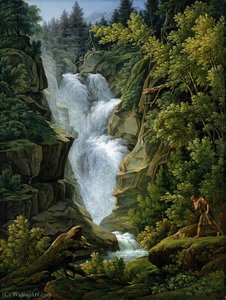
Waterfall near Subiaco (1813) by Joseph Anton Koch

Waterfall near Subiaco

1813 · Oil On Canvas · Nationalgalerie, Berlin

In the quiet majesty of Joseph Anton Koch’s 1813 masterpiece, "Waterfall near Subiaco," the viewer is invited into a world where the terrestrial and the divine converge. This breathtaking landscape does not merely depict a valley; it orchestrates a profound encounter with the sublime. At first glance, the eye is drawn to the powerful descent of the waterfall, a cascading ribbon of white that cuts through the rugged textures of…

5
Wine Festival near Olevano (1812) by Joseph Anton Koch

Wine Festival near Olevano

1812 · Oil On Canvas · Bavarian State Painting Collections, Munich

This work, titled Wine Festival near Olevano, was painted by the Austrian artist Joseph Anton Koch. Created about 1812, the piece captures a communal celebration set within a lush, hilly landscape. It reflects a specific moment in the artist's career, a period during which he was navigating the transition between the structured principles of Neoclassicism and the emotive spirit of the German Romantic movement.

6
Heroic Landscape with Saint George (1807) by Joseph Anton Koch

Heroic Landscape with Saint George

1807 · Oil On Canvas · Bavarian State Painting Collections, Munich

In this work, titled Heroic Landscape with Saint George, Joseph Anton Koch presents a scene of significant narrative tension. Painted about 1807, the composition centers on the legendary figure of Saint George. He is depicted on horseback, locked in a struggle against a dragon. This combat takes place in the lower right foreground, grounding the mythic action within the rugged terrain.

7
The Hospice on the Grimsel Pass (1813) by Joseph Anton Koch

The Hospice on the Grimsel Pass

1813 · Oil On Canvas · Staatliche Kunsthalle Karlsruhe, Carlsruhe

The rugged majesty of the Swiss Alps takes center stage in The Hospice on the Grimsel Pass. Painted by Joseph Anton Koch about 1813, this work captures a dramatic alpine scene at the Grimsel Pass. High, jagged peaks reach toward a turbulent sky, looming over the landscape with a sense of geological permanence. The scale of the mountains dwarfs the small signs of life below, creating a profound sense of…

8
Heroic Landscape with Rainbow (1805) by Joseph Anton Koch

Heroic Landscape with Rainbow

1805 · Oil On Canvas · Staatliche Kunsthalle Karlsruhe, Carlsruhe

The canvas of Heroic Landscape with Rainbow presents a sweeping, dramatic vista where the elements of nature collide in a quiet, monumental struggle. Joseph Anton Koch captures a moment of transition, where the heavy, dark weight of storm clouds meets the sudden, luminous clarity of a breaking sky. A prominent rainbow arcs across the upper frame, acting as a bridge between the turbulent weather on one side and the tranquil,…

9
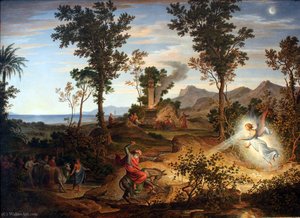
Noah's Offers up Thanks (1814) by Joseph Anton Koch

Noah's Offers up Thanks

1814 · Oil · Alte Nationalgalerie, Berlin

Noah's Offers up Thanks is a work by the Austrian painter Joseph Anton Koch. Executed in 1814, the piece reflects the artist's transition through the shifting currents of Neoclassicism and the German Romantic movement. Koch, born in 1768 in Elbigenalp, Austria, spent much of his career navigating the artistic centers of Europe, eventually settling in Rome, where he died in 1839.

10
Dante and Virgil (1811) by Joseph Anton Koch

Dante and Virgil

1811 · Engraving

This work, titled Dante and Virgil, was created by the Austrian painter Joseph Anton Koch. Dating to 1811, the piece reflects the artist's specific approach to narrative and landscape. Koch, who was born in 1768 in Elbigenalp, Austria, spent much of his career navigating the transition between different artistic movements, eventually settling in Rome, where he died in 1839.

The Joseph Anton Koch selection continues, 11 to 48

11The Berner Oberland (1815) by Joseph Anton KochThe Berner Oberland1815 12Tyrolean Landsturm 1809 (1820) by Joseph Anton KochTyrolean Landsturm 18091820 13Scene: Ship of Atonement and Mount Purgatory from the Purgatorio (1822) by Joseph Anton KochScene: Ship of Atonement and Mount Purgatory from the Purgatorio1822 14Landscape with messagers from the promised land (1816) by Joseph Anton KochLandscape with messagers from the promised land1816 · Wallraf-Richartz-Museum 15Italian Landscape with a Plowing Peasant (Die Serpentara near Olevano, Landscape near Paliano) (1825) by Joseph Anton KochItalian Landscape with a Plowing Peasant (Die Serpentara near Olevano, Landscape near Paliano)1825 16Landscape from Civitella near Olevano (1823) by Joseph Anton KochLandscape from Civitella near Olevano1823 · Statens Museum For Kunst 17Dante's Inferno (1825) by Joseph Anton KochDante's Inferno1825 18Diana and Actaeon (1833) by Joseph Anton KochDiana and Actaeon1833 · Bavarian State Painting Collections 19Landscape with the Rape of Hylas (1832) by Joseph Anton KochLandscape with the Rape of Hylas1832 · Städel Museum 20Apollo among the shepherds (1837) by Joseph Anton KochApollo among the shepherds1837 21Macbeth and the witches (1835) by Joseph Anton KochMacbeth and the witches1835 22The Upland near Bern (1816) by Joseph Anton KochThe Upland near Bern1816 · Gemäldegalerie 23View from Kloster S. Isidoro on the Engelsburg (1793) by Joseph Anton KochView from Kloster S. Isidoro on the Engelsburg1793 24The Via Mala in Graubünden (1804) by Joseph Anton KochThe Via Mala in Graubünden1804 · Staatliche Kunsthalle Karlsruhe 25The Lauterbrunnen Valley (1821) by Joseph Anton KochThe Lauterbrunnen Valley1821 26Brickworks near Olevano (1830) by Joseph Anton KochBrickworks near Olevano1830 · Bavarian State Painting Collections 27The Wetterhorn with the Reichenbachtal (1824) by Joseph Anton KochThe Wetterhorn with the Reichenbachtal1824 · Kunst Museum Winterthur | Reinhart am Stadtgarten 28Grindelwald Glacier in the Alps (1823) by Joseph Anton KochGrindelwald Glacier in the Alps1823 · National Museum in Wrocław 29Southern Landscape with Approaching Thunderstorm (1837) by Joseph Anton KochSouthern Landscape with Approaching Thunderstorm1837 30Landscape with Ruth and Boaz by Joseph Anton KochLandscape with Ruth and BoazMilwaukee Art Museum 31The Waterfalls of Tivoli near Rome by Joseph Anton KochThe Waterfalls of Tivoli near Rome 32Landscape with Ruth and Boaz by Joseph Anton KochLandscape with Ruth and BoazMilwaukee Art Museum 33Mountain Scene (1796) by Joseph Anton KochMountain Scene1796 · Wallraf-Richartz-Museum 34Heroic Landscape with Rainbow (1815) by Joseph Anton KochHeroic Landscape with Rainbow1815 · Neue Pinakothek 35Monastery of San Francesco di Civitella in the Sabine Mountains (1812) by Joseph Anton KochMonastery of San Francesco di Civitella in the Sabine Mountains1812 · Hermitage Museum 36View of the town of Olevano (Rome Province, Italy) with Rainbow by Joseph Anton KochView of the town of Olevano (Rome Province, Italy) with RainbowKupferstichkabinett 37Waterfalls at Subiaco by Joseph Anton KochWaterfalls at SubiacoAlte Nationalgalerie 38Landscape after a thunderstorm by Joseph Anton KochLandscape after a thunderstormStaatsgalerie Stuttgart 39Rape of Proserpine by Joseph Anton KochRape of Proserpine 40Two Models by Joseph Anton KochTwo Models 41Waterfall in the Bern Highlands by Joseph Anton KochWaterfall in the Bern HighlandsHamburger Kunsthalle 42Landscape with Shepherds and Cows and at the Spring by Joseph Anton KochLandscape with Shepherds and Cows and at the SpringHamburger Kunsthalle 43Countryside at Olevano with a mounted monk by Joseph Anton KochCountryside at Olevano with a mounted monkBavarian State Painting Collections 44Landscape with Abraham and the Three Angels in the Valley of Mambre by Joseph Anton KochLandscape with Abraham and the Three Angels in the Valley of Mambre 45Landscape with Bileam by Joseph Anton KochLandscape with Bileam 46Three Musicians (1958) by Joseph Anton KochThree Musicians1958 47Santa Maria Maggiore in Rome by Joseph Anton KochSanta Maria Maggiore in RomeMuseum Folkwang 48The Schmadribach Falls (1821) by Joseph Anton KochThe Schmadribach Falls1821 · Neue Pinakothek

Joseph Anton Koch's famous paintings, period by period

The subjects that held Joseph Anton Koch's eye

The four subjects that come back most often in these originals, each with its finest example.

The museums that keep Joseph Anton Koch's originals

The 8 museums that hold the most of the paintings on this page.

Museum City Works by Joseph Anton Koch Paintings from this list
Bavarian State Painting Collections, MunichBavarian State Painting Collections Munich 5 Wine Festival near Olevano, Heroic Landscape with Saint George, Diana and Actaeon
Alte Nationalgalerie, BerlinAlte Nationalgalerie Berlin 3 The death of Oscar (from The Poems of Ossian), Noah's Offers up Thanks, Waterfalls at Subiaco
Staatliche Kunsthalle Karlsruhe, CarlsruheStaatliche Kunsthalle Karlsruhe Carlsruhe 3 The Hospice on the Grimsel Pass, Heroic Landscape with Rainbow, The Via Mala in Graubünden
Städel Museum, FrankfurtStädel Museum Frankfurt 2 Landscape with Noah, Offering a Sacrifice of Gratitude, Landscape with the Rape of Hylas
Wallraf-Richartz-Museum, CologneWallraf-Richartz-Museum Cologne 2 Landscape with messagers from the promised land, Mountain Scene
Milwaukee Art Museum, MilwaukeeMilwaukee Art Museum Milwaukee 2 Landscape with Ruth and Boaz, Landscape with Ruth and Boaz
Neue Pinakothek, MunichNeue Pinakothek Munich 2 Heroic Landscape with Rainbow, The Schmadribach Falls
Hamburger Kunsthalle, HamburgHamburger Kunsthalle Hamburg 2 Waterfall in the Bern Highlands, Landscape with Shepherds and Cows and at the Spring

Joseph Anton Koch decade by decade: the original that defines each

Works per decade

Pick a decade to see the original that defines it.

Collectors' questions about Joseph Anton Koch's paintings

Which work is Joseph Anton Koch most famous for?Reveal the answer

Heroic Landscape with Rainbow (1824), Metropolitan Museum of Art, New York. The death of Oscar (from The Poems of Ossian) (1804) and Landscape with Noah, Offering a Sacrifice of Gratitude (1803) come next.

What age was Joseph Anton Koch when Heroic Landscape with Rainbow was made?Reveal the answer

56 years old: Heroic Landscape with Rainbow dates from 1824, and Joseph Anton Koch was born in 1768.

What are the ten most famous Joseph Anton Koch paintings?Reveal the answer

Heroic Landscape with Rainbow, The death of Oscar (from The Poems of Ossian), Landscape with Noah, Offering a Sacrifice of Gratitude, Waterfall near Subiaco, Wine Festival near Olevano, Heroic Landscape with Saint George, The Hospice on the Grimsel Pass, Heroic Landscape with Rainbow, Noah's Offers up Thanks and Dante and Virgil. The ranking above gives each one's year and museum.

How many paintings did Joseph Anton Koch leave?Reveal the answer

Our catalog holds 50 works by Joseph Anton Koch, dated from 1793 to 1837.

In which museums do Joseph Anton Koch's masterpieces hang?Reveal the answer

Mostly in Bavarian State Painting Collections (Munich), Alte Nationalgalerie (Berlin) and Staatliche Kunsthalle Karlsruhe (Carlsruhe). The museum table above lists them all.

In which years did Joseph Anton Koch paint the most famous works?Reveal the answer

In 1810s: 10 of the 48 works on this page were made then, Waterfall near Subiaco among them.

What are the first and the last famous originals of Joseph Anton Koch?Reveal the answer

On this page, the earliest is View from Kloster S. Isidoro on the Engelsburg (1793) and the latest Apollo among the shepherds (1837).

Which subjects did Joseph Anton Koch choose most often?Reveal the answer

Mountains (24), Trees (19) and Landscape (14), across the 48 works on this page.

Which technique did Joseph Anton Koch use most?Reveal the answer

Oil On Canvas, for 24 of the 48 works on this page.

To which art movement does Joseph Anton Koch belong?Reveal the answer

Romanticism and Neoclassicism, judging by the originals on this page.

Which Joseph Anton Koch works hang at the Bavarian State Painting Collections?Reveal the answer

Wine Festival near Olevano, Heroic Landscape with Saint George and Diana and Actaeon: the Bavarian State Painting Collections, Munich holds 5 of the works on this page.

Joseph Anton Koch: life and work

The Architect of the Heroic Landscape

Joseph Anton Koch stands as a singular figure in Austrian art history—a painter who deftly navigated the shifting currents of Neoclassicism into the burgeoning fervor of German Romanticism. Born in 1768 in Elbigenalp, Austria, his early life was marked by a pastoral simplicity that would profoundly shape his artistic vision; tending cattle in his youth instilled in him an intimate appreciation for the natural world, a connection that later manifested in his monumental depictions of earth and sky. A fortuitous recommendation from Bishop Umgelder secured him a prestigious academic education at Stuttgart’s Karlsschule, a rigorous military academy where discipline and intellectual pursuit converged. However, Koch's youthful spirit rebelled against such constraints, leading to a brief but formative wanderlust through France and Switzerland before he finally established himself in the artistic crucible of Rome in 1795.

In the heart of Italy, Koch found kinship with fellow painter Asmus Jacob Carstens, adopting a style often referred to as the heroic aesthetic. This approach initially mirrored Carstens’ literal interpretations of mythological narratives, characterized by a certain sculptural clarity and formal rigor. Koch demonstrated his technical prowess not only through paint but also through the meticulous art of printmaking, notably etching the pages of Carrend's Les Argonautes. This period of his life was defined by a mastery of detail and a command over line that would serve as the foundation for his later, more expansive compositions.

A Visionary Evolution: From Myth to Mountain

As his career progressed, Koch underwent a profound artistic evolution, transitioning from the structured narratives of Neoclassicism toward the sweeping grandeur of landscape painting. He began to reimagine classical ideals through the lens of the Austrian Alps and the Italian countryside, producing works that felt both timeless and intensely visceral. Influenced by the monumental compositions of masters like Nicolas Poussin and Claude Lorrain, Koch developed a unique way of organizing space, where dramatic lighting and vast, rugged terrains created a sense of awe. His landscapes were never merely topographical records; they were emotional journeys through heroic scenery.

His ability to blend the classical with the romantic is perhaps best seen in his treatment of light and atmosphere. In works such as Heroic Landscape with Rainbow, he utilizes a Baroque sensibility to introduce dramatic weather elements that punctuate the stillness of the mountains. This technique allowed him to bridge two eras: the ordered, rational world of the Enlightenment and the emotive, untamed spirit of Romanticism. Even when depicting serene scenes, such as the Monastery of San Francesco di Civitella in the Sabine Mountains, there remains an underlying sense of the sublime—a realization of nature's immense power and scale.

Legacy and Historical Significance

The later years of Koch's life were marked by both movement and resilience. Facing financial hardships exacerbated by Napoleon’s invasions, he relocated to Vienna in 1812. In this new setting, he flourished under the patronage of influential intellectuals like Friedrich Schlegel and became a central figure in the Germanic artistic tradition. His work during this period began to reflect a shift toward harsher, more dramatic elements, further cementing his role as a pioneer of the landscape genre.

The historical significance of Joseph Anton Koch lies in his ability to transform the landscape from a secondary, decorative element into a primary vehicle for philosophical and emotional expression. His contributions can be summarized through several key artistic pillars:

  • Synthesis of Styles: He successfully merged the formal discipline of Neoclassicism with the emotional depth of German Romanticism.
  • The Heroic Aesthetic: He redefined landscape painting by introducing a sense of monumental scale and dramatic, "heroic" compositions.
  • Technical Mastery: His skill spanned from the delicate precision of etching to the sweeping, atmospheric brushwork required for vast mountain vistas.
  • Cultural Bridge: He acted as a vital link between the classical traditions of Rome and the emerging nationalistic landscape movements in Austria and Germany.

Today, Koch is remembered not just as an Austrian painter, but as a visionary who taught viewers to look upon the mountains and see within them the very soul of the sublime.