Portrait of Bernardo Daddi

The 89 Most Famous Bernardo Daddi Paintings, a Gallery Selection

Updated November 2026 · ranked by our popularity score (searches, visits and orders for each work) · 89 works by Bernardo Daddi in our catalogue

In short

Of all the originals Bernardo Daddi left, the most famous is Saint Gregory the Great (in pinnacle: a Prophet) (1334), in the collection of the Harvard Art Museums, Cambridge. Close behind it come Saint Reparata Being Prepared for Execution (1300) and Saint Reparata before the Emperor Decius (1338). Our catalog holds 89 works by Bernardo Daddi; the gallery has kept the 89 the world admires most, each shown with its date, its museum and its story.

1290 – 1348, Florence Gothic Most works: Courtauld Gallery

Bernardo Daddi's top 10 paintings: the gallery's choice

1
Saint Gregory the Great (in pinnacle: a Prophet) (1334) by Bernardo Daddi

Saint Gregory the Great (in pinnacle: a Prophet)

1334 · Tempera On Panel · Harvard Art Museums, Cambridge

A single figure occupies the center of this vertical wooden panel, suspended against a flat, luminous gold ground. Saint Gregory the Great faces the viewer with a solemn, steady gaze. He is an elderly man, his face etched with the gravity of his station. He wears a white mitre, its surface adorned with a jeweled crown-like band that catches the light. Over his shoulders, a heavy red cope falls in…
2
Saint Reparata Being Prepared for Execution (1300) by Bernardo Daddi

Saint Reparata Being Prepared for Execution

1300 · Tempera On Panel · Metropolitan Museum of Art, New York

The painted panel titled Saint Reparata Being Prepared for Execution is a work by the Florentine artist Bernardo Daddi. This piece dates to approximately 1338–1340. It is a tempera on panel composition that originated as part of a larger series from a high altarpiece. Specifically, the panel functioned as part of a predella, which is a two-tiered base, illustrating eight distinct scenes from the life of the saint.

4
A Crowned Virgin Martyr (St. Catherine of Alexandria) (1340) by Bernardo Daddi

A Crowned Virgin Martyr (St. Catherine of Alexandria)

1340 · Tempera On Panel · Fine Arts Museums of San Francisco, San Francisco

A vertical silhouette emerges from a field of textured gold. St. Catherine of Alexandria is caught in a moment of quietude, her head tilted slightly toward the left. She wears a crown of gold, heavy with dark jewels, resting upon hair that meets the sharp point of a Gothic arch. Her tunic is the color of deep teal, draped in folds that catch the light, while an orange mantle wraps…

5
Christ Enthroned with Saints (1350) by Bernardo Daddi

Christ Enthroned with Saints

1350 · Tempera On Panel · Metropolitan Museum of Art, New York

To stand before this panel is to encounter the structured devotion of mid-14th century Florence. The composition is governed by a strict verticality, drawing the eye upward toward Christ, who is seated in an upper lobed section. He holds a red book and offers a gesture of blessing, his presence anchored by the formal symmetry of the throne. Below this central figure, the arrangement shifts into a circular medallion, flanked…

6
Arrival of Saint Ursula at Cologne (1333) by Bernardo Daddi

Arrival of Saint Ursula at Cologne

1333 · Tempera On Panel · J. Paul Getty Museum, Los Angeles

We are looking at Arrival of Saint Ursula at Cologne, a work by the Florentine painter Bernardo Daddi. Created about 1333, this piece originates from a period when Daddi was a central figure in the artistic life of Florence. He was an Italian artist who lived from about 1280 to 1348, working through the transition of styles in the early fourteenth century.

7
The Temptation of St Thomas Aquinas (1338) by Bernardo Daddi

The Temptation of St Thomas Aquinas

1338 · Tempera · Staatliche Museen zu Berlin, Berlin

To gaze upon this depiction of Saint Dominic receiving divine guidance is to witness art at its most profound—a captured breath from the intersection of earthly devotion and celestial revelation. The scene, rendered with exquisite care, transports the viewer into an intimate architectural space, suggesting a moment so sacred that time itself seems to pause. It is not merely a portrait of a saint; it is an embodiment of spiritual…

8
The Assumption of the Virgin (1337) by Bernardo Daddi

The Assumption of the Virgin

1337 · Tempera On Panel · Metropolitan Museum of Art, New York

In the heart of fourteenth-century Florence, a period defined by the delicate transition from the stylized elegance of the Gothic era to the burgeoning humanism of the Renaissance, Bernardo Daddi emerged as a master of light and devotion. His masterpiece, The Assumption of the Virgin, serves as a breathtaking window into a world where the earthly and the divine intersect. This tempera panel on wood, executed with a meticulous hand…

9
Fixed Triptych: in the center, The Virgin and Child surrounded by twenty angels and four saints (John the Baptist and Peter on one side, Paul and Lawrence [?] on the other); on the left, The Nativity; on the right, The (1338) by Bernardo Daddi

Fixed Triptych: in the center, The Virgin and Child surrounded by twenty angels and four saints (John the Baptist and Peter on one side, Paul and Lawrence [?] on the other); on the left, The Nativity; on the right, The

1338 · Tempera On Panel

This Fixed Triptych: in the center, The Virgin and Child surrounded by twenty angels and four saints (John the Baptist and Peter on one side, Paul and Lawrence [?] on the other); on the left, The Nativity; on the right, The is a work by Bernardo Daddi. The artist, born in Florence, Italy, in 1290, crafted this composition in 1338. His hand guided the brush through the transition of eras…

10
The Wedding Feast of St Cecilia (1334) by Bernardo Daddi

The Wedding Feast of St Cecilia

1334 · Tempera On Panel · Bavarian State Painting Collections, Munich

The air within this architectural space feels heavy with the scent of fruit and the quiet murmur of a communal meal. Sunlight does not strike the scene from a single source; instead, a soft, diffused glow bathes the figures, casting no harsh shadows and creating a sense of eternal, suspended time. We find ourselves looking into a shallow, stage-like room where the boundaries of space are defined by elegant vertical…

The Bernardo Daddi selection continues, 11 to 89

11Virgin and Child with Saints John the Baptist and Giles, Two Prophets, and Christ the Redeemer (1334) by Bernardo DaddiVirgin and Child with Saints John the Baptist and Giles, Two Prophets, and Christ the Redeemer1334 · Philadelphia Museum of Art 12The Nativity and the Annunciation to the Shepherds (1336) by Bernardo DaddiThe Nativity and the Annunciation to the Shepherds1336 · Museum of Fine Arts 13Saint Paul and a Group of Worshippers (1333) by Bernardo DaddiSaint Paul and a Group of Worshippers1333 · National Gallery of Art 14Saint Reparata Tortured with Red-Hot Irons (1337) by Bernardo DaddiSaint Reparata Tortured with Red-Hot Irons1337 · Metropolitan Museum of Art 15The Virgin and Child Enthroned with Saints (triptych, closed) (1338) by Bernardo DaddiThe Virgin and Child Enthroned with Saints (triptych, closed)1338 · Courtauld Gallery 16Magus Adoring the Infant Christ and Bishop (triptych, right wing) (verso) (1338) by Bernardo DaddiMagus Adoring the Infant Christ and Bishop (triptych, right wing) (verso)1338 · Courtauld Gallery 17Four Musical Angels (1340) by Bernardo DaddiFour Musical Angels1340 · Christ Church Picture Gallery 18Saint Peter (1330) by Bernardo DaddiSaint Peter1330 · Courtauld Gallery 19Two Magi and Bishop (triptych, left wing) (verso) (1338) by Bernardo DaddiTwo Magi and Bishop (triptych, left wing) (verso)1338 · Courtauld Gallery 20The Group of saints. (1330) by Bernardo DaddiThe Group of saints.1330 · Czartoryski Museum 21Birth of Christ (1338) by Bernardo DaddiBirth of Christ1338 · Scottish National Gallery 22Triptych: the Nativity, the Coronation of the Virgin, and the Crucifixion (1339) by Bernardo DaddiTriptych: the Nativity, the Coronation of the Virgin, and the Crucifixion1339 · Gemäldegalerie 23The Virgin and Child, with Christ Blessing (1340) by Bernardo DaddiThe Virgin and Child, with Christ Blessing1340 · Harvard Art Museums 24Virgin and Child (1345) by Bernardo DaddiVirgin and Child1345 · Yale University Art Gallery 25Holy bishop wit a goldfinch (1350) by Bernardo DaddiHoly bishop wit a goldfinch1350 · Bavarian State Painting Collections 26The Crucifixion (polyptych, panel 3 of 5) (1348) by Bernardo DaddiThe Crucifixion (polyptych, panel 3 of 5)1348 · Courtauld Gallery 27Saints Peter and Paul (polyptych, panel 4 of 5) (1348) by Bernardo DaddiSaints Peter and Paul (polyptych, panel 4 of 5)1348 · Courtauld Gallery 28Saints Bartholomew and George (polyptych, panel 2 of 5) (1348) by Bernardo DaddiSaints Bartholomew and George (polyptych, panel 2 of 5)1348 · Courtauld Gallery 29Virgin and Child (1346) by Bernardo DaddiVirgin and Child1346 · Isabella Stewart Gardner Museum 30Saint Margret and Saint Agnes (1507) by Bernardo DaddiSaint Margret and Saint Agnes1507 · Musée Des Beaux 31Christ on the Cross between the Virgin and Saints Mary Magdalene and John the Evangelist; left panel: The Agony in the Garden and Saints Peter and Paul; right panel: Saints Catherine of Alexandria and (1334) by Bernardo DaddiChrist on the Cross between the Virgin and Saints Mary Magdalene and John the Evangelist; left panel: The Agony in the Garden and Saints Peter and Paul; right panel: Saints Catherine of Alexandria and1334 · Harvard Art Museums 32The Crucifixion (1325) by Bernardo DaddiThe Crucifixion1325 · Metropolitan Museum of Art 33The Virgin Mary with Saints Thomas Aquinas and Paul (1335) by Bernardo DaddiThe Virgin Mary with Saints Thomas Aquinas and Paul1335 · J. Paul Getty Museum 34Madonna and Child Enthroned with Saints (1339) by Bernardo DaddiMadonna and Child Enthroned with Saints1339 · Minneapolis Institute of Art 35Madonna and Child (1335) by Bernardo DaddiMadonna and Child1335 · Vatican Pinacoteca 36Portable, Double Sided Cross (recto) (1340) by Bernardo DaddiPortable, Double Sided Cross (recto)1340 · Museo Poldi Pezzoli 37Triptych (1333) by Bernardo DaddiTriptych1333 · Loggia del Bigallo 38Virgin and Child with Saint Peter and Saint Paul (1340) by Bernardo DaddiVirgin and Child with Saint Peter and Saint Paul1340 · Courtauld Gallery 39Coronation of the Virgin (1340) by Bernardo DaddiCoronation of the Virgin1340 · Lindenau-Museum 40The Coronation of the Virgin (1340) by Bernardo DaddiThe Coronation of the Virgin1340 · National Gallery 41St Catherine of Alexandria with Donor and Christ Blessing (detail) (1340) by Bernardo DaddiSt Catherine of Alexandria with Donor and Christ Blessing (detail)1340 · Museo dell'Opera del Duomo 42Crucifixion (1345) by Bernardo DaddiCrucifixion1345 · Lindenau-Museum 43Crucifixion (1320) by Bernardo DaddiCrucifixion1320 · Worcester Art Museum 44Madonna and Child with Saints (1320) by Bernardo DaddiMadonna and Child with Saints1320 · Worcester Art Museum 45The Nativity (1340) by Bernardo DaddiThe Nativity1340 · Metropolitan Museum of Art 46Triptych (1335) by Bernardo DaddiTriptych1335 · Lindenau-Museum 47The Vocation of Saint Dominic (1338) by Bernardo DaddiThe Vocation of Saint Dominic1338 · Yale University Art Gallery 48The Crucifixion (1325) by Bernardo DaddiThe Crucifixion1325 · National Gallery of Art 49Triptych (detail) (1335) by Bernardo DaddiTriptych (detail)1335 · Lindenau-Museum 50The Martyrdom of St Stephen (1324) by Bernardo DaddiThe Martyrdom of St Stephen1324 · Santa Croce 51St Catherine of Alexandria with Donor and Christ Blessing (1340) by Bernardo DaddiSt Catherine of Alexandria with Donor and Christ Blessing1340 · Museo dell'Opera del Duomo 52Crucifixion (detail) (1345) by Bernardo DaddiCrucifixion (detail)1345 · Lindenau-Museum 53Virgin and Child (1340) by Bernardo DaddiVirgin and Child1340 · Thyssen-Bornemisza Museum 54Madonna and Child with Sts Matthew and Nicholas (1328) by Bernardo DaddiMadonna and Child with Sts Matthew and Nicholas1328 · Galleria degli Uffizi 55The Annunciation (1335) by Bernardo DaddiThe Annunciation1335 · The Louvre 56Madonna and Child with Saints and Angels d8 by Bernardo DaddiMadonna and Child with Saints and Angels d8 57Madonna and Child with Saints (1340) by Bernardo DaddiMadonna and Child with Saints1340 · New Orleans Museum of Art 58Orsanmichele Madonna and Child with Angels (1346) by Bernardo DaddiOrsanmichele Madonna and Child with Angels1346 · Orsanmichele 59Virgin and Child Enthroned with Saints (1343) by Bernardo DaddiVirgin and Child Enthroned with Saints1343 · Museo Horne 60Virgin and Child with Saints (1338) by Bernardo DaddiVirgin and Child with Saints1338 · Courtauld Gallery 61Portable, Double Sided Cross (verso) (1340) by Bernardo DaddiPortable, Double Sided Cross (verso)1340 · Museo Poldi Pezzoli 62Triptych (1338) by Bernardo DaddiTriptych1338 · Staatliche Museen zu Berlin 63The Crucifixion by Bernardo DaddiThe CrucifixionMuseum of Fine Arts 64The Nativity by Bernardo DaddiThe NativityWallace Collection 65Madonna and Child Enthroned with Saints by Bernardo DaddiMadonna and Child Enthroned with Saints 66Madonna and Child Enthroned with Saints by Bernardo DaddiMadonna and Child Enthroned with Saints 67Madonna and Child with Saints and Angels (1345) by Bernardo DaddiMadonna and Child with Saints and Angels1345 · National Gallery of Art 68Crucifixion (1340) by Bernardo DaddiCrucifixion1340 · Collezione Vittorio Cini 69Polyptych of San Pancrazio: Predella panel by Bernardo DaddiPolyptych of San Pancrazio: Predella panelGalleria degli Uffizi 70Triptych of the Betrothal of St. Catherine Flanked with St. Bartholomew and St. Benedict? by Bernardo DaddiTriptych of the Betrothal of St. Catherine Flanked with St. Bartholomew and St. Benedict?National Gallery Prague 71Madonna and Child with Saints and Angels d0 by Bernardo DaddiMadonna and Child with Saints and Angels d0 72Madonna and Child with Saints and Angels d6 by Bernardo DaddiMadonna and Child with Saints and Angels d6 73Madonna and Child with Saints and Angels d2 by Bernardo DaddiMadonna and Child with Saints and Angels d2 74Madonna and Child with Saints and Angels d1 by Bernardo DaddiMadonna and Child with Saints and Angels d1 75Madonna and Child with Saints and Angels d3 by Bernardo DaddiMadonna and Child with Saints and Angels d3 76Madonna and Child with Saints and Angels d5 by Bernardo DaddiMadonna and Child with Saints and Angels d5 77Madonna and Child with Saints and Angels d9 by Bernardo DaddiMadonna and Child with Saints and Angels d9 78Madonna and Child with Saints and Angels d7 by Bernardo DaddiMadonna and Child with Saints and Angels d7 79Madonna and Child with Saints and Angels d4 by Bernardo DaddiMadonna and Child with Saints and Angels d4 80Polyptych of San Pancrazio: Predella panel by Bernardo DaddiPolyptych of San Pancrazio: Predella panelRoyal Collection 81Polyptych of San Pancrazio: Predella panel by Bernardo DaddiPolyptych of San Pancrazio: Predella panelGalleria degli Uffizi 82Polyptych of San Pancrazio by Bernardo DaddiPolyptych of San PancrazioGalleria degli Uffizi 83Saint Pancras Polyptych (1338) by Bernardo DaddiSaint Pancras Polyptych1338 84Madonna and Child with Sts Matthew and Nicholas (1328) by Bernardo DaddiMadonna and Child with Sts Matthew and Nicholas1328 85Saint Lawrence (1340) by Bernardo DaddiSaint Lawrence1340 · Pinacoteca di Brera 86Polyptych of the Madonna and four saints (1332) by Bernardo DaddiPolyptych of the Madonna and four saints1332 · Museo Civico 87Crucifix (1340) by Bernardo DaddiCrucifix1340 · Museo Bardini 88Story of the true Belt (1337) by Bernardo DaddiStory of the true Belt1337 · Museo Civico 89Madonna and Child Enthroned with Angels and Saints (1334) by Bernardo DaddiMadonna and Child Enthroned with Angels and Saints1334 · Galleria degli Uffizi

Bernardo Daddi's famous paintings, period by period

The subjects that held Bernardo Daddi's eye

The four subjects that come back most often in these originals, each with its finest example.

The museums that keep Bernardo Daddi's originals

The 8 museums that hold the most of the paintings on this page.

Museum City Works by Bernardo Daddi Paintings from this list
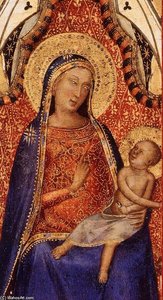
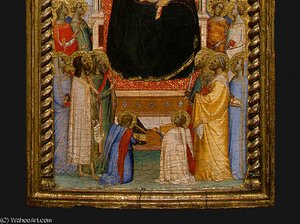
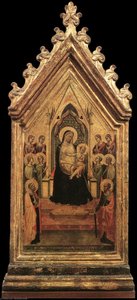
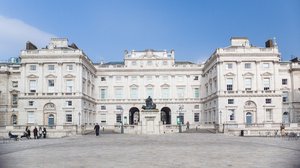
Courtauld Gallery, LondonCourtauld Gallery London 9 The Virgin and Child Enthroned with Saints (triptych, closed), Magus Adoring the Infant Christ and Bishop (triptych, right wing) (verso), Saint Peter
Metropolitan Museum of Art, New YorkMetropolitan Museum of Art New York 7 Saint Reparata Being Prepared for Execution, Saint Reparata before the Emperor Decius, Christ Enthroned with Saints
Lindenau-Museum, AltengauLindenau-Museum Altengau 5 Coronation of the Virgin, Crucifixion, Triptych
Galleria degli Uffizi, FlorenceGalleria degli Uffizi Florence 5 Madonna and Child with Sts Matthew and Nicholas, Polyptych of San Pancrazio: Predella panel, Polyptych of San Pancrazio: Predella panel
Harvard Art Museums, CambridgeHarvard Art Museums Cambridge 3 Saint Gregory the Great (in pinnacle: a Prophet), The Virgin and Child, with Christ Blessing, Christ on the Cross between the Virgin and Saints Mary Magdalene and John the Evangelist; left panel: The Agony in the Garden and Saints Peter and Paul; right panel: Saints Catherine of Alexandria and
National Gallery of Art, WashingtonNational Gallery of Art Washington 3 Saint Paul and a Group of Worshippers, The Crucifixion, Madonna and Child with Saints and Angels
J. Paul Getty Museum, Los AngelesJ. Paul Getty Museum Los Angeles 2 Arrival of Saint Ursula at Cologne, The Virgin Mary with Saints Thomas Aquinas and Paul
Staatliche Museen zu Berlin, BerlinStaatliche Museen zu Berlin Berlin 2 The Temptation of St Thomas Aquinas, Triptych

Bernardo Daddi decade by decade: the original that defines each

Works per decade

Pick a decade to see the original that defines it.

Collectors' questions about Bernardo Daddi's paintings

Which work is Bernardo Daddi most famous for?Reveal the answer

Saint Gregory the Great (in pinnacle: a Prophet) (1334), Harvard Art Museums, Cambridge. Saint Reparata Being Prepared for Execution (1300) and Saint Reparata before the Emperor Decius (1338) come next.

What age was Bernardo Daddi when Saint Gregory the Great (in pinnacle: a Prophet) was made?Reveal the answer

44 years old: Saint Gregory the Great (in pinnacle: a Prophet) dates from 1334, and Bernardo Daddi was born in 1290.

What are the ten most famous Bernardo Daddi paintings?Reveal the answer

Saint Gregory the Great (in pinnacle: a Prophet), Saint Reparata Being Prepared for Execution, Saint Reparata before the Emperor Decius, A Crowned Virgin Martyr (St. Catherine of Alexandria), Christ Enthroned with Saints, Arrival of Saint Ursula at Cologne, The Temptation of St Thomas Aquinas, The Assumption of the Virgin, Fixed Triptych: in the center, The Virgin and Child surrounded by twenty angels and four saints (John the Baptist and Peter on one side, Paul and Lawrence [?] on the other); on the left, The Nativity; on the right, The and The Wedding Feast of St Cecilia. The ranking above gives each one's year and museum.

How many paintings did Bernardo Daddi leave?Reveal the answer

Our catalog holds 89 works by Bernardo Daddi, dated from 1300 to 1348.

In which museums do Bernardo Daddi's masterpieces hang?Reveal the answer

Mostly in Courtauld Gallery (London), Metropolitan Museum of Art (New York) and Lindenau-Museum (Altengau). The museum table above lists them all.

In which years did Bernardo Daddi paint the most famous works?Reveal the answer

In 1330s: 33 of the 89 works on this page were made then, Saint Gregory the Great (in pinnacle: a Prophet) among them.

What are the first and the last famous originals of Bernardo Daddi?Reveal the answer

On this page, the earliest is Saint Reparata Being Prepared for Execution (1300) and the latest The Crucifixion (polyptych, panel 3 of 5) (1348).

Which subjects did Bernardo Daddi choose most often?Reveal the answer

Gold background (26), Saints (26) and Angels (24), across the 89 works on this page.

Which technique did Bernardo Daddi use most?Reveal the answer

Tempera On Panel, for 52 of the 89 works on this page.

To which art movement does Bernardo Daddi belong?Reveal the answer

Gothic and Proto-renaissance, judging by the originals on this page.

Which Bernardo Daddi works hang at the Courtauld Gallery?Reveal the answer

The Virgin and Child Enthroned with Saints (triptych, closed), Magus Adoring the Infant Christ and Bishop (triptych, right wing) (verso) and Saint Peter: the Courtauld Gallery, London holds 9 of the works on this page.

Bernardo Daddi: life and work

Bernardo Daddi: Bridging Gothic and Renaissance in Florence

Bernardo Daddi, born in Florence around 1290 and passing away in 1348, stands as a pivotal figure in the transition from the late Gothic to the burgeoning Italian Renaissance. He wasn’t a revolutionary iconoclast shattering established conventions overnight, but rather a master craftsman who subtly yet profoundly shifted the artistic landscape of his time, particularly within the vibrant city of Florence. Often described as the “leading painter” of Florence during his generation, Daddi's legacy lies not in radical departures, but in a measured evolution—a careful refinement of existing techniques and a dedication to realism that marked a crucial step toward the humanist ideals of the Renaissance.

Early Life and Artistic Roots

Daddi’s precise birthdate remains shrouded in some mystery, though records indicate he was first mentioned in 1312. It's widely believed that his artistic journey began under the tutelage of Giotto di Bondone, one of the most influential artists of the era. Giotto’s emphasis on naturalism and emotional expression undoubtedly shaped Daddi’s early style. His initial works demonstrate a clear connection to Giotto’s followers – masters like the “Master of Santa Cecilia” and other Florentine painters of the first quarter of the 14th century—reflecting a direct lineage of artistic influence. These early pieces showcase a stylistic fidelity, utilizing techniques common in the Gothic tradition while hinting at the burgeoning realism that would define his later career. The meticulous detail and vibrant colors characteristic of this period suggest a strong grounding in established practices, yet with an emerging sensitivity to depicting human form and emotion.

A Style Defined by Realism and Portable Altarpieces

Daddi’s artistic style represents a significant departure from the stylized, often highly symbolic, imagery prevalent in Gothic art. He sought to achieve a more accurate and believable representation of reality—a core tenet of the Renaissance. This shift is particularly evident in his smaller-scale works, where he skillfully rendered textures, drapery, and facial expressions with remarkable detail. Crucially, Daddi played a key role in popularizing the portable altarpiece format. These multi-panel compositions, designed to be displayed in churches and chapels, allowed for greater narrative complexity and visual richness than traditional wall paintings. Daddi’s later style, influenced by Maso di Banco, demonstrates an increased refinement—a subtle elegance that belies a certain academic precision. This blend of lyrical beauty and technical skill is what distinguishes his work and cemented his position as a leading Florentine painter.

Notable Works and Museum Collections

Bernardo Daddi’s artistic output has left an indelible mark on the collections of some of the world's most prestigious museums. The Uffizi Gallery in Florence houses a significant triptych from 1328, offering a compelling glimpse into his compositional skills and narrative storytelling. Equally remarkable is the “Martyrdom of Saint Stephen” housed within the Pinacoteca Vaticana—a predella comprised of eight panels painted around 1345. Beyond these iconic pieces, Daddi’s influence can be seen in numerous works scattered across institutions like the National Gallery of Art and the Walters Art Museum. His “Processional Cross,” for example, exemplifies his ability to capture movement and detail within a relatively small format. The Courtauld Institute of Art holds several panels from the "Coronation of the Virgin," showcasing his mastery of depicting religious figures and their surroundings.

Influences and Lasting Legacy

Daddi’s artistic development wasn't solely rooted in Giotto’s teachings; he was also influenced by the Sienese art of Lorenzetti, whose emphasis on civic virtue and naturalistic representation resonated with Daddi’s own aesthetic sensibilities. His last known work dates back to 1347, and sadly, he passed away shortly thereafter. Despite a certain “academic and mechanical hardness” noted by some critics—a characteristic perhaps stemming from his workshop's prolific output—Daddi’s lyrical elegance and technical skill ensured his enduring legacy. He bridged the gap between the Gothic past and the nascent Renaissance, shaping the visual language of Florence and leaving behind a body of work that continues to captivate viewers today. His contributions to the development of portable altarpieces and his commitment to realistic depiction laid the groundwork for future generations of Italian artists.

Useful Resources