Portrait of Simon De Vlieger

Simon De Vlieger Paintings: The 93 Most Famous, Through a Gallery's Eye

Updated November 2026 · ranked by our popularity score (searches, visits and orders for each work) · 105 works by Simon De Vlieger in our catalogue

In short

To the gallery's eye, Simon De Vlieger's most famous painting is The Northwest Side of the Rotterdam Gate at Delft in Winter (1645), whose original hangs in the Rijksmuseum, Amsterdam. A Calm Sea (1642) and Estuary at Day's End (1645) complete the trio every eye recognises. Of the 105 works by Simon De Vlieger in our catalog, the gallery presents the 93 most famous below, each original with its year, its museum and what makes it unique.

1601 – 1653, Rotterdam Dutch golden age Most works: National Maritime Museum

The gallery's top 10 Simon De Vlieger paintings

1
The Northwest Side of the Rotterdam Gate at Delft in Winter (1645) by Simon De Vlieger

The Northwest Side of the Rotterdam Gate at Delft in Winter

1645 · Chalk · Rijksmuseum, Amsterdam

Simon De Vlieger’s The Northwest Side of the Rotterdam Gate at Delft in Winter presents a detailed winter scene centered on a bustling city gate. In the foreground, human activity defines a commercial area where people converse and load goods onto carts. Several horses, harnessed to these carts, anchor the lower plane of the composition. A small boat rests on the waterway, marking the importance of the canal for local…

2
A Calm Sea (1642) by Simon De Vlieger

A Calm Sea

1642 · Oil On Panel · Detroit Institute of Arts, Detroit

is a maritime landscape by the Dutch Golden Age painter Simon De Vlieger. Executed in 1642, the work captures a moment of maritime stillness. The composition focuses on a tranquil seascape characterized by calm weather and a steady horizon.

3
Estuary at Day's End (1645) by Simon De Vlieger

Estuary at Day's End

1645 · Oil On Canvas · National Gallery of Art, Washington

In "Estuary at Day's End," Simon de Vlieger captures a quiet moment where the land meets the tide. The scene unfolds across a wide estuary, where the water reflects the fading light of the day. To the left, a rugged, rocky coastline breaks the edge of the water, providing a solid boundary to the shifting currents. Along this shore, fishermen go about their work, their presence grounding the vast landscape…

4
View of a Beach (1646) by Simon De Vlieger

View of a Beach

1646 · Oil On Canvas · Los Angeles County Museum of Art, Los Angeles

is an oil painting by the Dutch artist Simon De Vlieger. The work is dated 1646. This piece belongs to the period of the Dutch Golden Age, a time characterized by maritime dominance and artistic development in the Netherlands. The artist, Simon De Vlieger, was born in Rotterdam around 1601 and remained active in the region until his death in 1653.

5
Beach with fishermen (1650) by Simon De Vlieger

Beach with fishermen

1650 · Oil On Canvas · Rijksmuseum, Amsterdam

The artwork titled Beach with fishermen is an oil on canvas painting. This piece is attributed to the Dutch artist Simon De Vlieger. The work is dated about 1635 - 1640. It belongs to the period of the Dutch Golden Age, a time of maritime activity and artistic production in the Netherlands.

6
Sea Coast at Scheveningen (1653) by Simon De Vlieger

Sea Coast at Scheveningen

1653 · Oil On Canvas · National Museum in Warsaw, Warsaw

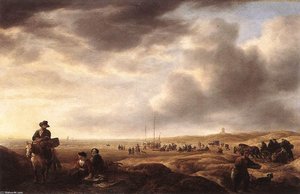
A wide expanse of beach stretches across the foreground, populated by scattered figures and several fishing boats. The horizon line divides the composition into three distinct zones: the sandy shore, the sea, and a vast, cloudy sky. To the left, a cluster of boats rests near the water's edge, their masts providing the only vertical interruptions to the dominant horizontal planes. In the distance, a faint cityscape traces the horizon,…

7
Seascape in the Morning (detail) (1640) by Simon De Vlieger

Seascape in the Morning (detail)

1640 · Oil On Panel · National Gallery of Art, Washington

To gaze upon Simon de Vlieger's "Seascape in the Morning" is to be immediately swept away by the raw, untamed power of the ocean. This 1640 masterpiece, an oil on panel, does not offer a tranquil vista; rather, it plunges the viewer into a moment of profound maritime crisis. The scene is a breathtaking tableau of human vulnerability set against nature's overwhelming might. One can almost hear the creak of…

8
The falconer's homecoming (1637) by Simon De Vlieger

The falconer's homecoming

1637 · Oil On Panel · Rijksmuseum, Amsterdam

We are looking at The falconer's homecoming, a work from 1637 by the Dutch painter Simon De Vlieger. This oil on panel piece carries several identities within the collections of the Rijksmuseum. It is known by the title Gezicht op een vervallen gebouw met een fontein, and it is also referred to as L’Abreuvoir (The Watering Place). It is a quiet, atmospheric composition that reflects the artist's ability to handle…

9
A Dutch Man-of-War and Various Vessels in a Breeze (1642) by Simon De Vlieger

A Dutch Man-of-War and Various Vessels in a Breeze

1642 · Acrylic On Canvas · National Gallery, London

Simon de Vlieger's "A Dutch Man-of-War and Various Vessels in a Breeze," painted in 1642, isn’t merely a depiction of ships at sea; it’s a visceral experience of the ocean’s raw power. This remarkable work transcends simple maritime record to become a profound meditation on human vulnerability against the immensity of nature. De Vlieger, a pivotal figure in the transition from the monochrome seascapes of Jan Porcellis and Willem van…

10
Visit of Frederick Hendriks II to Dordrecht in 1646 (1649) by Simon De Vlieger

Visit of Frederick Hendriks II to Dordrecht in 1646

1649 · Oil On Canvas · Kunsthistorisches Museum, Vienna

Simon de Vlieger’s “Visit of Frederick Hendriks II to Dordrecht in 1646” – A Masterpiece of Dutch Maritime Painting The year is 1646, and the bustling port city of Dordrecht plays host to a significant event: the arrival of Frederick Hendriks II. Captured with remarkable detail and imbued with a palpable sense of drama, Simon de Vlieger’s “Visit of Frederick Hendriks II to Dordrecht in 1646” is more than just…

Simon De Vlieger paintings, ranked 11 to 93

11Estuary Scene (1620) by Simon De VliegerEstuary Scene1620 12Calm Sea with Fishermen (1626) by Simon De VliegerCalm Sea with Fishermen1626 · Bavarian State Painting Collections 13Rough Sea (1635) by Simon De VliegerRough Sea1635 · Bavarian State Painting Collections 14Coast in Calm Sea (1626) by Simon De VliegerCoast in Calm Sea1626 · Bavarian State Painting Collections 15Coastal Landscape with Foraging Seafarers (1634) by Simon De VliegerCoastal Landscape with Foraging Seafarers1634 · Museum of Fine Arts of Lyon 16Edge of a Wood with a Stream and Cattle (1634) by Simon De VliegerEdge of a Wood with a Stream and Cattle1634 · Museum Boijmans Van Beuningen 17The entrance to a harbor (1634) by Simon De VliegerThe entrance to a harbor1634 18Seascape (1624) by Simon De VliegerSeascape1624 · Hermitage Museum 19Ships on a calm Sea (1634) by Simon De VliegerShips on a calm Sea1634 · Philadelphia Museum of Art 20Ships off the Dutch Coast (1634) by Simon De VliegerShips off the Dutch Coast1634 · Statens Museum For Kunst 21Marine with Dutch Shipping (1635) by Simon De VliegerMarine with Dutch Shipping1635 · Fine Arts Museums of San Francisco 22the shore near Scheveningen (1625) by Simon De Vliegerthe shore near Scheveningen1625 23Slightly waving sea with sailing ship (1634) by Simon De VliegerSlightly waving sea with sailing ship1634 · Gemäldegalerie 24Ships in Distress on a Rocky Coast (1630) by Simon De VliegerShips in Distress on a Rocky Coast1630 · Harvard Art Museums 25The storm (1631) by Simon De VliegerThe storm1631 · Yekaterinburg Museum of Fine Arts 26The Battle on the Slaak between the Dutch and Spanish Fleets during the Night of 12-13 September 1631, Simon de Vlieger, 1633 (1633) by Simon De VliegerThe Battle on the Slaak between the Dutch and Spanish Fleets during the Night of 12-13 September 1631, Simon de Vlieger, 16331633 · Rijksmuseum 27Storm with a Wreck (1635) by Simon De VliegerStorm with a Wreck1635 · Fitzwilliam College 28The Siege of Troy (1631) by Simon De VliegerThe Siege of Troy1631 29The Beach at Scheveningen (1633) by Simon De VliegerThe Beach at Scheveningen1633 · National Maritime Museum 30A Dutch Yacht from Zeeland (1629) by Simon De VliegerA Dutch Yacht from Zeeland1629 · National Maritime Museum 31Stormy Sea (1642) by Simon De VliegerStormy Sea1642 · Bavarian State Painting Collections 32Coast by the Zuyder Zee (1645) by Simon De VliegerCoast by the Zuyder Zee1645 · Nivaagaards Malerisamling 33Sea-piece, a breeze near a Dutch port (1640) by Simon De VliegerSea-piece, a breeze near a Dutch port1640 · Fitzwilliam Museum 34sea - scape at the shore (1636) by Simon De Vliegersea - scape at the shore1636 35Sea- scape sailing-boats (1639) by Simon De VliegerSea- scape sailing-boats1639 36Ship in Distress off a Rocky Coast (1645) by Simon De VliegerShip in Distress off a Rocky Coast1645 · Indianapolis Museum of Art 37Ships at the Beach at Scheveningen (1636) by Simon De VliegerShips at the Beach at Scheveningen1636 · Museum Rotterdam 38The Groothoofdspoort in Dordrecht (1648) by Simon De VliegerThe Groothoofdspoort in Dordrecht1648 · Hamburger Kunsthalle 39A herring fleet with a warship offshore in a light chop and gentle breeze (1645) by Simon De VliegerA herring fleet with a warship offshore in a light chop and gentle breeze1645 40Calming the storm (1637) by Simon De VliegerCalming the storm1637 41Frigate Giving a Salute (1648) by Simon De VliegerFrigate Giving a Salute1648 · Städel Museum 42Calm Sea (1640) by Simon De VliegerCalm Sea1640 43Fishing Boats in a Rough Sea (1644) by Simon De VliegerFishing Boats in a Rough Sea1644 · National Maritime Museum 44An Estuary Scene (1641) by Simon De VliegerAn Estuary Scene1641 45Ships Becalmed on a Rocky Coast (1640) by Simon De VliegerShips Becalmed on a Rocky Coast1640 · National Maritime Museum 46Dutch Ships Revictualling off a Rocky Coast (1637) by Simon De VliegerDutch Ships Revictualling off a Rocky Coast1637 · National Maritime Museum 47A View of an Estuary, with Dutch Vessels at a Jetty and a Dutch Man of War at Anchor (1645) by Simon De VliegerA View of an Estuary, with Dutch Vessels at a Jetty and a Dutch Man of War at Anchor1645 48A Squally Day in a Dutch Estuary (1640) by Simon De VliegerA Squally Day in a Dutch Estuary1640 · National Maritime Museum 49A Ship Wrecked off a Rocky Coast (1640) by Simon De VliegerA Ship Wrecked off a Rocky Coast1640 · National Maritime Museum 50A Dutch Ferry Boat before a Breeze (1640) by Simon De VliegerA Dutch Ferry Boat before a Breeze1640 · National Maritime Museum 51A Sea Piece (1660) by Simon De VliegerA Sea Piece1660 52Scheveningen (1650) by Simon De VliegerScheveningen1650 53Sleeping Peasants near Fields (Parable of the Weeds) (1651) by Simon De VliegerSleeping Peasants near Fields (Parable of the Weeds)1651 · Cleveland Museum of Art 54Dovecote on a broad river (1649) by Simon De VliegerDovecote on a broad river1649 55Ships in the River Maas off Rotterdam (1652) by Simon De VliegerShips in the River Maas off Rotterdam1652 · Statens Museum For Kunst 56Calm Water (1652) by Simon De VliegerCalm Water1652 · Museum Boijmans Van Beuningen 57Rocky coast (1650) by Simon De VliegerRocky coast1650 · Rijksmuseum 58The Battle of the Downs (1650) by Simon De VliegerThe Battle of the Downs1650 59The Fisherman (1653) by Simon De VliegerThe Fisherman1653 60Dutch Men of War at Anchor (1650) by Simon De VliegerDutch Men of War at Anchor1650 61Visit of Frederick Hendriks II to Dordrecht in 1646 (1650) by Simon De VliegerVisit of Frederick Hendriks II to Dordrecht in 16461650 · Szépművészeti Múzeum 62A Battle between Dutch Ships (the 'Texel', 'Domburch' and 'Arnemude') and Chinese Junks (1650) by Simon De VliegerA Battle between Dutch Ships (the 'Texel', 'Domburch' and 'Arnemude') and Chinese Junks1650 · National Trust 63Visit of Frederick Hendriks II to Dordrecht in 1646 (1649) by Simon De VliegerVisit of Frederick Hendriks II to Dordrecht in 16461649 · Szépművészeti Múzeum 64Hunters at Rest by Simon De VliegerHunters at RestStatens Museum For Kunst 65A calm estuary at dawn with a Dutch kaag by Simon De VliegerA calm estuary at dawn with a Dutch kaag 66Coastal Scene by Simon De VliegerCoastal Scene 67River Estuary with Shipping on a Windy Day by Simon De VliegerRiver Estuary with Shipping on a Windy Day 68Marée basse by Simon De VliegerMarée basseMusée Des Beaux 69Landscape with River and Trees by Simon De VliegerLandscape with River and TreesSzépművészeti Múzeum 70Dutch Men of War off a Craggy Coast (1640) by Simon De VliegerDutch Men of War off a Craggy Coast1640 · National Maritime Museum 71Low Tide (1652) by Simon De VliegerLow Tide1652 · Musée Des Beaux 72Seashore (1630) by Simon De VliegerSeashore1630 · Hermitage Museum 73Calm Sea (1645) by Simon De VliegerCalm Sea1645 · Metropolitan Museum of Art 74Shipping off the English Coast (1643) by Simon De VliegerShipping off the English Coast1643 · National Maritime Museum 75Beach near Scheveningen with Fish-Sellers (1643) by Simon De VliegerBeach near Scheveningen with Fish-Sellers1643 · Wallraf-Richartz-Museum 76Ships on Calm Water by Simon De VliegerShips on Calm WaterRoyal Museum of Fine Arts Antwerp 77Dutch Merchantmen in Rough Seas off a Rocky Coast by Simon De VliegerDutch Merchantmen in Rough Seas off a Rocky CoastLiechtenstein Museum 78Stormy Sea by Simon De VliegerStormy Sea 79Dutch Fishing Boats Shooting their Nets by Simon De VliegerDutch Fishing Boats Shooting their Nets 80Thunderstorm off the Coast by Simon De VliegerThunderstorm off the CoastThyssen-Bornemisza Museum 81A View of an Estuary by Simon De VliegerA View of an Estuary 82Port sur rivière by Simon De VliegerPort sur rivière 83Sea Piece, a Calm by Simon De VliegerSea Piece, a CalmFitzwilliam College 84Seascape Storm at Sea by Simon De VliegerSeascape Storm at SeaPetworth House 85Forest by Simon De VliegerForestMuseo del Prado 86Fishing Boats off a Jetty by Simon De VliegerFishing Boats off a JettyThe National Trust For Scotland 87The 'Brederode' off Hellevoetsluis by Simon De VliegerThe 'Brederode' off HellevoetsluisNational Maritime Museum 88A Boat off Shore by Simon De VliegerA Boat off ShoreThe National Trust For Scotland 89Shipping before Dordrecht (1651) by Simon De VliegerShipping before Dordrecht1651 · Fitzwilliam College 90Beach View (1643) by Simon De VliegerBeach View1643 · Mauritshuis 91Smallschip and frigate in stormy waters. (1630) by Simon De VliegerSmallschip and frigate in stormy waters.1630 · National Museum in Warsaw 92Stormy Sea with Sailing Ships (1640) by Simon De VliegerStormy Sea with Sailing Ships1640 · Hermitage Museum 93Arrival of William of Orange in Rotterdam (1642) by Simon De VliegerArrival of William of Orange in Rotterdam1642 · Hermitage Museum

The subjects that held Simon De Vlieger's eye

The four subjects that come back most often in these originals, each with its finest example.

The museums that keep Simon De Vlieger's originals

The 8 museums that hold the most of the paintings on this page.

Museum City Works by Simon De Vlieger Paintings from this list
National Maritime Museum, LondonNational Maritime Museum London 11 The Beach at Scheveningen, A Dutch Yacht from Zeeland, Fishing Boats in a Rough Sea
Rijksmuseum, AmsterdamRijksmuseum Amsterdam 5 The Northwest Side of the Rotterdam Gate at Delft in Winter, Beach with fishermen, The falconer's homecoming
Bavarian State Painting Collections, MunichBavarian State Painting Collections Munich 4 Calm Sea with Fishermen, Rough Sea, Coast in Calm Sea
Hermitage Museum, Saint PetersburgHermitage Museum Saint Petersburg 4 Seascape, Seashore, Stormy Sea with Sailing Ships
Statens Museum For Kunst, CopenhagenStatens Museum For Kunst Copenhagen 3 Ships off the Dutch Coast, Ships in the River Maas off Rotterdam, Hunters at Rest
Fitzwilliam College, CambridgeFitzwilliam College Cambridge 3 Storm with a Wreck, Sea Piece, a Calm, Shipping before Dordrecht
Szépművészeti Múzeum, BudapestSzépművészeti Múzeum Budapest 3 Visit of Frederick Hendriks II to Dordrecht in 1646, Visit of Frederick Hendriks II to Dordrecht in 1646, Landscape with River and Trees
National Gallery of Art, WashingtonNational Gallery of Art Washington 2 Estuary at Day's End, Seascape in the Morning (detail)

Simon De Vlieger, one signature painting per decade

Works per decade

Pick a decade to see the original that defines it.

Simon De Vlieger's paintings: the gallery answers

Which Simon De Vlieger painting is the most famous of all?Reveal the answer

The Northwest Side of the Rotterdam Gate at Delft in Winter (1645), Rijksmuseum, Amsterdam. A Calm Sea (1642) and Estuary at Day's End (1645) come next.

How old was Simon De Vlieger on completing The Northwest Side of the Rotterdam Gate at Delft in Winter?Reveal the answer

44 years old: The Northwest Side of the Rotterdam Gate at Delft in Winter dates from 1645, and Simon De Vlieger was born in 1601.

Which are Simon De Vlieger's top 10 paintings?Reveal the answer

The Northwest Side of the Rotterdam Gate at Delft in Winter, A Calm Sea, Estuary at Day's End, View of a Beach, Beach with fishermen, Sea Coast at Scheveningen, Seascape in the Morning (detail), The falconer's homecoming, A Dutch Man-of-War and Various Vessels in a Breeze and Visit of Frederick Hendriks II to Dordrecht in 1646. The ranking above gives each one's year and museum.

How many works did Simon De Vlieger create?Reveal the answer

Our catalog holds 105 works by Simon De Vlieger, dated from 1620 to 1653.

Where do Simon De Vlieger's most famous originals hang?Reveal the answer

Mostly in National Maritime Museum (London), Rijksmuseum (Amsterdam) and Bavarian State Painting Collections (Munich). The museum table above lists them all.

When did Simon De Vlieger create the most famous paintings?Reveal the answer

In 1640s: 31 of the 93 works on this page were made then, The Northwest Side of the Rotterdam Gate at Delft in Winter among them.

Which are Simon De Vlieger's earliest and latest famous works?Reveal the answer

On this page, the earliest is Estuary Scene (1620) and the latest Sea Coast at Scheveningen (1653).

Which subjects did Simon De Vlieger return to most?Reveal the answer

Beach (14), Boats (8) and Maritime (4), across the 93 works on this page.

Which medium did Simon De Vlieger work in most?Reveal the answer

Oil On Canvas, for 5 of the 93 works on this page.

Which movement is Simon De Vlieger associated with?Reveal the answer

Dutch golden age and Baroque, judging by the originals on this page.

Which Simon De Vlieger originals does the National Maritime Museum hold?Reveal the answer

The Beach at Scheveningen, A Dutch Yacht from Zeeland and Fishing Boats in a Rough Sea: the National Maritime Museum, London holds 11 of the works on this page.

Simon De Vlieger: the artist

Early Life and Apprenticeship in the Dutch Golden Age

Simon de Vlieger, born in Rotterdam around 1601, emerged during the zenith of the Dutch Golden Age—a period defined by unprecedented prosperity, maritime dominance, and artistic flourishing. While specific details regarding his early training remain elusive, it’s understood he began his artistic journey within the vibrant milieu of his hometown. The bustling port city provided an immediate and compelling subject matter for a budding painter: ships. Unlike many artists who initially diversified their skills through genre scenes or portraiture, de Vlieger seems to have focused almost exclusively on marine subjects from a relatively young age, suggesting an early fascination with the sea and its vessels.

His initial style likely drew inspiration from earlier maritime painters like Jan Porcellis, whose work often featured dramatic, turbulent seascapes. However, de Vlieger quickly began to distinguish himself by moving away from the more monochrome palettes favored by his predecessors. He sought a greater degree of realism and luminosity in his depictions, aiming for an accurate representation of light reflecting on water and the intricate details of ship construction.

A Career Navigating Delft and Amsterdam

De Vlieger’s career unfolded across several key Dutch cities, each contributing to his artistic development. In 1627, he married Anna Gerridts van Willige, a union that provided stability as he established himself professionally. He joined the Guild of Saint Luke in Delft in 1634, signifying his acceptance into the established art community. This period saw him honing his skills and building a reputation for capturing the essence of Dutch maritime life.

Around 1638, de Vlieger relocated to Amsterdam, the heart of the Dutch art market and a major center for shipbuilding and trade. Here, he encountered a wider audience and greater opportunities. Despite maintaining a residence in Rotterdam until 1650—when he finally settled in Weesp, a smaller town near Amsterdam—Amsterdam became his primary base of operations. It was during this time that de Vlieger truly solidified his position as one of the leading maritime painters of the era.

Innovation and Artistic Style

De Vlieger’s artistic innovation lay in his meticulous attention to detail and his masterful use of color. He moved beyond simply depicting ships at sea; he sought to capture the *feeling* of being on the water—the spray of the waves, the glint of sunlight on sails, the complex rigging of a vessel. His paintings are characterized by their highly detailed representations of ship construction, reflecting a deep understanding of naval architecture.

He wasn’t merely a recorder of ships; he was an interpreter of maritime life. He painted scenes of ships in harbor, at sea during calm weather, and caught in the throes of violent storms. His storm seascapes are particularly compelling, conveying both the power of nature and the vulnerability of human endeavor. Beyond painting, de Vlieger demonstrated a remarkable versatility, designing tapestries, etchings, and even stained glass windows for Amsterdam’s Nieuwe Kerk and the organ screen for Rotterdam's St. Laurenskerk.

Legacy and Influence on Maritime Painting

Simon de Vlieger’s influence on subsequent generations of maritime painters was profound. He trained several pupils, including Willem van de Velde the Younger, Adriaen van de Velde, and Jan van der Cappelle—all of whom went on to achieve significant recognition in their own right. Van der Cappelle, in particular, held de Vlieger in high esteem, owning nine original paintings and over 1300 prints by his master.

Even after de Vlieger’s death in 1653, his work continued to circulate and inspire. Numerous unfinished works remained in his studio, testament to the constant demand for his art. One such painting—depicting fishermen dragging nets ashore—was sold by Van der Cappelle to Joanna Six, wife of Simon van der Stel, and shipped to the Cape of Good Hope, where it was displayed at Groot Constantia, the Van der Stel family estate. This act underscores the enduring appeal of de Vlieger’s work and its connection to the broader Dutch colonial enterprise.

De Vlieger's legacy extends beyond his technical skill; he captured a crucial aspect of Dutch identity—its relationship with the sea. His paintings are not simply beautiful depictions of ships; they are windows into a world defined by trade, exploration, and the constant interplay between humanity and nature. He remains a pivotal figure in the history of maritime art, celebrated for his realism, luminosity, and enduring ability to evoke the spirit of the Dutch Golden Age.