


1


Updated October 2026 · ranked by our popularity score (searches, visits and orders for each work) · 195 works by Robert Havell in our catalogue
In short
Virginian Partridge is the Robert Havell painting that draws the most eyes. After it, the eye goes to American White Pelican and Blue Jay. Among the 195 works of Robert Havell in our catalog, these 100 are the most famous, each a unique original presented with its year, its museum and the reason it endures.


 Black and White Creeper
12
 The Williams House, Deerfield, Massachusetts
13
 Hooping Crane
14
 Lilium candidum
15
 Prairie Warbler
16
 Brunnich's Murre
17
 Frigate Pelican
18
 Amaryllis picta
19
 Lilium pyrenaicum
20
 Lilium longiflorum
21
 Pancratium calathinum
22
 Nerine aurea
23
 Amaryllis miniata
24
 Amaryllis Formosissima
25
 Crinum ornatum
26
 Amaryllis belladonna
27
 Amaryllis stilosa
28
 Amaryllis solandriflora varMusee National du Chateau de Compiegne
29
 Panoramic view of New York (taken from the North River)
30
 Pigeon Hawk, Male
31
 Lilium canadense
32
 Amaryllis aulica
33
 Pancratium amancaes
34
 Amaryllis Harrisoni
35
 Pancratium amboinense
36
 Lilium Japonicum
37
 Griffinia hyacinthina
38
 Crinum zeylanicum [Ceylon swamplily, Milk-and wine lily]
39
 Lilium pomponium, Lilium chalcedonicum, Lilium martagon varieties
40
 Crinum scabrum
41
 Crinum yuccæides
42
 Crinum erubescens
43
 Amaryllis longifolia (glauca)
44
 Amaryllis steilatafolia
45
 Ameryllis superba (vittata)
46
 Amaryllis pulverulenta, Hippeastrum pulverulentum, Amaryllis acuminata
47
 Amaryllis crocata - Papilio nestor branil
48
 1. Zephyranthes carinatus. 2. Zephyranthes rosea.
49
 1. Zephyranthes tubispatha 2. Zephyranthes Candida
50
 Savannah Finch
51
 Great blue Heron
52
 Herring Gull
53
 Cat Bird
54
 Red-eyed Vireo
55
 Purple Martin
56
 Passenger Pigeon
57
 Olive sided Flycatcher
58
 Ruddy Duck
59
 Maryland Yellow Throat
60
 Gannet
61
 Kentucky Warbler. Male
62
 EIDER DUCK
63
 Columbia Jay
64
 Field Sparrow
65
 Cardinal GrosbeakFries Museum
66
 Great horned-Owl
67
 American Goldfinch
68
 Winter Hawk
69
 Black Warrior
70
 Yellow-throated Vireo
71
 Yellow Bird or American Goldfinch
72
 Purple Heron
73
 Arctic Tern
74
 Swallow-tailed Hawk
75
 Pancratium amænum
76
 Trumpeter Swan 1
77
 Iceland or Jer Falcon
78
 Winter Wren. Rock Wren
79
 Pancratium specidsum
80
 Amaryllis vittata
81
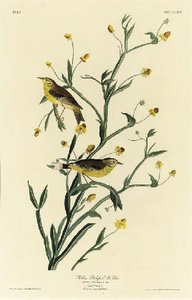 Yellow Red-poll Warbler
82
 Rough-legged Falcon
83
 Curlew Sandpiper
84
 Yellow Crowned Heron
85
 Whip-poor-will
86
 Great White Heron
87
 Black Vulture or Carrion Crow
88
 Golden-eye Duck
89
 The Mocking Bird
90
 Red Tailed HawkYale University Art Gallery
91
 Brown Pelican
92
 Barred Owl
93
 Le Petit Corporal
94
 THE FALLS
95
 Ruffed Grouse
96
 PANORAMIC VIEW OF VENICE
97
 Great Marbled Godwit
98
 Crinum declinatum
99
 American Flamingo
100
 Summer or Wood Duck
The four subjects that come back most often in these originals, each with its finest example.
The 5 museums that hold the most of the paintings on this page.
| Museum | City | Works by Robert Havell | Paintings from this list |
|---|---|---|---|
 Minneapolis Institute of Art |
Minneapolis | 1 | View of the Hudson from Horton's Road near Croton |
 New York Historical Society |
New York City | 1 | View of Hudson River from near Sing Sing, New York |
 Musee National du Chateau de Compiegne |
Compiegne | 1 | Amaryllis solandriflora var |
 Fries Museum |
Leeuwarden | 1 | Cardinal Grosbeak |
 Yale University Art Gallery |
New Haven | 1 | Red Tailed Hawk |
A long career of 17 years, 1850 to 1866: Robert Havell's most famous originals, shown year by year.
Pick a year to see its originals.
Virginian Partridge. American White Pelican and Blue Jay come next.
Virginian Partridge, American White Pelican, Blue Jay, Ivory-billed Woodpecker, Attack on Fort Oswego, Lake Ontario, N. America, View of the Hudson from Horton's Road near Croton, View of Hudson River from near Sing Sing, New York, View of the Hudson River from Tarrytown, Fish Hawk and Snowy Owl. The ranking above gives each one's year and museum.
Our catalog holds 195 works by Robert Havell, dated from 1850 to 1866.
Mostly in Minneapolis Institute of Art (Minneapolis), New York Historical Society (New York City) and Musee National du Chateau de Compiegne (Compiegne). The museum table above lists them all.
In 1850: 2 of the 100 works on this page were made then, View of the Hudson from Horton's Road near Croton among them.
On this page, the earliest is View of the Hudson from Horton's Road near Croton (1850) and the latest View of the Hudson River from Tarrytown (1866).
Birds (45), Flowers (33) and Botanical art (6), across the 100 works on this page.
Hudson river school, judging by the originals on this page.
Robert Havell (1793-1878) was a renowned English engraver, etcher, and painter. Born in Reading, Berkshire, England, he came from a family deeply rooted in the arts. His father, Robert Havell the Elder, was also an accomplished engraver and publisher. The Havell family boasted numerous artists, writers, publishers, educators, and musicians, providing young Robert with an environment rich in creative stimulation.
Growing up within such a creatively inclined family, Havell was exposed to art from a very early age. He received his initial training from his father, mastering the techniques of engraving and etching. This foundational education proved crucial for his later success. His artistic style developed with a keen attention to detail and an ability to capture the essence of his subjects.
Havell is most famously known for his pivotal role in producing The Birds of America by John James Audubon. Between 1827 and 1838, he served as the engraver and publisher of this monumental work. This collaboration showcased Havell’s exceptional skill in aquatint – a technique involving etching designs onto copper plates to create tonal variations. The sheer scale and ambition of The Birds of America cemented both Audubon's and Havell’s reputations.
Havell’s artistic style was characterized by precision, detail, and a sensitivity to the natural world. While best known for his aquatints of Audubon’s birds, he also created landscapes and portraits demonstrating his versatility as an artist. Some notable works include his engraving of “A Battle,” which highlights his mastery of composition and technique. Other significant pieces include:
Havell’s work reflects an interest in both the natural world and historical events. His collaboration with Audubon clearly demonstrates a fascination with ornithology and wildlife. He also showed an appreciation for Indian art and culture, which subtly influenced his aesthetic sensibilities. The Hudson River School movement, with its emphasis on romantic landscapes, also appears to have impacted his landscape paintings.
Robert Havell Jr. died in London in 1878, leaving behind a lasting legacy as one of the foremost practitioners of aquatint engraving. His meticulous work on The Birds of America remains a testament to his skill and dedication. He played an integral role in popularizing American wildlife art and contributed significantly to the development of printmaking techniques during the 19th century. Today, his works are celebrated by art lovers worldwide and can be found in prominent collections, including those available at OriginalUniqueArt.com.

