Portrait of Johan Jongkind

The 100 Most Famous Johan Jongkind Paintings, a Gallery Selection

Updated October 2026 · ranked by our popularity score (searches, visits and orders for each work) · 337 works by Johan Jongkind in our catalogue

In short

Of all the originals Johan Jongkind left, the most famous is Windmill near Delft (1857), in the collection of the Thyssen-Bornemisza Museum, Madrid. Close behind it come Moonlight and Moonlight on the Canal. Our catalog holds 337 works by Johan Jongkind; the gallery has kept the 100 the world admires most, each shown with its date, its museum and its story.

1819 – 1891, Lattrop Impressionism Most works: Rijksmuseum

Johan Jongkind's top 10 paintings: the gallery's choice

1
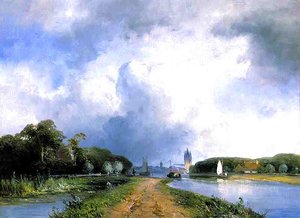
Windmill near Delft (1857) by Johan Jongkind

Windmill near Delft

1857 · Oil On Canvas · Thyssen-Bornemisza Museum, Madrid

In the quiet, sun-drenched landscapes of the Netherlands, certain moments possess a timeless quality that transcends the mere passage of years. Johan Barthold Jongkind’s 1857 masterpiece, Windmill near Delft, captures such a moment with unparalleled grace. This is not simply a landscape painting; it is a profound meditation on the ephemeral nature of light and the enduring spirit of the Dutch countryside. As the eye wanders across the canvas, one…

2
Moonlight by Johan Jongkind

Moonlight

Oil On Canvas · Dordrechts Museum, Dordrecht

Moonlight by Johan Jongkind captures a single, quiet moment on a river under the night sky. This oil on canvas depicts the silver glow of the moon as it touches the water's surface. The scene focuses on the nocturnal atmosphere of the river, where light and shadow meet in the dark. It is a study of a fleeting, lunar presence over the moving current.

3
Moonlight on the Canal by Johan Jongkind

Moonlight on the Canal

Oil On Canvas · The Baltimore Museum of Art, Baltimore

In the quietude of Moonlight on the Canal, we are invited into a world where the boundaries between reality and dream begin to dissolve. This evocative masterpiece by Johan Barthold Jongkind captures a nocturnal scene of a canal bathed in the ethereal glow of a luminous moon. The composition is a masterclass in atmospheric tension, dominated by a profound interplay of light and shadow that creates a hazy, almost mystical…

4
Winter Scene (1871) by Johan Jongkind

Winter Scene

1871 · Oil On Canvas

The oil on canvas work titled Winter Scene was executed by the Dutch artist Johan Jongkind. This specific painting dates to 1871. The artist applied his signature and the date, Jongkind 1871, in the lower left corner of the composition.

5
The Beach at Sainte-Adresse by Johan Jongkind

The Beach at Sainte-Adresse

Oil On Canvas

The Beach at Sainte-Adresse is an oil painting by the Dutch artist Johan Jongkind. Created about 1862, this work depicts a coastal landscape situated at Sainte-Adresse, France. The scene captures a wide expanse of shoreline where the land meets the sea under a sky filled with clouds.

6
The Seine at Bas-Meudon by Johan Jongkind

The Seine at Bas-Meudon

Oil On Canvas

The Seine at Bas-Meudon emerges from the canvas as a quiet moment captured in 1865. Johan Jongkind, a Dutch painter who lived from 1819 to 1891, renders this river scene with a focus on the shifting atmosphere of the French landscape. The work exists as an oil on fabric, a medium that allows for the quick, visible brushstrokes characteristic of the Impressionist style. Through these marks, the artist seeks to…

The Johan Jongkind selection continues, 11 to 100

11Honfleur, Market Place (1864) by Johan JongkindHonfleur, Market Place1864 12Portrait of the Artist by Himself (1850) by Johan JongkindPortrait of the Artist by Himself1850 · Musée d'Orsay 13A street in Landerneau (1851) by Johan JongkindA street in Landerneau1851 · Kunstmuseum 14Honfleur the Railroad Dock by Johan JongkindHonfleur the Railroad Dock 15Rotterdam in the Moonlight (1881) by Johan JongkindRotterdam in the Moonlight1881 · Rijksmuseum 16A street in Nevers by Johan JongkindA street in Nevers 17Market Square-au-Wheat and the Ducal Palace, Nevers by Johan JongkindMarket Square-au-Wheat and the Ducal Palace, Nevers 18Canal in the Moonlight (1868) by Johan JongkindCanal in the Moonlight1868 19The Port of Rotterdam (1819) by Johan JongkindThe Port of Rotterdam1819 · Musée d'Orsay 20View of Delft (1844) by Johan JongkindView of Delft1844 · Kunstmuseum Den Haag 21View of Paris, the Seine, l’Estacade (1853) by Johan JongkindView of Paris, the Seine, l’Estacade1853 · Musée Des Beaux 22Moonlight at Overschie (outskirts of Rotterdam) (1855) by Johan JongkindMoonlight at Overschie (outskirts of Rotterdam)1855 · Petit Palais 23Notre-Dame Seen from Quai de la Tournelle (1852) by Johan JongkindNotre-Dame Seen from Quai de la Tournelle1852 · Petit Palais 24The Sea at Etretat (1853) by Johan JongkindThe Sea at Etretat1853 · Birmingham Museum and Art Gallery 25Étretat Harbor (1852) by Johan JongkindÉtretat Harbor1852 · Kröller-Müller Museum 26View on Monmartre (1850) by Johan JongkindView on Monmartre1850 · Museum Boijmans Van Beuningen 27Le soir sur le canal (1854) by Johan JongkindLe soir sur le canal1854 · Musée Salies 28View of the Seine looking towards the Pont Royal and the Pavillon de Flore (1853) by Johan JongkindView of the Seine looking towards the Pont Royal and the Pavillon de Flore1853 · Fondation Custodia 29Frigates (1852) by Johan JongkindFrigates1852 30River View in France, possibly near Pontoise, Johan Barthold Jongkind, 1855 (1855) by Johan JongkindRiver View in France, possibly near Pontoise, Johan Barthold Jongkind, 18551855 · Rijksmuseum 31Le Pont de l'Estacade (1854) by Johan JongkindLe Pont de l'Estacade1854 32Landscape in the surroundings of Den Haag (1859) by Johan JongkindLandscape in the surroundings of Den Haag1859 · Rijksmuseum Twenthe 33View of the Ooster Oudehoofdpoort (1857) by Johan JongkindView of the Ooster Oudehoofdpoort1857 · Museum Rotterdam 34River Landscape at Evening (1861) by Johan JongkindRiver Landscape at Evening1861 · Groninger Museum 35View of Maassluis (1860) by Johan JongkindView of Maassluis1860 · Staatliche Kunsthalle Karlsruhe 36Boat Under Construction by Canal Side, Dutch Landscape (1857) by Johan JongkindBoat Under Construction by Canal Side, Dutch Landscape1857 · Petit Palais 37Entrance to Honfleur Harbor (1863) by Johan JongkindEntrance to Honfleur Harbor1863 · Toledo Museum of Art 38Le Chautay (Nièvre) (1862) by Johan JongkindLe Chautay (Nièvre)1862 · National Gallery of Ireland 39Environs of Breda (1857) by Johan JongkindEnvirons of Breda1857 · Museum of Fine Arts 40Rotterdam Harbour (1856) by Johan JongkindRotterdam Harbour1856 41Beach at Ste.-Adresse (1862) by Johan JongkindBeach at Ste.-Adresse1862 · Phoenix Art Museum 42A View of the Harbour, Rotterdam (1856) by Johan JongkindA View of the Harbour, Rotterdam1856 · Thyssen-Bornemisza Museum 43Landscape (1860) by Johan JongkindLandscape1860 · Royal Museum of Fine Arts Antwerp 44A Roadside Tavern (1863) by Johan JongkindA Roadside Tavern1863 · Art Institute of Chicago 45Windmills near Rotterdam (1857) by Johan JongkindWindmills near Rotterdam1857 · Rijksmuseum 46Sailing Ships near Dordrecht (1870) by Johan JongkindSailing Ships near Dordrecht1870 · Dordrechts Museum 47View of Rotterdam from Overschie (1869) by Johan JongkindView of Rotterdam from Overschie1869 · Groninger Museum 48Rider and Figure in a Landscape (1864) by Johan JongkindRider and Figure in a Landscape1864 · Groninger Museum 49Saint-Parize-le-Châtel (1869) by Johan JongkindSaint-Parize-le-Châtel1869 · Petit Palais 50A Street in Delft, Evening (1868) by Johan JongkindA Street in Delft, Evening1868 · Petit Palais 51Seascape (1866) by Johan JongkindSeascape1866 · National Museum of Fine Arts of Cuba 52A Windmill in Moonlight (1868) by Johan JongkindA Windmill in Moonlight1868 · National Gallery of Ireland 53Marine (1866) by Johan JongkindMarine1866 · Museu Nacional de Belas Artes 54Village Street with a Canal (1871) by Johan JongkindVillage Street with a Canal1871 · Detroit Institute of Arts 55The Inn (1867) by Johan JongkindThe Inn1867 · Rhode Island School of Design Museum of Art 56The Seine at Bas-Meudon (1865) by Johan JongkindThe Seine at Bas-Meudon1865 · Cleveland Museum of Art 57Little Channel at the Seine near Meudon (1865) by Johan JongkindLittle Channel at the Seine near Meudon1865 · Alte Nationalgalerie 58Scene at Delft (1868) by Johan JongkindScene at Delft1868 · Yale University Art Gallery 59River Scene (1870) by Johan JongkindRiver Scene1870 · National Gallery 60Demolition work in Rue des Franc-Bourgeois St. Marcel (1868) by Johan JongkindDemolition work in Rue des Franc-Bourgeois St. Marcel1868 · Kunstmuseum Den Haag 61Harbor Scene in Holland (1868) by Johan JongkindHarbor Scene in Holland1868 · Museum of Fine Arts 62Harbor by Moonlight (1871) by Johan JongkindHarbor by Moonlight1871 · Museum of Fine Arts 63The Towpath (1864) by Johan JongkindThe Towpath1864 · National Gallery of Art 64Sunset near Overschie (1867) by Johan JongkindSunset near Overschie1867 · Museum Boijmans Van Beuningen 65Honfleur (1865) by Johan JongkindHonfleur1865 · Metropolitan Museum of Art 66Pier in Honfleur (1866) by Johan JongkindPier in Honfleur1866 67Landscape at Nevers (1871) by Johan JongkindLandscape at Nevers1871 · Rijksmuseum 68Night Scene, Rotterdam (1868) by Johan JongkindNight Scene, Rotterdam1868 · Harvard Art Museums 69Place d'Enfer, Paris (1868) by Johan JongkindPlace d'Enfer, Paris1868 · Harvard Art Museums 70entrance to the port of honfleur (1864) by Johan Jongkindentrance to the port of honfleur1864 71View of the River Vliet near Delft (1866) by Johan JongkindView of the River Vliet near Delft1866 72Skaters in Holland (1864) by Johan JongkindSkaters in Holland1864 73View of the Port of Overschie (1871) by Johan JongkindView of the Port of Overschie1871 74The Towpath (1865) by Johan JongkindThe Towpath1865 · Thyssen-Bornemisza Museum 75Canal in Holland (1870) by Johan JongkindCanal in Holland1870 76Tree at the Seine Estuary (1864) by Johan JongkindTree at the Seine Estuary1864 77The Entrance to the Port of Rotterdam (1864) by Johan JongkindThe Entrance to the Port of Rotterdam1864 78The Port of Honfleur (1875) by Johan JongkindThe Port of Honfleur1875 · Yale University Art Gallery 79Sunset in Holland (1873) by Johan JongkindSunset in Holland1873 · National Museum of Fine Arts 80Cityscape Rotterdam: Canal à Rotterdam (1873) by Johan JongkindCityscape Rotterdam: Canal à Rotterdam1873 · Museum Rotterdam 81The Boulevard de Port-Royal, Paris (1877) by Johan JongkindThe Boulevard de Port-Royal, Paris1877 · National Gallery 82The House of Master Adam Billaud at Nevers (1874) by Johan JongkindThe House of Master Adam Billaud at Nevers1874 83View of Lake Lman at Nyon (1875) by Johan JongkindView of Lake Lman at Nyon1875 · Minneapolis Institute of Art 84Houses on a Waterway near Crooswijk (1874) by Johan JongkindHouses on a Waterway near Crooswijk1874 · Rijksmuseum 85Landscape (1877) by Johan JongkindLandscape1877 86Demolition of the Rue des Francs-Bourgeois (1873) by Johan JongkindDemolition of the Rue des Francs-Bourgeois1873 87La Cote-Saint-Andre (1878) by Johan JongkindLa Cote-Saint-Andre1878 88Moonlight over a Canal, Dordrecht (1876) by Johan JongkindMoonlight over a Canal, Dordrecht1876 89La Ciotat (1880) by Johan JongkindLa Ciotat1880 · Museum Boijmans Van Beuningen 90Rue du Faubourg-Saint-Jacques in Paris (1879) by Johan JongkindRue du Faubourg-Saint-Jacques in Paris1879 · Fondation Custodia 91Hitch of Bulls on the Road (1889) by Johan JongkindHitch of Bulls on the Road1889 92Skating in Holland (1895) by Johan JongkindSkating in Holland1895 · National Gallery 93The Seine at Argenteuil by Johan JongkindThe Seine at Argenteuil 94Au bord de la mer Sun by Johan JongkindAu bord de la mer Sun 95Fishing boat with two masts, anchored by Johan JongkindFishing boat with two masts, anchored 96Boats on an estuary, Antwerp by Johan JongkindBoats on an estuary, Antwerp 97Canal in Bruxelles by Johan JongkindCanal in Bruxelles 98A winter morning on a country road by Johan JongkindA winter morning on a country road 99A place in Avignon with a drugstore by Johan JongkindA place in Avignon with a drugstore 100Characters seated outdoors near the mill Sannois by Johan JongkindCharacters seated outdoors near the mill Sannois

The subjects that held Johan Jongkind's eye

The four subjects that come back most often in these originals, each with its finest example.

The museums that keep Johan Jongkind's originals

The 8 museums that hold the most of the paintings on this page.

Museum City Works by Johan Jongkind Paintings from this list
Rijksmuseum, AmsterdamRijksmuseum Amsterdam 7 Rotterdam in the Moonlight, River View in France, possibly near Pontoise, Johan Barthold Jongkind, 1855, Windmills near Rotterdam
Petit Palais, ParisPetit Palais Paris 6 Moonlight at Overschie (outskirts of Rotterdam), Notre-Dame Seen from Quai de la Tournelle, Boat Under Construction by Canal Side, Dutch Landscape
Museum Boijmans Van Beuningen, RotterdamMuseum Boijmans Van Beuningen Rotterdam 4 View on Monmartre, Sunset near Overschie, La Ciotat
Thyssen-Bornemisza Museum, MadridThyssen-Bornemisza Museum Madrid 3 Windmill near Delft, A View of the Harbour, Rotterdam, The Towpath
Groninger Museum, GroningenGroninger Museum Groningen 3 River Landscape at Evening, View of Rotterdam from Overschie, Rider and Figure in a Landscape
National Gallery, LondonNational Gallery London 3 River Scene, The Boulevard de Port-Royal, Paris, Skating in Holland
Musée d'Orsay, ParisMusée d'Orsay Paris 5 Portrait of the Artist by Himself, The Port of Rotterdam
Dordrechts Museum, DordrechtDordrechts Museum Dordrecht 3 Moonlight, Sailing Ships near Dordrecht

Johan Jongkind decade by decade: the original that defines each

Works per decade

Pick a decade to see the original that defines it.

Collectors' questions about Johan Jongkind's paintings

Which work is Johan Jongkind most famous for?Reveal the answer

Windmill near Delft (1857), Thyssen-Bornemisza Museum, Madrid. Moonlight and Moonlight on the Canal come next.

What age was Johan Jongkind when Windmill near Delft was made?Reveal the answer

38 years old: Windmill near Delft dates from 1857, and Johan Jongkind was born in 1819.

What are the ten most famous Johan Jongkind paintings?Reveal the answer

Windmill near Delft, Moonlight, Moonlight on the Canal, Winter Scene, The Beach at Sainte-Adresse, The Seine at Bas-Meudon, On the riverbank, Rouen at Sunset, Vue du Quai d'Orsay and Entrance to the Harbour of Honfleur. The ranking above gives each one's year and museum.

How many paintings did Johan Jongkind leave?Reveal the answer

Our catalog holds 337 works by Johan Jongkind, dated from 1844 to 1889.

In which museums do Johan Jongkind's masterpieces hang?Reveal the answer

Mostly in Rijksmuseum (Amsterdam), Petit Palais (Paris) and Museum Boijmans Van Beuningen (Rotterdam). The museum table above lists them all.

In which years did Johan Jongkind paint the most famous works?Reveal the answer

In 1860s: 35 of the 100 works on this page were made then, Entrance to the Harbour of Honfleur among them.

What are the first and the last famous originals of Johan Jongkind?Reveal the answer

On this page, the earliest is View of Delft (1844) and the latest Hitch of Bulls on the Road (1889).

Which subjects did Johan Jongkind choose most often?Reveal the answer

Water (5), River (4) and Night sky (4), across the 100 works on this page.

Which technique did Johan Jongkind use most?Reveal the answer

Oil On Canvas, for 7 of the 100 works on this page.

To which art movement does Johan Jongkind belong?Reveal the answer

Impressionism, judging by the originals on this page.

Which Johan Jongkind works hang at the Rijksmuseum?Reveal the answer

Rotterdam in the Moonlight, River View in France, possibly near Pontoise, Johan Barthold Jongkind, 1855 and Windmills near Rotterdam: the Rijksmuseum, Amsterdam holds 5 of the works on this page.

Johan Jongkind: life and work

A Forerunner of Light: The Life and Art of Johan Barthold Jongkind

Johan Barthold Jongkind, a name perhaps less immediately recognizable than those of Monet or Renoir, occupies a pivotal position in the story of Impressionism. Born on June 3, 1819, in Lattrop, a small town in the Netherlands, Jongkind’s artistic journey was one marked by both profound talent and personal struggle. His early life unfolded amidst the tranquil landscapes of Overijssel province, a region that would deeply inform his lifelong fascination with water, light, and atmosphere. Though initially employed as a clerk, his inherent artistic inclinations led him to The Hague in 1837, where he began formal training under Andreas Schelfhout, a respected landscape painter steeped in the Dutch tradition. This foundation proved crucial, instilling in Jongkind a meticulous observation of nature and a mastery of technique that would later be infused with a distinctly modern sensibility. It was a period of learning the fundamentals, but also one of burgeoning ambition, prompting him to seek further artistic development in the vibrant heart of Paris.

Parisian Encounters and Artistic Development

The move to Paris in 1846 proved transformative. Jongkind entered the studios of Eugène Isabey and François-Édouard Picot, immersing himself in the French art scene. He quickly gained recognition, exhibiting at the Salon as early as 1848, earning praise from influential critics like Charles Baudelaire and Émile Zola. These were years of promise, yet shadowed by a growing internal turmoil. Jongkind battled with bouts of depression and alcoholism, challenges that would intermittently disrupt his career and personal life. Despite these struggles, he continued to paint prolifically, focusing on scenes of the Seine River, the bustling Parisian streets, and the atmospheric nuances of the surrounding countryside. His work during this period reveals a unique blend of Dutch realism and emerging French Romanticism, characterized by vigorous brushwork and a keen sensitivity to light effects. He wasn’t merely depicting landscapes; he was capturing their fleeting moods, their ephemeral beauty. This ability to convey atmosphere would become his signature style and a key influence on the artists who followed.

A Mentor to Monet: The Seeds of Impressionism

Jongkind's return to the Netherlands in 1855 was temporary. He eventually settled back in Paris in 1861, where his artistic path intersected with that of a young Claude Monet. This encounter proved profoundly significant for both artists. Jongkind became a mentor to Monet, sharing his knowledge of *plein air* painting – working outdoors directly from nature – and encouraging him to embrace a more spontaneous and expressive approach. Monet himself credited Jongkind with providing the “definitive education” of his eye, recognizing in the older artist’s work a freedom and sensitivity that resonated deeply with his own artistic aspirations. Jongkind's influence can be seen in Monet’s early landscapes, particularly those depicting scenes along the Seine, where the emphasis on light, atmosphere, and fleeting impressions is strikingly similar. He wasn’t simply teaching technique; he was imparting a philosophy of seeing, a way of capturing the essence of a moment in time.

Legacy and Lasting Influence

Though Jongkind never fully achieved the widespread fame enjoyed by some of his contemporaries, his contribution to the development of Impressionism is undeniable. His paintings, often characterized by their loose brushwork, dramatic skies, and evocative use of color, paved the way for a new approach to landscape painting. He demonstrated that capturing the subjective experience of light and atmosphere was as important as accurately representing physical reality. His work can be found in prominent museums such as the Van Gogh Museum in Amsterdam and the Musée d'Orsay in Paris, testaments to his enduring artistic merit.
  • Notable Works: *Moonlight on the Canal*, numerous paintings of the Seine near Notre-Dame Cathedral.
  • Influence: A key influence on Claude Monet and a forerunner of Impressionism.
  • Final Years: Jongkind passed away on February 9, 1891, in Saint-Égrève, France, leaving behind a legacy that continues to inspire artists and art enthusiasts today.
Jongkind’s story is a poignant reminder that artistic innovation often arises from unexpected sources. He was not a revolutionary in the same way as Monet or Renoir, but his quiet dedication to capturing the beauty of the natural world, combined with his willingness to experiment with new techniques, laid crucial groundwork for the Impressionist movement and secured his place as a vital figure in 19th-century art history. His paintings remain powerful evocations of time and place, inviting viewers to experience the world through the eyes of an artist who truly understood the transformative power of light.