Famous painters by country

Great Swiss Painters

The masters our own painters keep coming back to. Swiss-born painters left their mark far from home: Füssli in London, Böcklin in Italy, Hodler in Geneva and Paul Klee at the Bauhaus. Here are 24 of them, each with three works that still teach painters today and the museum where they can be seen.

Paul Klee (1879–1940), Arnold Böcklin (1827–1901) and Henry Fuseli (1741–1825) head the 24 great Swiss masters who inspire our artists, all born in Switzerland, each with three key works.

  1. With the Egg by Paul Klee1Paul Klee
  2. Nymph and Satyr by Arnold Böcklin2Arnold Böcklin
  3. Dante and Virgil on the Ice of Kocythos by Henry Fuseli3Henry Fuseli
  • 24Painters on this list
  • 1539–1940Years of birth
  • 439Artists born in Switzerland in our catalogue
  • 6,114Of their works in our catalogue

The list

The 24 great Swiss painters

1of 24

Paul Klee

Born in Münchenbuchsee Expressionism, Cubism, Surrealism

Paul Klee

Klee was a natural draftsman who possessed a deep, almost scientific understanding of color theory. He was also a prolific printmaker, utilizing zinc-plate etchings and lithographs to expand his visual language.

Where to see To find the traces of his prolific output, one might travel to Bern, Switzerland.

Signature works · The 100 signature works

3of 24

Henry Fuseli

Born in Zurich Romanticism, Dark Romanticism

Henry Fuseli

He left for an art pilgrimage to Italy in 1770, staying there until 1778. It was during these years in Italy that he chose to change his name from Füssli to the more Italian-sounding Fuseli. One can see his shadow in the work of William Blake, who shared a similar interest in the visionary and the intense.

Signature works · The 100 signature works

4of 24

H.R. Giger

Born in Chur Biomechanical Surrealism

H.R. Giger

At the heart of Giger’s art lies a complex and unsettling vision—a world where humanity has merged with machinery. He often depicted figures caught in states of metamorphosis, suggesting a constant process of becoming and decay. The Giger Bar in Chur, Switzerland, and the Museum HR Giger Bar in Gruyères, France, are testament to his enduring fascination with biomechanical design—immersive environments that transport visitors into his surreal world.

Signature works · The 100 signature works

5of 24

Alberto Giacometti

Born in Borgonovo Surrealism, Existentialism

Alberto Giacometti

Giacometti's formal artistic journey began at the Geneva School of Fine Arts, but it was his move to Paris in 1922 that truly ignited his creative fire. The early years were marked by an exploration of Cubism, dismantling and reassembling forms in a manner reflective of the era’s intellectual ferment. Giacometti’s artistic contributions were recognized with increasing acclaim throughout his career, culminating in the Grand Prize for Sculpture at the Venice Biennale in 1962.

Signature works · The 100 signature works

6of 24

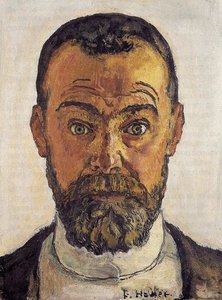
Ferdinand Hodler

Born in Bern Symbolism, Parallelism, Realism

Ferdinand Hodler

Born in Bern, Switzerland, in 1853, Ferdinand Hodler’s early years were defined by a quiet, persistent grief. His move to Geneva in 1871 marked a departure from the commercial demands of his youth. In works such as The Night, completed in 1890, he explored themes of repose and mortality through recumbent figures, a subject that challenged the prevailing tastes of the time.

Signature works · The 100 signature works

7of 24

Angelica Kauffmann

Born in Chur Neoclassical Painting

Angelica Kauffmann

Born Maria Anna Angelika Kauffmann on October 30, 1741, in Chur, Switzerland, her life was a masterful composition of cultural fluency and artistic ambition. In 1768, she achieved the extraordinary distinction of being named one of the two female founding members of the Royal Academy of Art in London, alongside Mary Moser.

Signature works · The 100 signature works

8of 24

Félix Vallotton

Born in Lannes Post-Impressionism, Symbolism, Les Nabis

Félix Vallotton

His style blended elements of Post-Impressionism and Symbolism, often resulting in a look that felt both modern and strangely still. He used brushstrokes characteristic of Neo-Impressionism, layering pigment to create depth and luminosity. Vallotton left behind a body of work that felt singular, often leaving those who viewed it with a sense of disquiet.

Where to see To encounter the quiet tension of Vallotton’s interiors, one might travel to the Cantonal Museum of Fine Arts in Lausanne, Switzerland, where The Red Room is kept.

Signature works · The 100 signature works

9of 24

Johannes Itten

Born in Wachseldorn Expressionism, Bauhaus

Johannes Itten

This divergence of philosophies ultimately led to his resignation in 1923. Undeterred, Itten established the “ontos weaving workshops” near Zurich in 1924, collaborating with Bauhaus weaver Gunta Stölzl. Johannes Itten, born in 1888 in the tranquil Swiss village of Südern-Linden, was more than just a painter; he was a visionary educator who fundamentally reshaped the landscape of modern art instruction.

Signature works · The 100 signature works

10of 24

Le Corbusier

Born in La Chaux-de-Fonds Modernism, Purism, Brutalism

Le Corbusier

Charles-Édouard Jeanneret, the man who would become globally recognized as Le Corbusier, emerged from the heart of Switzerland’s watchmaking country, La Chaux-de-Fonds, in 1887. Even the austere atmosphere of the local Masonic lodge, L'Amitié, emphasizing rectitude and exactitude, left its mark on the young Jeanneret’s developing worldview. The recognition afforded by UNESCO in 2016—designating seventeen of his architectural works across seven countries as World Heritage Sites—underscores his outstanding contribution to the Modern Movement.

Signature works · The 100 signature works

11of 24

Charles Gleyre

Born in Chevilly Academic, Orientalism

Charles Gleyre

In 1843, Gleyre assumed the studio of Paul Delaroche, a highly respected figure in French academic painting. Among his students were names that resonate with artistic revolution: Claude Monet, Pierre-Auguste Renoir, James Abbott McNeill Whistler, Alfred Sisley, and Jean-Léon Gérôme.

Signature works · The 100 signature works

12of 24

Jean-Étienne Liotard

Born in Geneva

Jean-Étienne Liotard

Liotard’s approach to art was rooted in a rigorous commitment to naturalism. He sought to capture the world with a precision that avoided the artificiality often found in the portraiture of his era.

Where to see The distribution of Liotard’s output across Europe and beyond allows for a varied study of his technical precision.

Signature works · The 100 signature works

13of 24

Albert Anker

Born in Ins Realism

Albert Anker

Albert Samuel Anker, a name synonymous with idyllic Swiss scenes and heartwarming portrayals of rural life, was born on April 1st, 1831, in the small town of Ens, Switzerland. His father, Samuel Anker, was a respected veterinarian who also served within the political arena as a member of the Canton of Bern’s constituent assembly. The decision to dedicate himself to art led Anker to Paris, the epicenter of artistic innovation during the mid- 19th century.

Pupil of Charles Gleyre #11

Signature works · The 100 signature works

14of 24

Sophie Taeuber-Arp

Born in Davos Dada, Constructivism & Concrete Art

Sophie Taeuber-Arp

She moved seamlessly between the tactile world of textile design, the structural demands of furniture creation, and the ethereal realms of dance and painting. She did not just observe the changing tides of modernism; she helped direct them. In the turbulent landscape of early 20th-century modernism, few figures possessed the multidisciplinary vision of Sophie Henriette Gertrud Taeuber-Arp.

Signature works · The 100 signature works

16of 24

Elizabeth Thompson

Born in Lausanne Victorian Painting

Elizabeth Thompson

born in 1846, thompson's artistic inclinations were evident from an early age. she specialized in painting scenes from british military campaigns and battles, including the crimean war and the napoleonic wars. her notable works include the roll call, the defence of rorke's drift, and scotland forever! elizabeth southerden thompson, later known as lady butler, was a british painter, but often mistakenly attributed to being from switzerland. her work, however, had a profound impact on the world of military art, leaving an indelible mark on the genre.

Signature works · The 100 signature works

17of 24

Bertha Wegmann

Born in Soglio Realism, Portraiture

Bertha Wegmann

This dedication coincided with a deeply influential friendship and artistic partnership with Swedish painter Jeanna Bauck. Together, they embarked on several study trips to Italy, broadening their horizons and deepening their understanding of light, color, and composition. The pursuit of artistic refinement led Wegmann to Munich in 1875, initially under the tutelage of historical painter Wilhelm von Lindenschmit the Younger, followed by genre painter Eduard Kurzbauer.

Signature works · The 100 signature works

18of 24

Gottfried Keller

Born in Zurich Baroque portraiture

Gottfried Keller

Kneller wasn’t simply a painter; he was an innovator in the English art world. This institution provided structured education in drawing, painting, and sculpture, fostering a new generation of British artists and challenging the traditional guild system. Born Gottfried Kniller in Lübeck, Germany, in 1646, Sir Godfrey Kneller’s journey to becoming the preeminent portraitist of England was one shaped by extensive travel, rigorous training, and an astute understanding of both artistic technique and social currents.

Signature works · The 100 signature works

19of 24

Jacques Laurent Agasse

Born in Geneva Romanticism

Jacques Laurent Agasse

Jacques Laurent Agasse (1767-1849) stands as a singular figure in the annals of Swiss art history, celebrated primarily for his unparalleled dedication to capturing the essence of equine anatomy and portraying animals with breathtaking realism. He championed the idea that artists could elevate their craft by grounding it in anatomical knowledge—a concept that foreshadowed developments in later academic painting and influenced generations of animal artists.

Signature works · The 100 signature works

20of 24

Anton Graff

Born in Winterthur Neoclassical painting

Anton Graff

As a teacher at the Dresden Art Academy, he nurtured the talents of future generations of artists, including Emma Körner, Philipp Otto Runge, and Karl Ludwig Kaaz.

Signature works · The 100 signature works

23of 24

Alexandre Calame

Born in Vevey Düsseldorf School

Alexandre Calame

Notable works include “Handeck Fall,” “ Torrent in the Alps,” and “Storm at Handeck,” each demonstrating his mastery of tonal harmony and compositional balance. Lithography: Calame’s contribution extended beyond painting; he excelled as a lithographer, producing stunning prints that further disseminated his vision of Alpine landscapes. He taught at Geneva University, fostering the artistic development of students like Adolf Mosengel, who continued Calame's legacy.

Signature works · The 100 signature works

Figures

Where they were born, when, and where to see them

City of birth
Zurich3
Basel2
Chur2
Geneva2
Lausanne2
Münchenbuchsee1
Borgonovo1
Bern1
Century of birth
16th century2
18th century5
19th century15
20th century2
Museums holding their key works
Kunsthaus Zürich5
Alte Nationalgalerie2
Boca Raton Museum of Art1
Lenbachhaus1
Philadelphia Museum of Art1
Te Papa1
Szépművészeti Múzeum1
Art Gallery of South Australia1

Questions and answers

Great Swiss painters: questions and answers

How this list is ranked Our ranking draws on Wikipedia, the manual rank our editors give each artist and artwork, and the visits each page receives every month.