Portrait of Arnold Böcklin

Arnold Böcklin Paintings: The 100 Most Famous, Through a Gallery's Eye

Updated October 2026 · ranked by our popularity score (searches, visits and orders for each work) · 233 works by Arnold Böcklin in our catalogue

In short

To the gallery's eye, Arnold Böcklin's most famous painting is The isle of the dead (First Version) (1880), whose original hangs in the Öffentliche Kunstsammlung, Basel. Autorretrato con la muerte tocando el violín and La Guerre (1896) complete the trio every eye recognises. Of the 233 works by Arnold Böcklin in our catalog, the gallery presents the 100 most famous below, each original with its year, its museum and what makes it unique.

1827 – 1901, Basel Symbolism Most works: Bavarian State Painting Collections

The gallery's top 10 Arnold Böcklin paintings

1
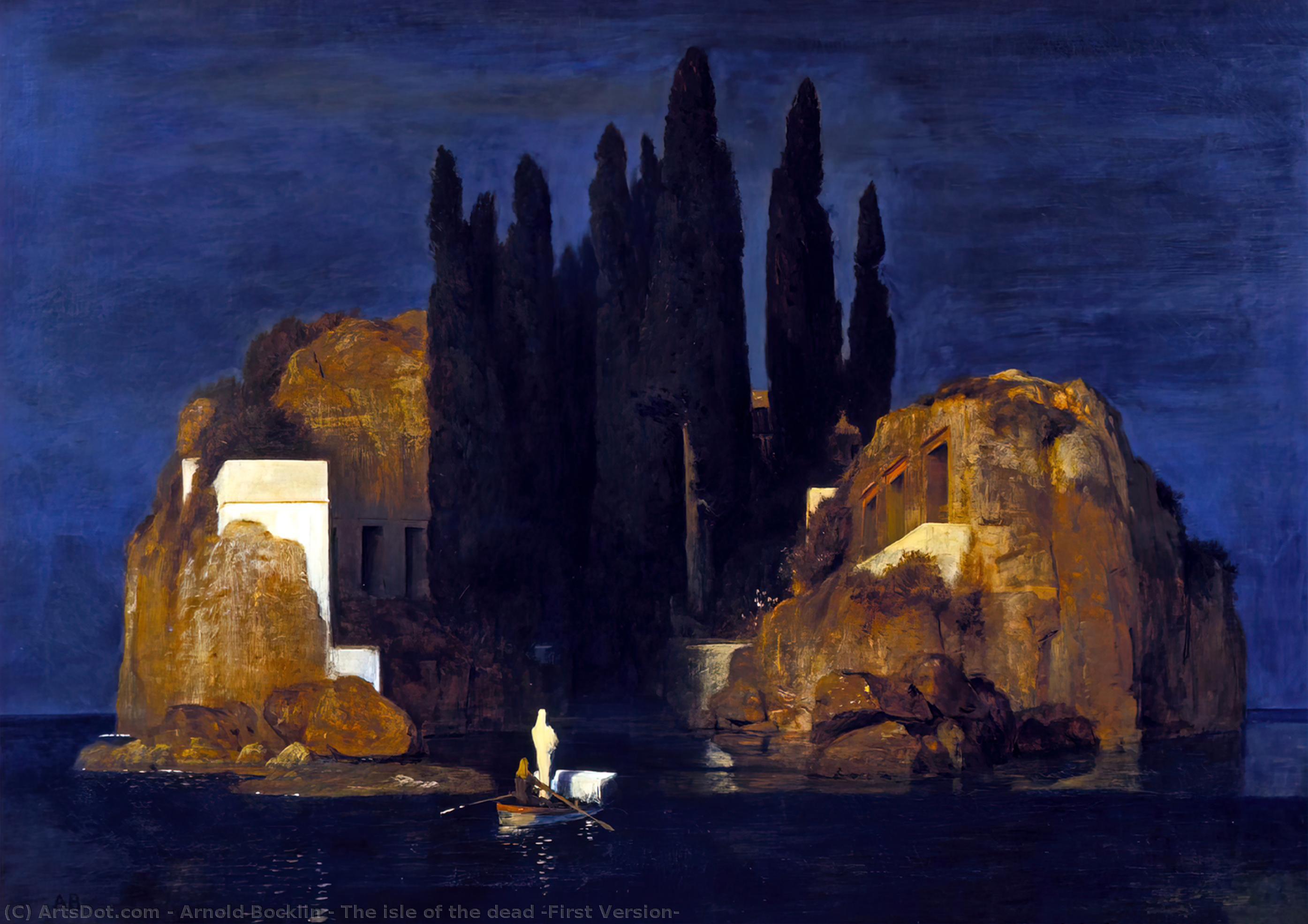
The isle of the dead (First Version) (1880) by Arnold Böcklin

The isle of the dead (First Version)

1880 · Oil On Canvas · Öffentliche Kunstsammlung, Basel

In the quiet, shadowed corridors of art history, few images possess the haunting magnetism of Arnold Böcklin’s The Isle of the Dead (First Version). Completed in the early 1880s, this masterpiece serves as a profound gateway into the Symbolist movement, where the artist’s brush seeks not to mirror reality, but to evoke the intangible whispers of the soul. As one gazes upon this monumental canvas, they are immediately transported to…

2
Autorretrato con la muerte tocando el violín by Arnold Böcklin

Autorretrato con la muerte tocando el violín

Oil · Alte Nationalgalerie, Berlin

The air in the room feels heavy, thick with the scent of old wood and the weight of an impending silence. A man sits in formal attire, his suit and tie lending a sense of somber dignity to his presence. He holds a violin, but he is not the one leading the melody. Behind him, a skeletal figure emerges from the shadows, its bony fingers dancing across the strings. This…

3
La Guerre (1896) by Arnold Böcklin

La Guerre

1896 · Oil On Canvas · Kunsthaus Zürich, Zurich

The Power of Conflict: Arnold Böcklin's "La Guerre" Subject and Composition Arnold Böcklin's *La Guerre* (1896) is a dramatic exploration of conflict and chaos. This powerful Symbolist masterpiece depicts a violent scene filled with human and possibly supernatural figures engaged in struggle. The composition is dense and layered, featuring a central cluster of figures in intense action. A man in red raises an axe above his head, poised to strike,…

4
The isle of the dead (Version 3) (1883) by Arnold Böcklin

The isle of the dead (Version 3)

1883 · Oil On Panel · Alte Nationalgalerie, Berlin

In the quietude of the late nineteenth century, few images captured the collective psyche of Europe as profoundly as Arnold Böcklin’s The Isle of the Dead. This particular version, a haunting masterpiece from 1883, serves as more than a mere landscape; it is a portal into the subconscious. As the viewer's eye meets the dark, mirror-like waters, there is an immediate sense of profound stillness, a hush that commands reverence.…

5
Island of the Dead (Version 5) (1886) by Arnold Böcklin

Island of the Dead (Version 5)

1886 · Acrylic On Canvas · Museum der bildenden Künste, Leipzig

The Haunting Beauty of Böcklin’s ‘Island of the Dead’ A Timeless Vision Arnold Böcklin's 'Island of the Dead (Version 5)' is more than just a painting; it’s an immersion into a realm of profound melancholy and enduring mystery. Completed in 1886, this iconic Symbolist work continues to captivate viewers with its stark beauty and unsettling serenity. Böcklin masterfully blends naturalistic elements – the rugged coastline, the imposing cypress trees –…

6
Island of the Dead (1880) by Arnold Böcklin

Island of the Dead

1880 · Oil On Panel · Metropolitan Museum of Art, New York

Introduction Arnold Böcklin's painting "Island of the Dead" is one of his most famous works, and it has been widely reproduced in prints. The painting depicts a desolate and rocky islet seen across an expanse of dark water, with a small rowboat carrying a shrouded figure approaching the shore. Size and Media The original painting measures 73.7 x 121.9 cm (29 x 48 in.) and is painted in oil on…

7
The Isle of the Dead (Version 2) (1880) by Arnold Böcklin

The Isle of the Dead (Version 2)

1880 · Oil On Board

The Isle of the Dead (Version 2) is an oil on board painting by the Swiss artist Arnold Böcklin. This specific work was executed in 1880. The physical dimensions of the panel measure 73.7 x 121.9 cms (29 x 47 ¾ ins).

8
L'Îlle des morts by Arnold Böcklin

L'Îlle des morts

Oil On Canvas · Museum der bildenden Künste, Leipzig

A rocky islet rises from a still, dark sea, its jagged silhouette defined by the presence of cypress trees. The composition centers on a small boat approaching the shore, carrying figures toward the silent, stony terrain. This scene, rendered in oil, captures a moment of profound stillness where the boundary between the physical world and the afterlife becomes porous. The atmosphere is heavy with the weight of transition, suggesting a…

9
Pont dans un paysage de montagne by Arnold Böcklin

Pont dans un paysage de montagne

Oil On Canvas · Alte Nationalgalerie, Berlin

Arnold Böcklin’s Pont dans un paysage de montagne is not merely a depiction of stone and foliage; it is an invitation—a sublime passage into a realm where the tangible world dissolves into myth and profound contemplation. This masterpiece, steeped in the evocative atmosphere of Symbolism, immediately draws the viewer across its painted threshold. One gazes upon a bridge, elegantly spanning a valley carved by time, set against a backdrop of…

10
Weeping at the Cross (1876) by Arnold Böcklin

Weeping at the Cross

1876 · Oil · Alte Nationalgalerie, Berlin

Arnold Böcklin's 1876 work, Weeping at the Cross, presents a somber scene of profound grief following the crucifixion. The subject matter is religious and tragic, centering on the mourning of a deceased Christ. The central figure's pale, lifeless skin provides a stark contrast to the surrounding figures, anchoring the emotional weight of the event.

Arnold Böcklin paintings, ranked 11 to 100

11Portrait d´un jeune Romain by Arnold BöcklinPortrait d´un jeune Romain 12Sirens (1875) by Arnold BöcklinSirens1875 · Alte Nationalgalerie 13Nymph and Satyr (1871) by Arnold BöcklinNymph and Satyr1871 · Philadelphia Museum of Art 14sideboard (1874) by Arnold Böcklinsideboard1874 · Los Angeles County Museum of Art 15La peste 1 by Arnold BöcklinLa peste 1 16Le Voyage de noces by Arnold BöcklinLe Voyage de nocesStädel Museum 17Diana's Hunt by Arnold BöcklinDiana's Hunt 18La peste by Arnold BöcklinLa peste 19In springtime (1873) by Arnold BöcklinIn springtime1873 · National Gallery of Victoria 20Veritas (1881) by Arnold BöcklinVeritas1881 · Bavarian State Painting Collections 21The Honeymoon (1878) by Arnold BöcklinThe Honeymoon1878 · Alte Nationalgalerie 22Poverty and Sorrow (1890) by Arnold BöcklinPoverty and Sorrow1890 · Staatliche Kunsthalle Karlsruhe 23Nymph at a Spring (1855) by Arnold BöcklinNymph at a Spring1855 · Bavarian State Painting Collections 24Roman May Day (1872) by Arnold BöcklinRoman May Day1872 · Bavarian State Painting Collections 25Farmland in Early Spring / (1884) by Arnold BöcklinFarmland in Early Spring /1884 · Alte Nationalgalerie 26The Artist and his Wife (1863) by Arnold BöcklinThe Artist and his Wife1863 · Alte Nationalgalerie 27A Nymph at the Fountain (Pan, Chasing a Nymph) (1855) by Arnold BöcklinA Nymph at the Fountain (Pan, Chasing a Nymph)1855 · Thyssen-Bornemisza Museum 28Germans on the Boar Hunt (1858) by Arnold BöcklinGermans on the Boar Hunt1858 · Wallraf-Richartz-Museum 29The painter Franz von Lenbach (1862) by Arnold BöcklinThe painter Franz von Lenbach1862 30Venus sending away Amor (1860) by Arnold BöcklinVenus sending away Amor1860 · Westfälishes Landesmuseum 31The sculptor Joseph von Kopf (1863) by Arnold BöcklinThe sculptor Joseph von Kopf1863 · Alte Nationalgalerie 32Portrait of a Woman (1871) by Arnold BöcklinPortrait of a Woman1871 33Fertur lux in tenebras (1881) by Arnold BöcklinFertur lux in tenebras1881 · Alte Nationalgalerie 34Old Roman wine tavern in spring (1865) by Arnold BöcklinOld Roman wine tavern in spring1865 · Bavarian State Painting Collections 35God father leading Adam into paradise (1871) by Arnold BöcklinGod father leading Adam into paradise1871 · Museum für Kunst und Kulturgeschichte 36Venus Anadyomene (1869) by Arnold BöcklinVenus Anadyomene1869 · Hessisches Landesmuseum 37Die Schaumgeborene / Grüne Venus (1871) by Arnold BöcklinDie Schaumgeborene / Grüne Venus1871 · Museum Wiesbaden 38Roman wine tavern (1867) by Arnold BöcklinRoman wine tavern1867 · Staatliche Kunsthalle Karlsruhe 39Triton carrying a nereid on his back (1875) by Arnold BöcklinTriton carrying a nereid on his back1875 40Triton blowing through a shell in the surf (1879) by Arnold BöcklinTriton blowing through a shell in the surf1879 · Niedersächsisches Landesmuseum 41Sea Idyll (1887) by Arnold BöcklinSea Idyll1887 42Susanna and the two old man (1888) by Arnold BöcklinSusanna and the two old man1888 43Playing in the Waves (1900) (1900) by Arnold BöcklinPlaying in the Waves (1900)1900 · Bavarian State Painting Collections 44The hermit (1863) by Arnold BöcklinThe hermit1863 · Bavarian State Painting Collections 45Honeymoon (1890) by Arnold BöcklinHoneymoon1890 · Städel Museum 46Ruine dans un paysage au clair de lune by Arnold BöcklinRuine dans un paysage au clair de lune 47Prometheus by Arnold BöcklinPrometheus 48Shepherdess (1864) by Arnold BöcklinShepherdess1864 · Bavarian State Painting Collections 49Ruin by the Sea (1881) by Arnold BöcklinRuin by the Sea1881 · Cleveland Museum of Art 50Centaur Watching Fish (1878) by Arnold BöcklinCentaur Watching Fish1878 · Kunsthaus Zürich 51Sappho (1862) by Arnold BöcklinSappho1862 · Philadelphia Museum of Art 52A Sacred Grove (1871) by Arnold BöcklinA Sacred Grove1871 · Bavarian State Painting Collections 53The Hermit (1884) by Arnold BöcklinThe Hermit1884 · Alte Nationalgalerie 54A Spring in a Narrow Gorge (1881) by Arnold BöcklinA Spring in a Narrow Gorge1881 · J. Paul Getty Museum 55Shield with Gorgon by Arnold BöcklinShield with GorgonGrand Palais 56A Cliff Face (1852) by Arnold BöcklinA Cliff Face1852 · National Gallery 57Ruine en bord de mer by Arnold BöcklinRuine en bord de mer 58La Chevauchée de la Mort (L'Automne et la Mort) by Arnold BöcklinLa Chevauchée de la Mort (L'Automne et la Mort)Bavarian State Painting Collections 59Villa by the Sea (1877) by Arnold BöcklinVilla by the Sea1877 · Staatsgalerie Stuttgart 60Centaurus and Nymph (1855) by Arnold BöcklinCentaurus and Nymph1855 · Alte Nationalgalerie 61Le Réveil du printemps by Arnold BöcklinLe Réveil du printempsKunsthaus Zürich 62Sous la tonnelle by Arnold BöcklinSous la tonnelle 63At Krazenbach in Unterwalden (1847) by Arnold BöcklinAt Krazenbach in Unterwalden1847 · Schloss Weimar 64Landscape in the Roman Campagna (1851) by Arnold BöcklinLandscape in the Roman Campagna1851 · Staatliche Kunsthalle Karlsruhe 65Roman Landscape (1850) by Arnold BöcklinRoman Landscape1850 66Villa by the Sea (1863) by Arnold BöcklinVilla by the Sea1863 · Bavarian State Painting Collections 67Bagpiper (1861) by Arnold BöcklinBagpiper1861 · Bavarian State Painting Collections 68Rocky landscape with a hunting centaur (1860) by Arnold BöcklinRocky landscape with a hunting centaur1860 · Schloss Weimar 69Pan Amongst the Reeds (1857) by Arnold BöcklinPan Amongst the Reeds1857 70Road to Emmaus (1870) by Arnold BöcklinRoad to Emmaus1870 · Bavarian State Painting Collections 71Landscape with Castle (1870) by Arnold BöcklinLandscape with Castle1870 · Statens Museum For Kunst 72nymphs bathing (1866) by Arnold Böcklinnymphs bathing1866 73elysian fields (1877) by Arnold Böcklinelysian fields1877 74Triton and Nereid (1877) by Arnold BöcklinTriton and Nereid1877 75Isle of the Dead (1884) by Arnold BöcklinIsle of the Dead1884 76The Summer's Day (1881) by Arnold BöcklinThe Summer's Day1881 77Centaur at the Village Blacksmith's Shop (1888) by Arnold BöcklinCentaur at the Village Blacksmith's Shop1888 · Szépművészeti Múzeum 78the sacred wood (1882) by Arnold Böcklinthe sacred wood1882 79Villa by the Sea III (1872) by Arnold BöcklinVilla by the Sea III1872 · Städel Museum 80Meerestille (Calm Sea) (1887) by Arnold BöcklinMeerestille (Calm Sea)1887 · Kunstmuseum Bern 81la sirene (1887) by Arnold Böcklinla sirene1887 82The hunt of Diana (1896) by Arnold BöcklinThe hunt of Diana1896 · Musée d'Orsay 83Vision at sea (1896) by Arnold BöcklinVision at sea1896 84Flora, Scattering Flowers by Arnold BöcklinFlora, Scattering FlowersMuseum Folkwang 85Étude de triton by Arnold BöcklinÉtude de triton 86Pan entre des colonnes 1 by Arnold BöcklinPan entre des colonnes 1 87Pan entre des colonnes by Arnold BöcklinPan entre des colonnes 88Victimes du choléra by Arnold BöcklinVictimes du choléra 89Esquisse pour 'Autoportrait dans l'atelier' by Arnold BöcklinEsquisse pour 'Autoportrait dans l'atelier' 90untitled (1785) by Arnold Böcklinuntitled (1785) 91tomb by Arnold BöcklintombStaatliche Kunsthalle Karlsruhe 92Pan dans les roseaux 1 by Arnold BöcklinPan dans les roseaux 1 93Le Roi David (Panneau central) by Arnold BöcklinLe Roi David (Panneau central) 94Soirée de printemps by Arnold BöcklinSoirée de printemps 95Melancholia by Arnold BöcklinMelancholia 96Combat sur un pont by Arnold BöcklinCombat sur un pont 97Villa en bord de mer by Arnold BöcklinVilla en bord de merKunst Museum Winterthur 98Combat sur un pont 1 by Arnold BöcklinCombat sur un pont 1 99Self portrait with Death by Arnold BöcklinSelf portrait with Death 100Combat de centaures by Arnold BöcklinCombat de centauresKunstmuseum Basel

Arnold Böcklin's famous paintings, period by period

The subjects that held Arnold Böcklin's eye

The four subjects that come back most often in these originals, each with its finest example.

The museums that keep Arnold Böcklin's originals

The 8 museums that hold the most of the paintings on this page.

Museum City Works by Arnold Böcklin Paintings from this list
Bavarian State Painting Collections, MunichBavarian State Painting Collections Munich 24 Veritas, Nymph at a Spring, Roman May Day
Alte Nationalgalerie, BerlinAlte Nationalgalerie Berlin 18 Autorretrato con la muerte tocando el violín, The isle of the dead (Version 3), Pont dans un paysage de montagne
Staatliche Kunsthalle Karlsruhe, CarlsruheStaatliche Kunsthalle Karlsruhe Carlsruhe 4 Poverty and Sorrow, Roman wine tavern, Landscape in the Roman Campagna
Kunsthaus Zürich, ZurichKunsthaus Zürich Zurich 5 La Guerre, Centaur Watching Fish, Le Réveil du printemps
Städel Museum, FrankfurtStädel Museum Frankfurt 4 Le Voyage de noces, Honeymoon, Villa by the Sea III
Museum der bildenden Künste, LeipzigMuseum der bildenden Künste Leipzig 2 Island of the Dead (Version 5), L'Îlle des morts
Philadelphia Museum of Art, PhiladelphiaPhiladelphia Museum of Art Philadelphia 2 Nymph and Satyr, Sappho
Schloss Weimar, WeimarSchloss Weimar Weimar 2 At Krazenbach in Unterwalden, Rocky landscape with a hunting centaur

Arnold Böcklin, one signature painting per decade

Works per decade

Pick a decade to see the original that defines it.

Arnold Böcklin's paintings: the gallery answers

Which Arnold Böcklin painting is the most famous of all?Reveal the answer

The isle of the dead (First Version) (1880), Öffentliche Kunstsammlung, Basel. Autorretrato con la muerte tocando el violín and La Guerre (1896) come next.

How old was Arnold Böcklin on completing The isle of the dead (First Version)?Reveal the answer

53 years old: The isle of the dead (First Version) dates from 1880, and Arnold Böcklin was born in 1827.

Which are Arnold Böcklin's top 10 paintings?Reveal the answer

The isle of the dead (First Version), Autorretrato con la muerte tocando el violín, La Guerre, The isle of the dead (Version 3), Island of the Dead (Version 5), Island of the Dead, The Isle of the Dead (Version 2), L'Îlle des morts, Pont dans un paysage de montagne and Weeping at the Cross. The ranking above gives each one's year and museum.

How many works did Arnold Böcklin create?Reveal the answer

Our catalog holds 233 works by Arnold Böcklin, dated from 1847 to 1900.

Where do Arnold Böcklin's most famous originals hang?Reveal the answer

Mostly in Bavarian State Painting Collections (Munich), Alte Nationalgalerie (Berlin) and Staatliche Kunsthalle Karlsruhe (Carlsruhe). The museum table above lists them all.

When did Arnold Böcklin create the most famous paintings?Reveal the answer

In 1870s: 20 of the 100 works on this page were made then, Weeping at the Cross among them.

Which are Arnold Böcklin's earliest and latest famous works?Reveal the answer

On this page, the earliest is At Krazenbach in Unterwalden (1847) and the latest Playing in the Waves (1900) (1900).

Which subjects did Arnold Böcklin return to most?Reveal the answer

Trees (14), Sky (12) and Rocks (10), across the 100 works on this page.

Which medium did Arnold Böcklin work in most?Reveal the answer

Oil On Canvas, for 26 of the 100 works on this page.

Which movement is Arnold Böcklin associated with?Reveal the answer

Symbolism, judging by the originals on this page.

Which Arnold Böcklin originals does the Bavarian State Painting Collections hold?Reveal the answer

Veritas, Nymph at a Spring and Roman May Day: the Bavarian State Painting Collections, Munich holds 12 of the works on this page.

Arnold Böcklin: the artist

The Shadow of the Isle

Basel, Switzerland, provides the starting point for a life defined by the tension between the tangible and the spectral. Born on October 16, 1827, to Christian Frederick Böcklin and Ursula Lippe, the young man would eventually move beyond the silk trade of his father to the rigorous halls of the Düsseldorf Academy. Under the guidance of Schirmer, he began to absorb the language of landscape, a skill that would later be used to map the geography of the human soul. He did not merely paint scenery; he constructed realms where the classical and the macabre collide.

The movement from the academic discipline of Düsseldorf to the light of Paris and the ancient weight of Rome marks a fundamental shift in his vision. In the Louvre, he absorbed the history of the masters, but it was the atmosphere of Italy that truly shaped his hand. He returned to Rome between 1862 and 1866, a period where his palette began to favor more violent, expressive colors. This was not the bright, sun-drenched Italy of the Renaissance, but a place of deep shadows and mythological weight. His work began to lean into the allegorical, using figures from antiquity to explore the heavy, inescapable presence of mortality.

The Architecture of Dreams

By the late 19th century, his reputation was anchored by a specific, haunting preoccupation. Between 1880 and 1886, he produced five versions of The Isle of the Dead. This work, inspired by the English cemetery in Florence where his daughter was buried, became a focal point for the Symbolist movement. It is a scene of profound stillness: a rocky islet, dark cypress trees, and a rowboat approaching a silent shore. The painting does not merely depict a place; it depicts a state of being. This ability to render the intangible—the whispers of dreams and the weight of the afterlife—placed him at the center of a new European sensibility.

His technical approach often utilized a thick, expressive impasto, particularly in works like La Guerre (1896). In this piece, the canvas trembles with the chaos of conflict. He avoids the clean lines of traditionalism, opting instead for a dense, layered composition where figures clash amidst crumbling architecture. It is a visceral manifestation of destruction, where the veil between myth and reality dissolves into a storm of shadows. His style overlapped with the Pre-Raphaelites, yet he remained distinct, focused on a mysticism that felt both ancient and unsettlingly modern.

A Legacy of Influence

The impact of his imagery extended far beyond the canvas, reaching into the auditory realm of late-Romantic music. His paintings provided a visual stimulus for composers, most notably influencing the atmosphere of Gustav Mahler’s work. His ability to bridge the gap between the visual and the psychological meant that his influence was felt by those who sought to represent the subconscious. His reach touched several generations of artists:

  • Hans Thoma, a younger artist influenced by his symbolic depth.
  • Giorgio de Chirico, who found a profound connection in the isolation of Böcklin's compositions.
  • Salvador Dalí and Max Ernst, who drew from his ability to blend the comic with the nightmarish.
  • Marcel Duchamp, who noted the artist's significant influence on his own development.

He died in Fiesole, Italy, leaving behind a body of work that refused to be easily categorized. He was a painter of the Swiss landscape, the Roman tavern, and the mythological grove, yet his true subject remained the silent, enduring presence of the unknown. His works remain held in significant collections, including the Kunstmuseum Basel and the Kunsthaus Zürich, serving as anchors for those exploring the intersection of myth and mortality.