Portrait of Cornelis Troost

Cornelis Troost Paintings: The 81 Most Famous, Through a Gallery's Eye

Updated November 2026 · ranked by our popularity score (searches, visits and orders for each work) · 82 works by Cornelis Troost in our catalogue

In short

To the gallery's eye, Cornelis Troost's most famous painting is Inspection of a Cavalry Regiment, perhaps by William of Hesse-Homburg (1742), whose original hangs in the Rijksmuseum, Amsterdam. The Regents of the Oudezijds Huiszittenhuis (1740) and A Couple Making Music, Cornelis Troost, 1743 (1743) complete the trio every eye recognises. Of the 82 works by Cornelis Troost in our catalog, the gallery presents the 81 most famous below, each original with its year, its museum and what makes it unique.

1696 – 1750, Amsterdam Rococo Most works: Rijksmuseum

The gallery's top 10 Cornelis Troost paintings

1
Inspection of a Cavalry Regiment, perhaps by William of Hesse-Homburg (1742) by Cornelis Troost

Inspection of a Cavalry Regiment, perhaps by William of Hesse-Homburg

1742 · Oil · Rijksmuseum, Amsterdam

In this expansive oil painting from 1742, we find ourselves amidst a grand military ceremony set within a wooded landscape. The scene captures a formal inspection of a cavalry regiment, where the rigid structure of military hierarchy meets the organic textures of the natural world. A procession of mounted soldiers and infantry moves through the scene, their presence creating a sense of rhythmic movement across the wide horizontal plane. The…

2
The Regents of the Oudezijds Huiszittenhuis (1740) by Cornelis Troost

The Regents of the Oudezijds Huiszittenhuis

1740 · Oil On Canvas · Amsterdam Museum, Amsterdam

In this oil on canvas composition from 1740, five men are arranged within a structured interior. The group is positioned around a central table, forming a pyramidal configuration that directs the eye through the assembly. The men are dressed in 18th-century attire, featuring heavy fabrics such as silk and velvet. Their garments appear in shades of black, grey, and brown, though one central figure wears a coat of warm ochre.…

3
A Couple Making Music, Cornelis Troost, 1743 (1743) by Cornelis Troost

A Couple Making Music, Cornelis Troost, 1743

1743 · Oil On Panel · Rijksmuseum, Amsterdam

Step closer and observe the intimacy of this 1743 interior. We find ourselves in a private room where the air seems to hold the soft notes of a melody. A man stands to the right, his posture relaxed as he breathes life into a recorder. Beside him, his wife sits in a moment of quiet concentration, her fingers poised to turn the corner of a page in a music book.…

4
Scene in a Coffee Shop (1750) by Cornelis Troost

Scene in a Coffee Shop

1750 · Oil On Canvas · Hermitage Museum, Saint Petersburg

The air in the room feels heavy with the scent of roasted beans and the low hum of conversation. Light pours through large windows on the left, slicing through the dimness to strike the edges of ceramic cups and the folds of heavy fabric. It is a wide, expansive space where the architecture of grand arches meets the intimate clutter of social life. A large, ornate medallion on the ceiling,…

5
The Organ Grinder (1743) by Cornelis Troost

The Organ Grinder

1743 · Oil On Canvas · Mauritshuis, The Hague

A Moment Captured on an Amsterdam Street The air feels heavy with the soft light of an overcast day as a small crowd gathers in this mid-18th century street scene. In the foreground, a man dressed in dark clothing sits quietly, his gaze fixed upon a woman who cradles a baby in her arms. Beside them, another woman stands near a child, their figures part of a loose, naturalistic grouping…

6
Harlequin, Magician and Barber: The Rivals Exposed (1738) by Cornelis Troost

Harlequin, Magician and Barber: The Rivals Exposed

1738 · Oil On Canvas · Mauritshuis, The Hague

Cornelis Troost's “Harlequin, Magician and Barber: The Rivals Exposed,” painted in 1738, isn’t merely a depiction of a bustling street scene; it’s a meticulously crafted window into the social fabric and subtle anxieties of 18th-century Amsterdam. This Baroque masterpiece, now housed within the Mauritshuis museum in The Hague, pulsates with life—a vibrant tableau of commerce, class distinctions, and perhaps even a touch of subversive commentary. Troost, a former actor who…

7
Double portrait of an unknown man and a boy (1722) by Cornelis Troost

Double portrait of an unknown man and a boy

1722 · Print · Rijksmuseum Twenthe, Enschede

In this 1722 portrait, we find ourselves in a private, monochromatic world where the weight of lineage is felt through a subtle, sepia-toned atmosphere. An older man sits with a quiet, regal dignity, his presence anchoring the composition. Beside him, a young boy stands, creating a gentle diagonal that draws the eye through the space. There is a profound sense of stillness here, as if we have interrupted a private…

8
Aeneas and Dido Set Out for the Hunt (1731) by Cornelis Troost

Aeneas and Dido Set Out for the Hunt

1731 · Oil On Canvas · Bavarian State Painting Collections, Munich

The oil painting titled Aeneas and Dido Set Out for the Hunt was created by the Dutch artist Cornelis Troost. This work dates to about 1731. It captures a moment of high drama within an ancient urban setting, where the figures of Aeneas and Dido move amidst a large, bustling entourage. The scene is framed by monumental architecture and the heavy presence of a central golden statue.

9
Triptych depicting the peasants' court from the comedy "Beslikte Swaantje" (1727) by Cornelis Troost

Triptych depicting the peasants' court from the comedy "Beslikte Swaantje"

1727 · Oil On Panel · Amsterdam Museum, Amsterdam

This triptych painting, created in 1727, presents a dramatic scene from the comedy "Beslikte Swaantje", depicting a peasants' court. The composition is organized into three vertical panels, establishing a stage-like setting that offers a wide, panoramic view of a group of characters gathered within an interior. The scene is characterized by a frontal perspective, placing the viewer directly before the unfolding narrative, which enhances the overall theatrical atmosphere of the…

10
Triptych depicting the peasants' court from the comedy "Beslikte Swaantje" (center panel of triptych) (1727) by Cornelis Troost

Triptych depicting the peasants' court from the comedy "Beslikte Swaantje" (center panel of triptych)

1727 · Oil · Amsterdam Museum, Amsterdam

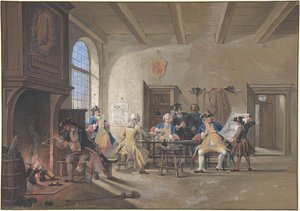
This 1727 oil painting captures a moment of dramatic tension from the comedy Beslikte Swaantje. The scene is set within a domestic interior, where a group of figures is gathered around a fireplace. A prominent character on the left, wearing a large, dark hat and a long cloak, gestures toward the assembly, driving the narrative forward. The composition relies on layered planes to create depth, with a smaller framed painting…

Cornelis Troost paintings, ranked 11 to 81

11Triptych depicting the peasants' court from the comedy "Beslikte Swaantje" (right panel of triptych) (1727) by Cornelis TroostTriptych depicting the peasants' court from the comedy "Beslikte Swaantje" (right panel of triptych)1727 · Amsterdam Museum 12Triptych depicting the peasants' court from the comedy "Beslikte Swaantje" (left panel of triptych) (1727) by Cornelis TroostTriptych depicting the peasants' court from the comedy "Beslikte Swaantje" (left panel of triptych)1727 · Amsterdam Museum 13Portrait of two men in an interior (1727) by Cornelis TroostPortrait of two men in an interior1727 · Rijksmuseum Twenthe 14Portrait of Gerrit Sichterman ( -1730) (1726) by Cornelis TroostPortrait of Gerrit Sichterman ( -1730)1726 · Groninger Museum 15Portrait of an unknown man (1732) by Cornelis TroostPortrait of an unknown man1732 · Amsterdam Museum 16Portrait of een persoon genaamd Willem Roell (1700-1775) (1729) by Cornelis TroostPortrait of een persoon genaamd Willem Roell (1700-1775)1729 · Amsterdam Museum 17Portrait of een persoon genaamd Elisabeth de Famars (1715-1780) (1724) by Cornelis TroostPortrait of een persoon genaamd Elisabeth de Famars (1715-1780)1724 · Amsterdam Museum 18Inspectors of the Collegium Medicum in Amsterdam, 1724 (1724) by Cornelis TroostInspectors of the Collegium Medicum in Amsterdam, 17241724 · Rijksmuseum 19Portrait of Maria de Lange (1696-1744), wife of Cornelius Ascanius van Sypesteyn, with her three young children (1727) by Cornelis TroostPortrait of Maria de Lange (1696-1744), wife of Cornelius Ascanius van Sypesteyn, with her three young children1727 · Kasteel-Museum Sypesteyn 20Depart for hunting with monumental architecture (1731) by Cornelis TroostDepart for hunting with monumental architecture1731 21Portrait of the Inspectors of the Collegium Medicum, Cornelis Troost, 1724 (1724) by Cornelis TroostPortrait of the Inspectors of the Collegium Medicum, Cornelis Troost, 17241724 22Herman Boerhaave (1668-1738) (1740) by Cornelis TroostHerman Boerhaave (1668-1738)1740 · Amsterdam Museum 23Portrait of Jeronimus Tonneman and his Son Jeronimus (1736) by Cornelis TroostPortrait of Jeronimus Tonneman and his Son Jeronimus1736 · National Gallery of Ireland 24Anna Homout b. Horneman (1740) by Cornelis TroostAnna Homout b. Horneman1740 25Dutch delivery room (1741) by Cornelis TroostDutch delivery room1741 · Museum Boijmans Van Beuningen 26Het beslikte Zwaentje or the court house at Puyterveen (1741) by Cornelis TroostHet beslikte Zwaentje or the court house at Puyterveen1741 · Museum Boijmans Van Beuningen 27Portrait of Herman Boerhaave, teacher of medicine in Leiden (1736) by Cornelis TroostPortrait of Herman Boerhaave, teacher of medicine in Leiden1736 28Portrait of the Tolling Family (1742) by Cornelis TroostPortrait of the Tolling Family1742 · Museum de Fundatie 29Guardroom Scene (1744) by Cornelis TroostGuardroom Scene1744 30Portrait of a Man (1730) by Cornelis TroostPortrait of a Man1730 · Mauritshuis 31The Delivery Room (1748) by Cornelis TroostThe Delivery Room1748 · Rijksmuseum 32The Doctor's Visit (1750) by Cornelis TroostThe Doctor's Visit1750 33Nursery Visit (1750) by Cornelis TroostNursery Visit1750 34Portrait of Louise Christina Trip, Wife of Gerrit Sichterman (1725) by Cornelis TroostPortrait of Louise Christina Trip, Wife of Gerrit Sichterman1725 · Rijksmuseum 35Reinier Adriaansz (1737) by Cornelis TroostReinier Adriaansz1737 · Mauritshuis 36Lady with Cupid and a Songbook (1745) by Cornelis TroostLady with Cupid and a Songbook1745 · Mauritshuis 37Love Scene (1736) by Cornelis TroostLove Scene1736 · Rijksmuseum 38Rumor erat in casa (1740) by Cornelis TroostRumor erat in casa1740 · Mauritshuis 39Guardroom Scene;Allegory on the War with France in 1747 (1747) by Cornelis TroostGuardroom Scene;Allegory on the War with France in 17471747 · Mauritshuis 40False Virtue Discovered: The Discovery of Volkert in the Laundry Basket (1739) by Cornelis TroostFalse Virtue Discovered: The Discovery of Volkert in the Laundry Basket1739 · Mauritshuis 41The Mathematicians or the Young Lady Who Fled: The Dispute between Doctors Raasbollius and Urinaal (1741) by Cornelis TroostThe Mathematicians or the Young Lady Who Fled: The Dispute between Doctors Raasbollius and Urinaal1741 · Mauritshuis 42Nemo Loquebatur (1740) by Cornelis TroostNemo Loquebatur1740 · Mauritshuis 43Portrait of Maria Magdalena Stavenisse, Wife of Jacob de Witte of Elkerzee, Councilor of Zierikzee, Cornelis Troost, c. 1726 (1726) by Cornelis TroostPortrait of Maria Magdalena Stavenisse, Wife of Jacob de Witte of Elkerzee, Councilor of Zierikzee, Cornelis Troost, c. 17261726 · Rijksmuseum 44Regents of the Aalmoezeniersweeshuis Orphanage in Amsterdam, 1729, Cornelis Troost, 1729 (1729) by Cornelis TroostRegents of the Aalmoezeniersweeshuis Orphanage in Amsterdam, 1729, Cornelis Troost, 17291729 · Rijksmuseum 45Pefroen and the Sheep (1739) by Cornelis TroostPefroen and the Sheep1739 · Mauritshuis 46Erat Sermo inter Fratres (1740) by Cornelis TroostErat Sermo inter Fratres1740 · Mauritshuis 47Three Governors of the Surgeons Guild, Amsterdam (1731) by Cornelis TroostThree Governors of the Surgeons Guild, Amsterdam1731 · Rijksmuseum 48Self-Portrait (1745) by Cornelis TroostSelf-Portrait1745 · Mauritshuis 49Rumor erat in Casa (There was a Commotion in the House) (1740) by Cornelis TroostRumor erat in Casa (There was a Commotion in the House)1740 · Mauritshuis 50Captain Ulrich or Greed Thwarted: Disguised, Godefroy and his Servant Put Captain Ulrich to Flight (1738) by Cornelis TroostCaptain Ulrich or Greed Thwarted: Disguised, Godefroy and his Servant Put Captain Ulrich to Flight1738 · Mauritshuis 51Portrait of a Gentleman (1716) by Cornelis TroostPortrait of a Gentleman1716 52Portrait of a Man, Cornelis Troost, 1723 (1723) by Cornelis TroostPortrait of a Man, Cornelis Troost, 17231723 · Rijksmuseum 53Portrait of the Physician Herman Boerhaave, Professor at the University of Leiden, Cornelis Troost, 1735 (1735) by Cornelis TroostPortrait of the Physician Herman Boerhaave, Professor at the University of Leiden, Cornelis Troost, 17351735 · Rijksmuseum 54Alexander the Great at the Battle of the Granicus against the Persians, Cornelis Troost, 1737 (1737) by Cornelis TroostAlexander the Great at the Battle of the Granicus against the Persians, Cornelis Troost, 17371737 · Rijksmuseum 55Portrait of Isaac Sweers, Chief Officer of Amsterdam and Governor of the Dutch East India Company, Cornelis Troost, 1730 - 1740 (1740) by Cornelis TroostPortrait of Isaac Sweers, Chief Officer of Amsterdam and Governor of the Dutch East India Company, Cornelis Troost, 1730 - 17401740 · Rijksmuseum 56Jeronimus Tonneman and his Son (1736) by Cornelis TroostJeronimus Tonneman and his Son1736 57The Phoenix, Cornelis Troost, 1720 - 1750 (1750) by Cornelis TroostThe Phoenix, Cornelis Troost, 1720 - 17501750 · Rijksmuseum 58Portrait of Ludolf Backhuysen II, Painter and Dragoon, Grandson of the Marine Painter Ludolf Backhuysen I, Cornelis Troost, 1735 - 1750 (1750) by Cornelis TroostPortrait of Ludolf Backhuysen II, Painter and Dragoon, Grandson of the Marine Painter Ludolf Backhuysen I, Cornelis Troost, 1735 - 17501750 · Rijksmuseum 59An Amsterdam Canal House Garden, Cornelis Troost, c. 1740 - 1745 (1745) by Cornelis TroostAn Amsterdam Canal House Garden, Cornelis Troost, c. 1740 - 17451745 · Rijksmuseum 60The Discovery of Jan Claasz (1738) by Cornelis TroostThe Discovery of Jan Claasz1738 · Mauritshuis 61the consultation by Cornelis Troostthe consultation 62motherhood by Cornelis Troostmotherhood 63Saartje Jans is Asked for her Hand in Marriage (1738) by Cornelis TroostSaartje Jans is Asked for her Hand in Marriage1738 · Mauritshuis 64Ibant qui poterant, qui non potuere cadebant (1739) by Cornelis TroostIbant qui poterant, qui non potuere cadebant1739 · Mauritshuis 65Loquebantur Omnes (1740) by Cornelis TroostLoquebantur Omnes1740 · Mauritshuis 66Self-Portrait, Cornelis Troost, 1715 - 1730 (1730) by Cornelis TroostSelf-Portrait, Cornelis Troost, 1715 - 17301730 · Yale Center for British Art 67Regents of the Aalmoezeniersweeshuis Orphanage in Amsterdam, 1729, Cornelis Troost, 1729 (1729) by Cornelis TroostRegents of the Aalmoezeniersweeshuis Orphanage in Amsterdam, 1729, Cornelis Troost, 17291729 · Rijksmuseum 68Gerrit Sichterman (1688-1730). Quartermaster-General of the Cavalry, Colonel of the Oranje-Groningen Infantry Regiment, Commandant of Grave, Cornelis Troost, c. 1725 (1725) by Cornelis TroostGerrit Sichterman (1688-1730). Quartermaster-General of the Cavalry, Colonel of the Oranje-Groningen Infantry Regiment, Commandant of Grave, Cornelis Troost, c. 17251725 · Rijksmuseum 69Gerrit Sichterman (1688-1730). Quartermaster-General of the Cavalry, Colonel of the Oranje-Groningen Infantry Regiment, Commandant of Grave, Cornelis Troost, 1725 (1725) by Cornelis TroostGerrit Sichterman (1688-1730). Quartermaster-General of the Cavalry, Colonel of the Oranje-Groningen Infantry Regiment, Commandant of Grave, Cornelis Troost, 17251725 · Rijksmuseum 70Self-portrait, Cornelis Troost, 1739 (1739) by Cornelis TroostSelf-portrait, Cornelis Troost, 17391739 · Rijksmuseum 71Self portrait by Cornelis TroostSelf portrait 72Jan lepeltak by Cornelis TroostJan lepeltakRijksmuseum 73The Ambassador of the Rascals Exposes himself from the Window of 't Bokki Tavern in the Haarlemmerhout by Cornelis TroostThe Ambassador of the Rascals Exposes himself from the Window of 't Bokki Tavern in the HaarlemmerhoutRijksmuseum 74Family group at a harpsichord. by Cornelis TroostFamily group at a harpsichord.Rijksmuseum 75The feigned sadness first company, eleventh stage of the comedy The discovered apparent virtue by Cornelis TroostThe feigned sadness first company, eleventh stage of the comedy The discovered apparent virtue 76The Spendthrift or the Wasteful Woman, act III, scene V, from the Play by Thomas Asselijn (Joanna and the Polish Jewish Traders) by Cornelis TroostThe Spendthrift or the Wasteful Woman, act III, scene V, from the Play by Thomas Asselijn (Joanna and the Polish Jewish Traders)Rijksmuseum 77The Wedding of Kloris and Roosje by Cornelis TroostThe Wedding of Kloris and RoosjeMauritshuis 78Singing Round the Star on Twelfth Night by Cornelis TroostSinging Round the Star on Twelfth NightMauritshuis 79Blindman's buff (1740) by Cornelis TroostBlindman's buff1740 · Museum Boijmans Van Beuningen 80The anatomy of Dr Willem Roell by Cornelis TroostThe anatomy of Dr Willem RoellAmsterdam Museum 81Portrait of a Music Lover (1736) by Cornelis TroostPortrait of a Music Lover1736 · Rijksmuseum

Cornelis Troost's famous paintings, period by period

The subjects that held Cornelis Troost's eye

The four subjects that come back most often in these originals, each with its finest example.

The museums that keep Cornelis Troost's originals

The 8 museums that hold the most of the paintings on this page.

Museum City Works by Cornelis Troost Paintings from this list
Rijksmuseum, AmsterdamRijksmuseum Amsterdam 25 Inspection of a Cavalry Regiment, perhaps by William of Hesse-Homburg, A Couple Making Music, Cornelis Troost, 1743, Inspectors of the Collegium Medicum in Amsterdam, 1724
Mauritshuis, The HagueMauritshuis The Hague 21 The Organ Grinder, Harlequin, Magician and Barber: The Rivals Exposed, Portrait of a Man
Amsterdam Museum, AmsterdamAmsterdam Museum Amsterdam 10 The Regents of the Oudezijds Huiszittenhuis, Triptych depicting the peasants' court from the comedy "Beslikte Swaantje", Triptych depicting the peasants' court from the comedy "Beslikte Swaantje" (center panel of triptych)
Museum Boijmans Van Beuningen, RotterdamMuseum Boijmans Van Beuningen Rotterdam 3 Dutch delivery room, Het beslikte Zwaentje or the court house at Puyterveen, Blindman's buff
Rijksmuseum Twenthe, EnschedeRijksmuseum Twenthe Enschede 2 Double portrait of an unknown man and a boy, Portrait of two men in an interior
Hermitage Museum, Saint PetersburgHermitage Museum Saint Petersburg 1 Scene in a Coffee Shop
Bavarian State Painting Collections, MunichBavarian State Painting Collections Munich 1 Aeneas and Dido Set Out for the Hunt
Groninger Museum, GroningenGroninger Museum Groningen 1 Portrait of Gerrit Sichterman ( -1730)

Cornelis Troost, one signature painting per decade

Works per decade

Pick a decade to see the original that defines it.

Cornelis Troost's paintings: the gallery answers

Which Cornelis Troost painting is the most famous of all?Reveal the answer

Inspection of a Cavalry Regiment, perhaps by William of Hesse-Homburg (1742), Rijksmuseum, Amsterdam. The Regents of the Oudezijds Huiszittenhuis (1740) and A Couple Making Music, Cornelis Troost, 1743 (1743) come next.

How old was Cornelis Troost on completing Inspection of a Cavalry Regiment, perhaps by William of Hesse-Homburg?Reveal the answer

46 years old: Inspection of a Cavalry Regiment, perhaps by William of Hesse-Homburg dates from 1742, and Cornelis Troost was born in 1696.

Which are Cornelis Troost's top 10 paintings?Reveal the answer

Inspection of a Cavalry Regiment, perhaps by William of Hesse-Homburg, The Regents of the Oudezijds Huiszittenhuis, A Couple Making Music, Cornelis Troost, 1743, Scene in a Coffee Shop, The Organ Grinder, Harlequin, Magician and Barber: The Rivals Exposed, Double portrait of an unknown man and a boy, Aeneas and Dido Set Out for the Hunt, Triptych depicting the peasants' court from the comedy "Beslikte Swaantje" and Triptych depicting the peasants' court from the comedy "Beslikte Swaantje" (center panel of triptych). The ranking above gives each one's year and museum.

How many works did Cornelis Troost create?Reveal the answer

Our catalog holds 82 works by Cornelis Troost, dated from 1716 to 1750.

Where do Cornelis Troost's most famous originals hang?Reveal the answer

Mostly in Rijksmuseum (Amsterdam), Mauritshuis (The Hague) and Amsterdam Museum (Amsterdam). The museum table above lists them all.

When did Cornelis Troost create the most famous paintings?Reveal the answer

In 1740s: 23 of the 81 works on this page were made then, Inspection of a Cavalry Regiment, perhaps by William of Hesse-Homburg among them.

Which are Cornelis Troost's earliest and latest famous works?Reveal the answer

On this page, the earliest is Portrait of a Gentleman (1716) and the latest Scene in a Coffee Shop (1750).

Which subjects did Cornelis Troost return to most?Reveal the answer

Man (18), Woman (13) and 18th century (13), across the 81 works on this page.

Which medium did Cornelis Troost work in most?Reveal the answer

Oil On Canvas, for 29 of the 81 works on this page.

Which movement is Cornelis Troost associated with?Reveal the answer

Rococo, judging by the originals on this page.

Which Cornelis Troost originals does the Rijksmuseum hold?Reveal the answer

Inspection of a Cavalry Regiment, perhaps by William of Hesse-Homburg, A Couple Making Music, Cornelis Troost, 1743 and Inspectors of the Collegium Medicum in Amsterdam, 1724: the Rijksmuseum, Amsterdam holds 25 of the works on this page.

Cornelis Troost: the artist

A Window into Amsterdam’s Golden Age

Cornelis Troost, a name inextricably linked to the vibrant tapestry of 18th-century Amsterdam, was more than just an artist; he was a keen observer and masterful recorder of his era. Born in the heart of the Dutch Republic on October 8, 1696, in Amsterdam, Troost’s journey from aspiring actor to celebrated painter reveals a fascinating confluence of artistic passions and personal transformation. Initially trained as a performer on the stage, he found his true calling not amidst applause and drama, but within the meticulous detail and subtle nuances of painting. His life's trajectory is marked by a deliberate shift – a conscious rejection of the spotlight for the quiet contemplation of brushstrokes, ultimately leading him to become one of the most significant figures in Dutch Rococo genre art.

Troost’s artistic education began under the tutelage of Arnold Boonen, a respected portraitist who recognized his student's innate talent. This apprenticeship provided a crucial foundation, but it was Troost’s early drawings that truly showcased his distinctive style – particularly one dated 1708 depicting Prince Eugene of Savoy and the notorious bookseller and spy, Louis Renard, engaging in clandestine activities within a luxurious Amsterdam brothel. This piece, brimming with wit and intrigue, hinted at the themes he would later explore with such captivating skill: the complexities of social life, the allure of pleasure, and the hidden currents beneath the veneer of respectability.

The Elegance of Rococo and Social Narrative

As his career matured, Troost became a master of capturing the delicate balance between frivolity and sophistication. His work was undoubtedly influenced by the prevailing artistic trends of his time, including the dramatic compositions of William Hogarth, known for his satirical depictions of London society, and the elegant grace of French masters like Watteau, Boucher, and Lancret. This synthesis of Dutch realism and French Rococo elegance allowed him to create works that were both deeply grounded in local reality and exquisitely refined.

His repertoire was remarkably diverse, ranging from intimate portraits to monumental group compositions. Some of his most enduring contributions to the art world include:

Legacy of a Master Observer

The significance of Cornelis Troost lies in his ability to act as a visual historian for a period of transition. While the era of the great Dutch Golden Age masters had passed, Troost breathed new life into the Dutch tradition by infusing it with the lightheartedness and decorative charm of the Rococo movement. His paintings do not merely depict faces; they capture the spirit of an age—the rustle of silk, the flicker of candlelight, and the subtle social hierarchies of Amsterdam's upper class.

Through his witty portraits and captivating genre scenes, Troost left behind a legacy that continues to enchant viewers. He remains a pivotal figure who bridged the gap between the heavy, dramatic traditions of the 17th century and the airy, graceful aesthetics of the 18th century, ensuring that the social nuances of his beloved Amsterdam would be preserved in pigment for generations to come.