Portrait of Andries Van Eertvelt

The 41 Most Famous Andries Van Eertvelt Paintings, a Gallery Selection

Updated November 2026 · ranked by our popularity score (searches, visits and orders for each work) · 43 works by Andries Van Eertvelt in our catalogue

In short

Of all the originals Andries Van Eertvelt left, the most famous is Two Ships at Anchor (1640), in the collection of the Hermitage Museum, Saint Petersburg. Close behind it come Sea Battle (1627) and Seascape with Four Frigates (1621). Our catalog holds 43 works by Andries Van Eertvelt; the gallery has kept the 41 the world admires most, each shown with its date, its museum and its story.

1590 – 1652, Antwerp Baroque Most works: National Maritime Museum

Andries Van Eertvelt's top 10 paintings: the gallery's choice

1
Two Ships at Anchor (1640) by Andries Van Eertvelt

Two Ships at Anchor

1640 · Oil On Canvas · Hermitage Museum, Saint Petersburg

To gaze upon Andries Van Eertvelt’s "Two Ships at Anchor" is to be transported directly into the serene, yet richly detailed world of 17th-century Dutch maritime life. Completed in 1640, this oil on canvas masterpiece captures more than just two vessels resting in a harbor; it encapsulates an entire atmosphere—one of quiet industry, profound depth, and the enduring relationship between humanity and the vast sea. The scene unfolds with remarkable…

2
Sea Battle (1627) by Andries Van Eertvelt

Sea Battle

1627 · Oil On Canvas · Hermitage Museum, Saint Petersburg

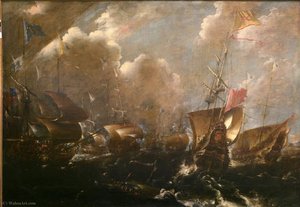
Andries van Eertvelt's "Sea Battle," painted in 1627-29, isn’t merely a depiction of naval combat; it’s a visceral immersion into the heart of a storm-wracked encounter. This monumental oil on canvas, measuring an impressive 134 x 166 cm, transports the viewer directly to the chaotic embrace of the North Sea, where two formidable ships clash amidst a maelstrom of spray and fury. Van Eertvelt, a pivotal figure in the nascent…

3
Seascape with Four Frigates (1621) by Andries Van Eertvelt

Seascape with Four Frigates

Seascape with Four Frigates by Andries Van Eertvelt, created about 1621, presents a busy maritime scene centered on naval activity. The composition features several large sailing vessels, identified as likely frigates, navigating the waters near a rugged coastline. These ships occupy the midground and background, positioned against a sky filled with voluminous clouds. The scale of the vessels is emphasized by their proximity to the viewer and their placement within…

4
Naval Battle (1621) by Andries Van Eertvelt

Naval Battle

1621 · Oil On Canvas · Bavarian State Painting Collections, Munich

Naval Battle is an oil on canvas work by Andries Van Eertvelt, dated 1621. The composition centers on the subject of naval warfare, capturing a moment of maritime conflict. The artist focuses on the technical anatomy of the vessels and the movement of the sea to define the scene.

5
The Battle of Lepanto (1617) by Andries Van Eertvelt

The Battle of Lepanto

1617 · Oil On Canvas · Birmingham Museum and Art Gallery, Birmingham

Andries Van Eertvelt’s The Battle of Lepanto, dated about 1617, captures a pivotal naval engagement fought on 7 October 1571. The conflict took place in the Gulf of Patras, marking a significant confrontation between the Holy League and the Ottoman Empire. This massive maritime struggle involved more than 450 warships, representing one of the largest naval encounters of the era.

6
Dutch Ships loading Timber in a Northern Port (1615) by Andries Van Eertvelt

Dutch Ships loading Timber in a Northern Port

1615 · Oil On Panel · National Maritime Museum, London

The scene unfolds in "Dutch Ships loading Timber in a Northern Port," a maritime oil painting by Andries Van Eertvelt. Created about 1615, the work captures a moment of intense industry within a bustling harbor. We find ourselves amidst the heavy labor of 17th-century maritime commerce, where the rhythmic movement of trade defines the very air of the port. The focus remains fixed on the specific, weighty task of loading…

7
Shipping of a coastal town (1621) by Andries Van Eertvelt

Shipping of a coastal town

Andries Van Eertvelt, a Flemish painter born in Antwerp, Belgium, in 1590, created Shipping of a coastal town in about 1621. This maritime oil painting captures a bustling harbor scene, focusing on the technical complexity of various sailing vessels. The composition features a wide-angle seascape where large merchant ships with intricate rigging and sails occupy the midground, while smaller boats navigate the choppy waters in the foreground. A prominent, detailed…

8
Battle of Gibraltar (1633) by Andries Van Eertvelt

Battle of Gibraltar

1633 · Oil · Musée des Beaux-Arts, Rennes

The oil painting titled Battle of Gibraltar by Andries Van Eertvelt captures a moment of violent maritime struggle. Dating to about 1633, the work presents a chaotic naval battle amidst churning waters. The scene likely represents the historical Battle of Gibraltar, frozen in a state of intense movement and smoke.

9
Attack on San Salvador (1624) by Andries Van Eertvelt

Attack on San Salvador

1624 · Oil On Canvas · National Maritime Museum, London

In Attack on San Salvador, Andries Van Eertvelt organizes a chaotic maritime engagement through a wide-angle perspective. The composition directs the viewer's gaze from the turbulent foreground of sailing ships toward a fortified hilltop settlement in the distance. This spatial arrangement emphasizes the scale of the naval siege occurring near the coastal city. The scene is structured by strong diagonal lines, specifically the masts of the vessels and the billowing…

The Andries Van Eertvelt selection continues, 11 to 41

11Dutch Yachts Racing (1630) by Andries Van EertveltDutch Yachts Racing1630 · National Maritime Museum 12Storm at Sea (1625) by Andries Van EertveltStorm at Sea1625 · Royal Museum of Fine Arts Antwerp 13Battle of Lepanto (1629) by Andries Van EertveltBattle of Lepanto1629 14Ships in Peril (1623) by Andries Van EertveltShips in Peril1623 · Museum voor Schone Kunsten 15Port with Warships (1640) by Andries Van EertveltPort with Warships1640 · Kunsthistorisches Museum 16Stormy Sea (1640) by Andries Van EertveltStormy Sea1640 · Hermitage Museum 17Spanish engagement with Barbary pirates (1650) by Andries Van EertveltSpanish engagement with Barbary pirates1650 · National Maritime Museum 18The return of a Spanish expedition (1650) by Andries Van EertveltThe return of a Spanish expedition1650 · National Maritime Museum 19Action between Spanish and Dutch ships (1650) by Andries Van EertveltAction between Spanish and Dutch ships1650 · National Maritime Museum 20Mediterranean coastal landscape with sailing ships (1650) by Andries Van EertveltMediterranean coastal landscape with sailing ships1650 21Ships in a Storm, Andries van Eertvelt (attributed to), 1600 - 1652 (1652) by Andries Van EertveltShips in a Storm, Andries van Eertvelt (attributed to), 1600 - 16521652 · Rijksmuseum 22Stormy Seas by Andries Van EertveltStormy Seas 23Untitled (833) by Andries Van EertveltUntitled (833) 24A Dutch ship at anchor off Genoa by Andries Van EertveltA Dutch ship at anchor off GenoaNational Maritime Museum 25A Dutch ship running out of a harbour by Andries Van EertveltA Dutch ship running out of a harbourNational Maritime Museum 26Action between English and Spanish ships by Andries Van EertveltAction between English and Spanish shipsNational Maritime Museum 27Naval Battle by Andries Van EertveltNaval BattleMuseum of Fine Arts Ghent (MSK) 28Ships in Stormy Seas by Andries Van EertveltShips in Stormy Seas 29Naval battle by Andries Van EertveltNaval battleBavarian State Painting Collections 30Effect of the Setting Sun by Andries Van EertveltEffect of the Setting Sun 31Dutch Ships sailing off a Rocky Shore by Andries Van EertveltDutch Ships sailing off a Rocky ShoreNational Maritime Museum 32The Return to Amsterdam of the Second Expedition to the East Indies by Andries Van EertveltThe Return to Amsterdam of the Second Expedition to the East IndiesNational Maritime Museum 33The Santa Maria at anchor by Andries Van EertveltThe Santa Maria at anchorNational Maritime Museum 34Naval Battle of Guetaria in (1638) by Andries Van EertveltNaval Battle of Guetaria in (1638) 35A Harbour Scene, possibly Genoa by Andries Van EertveltA Harbour Scene, possibly Genoa 36The Battle of Lepanto by Andries Van EertveltThe Battle of Lepanto 37The Return to Amsterdam of the Second Expedition to the East Indies on 19th July (1599) by Andries Van EertveltThe Return to Amsterdam of the Second Expedition to the East Indies on 19th July (1599)Het Scheepvaartmuseum 38Coastal landscape with warship under papal flag and a Dutch sloop by Andries Van EertveltCoastal landscape with warship under papal flag and a Dutch sloop 39Embarkation of Spanish Troops by Andries Van EertveltEmbarkation of Spanish TroopsNational Maritime Museum 40An Algerine ship off a barbary port by Andries Van EertveltAn Algerine ship off a barbary portNational Maritime Museum 41Marine by Andries Van EertveltMarine

Andries Van Eertvelt's famous paintings, period by period

The subjects that held Andries Van Eertvelt's eye

The four subjects that come back most often in these originals, each with its finest example.

The museums that keep Andries Van Eertvelt's originals

The 8 museums that hold the most of the paintings on this page.

Museum City Works by Andries Van Eertvelt Paintings from this list
National Maritime Museum, LondonNational Maritime Museum London 15 Dutch Ships loading Timber in a Northern Port, Attack on San Salvador, Daybreak after the bombardment of a port by Spanish ships
Bavarian State Painting Collections, MunichBavarian State Painting Collections Munich 4 Seascape with Four Frigates, Naval Battle, Shipping of a coastal town
Hermitage Museum, Saint PetersburgHermitage Museum Saint Petersburg 3 Two Ships at Anchor, Sea Battle, Stormy Sea
Birmingham Museum and Art Gallery, BirminghamBirmingham Museum and Art Gallery Birmingham 1 The Battle of Lepanto
Musée des Beaux-Arts, RennesMusée des Beaux-Arts Rennes 1 Battle of Gibraltar
Royal Museum of Fine Arts Antwerp, AntwerpRoyal Museum of Fine Arts Antwerp Antwerp 1 Storm at Sea
Museum voor Schone Kunsten, GentMuseum voor Schone Kunsten Gent 1 Ships in Peril
Kunsthistorisches Museum, ViennaKunsthistorisches Museum Vienna 1 Port with Warships

Andries Van Eertvelt decade by decade: the original that defines each

Works per decade

Pick a decade to see the original that defines it.

Collectors' questions about Andries Van Eertvelt's paintings

Which work is Andries Van Eertvelt most famous for?Reveal the answer

Two Ships at Anchor (1640), Hermitage Museum, Saint Petersburg. Sea Battle (1627) and Seascape with Four Frigates (1621) come next.

What age was Andries Van Eertvelt when Two Ships at Anchor was made?Reveal the answer

50 years old: Two Ships at Anchor dates from 1640, and Andries Van Eertvelt was born in 1590.

What are the ten most famous Andries Van Eertvelt paintings?Reveal the answer

Two Ships at Anchor, Sea Battle, Seascape with Four Frigates, Naval Battle, The Battle of Lepanto, Dutch Ships loading Timber in a Northern Port, Shipping of a coastal town, Battle of Gibraltar, Attack on San Salvador and Daybreak after the bombardment of a port by Spanish ships. The ranking above gives each one's year and museum.

How many paintings did Andries Van Eertvelt leave?Reveal the answer

Our catalog holds 43 works by Andries Van Eertvelt, dated from 1615 to 1652.

In which museums do Andries Van Eertvelt's masterpieces hang?Reveal the answer

Mostly in National Maritime Museum (London), Bavarian State Painting Collections (Munich) and Hermitage Museum (Saint Petersburg). The museum table above lists them all.

In which years did Andries Van Eertvelt paint the most famous works?Reveal the answer

In 1620s: 9 of the 41 works on this page were made then, Sea Battle among them.

What are the first and the last famous originals of Andries Van Eertvelt?Reveal the answer

On this page, the earliest is Dutch Ships loading Timber in a Northern Port (1615) and the latest Ships in a Storm, Andries van Eertvelt (attributed to), 1600 - 1652 (1652).

Which subjects did Andries Van Eertvelt choose most often?Reveal the answer

Sea (14), Ships (11) and Water (11), across the 41 works on this page.

Which technique did Andries Van Eertvelt use most?Reveal the answer

Oil On Canvas, for 15 of the 41 works on this page.

To which art movement does Andries Van Eertvelt belong?Reveal the answer

Baroque, judging by the originals on this page.

Which Andries Van Eertvelt works hang at the National Maritime Museum?Reveal the answer

Dutch Ships loading Timber in a Northern Port, Attack on San Salvador and Daybreak after the bombardment of a port by Spanish ships: the National Maritime Museum, London holds 15 of the works on this page.

Andries Van Eertvelt: life and work

The Master of the Flemish Seas: The Life and Legacy of Andries van Eertvelt

In the golden age of Flemish painting, when the salt spray of the North Sea met the burgeoning maritime power of the Low Countries, one artist emerged to capture the untamed spirit of the ocean. Andries van Eertvelt, born in Antwerp in 1590, was not merely a painter of water and wind; he was a pioneer who redefined the boundaries of marine art. While his contemporaries often focused on the terrestrial triumphs of portraiture or religious devotion, van Eertvelt turned his gaze toward the horizon, finding profound drama in the churning waves, the creaking timber of Dutch ships, and the perilous beauty of naval warfare.

Van Eert velt’s journey began in the heart of Antwerp, a city pulsating with artistic energy. Baptized in the magnificent Antwerp Cathedral, his early years were steeped in the traditions of the Guild of St. Luke, where he officially registered as a master in 1609. Though the records of his formal apprenticeship remain lost to time, his technical prowess suggests a rigorous foundation in the Flemish tradition. His life, however, was marked by both personal tragedy and profound wanderlust. Following the death of his wife, Catherine de Vlieger, in the mid-1620s, van Eertvelt embarked on a transformative journey through Italy. Accompanied by his pupil, Matthieu van Plattenberg, he found himself in Genoa between 1628 and 1630, living alongside the renowned marine artist Cornelis de Wael. This period of Mediterranean exposure likely infused his work with a new understanding of light and atmosphere, bridging the gap between the rugged Northern maritime style and the luminous sensibilities of the South.

A Symphony of Storm and Steel

The true genius of van Eertvelt lies in his ability to translate the chaotic energy of the sea into a structured, emotive visual narrative. He was one of the first Flemish artists to specialize specifically in marine subjects, moving beyond mere background scenery to make the ocean the central protagonist of his canvases. His work often oscillates between two distinct modes: the terrifying intensity of naval combat and the serene, yet powerful, majesty of the open sea.

In his depictions of battle, such as the epic The Battle of Lepanto or his visceral Sea Battle, the viewer is thrust into the heart of the conflict. Here, the artist employs a masterful command of Baroque dynamism, using thick textures and dramatic lighting to convey the smoke of cannon fire, the splintering of masts, and the desperate struggle of sailors amidst the waves. Conversely, in works like Two Ships at Anchor, he demonstrates an incredible capacity for stillness and realism. In these compositions, the focus shifts to the subtle play of light upon calm waters and the meticulous detail of the vessels, showcasing a profound respect for the technical anatomy of the ships that defined his era.

His artistic repertoire was remarkably diverse, encompassing:

  • Dramatic Seascapes: Capturing the overwhelming power of storms and the turbulent motion of heavy swells.
  • Maritime Portraits: Detailed renderings of Dutch and Flemish vessels, serving as both art and historical record.
  • Naval Warfare: Intense, action-oriented scenes that utilize light and shadow to heighten the sense of peril.
  • Harbor Views: Observational studies of maritime commerce and the bustling life of coastal ports.

Historical Significance and Enduring Influence

The historical importance of Andries van Eertvelt cannot be overstated. By carving out a specialized niche within the Flemish school, he laid the groundwork for generations of marine painters who would follow in his wake. He transformed the sea from a mere setting into a psychological landscape capable of expressing human vulnerability and triumph. His ability to blend the meticulous detail required by the Northern tradition with the dramatic, theatrical flair of the Baroque movement allowed him to create works that were both intellectually stimulating and emotionally resonant.

As a master, draughtsman, and engraver, his influence extended far beyond his own brushstrokes; many of his pupils went on to become prominent figures in the maritime art world, ensuring that his vision of the sea continued to evolve. Today, when we look upon a van Eertvelt seascape, we are not just looking at water and wood; we are witnessing the birth of a genre. His legacy remains etched in the salt-stained canvases of history, reminding us of a time when the mastery of the elements was the ultimate frontier of artistic expression.