Italian Renaissance
St. Augustine (Sandro Botticelli)
Sandro Botticelli (1445–1510) made St. Augustine. It belongs to the Italian Renaissance movement. It is made in oil on panel.
- Oil On Panel

 Preview

 Hand Made Oil Painting
 Send
 Share
 Fact sheet


 Download
 Similars
 X-Ray
 Diaporama
 Q&A

 Stats
St. Augustine, in brief
- Title
- St. Augustine
- Artist
- Sandro Botticelli (1445–1510)
- Artist born in
- Florence, Italy
- Medium
- Oil On Panel
- Movement
- Italian Renaissance
- Period
- Renaissance
- Subject
- saint augustine, renaissance painting, botticelli, fresco, cardinal, desk
What does St. Augustine depict?
The Artist: Sandro Botticelli
Alessandro di Mariano di Vanni Filipepi, known as Sandro Botticelli (around 1445 - May 17, 1510), was an Italian painter of the Early Renaissance. He is best known for his mythological works, such as "The Birth of Venus" and "Primavera."Title: St. Augustine
St. Augustine is the subject of two paintings by Sandro Botticelli, both executed in 1480. The first painting is housed in the church of Ognissanti in Florence, while the second one is in the Uffizi Gallery, also in Florence.Media: Oil on Panel
Botticelli's St. Augustine paintings are executed in oil on panel, a technique that was widely used during the Renaissance period. This medium allowed artists to create rich and detailed works with vibrant colors and subtle shading.Style: Italian Renaissance
Botticelli's St. Augustine paintings are characteristic of the Italian Renaissance style, which is known for its harmonious composition, naturalism, and idealized beauty. The artist uses a linear perspective to create depth and space, while the figures are depicted with graceful movements and expressive faces.Historical Context
The St. Augustine paintings were created during the Italian Renaissance, a period of great cultural and artistic achievement in Italy. This was a time when artists, writers, and thinkers were rediscovering the classical culture of ancient Greece and Rome, leading to a renewed interest in humanism, science, and art.Commissioned by Amerigo Vespucci's Father
It has been supposed that the second St. Augustine painting was commissioned by Amerigo Vespucci's father, who was a friend of Botticelli's. The Coat of Arms visible in the upper part of the painting is that of the Vespucci family, indicating their connection to the work.Where to See St. Augustine by Sandro Botticelli
The second St. Augustine painting by Sandro Botticelli is housed in the Uffizi Gallery in Florence, Italy. This museum is one of the most important Italian museums and the most visited, holding a collection of priceless works from the period of the Italian Renaissance. Uffizi Gallery, located adjacent to the Piazza della Signoria in the Historic Centre of Florence, Tuscany, Italy, is home to many masterpieces of Western art, including Botticelli's St. Augustine.Hand Made Oil Paintings Reproductions by OriginalUniqueArt.com
At OriginalUniqueArt.com, we offer high-quality hand made oil paintings reproductions of Sandro Botticelli's St. Augustine. Our skilled artists use traditional techniques to create beautiful and accurate reproductions that capture the essence of the original work. OriginalUniqueArt.com is your go-to source for fine art reproductions, offering a wide range of paintings from famous artists, including Sandro Botticelli. Our team of experts is dedicated to providing you with the best possible service and ensuring that you are completely satisfied with your purchase.Conclusion
Sandro Botticelli's St. Augustine paintings are a testament to the artist's skill and mastery of the Italian Renaissance style. These works offer a glimpse into the cultural and artistic achievements of the period, showcasing Botticelli's unique talent for creating beautiful and expressive figures. If you're looking to add a touch of classic beauty to your home or office, consider purchasing a hand made oil painting reproduction of St. Augustine by Sandro Botticelli from OriginalUniqueArt.com. Our high-quality reproductions are sure to impress and inspire for years to come.High-resolution images of St. Augustine
Sandro Botticelli, St. Augustine. Public domain.
Questions on St. Augustine, answered
What technique was used for "St. Augustine" by Sandro Botticelli?
The medium of "St. Augustine" by Sandro Botticelli is oil on panel. Reproductions aim to render the appearance of this technique.
What is "St. Augustine" about?
"St. Augustine" by Sandro Botticelli depicts: saint augustine, renaissance painting, botticelli, fresco, cardinal, desk, books.
Is "St. Augustine" by Sandro Botticelli in the public domain?
"St. Augustine" by Sandro Botticelli is in the public domain - its copyright has expired. This status governs how the image of the work may be reproduced.
Who is the artist behind "St. Augustine"?
"St. Augustine" was created by Sandro Botticelli. The information on this page describes Sandro Botticelli's original work.
Which artistic current is "St. Augustine" by Sandro Botticelli part of?
"St. Augustine" is a work of Italian Renaissance. The movement indicates the artistic tradition the work is part of.
Where does "St. Augustine" fall in Sandro Botticelli's career?
"St. Augustine" belongs to the Early Renaissance of Sandro Botticelli's career. This classification relates the work to the artist's development.
What explains the copyright situation of "St. Augustine" by Sandro Botticelli?
The copyright status of "St. Augustine" - in the public domain - its copyright has expired - follows from the artist's death in 1510.
What does "St. Augustine" share with the rest of Sandro Botticelli's output?
Within Sandro Botticelli's output, "St. Augustine" sits in the Italian Renaissance style, alongside the themes of classical ideals, faith, knowledge, vespucci family, renaissance style.
How does the subject of "St. Augustine" relate to Sandro Botticelli's usual themes?
"St. Augustine" depicts saint augustine, renaissance painting, botticelli, fresco, cardinal, desk, books, while Sandro Botticelli's recorded themes are classical ideals, faith, knowledge, vespucci family, renaissance style. Comparing the two shows how the work relates to the artist's usual subjects.
About the artist, Sandro Botticelli
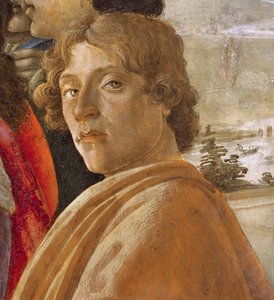
1445–1510, Italy
Sandro Botticelli
The Life of Sandro Botticelli Sandro Botticelli lived his life within the narrow, busy streets of Florence, Italy. Born Alessandro di Mariano di Vanni Filipepi around 1445, he was the son of a tanner. His family lived in the neighborhood of Ognissanti, a place he remained close to throughout his years. He eventually became known by the name Botticelli, a nickname taken from the word botticello, which refers to a small wine cask or little barrel.
Also by Sandro Botticelli
 The Birth Of Venus1485
 Primavera1482
 Venus and Mars1483
 Adoration Of The Magi
Essays around St. Augustine
 Early Netherlandish Painting vs. Italian Renaissance: A Comparative StudyMaster the differences between Netherlandish detail and Renaissance perspective. Explore this expert comparative study now.
 25 Must-See Masterpieces in the Uffizi Gallery, FlorenceEmbark on a journey through the Italian Renaissance. Explore 25 iconic masterpieces from Florence's Uffizi Gallery, featuring legends like …
 25 Masterpieces by Sandro Botticelli: The Ultimate Guide to Renaissance BeautyJourney through the ethereal beauty of the Italian Renaissance with our curated list of 25 Sandro Botticelli masterpieces. From myth to gra…