Northern Renaissance
Self portrait (Jean Fouquet)
Jean Fouquet (1420–1478) made Self portrait. It belongs to the Northern Renaissance movement.

 Preview

 Hand Made Oil Painting
 Send
 Share
 Fact sheet


 Download
 Similars
 X-Ray
 Diaporama
 Q&A

 Stats
Self portrait, in brief
- Title
- Self portrait
- Artist
- Jean Fouquet (1420–1478)
- Artist born in
- Tours, France
- Movement
- Northern Renaissance
- Subject
- portraits
High-resolution images of Self portrait

Jean Fouquet, Self portrait. Public domain.
Questions on Self portrait, answered
What subjects appear in "Self portrait" by Jean Fouquet?
The subjects of "Self portrait" are portraits.
Is "Self portrait" free of copyright?
Regarding copyright, "Self portrait" is in the public domain - its copyright has expired.
Who created "Self portrait"?
The artist behind "Self portrait" is Jean Fouquet. The work is catalogued under Jean Fouquet's name.
What style does "Self portrait" belong to?
"Self portrait" by Jean Fouquet belongs to the Northern Renaissance movement. This movement provides the stylistic context of the work.
What explains the copyright situation of "Self portrait" by Jean Fouquet?
"Self portrait" by Jean Fouquet is in the public domain - its copyright has expired. Copyright terms are measured from the artist's death, and Jean Fouquet died in 1478.
About the artist, Jean Fouquet

1420–1478, France
Jean Fouquet
A Bridge Between Worlds: The Art of Jean Fouquet Jean Fouquet, born around 1420 in Tours, France, occupies a pivotal and often debated position in the history of French painting. He wasn’t merely an artist of transition; he was a dynamic force who synthesized the waning elegance of Gothic traditions with the burgeoning innovations of the Italian Renaissance, forging a uniquely French visual language that would influence generations. While details surrounding his early life remain somewhat elusive—scholarly consensus has shifted away from earlier assumptions of apprenticeship under the Bedford Master towards a possible grounding in the workshop of the Jouvenal Master in Nantes—the impact of his artistic journey is undeniable. Fouquet’s story isn't simply one of stylistic evolution, but of deliberate engagement with the changing cultural currents of 15th-century Europe.
Also by Jean Fouquet
 Virgin and Child1445
 Estienne Chevalier with St Stephen
 The Life of Louis II (846-79) 'The Stammerer'1460
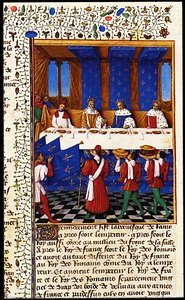 Banquet Given by Charles V (1338-80) in Hhonour of His Uncle Emperor Charles IV (1316-78) in 13781460
Essays around Self portrait
 Masterpieces of Albrecht Dürer: The Top 25 Essential ArtworksExplore 25 iconic Albrecht Dürer masterpieces. From woodcuts to engravings, discover the genius of the Northern Renaissance. Explore the co…
 Reflecting the Self: A History of Portraiture & Psychological InsightExplore the fascinating history of self-portraiture from Renaissance masters like Dürer & Rembrandt to modern interpretations. Discover the…
 The Inner Landscape: Exploring Themes of Introspection in Visual Art Across Movements & ErasExplore the captivating world of introspective art! Discover how artists across eras – from Rembrandt to Kahlo – used self-portraiture to r…