Fauvism · 1911
Vegetable fields (August Macke, 1911)
August Macke (1887–1914) made Vegetable fields. It dates from 1911. It belongs to the Fauvism movement. It is made in oil on canvas. It is kept at Kunstmuseum in Bonn, Germany. It measures 47 × 64 cm.
- 1911
- Oil On Canvas
- 47 × 64 cm
- Kunstmuseum, Bonn

 Preview

 Hand Made Oil Painting
 Send
 Share
 Fact sheet


 Download
 Similars
 X-Ray
 Diaporama
 Q&A

 Stats
Vegetable fields, in brief
- Title
- Vegetable fields
- Artist
- August Macke (1887–1914)
- Artist born in
- Meschede, Germany
- Date
- 1911
- Medium
- Oil On Canvas
- Dimensions
- 47 × 64 cm
- Where to see it
- Kunstmuseum, Bonn, Germany
- Movement
- Fauvism
- Subject
- rural landscape, haystacks, blue flowers, path, roads, color field
What does Vegetable fields depict?
August Macke’s ‘Vegetable Fields’: A Fauvist Echo of Rural Melancholy
This captivating oil painting, “Vegetable Fields,” created in 1911 by August Macke, offers a potent glimpse into the burgeoning world of German Expressionism. Measuring 47 x 64 cm, this work transcends a simple depiction of a rural landscape; it’s an intensely felt experience rendered through bold color and simplified forms – hallmarks of the Fauvist movement. Macke, tragically cut short by the First World War at just 27, was already producing art that resonated with a raw emotionality, anticipating the full force of Expressionism while still retaining traces of Impressionist influence.
- Subject Matter: The scene unfolds in a stylized countryside, dominated by haystacks, fields ablaze with blue flowers, and a prominent pathway leading the viewer’s eye into the distance. This isn't a meticulous rendering of reality; rather, it’s an interpretation filtered through Macke’s emotional lens.
- Style & Technique: The painting firmly embraces Fauvist principles – prioritizing color over precise representation. Thick impasto brushstrokes build texture and physicality onto the canvas, creating a vibrant, almost tactile surface. Lines are deliberately expressive, guiding the viewer's gaze and contributing to the overall sense of movement.
Decoding the Emotional Landscape
Macke’s use of color is particularly striking. The dominant blues and greens evoke a feeling of tranquility, yet they’re punctuated by jarring yellows and reds, creating an underlying tension. This deliberate dissonance reflects the anxieties and uncertainties of the era – a world on the cusp of profound change. The flattened perspective, prioritizing emotional impact over realistic spatial illusion, further intensifies this effect. It's as if Macke is inviting us to step into his subjective experience, rather than simply observing a landscape.
- Symbolism: The diverging paths in the distance are rich with symbolic potential, representing choices, journeys, or perhaps the fragmented nature of modern life. The isolated setting contributes to a sense of melancholy, hinting at themes of loneliness and contemplation.
- Historical Context: Created in 1911, “Vegetable Fields” sits squarely within the period of experimentation that preceded the full flowering of German Expressionism. Macke’s work foreshadowed the movement's emphasis on subjective emotion and distorted form, while still retaining a connection to earlier artistic traditions.
A Masterclass in Texture and Light
The painting’s technical brilliance lies not just in its color palette but also in Macke’s masterful manipulation of light and texture. The diffuse lighting suggests an overcast day, eliminating harsh shadows and contributing to the overall mood of quiet contemplation. The thick impasto technique – applying paint thickly to create a textured surface – is particularly evident in the haystacks and fields, adding a remarkable physicality to the composition. This deliberate roughness further emphasizes the emotional intensity of the work.
Collecting this Powerful Image
A hand-painted reproduction of “Vegetable Fields” offers an exceptional opportunity to bring this evocative artwork into your home or office. OriginalUniqueArt’s meticulous reproductions capture the essence of Macke's vision, faithfully recreating the painting’s vibrant colors and expressive brushwork. This piece is more than just a decoration; it’s a window into the soul of a brilliant artist and a poignant reflection on the human condition.
Which museum holds Vegetable fields?
Kunstmuseum
Bonn, Germany
A Sanctuary of Expression: The Soul of Kunstmuseum Bonn Nestled in the historic heart of Bonn, a city where the echoes of Beethoven’s compositions linger in the air, lies the Kunstmuseum Bonn —a profound sanctuary for those who seek the raw, emotive power of modernism. To step into this institution is to embark on a journey through the turbulent yet beautiful psyche of the twentieth century. Born from a necessity to rebuild not just walls, but a cultural identity during the transformative era of post-war reconstruction, the museum has since evolved into a global beacon for Rhenish Expressionism .

High-resolution images of Vegetable fields

August Macke, Vegetable fields (1911), Kunstmuseum. Public domain.
Colours matched to the original by a digital expert, the file finely retouched, faithful to the artist's brushwork.
Own the high-resolution fileQuestions on Vegetable fields, answered
Where is "Vegetable fields" by August Macke on display today?
You can see the original "Vegetable fields" at the Kunstmuseum, Bonn, Germany.
In what year was "Vegetable fields" by August Macke created?
"Vegetable fields" dates from 1911. The date places the work within August Macke's career and its era.
What medium is "Vegetable fields" by August Macke executed in?
The medium of "Vegetable fields" by August Macke is oil on canvas. Reproductions aim to render the appearance of this technique.
What size is "Vegetable fields" by August Macke in real life?
The original "Vegetable fields" by August Macke measures 47 x 64 cm.
What does "Vegetable fields" by August Macke depict?
"Vegetable fields" by August Macke depicts: rural landscape, haystacks, blue flowers, path, roads, color field, expressionism, geometric forms.
Is "Vegetable fields" free of copyright?
Regarding copyright, "Vegetable fields" is in the public domain - its copyright has expired.
Which artist is "Vegetable fields" attributed to?
The artist behind "Vegetable fields" is August Macke. The work is catalogued under August Macke's name.
Which artistic current is "Vegetable fields" by August Macke part of?
"Vegetable fields" is a work of Fauvism. The movement indicates the artistic tradition the work is part of.
Which period of August Macke's career does "Vegetable fields" belong to?
"Vegetable fields" represents the Mature Period of August Macke.
About the artist, August Macke
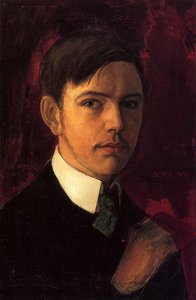
1887–1914, Germany
August Macke
Early Life, Family and Training The story of August Macke begins in the town of Meschede, Germany, where he was born on January 3, 1887. He was the only son born to August Friedrich Hermann Macke, a building contractor and amateur artist, and Maria Florentine. His childhood was shaped by the shifting fortunes of his father’s company, which brought the family to Cologne and later to Bonn. Even as a young boy, the pull of visual expression was evident; he spent his early years sketching and designing sets for school plays, finding a way to translate his surroundings onto paper long before he ever stepped into a formal academy.
Also by August Macke
 Woman in a Green Jacket1913
 Bathing girls with town in the backgraund1913
 The Hat Shop1913
 Portrait of the Artist's Wife with Hat1909

Essays around Vegetable fields
 August Macke: Expressionist Visions of Harmony & Modern LifeExplore the vibrant Expressionist paintings of August Macke (1887-1914). Discover his key role in Der Blaue Reiter, Fauvist influences, and…
 Expressionism's Soul: 10 Masterpieces for Your Home |Journey into the soul of Expressionism! Explore 10 iconic paintings by Munch, Kirchner, Kandinsky & more. Discover their stories, bold colo…
 Brushes of Anguish: The Psychological Landscape of Emotional Distress in Post-Impressionist ArtExplore the profound psychological depth of Post-Impressionist masters. Discover how color and form mirror human emotion.