Portrait of Il Pordenone

Il Pordenone Paintings: The 28 Most Famous, Through a Gallery's Eye

Updated November 2026 · ranked by our popularity score (searches, visits and orders for each work) · 31 works by Il Pordenone in our catalogue

In short

To the gallery's eye, Il Pordenone's most famous painting is Pilate Judges Christ (detail) (1520), whose original hangs in the Cathedral, Кρέμα. Portrait of a Musician (1517) and Saint Bonaventure (1532) complete the trio every eye recognises. Of the 31 works by Il Pordenone in our catalog, the gallery presents the 28 most famous below, each original with its year, its museum and what makes it unique.

1484 – 1539, Pordenone Mannerism Most works: Cathedral

The gallery's top 10 Il Pordenone paintings

1
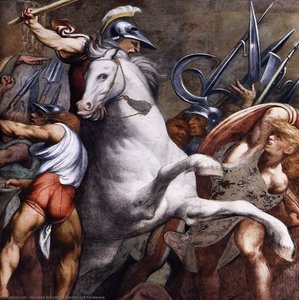
Pilate Judges Christ (detail) (1520) by Il Pordenone

Pilate Judges Christ (detail)

1520 · Fresco · Cathedral, Кρέμα

The scene unfolds within the intense drama of the Passion of Christ, captured in the work titled Pilate Judges Christ (detail). Created about 1520, this piece brings the viewer into a moment of profound tension. The artist, Il Pordenone, directs the eye toward a pivotal chapter of the sacred narrative. Every gesture and movement feels immediate, as if the weight of the trial hangs heavily in the air right now.

2
Portrait of a Musician (1517) by Il Pordenone

Portrait of a Musician

1517 · Oil On Canvas · Kunsthistorisches Museum, Vienna

A young man sits before us, his gaze steady and heavy with thought. He wears a dark beret and a deep black doublet, clothing that absorbs the light around him, leaving only the soft glow of his skin to command the eye. In his hand, he holds a small, open scorebook, its musical notation visible as a quiet hint at the melodies that occupy his mind. The air in the…

3
Saint Bonaventure (1532) by Il Pordenone

Saint Bonaventure

1532 · Oil On Panel · National Gallery, London

In this 1532 portrait, we encounter Saint Bonaventure not as a distant, ethereal figure, but as a man of profound weight and quiet gravity. He is presented in an octagonal composition, a choice that focuses our attention entirely on his contemplative presence. The subject gazes directly at us, his expression calm and steady, bridging the gap between the sacred and the observer. He is draped in a voluminous rose-colored mantle,…

4
Saint Louis of Toulouse (1532) by Il Pordenone

Saint Louis of Toulouse

1532 · Oil On Panel · National Gallery, London

The light enters from the upper left, casting soft shadows that give weight to the young man’s face and the heavy folds of his mantle. He sits in an intimate, octagonal space, caught in a quiet moment of spiritual focus. His hands rest upon an open book, the parchment-like pages appearing thin and fragile under his touch. There is a profound stillness here, as if the air itself has stilled…

5
Portrait of a Gentleman (1515) by Il Pordenone

Portrait of a Gentleman

1515 · Oil · National Gallery of Ireland, Dublin City

The oil portrait titled Portrait of a Gentleman captures a single, steady gaze. It is a work by Il Pordenone, the artist also known as Giovanni Antonio de’ Sacchis. The subject sits in a quiet, centered position, his presence defined by the starkness of his dark doublet and the pale skin of his hands. This image emerged in 1515.

6
Raising Lazarus (1530) by Il Pordenone

Raising Lazarus

1530 · Oil On Canvas · Prague Castle Picture Gallery, Prague

Raising Lazarus is a work by the Italian Mannerist painter Il Pordenone. Dating to about 1530, the composition captures a significant biblical miracle through a lens of dramatic tension and physical movement. The artist, born Giovanni Antonio de’ Sacchis, was a prominent figure in the Venetian art scene, known for a style that prioritized emotional impact and vigorous execution over the polished finish favored by many of his contemporaries.

7
View of the nave and the inner façade (1521) by Il Pordenone

View of the nave and the inner façade

1521 · Photography · Cathedral, Кρέμα

View of the nave and the inner façade is a work by the artist Il Pordenone. Created about 1521, the piece focuses on the architectural structure of a cathedral and its internal decorative elements. The primary subject matter involves the physical space of the nave and the inner façade, capturing the scale of the building's interior.

8
St Martin and St Christopher (1528) by Il Pordenone

St Martin and St Christopher

1528 · Oil On Panel · San Rocco, Venice

The air feels heavy with the tension of a sudden, violent movement. In this scene, the boundary between the viewer and the sacred space dissolves as figures seem to surge forward from the surface. St Martin sits atop a powerful steed, his hand gripping a sword as he prepares to perform an act of mercy, turning to divide his cloak for a beggar. Beside him, the muscular giant St Christopher…

9
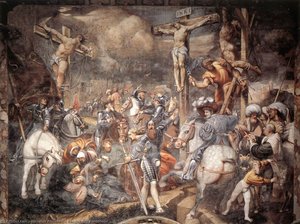
Golgotha (1521) by Il Pordenone

Golgotha

1521 · Fresco · Cathedral, Кρέμα

The air in the cathedral feels heavy, thick with the shadow of the counter-façade. Here, the scene of Golgotha unfolds not as a distant memory, but as a sudden, violent presence. A man hangs upon the wood, his body a pale anchor against the darkness. Around him, the world has fractured into a chaos of movement and steel. Soldiers and priests crowd the space, their limbs caught in mid-gesture, their…

10
St Luke (1535) by Il Pordenone

St Luke

1535 · Oil On Panel · Szépművészeti Múzeum, Budapest

This oil on panel painting, titled St Luke, was executed by the Italian artist Giovanni Antonio de’ Sacchis, who is known by the name Il Pordenone. The work is an Italian painting that depicts the subject Saint Luke the Evangelist. It is a square composition measuring 75 x 75 cm.

Il Pordenone paintings, ranked 11 to 28

The subjects that held Il Pordenone's eye

The four subjects that come back most often in these originals, each with its finest example.

The museums that keep Il Pordenone's originals

The 8 museums that hold the most of the paintings on this page.

Museum City Works by Il Pordenone Paintings from this list
Cathedral, КρέμαCathedral Кρέμα 9 Pilate Judges Christ (detail), View of the nave and the inner façade, Golgotha
National Gallery, LondonNational Gallery London 2 Saint Bonaventure, Saint Louis of Toulouse
Kunsthistorisches Museum, ViennaKunsthistorisches Museum Vienna 1 Portrait of a Musician
National Gallery of Ireland, Dublin CityNational Gallery of Ireland Dublin City 1 Portrait of a Gentleman
Prague Castle Picture Gallery, PraguePrague Castle Picture Gallery Prague 1 Raising Lazarus
San Rocco, VeniceSan Rocco Venice 1 St Martin and St Christopher
Szépművészeti Múzeum, BudapestSzépművészeti Múzeum Budapest 1 St Luke
Galleria degli Uffizi, FlorenceGalleria degli Uffizi Florence 1 The Martyrdom of St Peter

Il Pordenone, one signature painting per decade

Works per decade

Pick a decade to see the original that defines it.

Il Pordenone's paintings: the gallery answers

Which Il Pordenone painting is the most famous of all?Reveal the answer

Pilate Judges Christ (detail) (1520), Cathedral, Кρέμα. Portrait of a Musician (1517) and Saint Bonaventure (1532) come next.

How old was Il Pordenone on completing Pilate Judges Christ (detail)?Reveal the answer

36 years old: Pilate Judges Christ (detail) dates from 1520, and Il Pordenone was born in 1484.

Which are Il Pordenone's top 10 paintings?Reveal the answer

Pilate Judges Christ (detail), Portrait of a Musician, Saint Bonaventure, Saint Louis of Toulouse, Portrait of a Gentleman, Raising Lazarus, View of the nave and the inner façade, St Martin and St Christopher, Golgotha and St Luke. The ranking above gives each one's year and museum.

How many works did Il Pordenone create?Reveal the answer

Our catalog holds 31 works by Il Pordenone, dated from 1515 to 1539.

Where do Il Pordenone's most famous originals hang?Reveal the answer

Mostly in Cathedral (Кρέμα), National Gallery (London) and Kunsthistorisches Museum (Vienna). The museum table above lists them all.

When did Il Pordenone create the most famous paintings?Reveal the answer

In 1520s: 14 of the 28 works on this page were made then, Pilate Judges Christ (detail) among them.

Which are Il Pordenone's earliest and latest famous works?Reveal the answer

On this page, the earliest is Portrait of a Gentleman (1515) and the latest Judith with the Head of Holofernes, Pordenone (circle of), 1500 - 1539 (1539).

Which subjects did Il Pordenone return to most?Reveal the answer

Man (8), People (4) and Book (3), across the 28 works on this page.

Which medium did Il Pordenone work in most?Reveal the answer

Oil On Panel, for 4 of the 28 works on this page.

Which movement is Il Pordenone associated with?Reveal the answer

Mannerism and Renaissance, judging by the originals on this page.

Which Il Pordenone originals does the Cathedral hold?Reveal the answer

Pilate Judges Christ (detail), View of the nave and the inner façade and Golgotha: the Cathedral, Кρέμα holds 9 of the works on this page.

Il Pordenone: the artist

Early Life and Formation in Friuli

Giovanni Antonio de’ Sacchis, known universally as Il Pordenone, burst onto the Italian Renaissance scene as a force of nature rather than a product of careful academic training. Born around 1484 in Fruili-Visenza, Italy, his origins lay not within the established artistic centers of Florence or Rome, but in the relatively provincial town of Pordenone – a location that would indelibly shape his distinctive style. Details regarding his early education remain somewhat elusive; unlike many of his contemporaries, he doesn’t appear to have benefited from a formal apprenticeship with a renowned master. Instead, it is believed he received initial instruction from his father, also an artist, and developed his skills through practical experience and observation. This lack of conventional schooling arguably contributed to the raw energy and sometimes deliberately “coarse” execution that characterized his work, setting him apart from the more polished styles prevalent elsewhere. His early commissions were primarily local religious pieces, allowing him to hone his craft while establishing a reputation within the Friulian region. Even in these initial works, hints of the dramatic flair and bold color palette that would become his hallmarks are evident.

A Rising Star: Expanding Influence and Roman Encounters

By the early 16th century, Pordenone’s talent had begun to attract wider attention. He moved beyond local commissions, undertaking increasingly ambitious projects in cities like Cremona and Venice. Around 1516, a pivotal journey to Rome brought him into contact with the High Renaissance masterpieces of Raphael and Michelangelo. While he lacked the rigorous anatomical training of these masters, Pordenone absorbed their compositional power and grandeur, translating them through his own unique lens. This encounter didn’t lead to imitation but rather sparked a synthesis – a blending of classical ideals with a distinctly northern Italian sensibility. He returned from Rome imbued with new ideas, yet remained fiercely independent in his approach. His work began to exhibit a heightened sense of drama, emotional intensity, and a willingness to experiment with unconventional techniques. This period saw the development of large-scale fresco cycles, notably at Cremona Cathedral, where his *Passion* scenes shocked viewers with their visceral realism and powerful depiction of human suffering – a foreshadowing of the expressive force that would later define artists like Goya.

Venetian Years: Collaboration, Rivalry, and Artistic Maturity

The years from 1527 until his untimely death in 1539 were spent primarily in Venice, a city teeming with artistic innovation. Here, Pordenone became a prominent figure in the vibrant Venetian art scene, collaborating with younger artists like Tintoretto at the Scuola Grande della Carità. This collaboration proved mutually beneficial; Pordenone’s energetic style influenced Tintoretto's dynamic compositions, while Tintoretto likely absorbed some of Pordenone’s technical expertise in fresco painting. However, his time in Venice was not without its challenges. A fierce rivalry with Titian developed, fueled by competition for commissions and differing artistic philosophies. Gossip even suggests that Pordenone’s death may have been suspicious, hinting at the intensity of this professional animosity. Despite these tensions, Pordenone continued to produce a remarkable body of work during his Venetian years, refining his signature style and cementing his reputation as one of Italy's leading Mannerist painters. His altarpieces and murals were characterized by dramatic lighting effects, vibrant color combinations, and a palpable sense of movement.

Technique, Style, and Lasting Legacy

Il Pordenone’s artistic approach was marked by a distinctive combination of speed, vigor, and deliberate expressiveness. Vasari famously described his execution as “coarse,” but this should not be interpreted as a lack of skill; rather, it reflects a conscious rejection of the refined polish favored by some of his contemporaries. He prioritized emotional impact over meticulous detail, employing bold brushstrokes and unconventional color combinations to create works that were both visually striking and emotionally charged. His compositions often feature dynamic figures, dramatic gestures, and a heightened sense of realism – qualities that set him apart from the more idealized styles prevalent in other parts of Italy. His masterful use of color, particularly his ability to create luminous effects through layering and glazing, was widely admired. Pordenone’s influence on subsequent generations of artists was profound. He paved the way for the development of Venetian Mannerism, inspiring painters like Tintoretto and influencing even Titian in his later works. His legacy extends beyond his immediate circle; his emphasis on emotional intensity and dramatic realism foreshadowed the Baroque style that would dominate European art in the 17th century.

Major Works and Enduring Appeal

While many of Pordenone’s works were lost or damaged over the centuries, a significant number survive, offering glimpses into his extraordinary talent. The frescoes at Cremona Cathedral remain a testament to his early mastery, while his collaborations at the Scuola Grande della Carità in Venice showcase his dynamic style and innovative techniques. “Christ and Mary Magdalen” (1532) exemplifies his ability to convey profound religious devotion through vibrant color and expressive figures. His altarpieces, such as those created for churches throughout northern Italy, are characterized by their grandeur and emotional power. Today, Il Pordenone is recognized as a pivotal figure in the Italian Renaissance – an artist who defied convention, embraced experimentation, and left an indelible mark on the history of art. His works continue to captivate viewers with their raw energy, dramatic intensity, and enduring appeal.