Portrait of Gustave Boulanger

The 28 Most Famous Gustave Boulanger Paintings, a Gallery Selection

Updated November 2026 · ranked by our popularity score (searches, visits and orders for each work) · 28 works by Gustave Boulanger in our catalogue

In short

Of all the originals Gustave Boulanger left, the most famous is Hercules at the Feet of Omphale (1861). Close behind it come Galatea and the Shepherd Acis (1860) and Charles Garnier (1884). Our catalog holds 28 works by Gustave Boulanger; the gallery has kept the 28 the world admires most, each shown with its date, its museum and its story.

1824 – 1888, former 2nd arrondissement of Paris Academic painting Most works: Carnavalet Museum

Gustave Boulanger's top 10 paintings: the gallery's choice

1
Hercules at the Feet of Omphale (1861) by Gustave Boulanger

Hercules at the Feet of Omphale

1861

A Masterpiece of Drama and Intensity The painting Hercules at the Feet of Omphale by Gustave Clarence Rodolphe Boulanger, created in 1861, is a striking example of neoclassical art. This oil on canvas masterpiece captures a pivotal moment from Greek mythology, where Hercules, the legendary hero, finds himself at the mercy of Omphale, the queen of Lydia. Artistic Elements and Symbolism The painting depicts Omphale in a state of nudity,…

2
Galatea and the Shepherd Acis (1860) by Gustave Boulanger

Galatea and the Shepherd Acis

1860 · Oil

Galatea and the Shepherd Acis is an oil painting by Gustave Boulanger. Executed about 1860, the work belongs to the Academic tradition, reflecting the artist's rigorous training in the French atelier system. Boulanger, a prominent figure in the 19th-century French art establishment, utilized this medium to explore classical themes through a lens of meticulous detail and formal precision.

5
Phryne (1850) by Gustave Boulanger

Phryne

1850 · Oil On Canvas · Van Gogh Museum, Amsterdam

In this 1850 oil painting, a nude woman reclines within a setting defined by heavy drapery and patterned surfaces. The figure is positioned centrally, her body angled amidst a collection of cushions and folded fabrics. Light enters from the upper left, casting shadows that define the contours of her torso and limbs. The skin tones appear luminous, achieved through fine glazing techniques that contrast with the darker, shadowy background. The…

The Gustave Boulanger selection continues, 11 to 28

The subjects that held Gustave Boulanger's eye

The four subjects that come back most often in these originals, each with its finest example.

The museums that keep Gustave Boulanger's originals

The 6 museums that hold the most of the paintings on this page.

Museum City Works by Gustave Boulanger Paintings from this list
Carnavalet Museum, ParisCarnavalet Museum Paris 5 La Rotonde de la Villette Encircled by the Versailles Troops, The Hôtel de Ville on Fire, Besieged by the Troops of Versailles, Episode of the Commune, Place de la Concorde
Gothenburg Museum of Art, GothenburgGothenburg Museum of Art Gothenburg 1 The Mother of the Gracchi
Van Gogh Museum, AmsterdamVan Gogh Museum Amsterdam 1 Phryne
Musée National Magnin, DijonMusée National Magnin Dijon 1 Ulysse et Euryclée
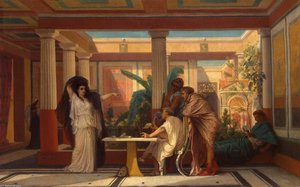
Hermitage Museum, Saint PetersburgHermitage Museum Saint Petersburg 1 Theatrical Rehearsal in the House of an Ancient Rome Poet
Musée d'Orsay, ParisMusée d'Orsay Paris 1 The flute concert

Gustave Boulanger decade by decade: the original that defines each

Works per decade

Pick a decade to see the original that defines it.

Collectors' questions about Gustave Boulanger's paintings

Which work is Gustave Boulanger most famous for?Reveal the answer

Hercules at the Feet of Omphale (1861). Galatea and the Shepherd Acis (1860) and Charles Garnier (1884) come next.

What age was Gustave Boulanger when Hercules at the Feet of Omphale was made?Reveal the answer

37 years old: Hercules at the Feet of Omphale dates from 1861, and Gustave Boulanger was born in 1824.

What are the ten most famous Gustave Boulanger paintings?Reveal the answer

Hercules at the Feet of Omphale, Galatea and the Shepherd Acis, Charles Garnier, The Mother of the Gracchi, Phryne, Portrait de Madame Lambinet, née Nathalie Sinclair ( 1926), dernière propriétaire de l'hôtel (futur musée Lambinet), La Rotonde de la Villette Encircled by the Versailles Troops, The Hôtel de Ville on Fire, Besieged by the Troops of Versailles, Episode of the Commune, Place de la Concorde and Assault of a Cemetery by Regular Troops, May 1871. The ranking above gives each one's year and museum.

How many paintings did Gustave Boulanger leave?Reveal the answer

Our catalog holds 28 works by Gustave Boulanger, dated from 1850 to 1885.

In which museums do Gustave Boulanger's masterpieces hang?Reveal the answer

Mostly in Carnavalet Museum (Paris), Gothenburg Museum of Art (Gothenburg) and Van Gogh Museum (Amsterdam). The museum table above lists them all.

In which years did Gustave Boulanger paint the most famous works?Reveal the answer

In 1870s: 6 of the 28 works on this page were made then, La Rotonde de la Villette Encircled by the Versailles Troops among them.

What are the first and the last famous originals of Gustave Boulanger?Reveal the answer

On this page, the earliest is Phryne (1850) and the latest The Mother of the Gracchi (1885).

Which subjects did Gustave Boulanger choose most often?Reveal the answer

Classical art (3), Portraiture (3) and Woman (2), across the 28 works on this page.

To which art movement does Gustave Boulanger belong?Reveal the answer

Academic painting, judging by the originals on this page.

Which Gustave Boulanger works hang at the Carnavalet Museum?Reveal the answer

La Rotonde de la Villette Encircled by the Versailles Troops, The Hôtel de Ville on Fire, Besieged by the Troops of Versailles and Episode of the Commune, Place de la Concorde: the Carnavalet Museum, Paris holds 5 of the works on this page.

Gustave Boulanger: life and work

A Life Immersed in Classical Echoes and Oriental Hues

Gustave Clarence Rodolphe Boulanger, a name resonating with the meticulous detail and dramatic flair of 19th-century Academic painting, was born in Paris in 1824. His early life took a somber turn when he was orphaned at the age of fourteen, finding guardianship under his uncle, Constant Desbrosses. This pivotal moment steered him toward artistic pursuits, beginning formal training in 1840 with Pierre-Jules Jollivet before progressing to the atelier of Paul Delaroche. It was within Delaroche’s studio that a formative friendship blossomed with Jean-Léon Gérôme, an association that would profoundly shape Boulanger's artistic trajectory and aesthetic sensibilities. This connection wasn’t merely one of camaraderie; it represented an alignment of vision within the burgeoning Néo-Grec movement—a revival of classical themes infused with a fresh perspective, often tinged with exoticism and sensuality.

The Allure of Antiquity and Distant Shores

Boulanger’s artistic development was a fascinating interplay between rigorous academic training and an insatiable curiosity for the ancient world and beyond. The Néo-Grec movement provided a fertile ground for his exploration, encouraging a reinterpretation of classical mythology and history with a newfound emphasis on vibrant color, dramatic composition, and often, a subtle undercurrent of narrative intrigue. A transformative journey to Algeria in 1845 ignited a lifelong fascination with Orientalist subjects. What began as an obligation to manage his uncle’s business interests quickly evolved into an immersive experience that captivated Boulanger's imagination. The vibrant landscapes, bustling marketplaces, and the unique cultural tapestry of North Africa became enduring sources of inspiration, finding their way into numerous canvases throughout his career. This initial exposure was followed by further travels, including a trip with Gérôme in 1872, solidifying his commitment to depicting these exotic locales with meticulous accuracy and artistic license. Complementing this fascination with the East were studies at the École de Rome, where visits to Pompeii proved particularly influential. The remarkably preserved ruins of the ancient city offered invaluable insights into Roman life, architecture, and artistry, inspiring a series of paintings that sought to recreate the grandeur and everyday realities of a bygone era.

Masterpieces Forged in Tradition

Boulanger’s artistic prowess was first formally recognized with his triumph at the prestigious Prix de Rome in 1849, awarded for his painting *Ulysses*. This victory secured him a scholarship to study at the Académie de France à Rome, allowing him extended immersion in the classical world. Throughout his career, he produced a remarkable body of work that showcased his mastery of academic technique and narrative storytelling. *A Moorish Cafe* (1848) stands as an early example of his burgeoning interest in Orientalist themes, capturing the atmosphere of daily life with striking detail. Later works, such as *Cæsar at the Rubicon* (1865), demonstrated his ability to tackle grand historical subjects with dramatic flair and compositional skill. Perhaps one of his most celebrated paintings, *The Promenade in the Street of Tombs, Pompeii* (1869), exemplifies his fascination with archaeological discoveries and his dedication to recreating ancient Roman life with painstaking accuracy. Even in his later years, as evidenced by *The Slave Market* (1888), Boulanger continued to explore historical and exotic themes, refining his technique and deepening his understanding of human drama.

Recognition and a Lasting Legacy

Boulanger’s talent did not go unnoticed during his lifetime. Beyond the initial honor of the Prix de Rome, he received numerous medals for his artistic achievements, culminating in his election as a member of the prestigious Institut de France in 1882. This recognition solidified his position within the French art establishment and underscored the significance of his contributions to the field. He further cemented his influence by serving as a professor at the Institut de France from 1882, guiding a new generation of artists—though he remained a staunch critic of the emerging Impressionist movement, preferring the established principles of academic painting. Boulanger’s work embodies the essence of Academic art in the 19th century: meticulous detail, historical accuracy, and a profound respect for classical ideals. He played a pivotal role in popularizing Orientalism within French painting, contributing to a broader cultural fascination with North African aesthetics and lifestyles. His paintings offer invaluable insights into the artistic tastes and societal values of his time, serving as both beautiful works of art and compelling historical documents. His dedication to technical skill and narrative clarity continues to inspire artists and captivate audiences today.

A Continuing Influence

The influence of Gustave Boulanger extends beyond the immediate circle of his students and contemporaries. His paintings continue to be admired for their masterful execution, evocative storytelling, and ability to transport viewers to distant times and places. His legacy can be seen in the work of subsequent generations of artists who embraced historical and exotic themes, demonstrating the enduring power of his artistic vision. Boulanger’s commitment to academic principles—his emphasis on draftsmanship, composition, and meticulous detail—remains a source of inspiration for artists seeking to master traditional techniques. As art historians continue to re-evaluate the complexities of 19th-century French painting, Gustave Boulanger stands as a significant figure whose work deserves continued study and appreciation.