Portrait of Francesco Guardi

Francesco Guardi Paintings: The 100 Most Famous, Through a Gallery's Eye

Updated November 2026 · ranked by our popularity score (searches, visits and orders for each work) · 439 works by Francesco Guardi in our catalogue

In short

To the gallery's eye, Francesco Guardi's most famous painting is Santa Maria della Salute (1760), whose original hangs in the Metropolitan Museum of Art, New York. LE PALAIS DES DOGES DE VENISE VU DU BASSIN DE SAN MARCO and The Doge's Palace and the Molo complete the trio every eye recognises. Of the 439 works by Francesco Guardi in our catalog, the gallery presents the 100 most famous below, each original with its year, its museum and what makes it unique.

1712 – 1793, Venice Rococo Most works: Metropolitan Museum of Art

The gallery's top 10 Francesco Guardi paintings

1
Santa Maria della Salute (1760) by Francesco Guardi

Santa Maria della Salute

1760 · Painting · Metropolitan Museum of Art, New York

Santa Maria della Salute: A Venetian Masterpiece Francesco Guardi’s “Santa Maria della Salute” transcends mere depiction; it embodies the very soul of Venice at the cusp of its golden age, capturing an ethereal beauty that continues to inspire awe centuries later. Painted in 1760, this monumental veduta—a panoramic cityscape view—represents not just a building but a profound meditation on faith and resilience amidst turbulent times. Guardi’s masterful use of sfumato,…

2
LE PALAIS DES DOGES DE VENISE VU DU BASSIN DE SAN MARCO by Francesco Guardi

LE PALAIS DES DOGES DE VENISE VU DU BASSIN DE SAN MARCO

Oil On Canvas · The Louvre, Paris

In the heart of the eighteenth century, as the sun began its slow descent over the fading grandeur of the Venetian Republic, Francesco Lazzaro Guardi captured a moment that transcends mere geography. Le Palais des Doges de Venise Vu Du Bassin De San Marco is not simply a panoramic view of architectural splendor; it is an evocative embodiment of a city caught in a beautiful, melancholic transition. Through his masterful…

3
The Doge's Palace and the Molo by Francesco Guardi

The Doge's Palace and the Molo

Oil · National Gallery, London

The painting The Doge's Palace and the Molo by Francesco Lazzaro Guardi is a beautiful representation of Venice, Italy with its iconic buildings and waterways. The scene features several boats floating on the water near the shore, including a large boat in the foreground and smaller ones scattered throughout the image. There are also numerous people visible in the painting, some standing or walking along the shoreline, while others can…

4
Venice The Arsenal (1755) by Francesco Guardi

Venice The Arsenal

1755 · Oil On Canvas · National Gallery, London

We are looking at Venice The Arsenal, an oil on canvas painting by Francesco Guardi. This work was executed between 1755 and 1760, a period during which the artist was active in Venice. Guardi, who lived from 1712 to 1793, captured the specific atmosphere of the city during the mid-eighteenth century.

5
LE COURONNEMENT DU DOGE DE VENISE SUR L'ESCALIER DES GEANTS AU PALAIS DUCAL DE VENISE by Francesco Guardi

LE COURONNEMENT DU DOGE DE VENISE SUR L'ESCALIER DES GEANTS AU PALAIS DUCAL DE VENISE

Acrylic On Canvas · The Louvre, Paris

A Venetian Twilight: Exploring Francesco Guardi’s “Le Couronnement du Doge” Francesco Lazzaro Guardi (1712-1793), born into a family steeped in artistic tradition on October 5, 1712, stands as a poignant figure at the close of the illustrious Venetian School. His life mirrored the fading grandeur of Venice itself—a city once a vibrant hub of commerce and culture, slowly yielding to political decline and economic hardship. Guardi wasn’t merely a painter;…

6
Tobias and the Angel (1754) by Francesco Guardi

Tobias and the Angel

1754 · Oil · Cleveland Museum of Art, Cleveland

This evocative oil painting depicts the biblical scene of Tobias and the Angel through a dramatic chiaroscuro effect, where light is emphasized against a dark, turbulent landscape. The composition is asymmetrical, creating a sense of movement and tension as the figures are positioned on the right and center-left. An angel, characterized by large, sweeping wings, leans over a large stone block and points toward Tobias. Tobias is seated near a…

7
Capriccio with the Archway of the Torre dell'Orologio (1780) by Francesco Guardi

Capriccio with the Archway of the Torre dell'Orologio

1780 · Oil On Canvas · Wallace Collection, London

To gaze upon this Capriccio with the Archway of the Torre dell'Orologio is to step directly into a sun-drenched moment of Venetian history, a scene imbued with the gentle rhythm of daily life. Francesco Lazzaro Guardi, master chronicler of a fading era, has gifted us more than just a painting; he offers an atmospheric memory. The composition unfolds like a beloved postcard from a bygone age, capturing the vibrant pulse…

8
ecstasy of two monks; Allegorie des Glaubens und der Liebe (1737) by Francesco Guardi

ecstasy of two monks; Allegorie des Glaubens und der Liebe

1737 · Oil

The oil painting titled ecstasy of two monks; Allegorie des Glaubens und der Liebe emerged from the brush of Francesco Guardi. This work dates to about 1737, a period when the artist was beginning to establish his presence within the Venetian tradition. It captures a moment of spiritual intensity through its allegorical subject matter.

9
Allegory of Abundance (1747) by Francesco Guardi

Allegory of Abundance

1747 · Oil · John and Mable Ringling Museum of Art, Sarasota

This mid-18th century allegorical oil painting presents a personification of abundance set within a romanticized landscape. The composition is vertically oriented, centering on a female figure positioned in the foreground and midground, slightly off-center to the left. She is depicted holding sheaves of wheat, a symbol of fertility and harvest. The scene is set against a backdrop featuring a receding shoreline and a distant horizon where the sea meets the…

10
Abraham Welcoming the Three Angels (1754) by Francesco Guardi

Abraham Welcoming the Three Angels

1754 · Oil · Cleveland Museum of Art, Cleveland

The scene unfolds in Abraham Welcoming the Three Angels, a work that captures a profound biblical moment through the hand of Francesco Guardi. Created in 1754, this oil painting brings a sacred narrative to life, centering on the intimate encounter between a patriarch and the divine. The air seems to hold its breath as the figures gather, caught in a moment of profound recognition and hospitality.

Francesco Guardi paintings, ranked 11 to 100

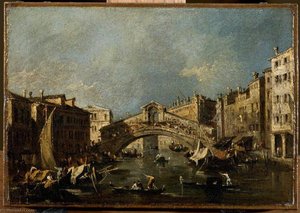
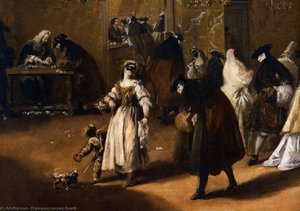
11The Angels Appearing to Abraham (1754) by Francesco GuardiThe Angels Appearing to Abraham1754 · Cleveland Museum of Art 12Godfrey of Boulogne Summons His Chiefs to Council (1755) by Francesco GuardiGodfrey of Boulogne Summons His Chiefs to Council1755 · Norton Simon Museum 13The diplomatic convent (1753) by Francesco GuardiThe diplomatic convent1753 · Ca' Rezzonico – Museum of the 18th Century Venice 14View of the Riva degli Schiavoni and the Piazzetta (1760) by Francesco GuardiView of the Riva degli Schiavoni and the Piazzetta1760 · Isabella Stewart Gardner Museum 15Venice The Grand Canal with Palazzo Pesaro (1755) by Francesco GuardiVenice The Grand Canal with Palazzo Pesaro1755 16Venice The Piazzetta di San Marco (1760) by Francesco GuardiVenice The Piazzetta di San Marco1760 17The Feast of the Ascension (1770) by Francesco GuardiThe Feast of the Ascension1770 18A View near Venice ( ) (1775) by Francesco GuardiA View near Venice ( )1775 · National Gallery 19A Caprice with Ruins on the Seashore (1775) by Francesco GuardiA Caprice with Ruins on the Seashore1775 · National Gallery 20An Architectural Caprice (1770) by Francesco GuardiAn Architectural Caprice1770 21The Piazza San Marco, Venice (1775) by Francesco GuardiThe Piazza San Marco, Venice1775 · Scottish National Gallery 22San Giorgio Maggiore, Venice (1770) by Francesco GuardiSan Giorgio Maggiore, Venice1770 · Scottish National Gallery 23Villa del Timpano Arcuato at Paese (1782) by Francesco GuardiVilla del Timpano Arcuato at Paese1782 · National Gallery 24Capriccio with an Island, a Tower, and Houses (701) by Francesco GuardiCapriccio with an Island, a Tower, and Houses701 25Capriccio with the Courtyard of the Doge's Palace (1770) by Francesco GuardiCapriccio with the Courtyard of the Doge's Palace1770 · Wallace Collection 26Pope Pius VI blessing the Crowd at Campo SS Giovanni e Paolo, Venice (1782) by Francesco GuardiPope Pius VI blessing the Crowd at Campo SS Giovanni e Paolo, Venice1782 · The Ashmolean Museum of Art And Archaeology 27Fantastic Landscape (1765) by Francesco GuardiFantastic Landscape1765 · Metropolitan Museum of Art 28The Lagoon from the Fondamenta Nuove by Francesco GuardiThe Lagoon from the Fondamenta Nuove 29Fantastic Landscape (1765) by Francesco GuardiFantastic Landscape1765 · Metropolitan Museum of Art 30A Regatta on the Grand Canal, Venice (1785) by Francesco GuardiA Regatta on the Grand Canal, Venice1785 · The Barber Institute of Fine Arts 31Capriccio: The Lagoon (1782) by Francesco GuardiCapriccio: The Lagoon1782 · Art Institute of Chicago 32Venice the Dogana with Santa Maria della Salute (1770) by Francesco GuardiVenice the Dogana with Santa Maria della Salute1770 · Wallace Collection 33L'EGLISE SAN GIORGIO MAGGIORE A VENISE by Francesco GuardiL'EGLISE SAN GIORGIO MAGGIORE A VENISEThe Louvre 34Venice San Giorgio Maggiore with the Giudecca (1770) by Francesco GuardiVenice San Giorgio Maggiore with the Giudecca1770 · Wallace Collection 35The lock at Dolo on the Brenta: Capriccio (1780) by Francesco GuardiThe lock at Dolo on the Brenta: Capriccio1780 · National Gallery of Victoria 36View of the Island of Sant'Elena, Venice (1780) by Francesco GuardiView of the Island of Sant'Elena, Venice1780 37LE DEPART DU BUCENTAURE VERS LE LIDO DE VENISE, LE JOUR DE L'ASCENSION by Francesco GuardiLE DEPART DU BUCENTAURE VERS LE LIDO DE VENISE, LE JOUR DE L'ASCENSIONThe Louvre 38View through an Archway (1767) by Francesco GuardiView through an Archway1767 · Bavarian State Painting Collections 39Venice the Dogana with the Giudecca (1770) by Francesco GuardiVenice the Dogana with the Giudecca1770 · Wallace Collection 40Rio dei Mendicanti by Francesco GuardiRio dei Mendicanti 41An Architectural Caprice (1774) by Francesco GuardiAn Architectural Caprice1774 · National Gallery 42An architectural capriccio (1750) by Francesco GuardiAn architectural capriccio1750 · Art Gallery of South Australia 43Piazza San Marco (1768) by Francesco GuardiPiazza San Marco1768 · Metropolitan Museum of Art 44LE PONT DU RIALTO A VENISE by Francesco GuardiLE PONT DU RIALTO A VENISEThe Louvre 45Venetian Capriccio: View of a Square and a Palace (1750) by Francesco GuardiVenetian Capriccio: View of a Square and a Palace1750 · Hermitage Museum 46Venice, the Church of Santa Lucia on the Grand Canal (1755) by Francesco GuardiVenice, the Church of Santa Lucia on the Grand Canal1755 · English Heritage 47The Canale Grande in Venice, with San Simeone Piccolo (1730) by Francesco GuardiThe Canale Grande in Venice, with San Simeone Piccolo1730 48Triumphal Arch in Venice (1737) by Francesco GuardiTriumphal Arch in Venice1737 · Royal Museum of Fine Arts Antwerp 49Palace-ruins venus at the beach (1737) by Francesco GuardiPalace-ruins venus at the beach1737 50Views at the Canale Grande in Venice (1737) by Francesco GuardiViews at the Canale Grande in Venice1737 51Caprice, with Ruined Arch and Fishermen's Houses (1750) by Francesco GuardiCaprice, with Ruined Arch and Fishermen's Houses1750 · Musée Cognacq-Jay 52St. Mark's Square in Venice with View towards Campanile and Doge's Palace (1752) by Francesco GuardiSt. Mark's Square in Venice with View towards Campanile and Doge's Palace1752 · Bavarian State Painting Collections 53Piazzetta with View of Santa Maria della Salute (1752) by Francesco GuardiPiazzetta with View of Santa Maria della Salute1752 · Bavarian State Painting Collections 54View of San Simeone Piccolo in Venice (1750) by Francesco GuardiView of San Simeone Piccolo in Venice1750 · Musée Des Beaux 55The Guidecca in Venice (1750) by Francesco GuardiThe Guidecca in Venice1750 · Musée Des Beaux 56Allegory of Hope (1747) by Francesco GuardiAllegory of Hope1747 · John and Mable Ringling Museum of Art 57Lagoon Landscape (1750) by Francesco GuardiLagoon Landscape1750 · Städel Museum 58A View of the Molo and the Riva degli Schiavone in Venice (1750) by Francesco GuardiA View of the Molo and the Riva degli Schiavone in Venice1750 · Yale University Art Gallery 59Capriccio of a Ruined Arch (1750) by Francesco GuardiCapriccio of a Ruined Arch1750 60Bucintoro-festen i Venedig (1750) by Francesco GuardiBucintoro-festen i Venedig1750 · Statens Museum For Kunst 61Cloister in Venice (1750) by Francesco GuardiCloister in Venice1750 · Accademia Carrara 62Fantastic Landscape (1750) by Francesco GuardiFantastic Landscape1750 · Metropolitan Museum of Art 63Capriccio with Venetian Themes (1750) by Francesco GuardiCapriccio with Venetian Themes1750 64Capriccio (1750) by Francesco GuardiCapriccio1750 65Capriccio (1750) by Francesco GuardiCapriccio1750 66Capriccio (1750) by Francesco GuardiCapriccio1750 67Ruins with Staffage (1750) by Francesco GuardiRuins with Staffage1750 · Museum Kunsthaus Heylshof 68The Arsenal, Venice (1750) by Francesco GuardiThe Arsenal, Venice1750 · Walters Art Museum 69A View on the Grand Canal with the Rialto Bridge (1754) by Francesco GuardiA View on the Grand Canal with the Rialto Bridge1754 70Piazzetta of S. Marco, Venice (1750) by Francesco GuardiPiazzetta of S. Marco, Venice1750 · Gemäldegalerie 71Erminia and the Shepherds (1755) by Francesco GuardiErminia and the Shepherds1755 · National Gallery of Art 72LE DOGE DE VENISE ASSISTE AUX FETES DU JEUDI GRAS SUR LA PIAZZETTA by Francesco GuardiLE DOGE DE VENISE ASSISTE AUX FETES DU JEUDI GRAS SUR LA PIAZZETTAThe Louvre 73Il ridotto (detail) (1750) by Francesco GuardiIl ridotto (detail)1750 74View of Saint Mark's Square, in Venice (1760) by Francesco GuardiView of Saint Mark's Square, in Venice1760 · Musée Cognacq-Jay 75Grand Canal near San Geremia (1760) by Francesco GuardiGrand Canal near San Geremia1760 · Bavarian State Painting Collections 76The Entrance of the Canal Grande with the Santa Maria della Salu (1765) by Francesco GuardiThe Entrance of the Canal Grande with the Santa Maria della Salu1765 · Museum Boijmans Van Beuningen 77The Piazzetta Towards Isola San Giorgio (1760) by Francesco GuardiThe Piazzetta Towards Isola San Giorgio1760 78Ancient Ruins with Two Figures (1760) by Francesco GuardiAncient Ruins with Two Figures1760 79View of the island of San Cristoforo di Murano (1764) by Francesco GuardiView of the island of San Cristoforo di Murano1764 · Musée Cognacq-Jay 80Main Salon in the Ridotto, Venice (1765) by Francesco GuardiMain Salon in the Ridotto, Venice1765 · Rhode Island School of Design Museum of Art 81Landscape-Capriccio (1765) by Francesco GuardiLandscape-Capriccio1765 · Museum Boijmans Van Beuningen 82Figure Studies (1765) by Francesco GuardiFigure Studies1765 · Metropolitan Museum of Art 83Caprice with Ruins of an Arch and a Villa in the Background, Fantasy View (1765) by Francesco GuardiCaprice with Ruins of an Arch and a Villa in the Background, Fantasy View1765 · David Owsley Museum of Art Ball State University 84The Entrance of the Canal Grande with the Santa Maria della Salute (1765) by Francesco GuardiThe Entrance of the Canal Grande with the Santa Maria della Salute1765 · Museum Boijmans Van Beuningen 85Capriccio (1780) by Francesco GuardiCapriccio1780 · Metropolitan Museum of Art 86The Grand Canal above the Rialto (1760) by Francesco GuardiThe Grand Canal above the Rialto1760 · Metropolitan Museum of Art 87View of the Giudecca Canal and the Zattere (1757) by Francesco GuardiView of the Giudecca Canal and the Zattere1757 · Thyssen-Bornemisza Museum 88View of San Giorgio Maggiore (1760) by Francesco GuardiView of San Giorgio Maggiore1760 · Kelvingrove Art Gallery and Museum 89View over the Giudecca Canal to the northwest with the Zattere (1765) by Francesco GuardiView over the Giudecca Canal to the northwest with the Zattere1765 · Gemäldegalerie 90The Doge at the Basilica of La Salute (1760) by Francesco GuardiThe Doge at the Basilica of La Salute1760 91Audience Granted by the Doge (1760) by Francesco GuardiAudience Granted by the Doge1760 92The Bacino di San Marco with the Molo and the Doge's Palace, Venice (1760) by Francesco GuardiThe Bacino di San Marco with the Molo and the Doge's Palace, Venice1760 93The Bacino di San Marco with the Churches of San Giorgio Maggiore and Santa Maria della Salute, Venice (1760) by Francesco GuardiThe Bacino di San Marco with the Churches of San Giorgio Maggiore and Santa Maria della Salute, Venice1760 94Landscape – Capriccio (1780) by Francesco GuardiLandscape – Capriccio1780 · Courtauld Gallery 95The Island of San Michele, Venice (1774) by Francesco GuardiThe Island of San Michele, Venice1774 · Metropolitan Museum of Art 96A view of the Grand Canal, Venice, with the church of Santa Maria della Salute (1770) by Francesco GuardiA view of the Grand Canal, Venice, with the church of Santa Maria della Salute1770 97View of the Piazzetta Looking toward San Giorgio Maggiore, Venice (1770) by Francesco GuardiView of the Piazzetta Looking toward San Giorgio Maggiore, Venice1770 · Wadsworth Atheneum 98The Torre dell’Orologio in Piazza San Marco (1775) by Francesco GuardiThe Torre dell’Orologio in Piazza San Marco1775 · Bavarian State Painting Collections 99View of the Canale della Giudecca, Venice (1770) by Francesco GuardiView of the Canale della Giudecca, Venice1770 · Museum Boijmans Van Beuningen 100Regatta at the Rialto Bridge (1770) by Francesco GuardiRegatta at the Rialto Bridge1770 · Museum of Fine Arts

Francesco Guardi's famous paintings, period by period

The subjects that held Francesco Guardi's eye

The four subjects that come back most often in these originals, each with its finest example.

The museums that keep Francesco Guardi's originals

The 8 museums that hold the most of the paintings on this page.

Museum City Works by Francesco Guardi Paintings from this list
Metropolitan Museum of Art, New YorkMetropolitan Museum of Art New York 15 Santa Maria della Salute, Fantastic Landscape, Fantastic Landscape
National Gallery, LondonNational Gallery London 23 The Doge's Palace and the Molo, Venice The Arsenal, A View near Venice ( )
The Louvre, ParisThe Louvre Paris 12 LE PALAIS DES DOGES DE VENISE VU DU BASSIN DE SAN MARCO, LE COURONNEMENT DU DOGE DE VENISE SUR L'ESCALIER DES GEANTS AU PALAIS DUCAL DE VENISE, L'EGLISE SAN GIORGIO MAGGIORE A VENISE
Bavarian State Painting Collections, MunichBavarian State Painting Collections Munich 10 View through an Archway, St. Mark's Square in Venice with View towards Campanile and Doge's Palace, Piazzetta with View of Santa Maria della Salute
Wallace Collection, LondonWallace Collection London 9 Capriccio with the Archway of the Torre dell'Orologio, Capriccio with the Courtyard of the Doge's Palace, Venice the Dogana with Santa Maria della Salute
Museum Boijmans Van Beuningen, RotterdamMuseum Boijmans Van Beuningen Rotterdam 6 The Entrance of the Canal Grande with the Santa Maria della Salu, Landscape-Capriccio, The Entrance of the Canal Grande with the Santa Maria della Salute
Musée Cognacq-Jay, ParisMusée Cognacq-Jay Paris 8 Caprice, with Ruined Arch and Fishermen's Houses, View of Saint Mark's Square, in Venice, View of the island of San Cristoforo di Murano
Cleveland Museum of Art, ClevelandCleveland Museum of Art Cleveland 6 Tobias and the Angel, Abraham Welcoming the Three Angels, The Angels Appearing to Abraham

Francesco Guardi, one signature painting per decade

Works per decade

Pick a decade to see the original that defines it.

Francesco Guardi's paintings: the gallery answers

Which Francesco Guardi painting is the most famous of all?Reveal the answer

Santa Maria della Salute (1760), Metropolitan Museum of Art, New York. LE PALAIS DES DOGES DE VENISE VU DU BASSIN DE SAN MARCO and The Doge's Palace and the Molo come next.

How old was Francesco Guardi on completing Santa Maria della Salute?Reveal the answer

48 years old: Santa Maria della Salute dates from 1760, and Francesco Guardi was born in 1712.

Which are Francesco Guardi's top 10 paintings?Reveal the answer

Santa Maria della Salute, LE PALAIS DES DOGES DE VENISE VU DU BASSIN DE SAN MARCO, The Doge's Palace and the Molo, Venice The Arsenal, LE COURONNEMENT DU DOGE DE VENISE SUR L'ESCALIER DES GEANTS AU PALAIS DUCAL DE VENISE, Tobias and the Angel, Capriccio with the Archway of the Torre dell'Orologio, ecstasy of two monks; Allegorie des Glaubens und der Liebe, Allegory of Abundance and Abraham Welcoming the Three Angels. The ranking above gives each one's year and museum.

How many works did Francesco Guardi create?Reveal the answer

Our catalog holds 439 works by Francesco Guardi, dated from 1730 to 1785.

Where do Francesco Guardi's most famous originals hang?Reveal the answer

Mostly in Metropolitan Museum of Art (New York), National Gallery (London) and The Louvre (Paris). The museum table above lists them all.

When did Francesco Guardi create the most famous paintings?Reveal the answer

In 1750s: 32 of the 100 works on this page were made then, Venice The Arsenal among them.

Which are Francesco Guardi's earliest and latest famous works?Reveal the answer

On this page, the earliest is The Canale Grande in Venice, with San Simeone Piccolo (1730) and the latest A Regatta on the Grand Canal, Venice (1785).

Which subjects did Francesco Guardi return to most?Reveal the answer

Architecture (22), Sky (16) and Water (11), across the 100 works on this page.

Which medium did Francesco Guardi work in most?Reveal the answer

Oil On Canvas, for 33 of the 100 works on this page.

Which movement is Francesco Guardi associated with?Reveal the answer

Rococo, judging by the originals on this page.

Which Francesco Guardi originals does the Metropolitan Museum of Art hold?Reveal the answer

Santa Maria della Salute, Fantastic Landscape and Fantastic Landscape: the Metropolitan Museum of Art, New York holds 9 of the works on this page.

Francesco Guardi: the artist

A Venetian Twilight: The Life and Art of Francesco Guardi

Francesco Lazzaro Guardi, born into a family steeped in artistic tradition on October 5, 1712, stands as a poignant figure at the close of the illustrious Venetian School. His life mirrored the fading grandeur of Venice itself—a city once a vibrant hub of commerce and culture, slowly yielding to political decline and economic hardship. Guardi wasn’t merely a painter; he was a chronicler of this twilight era, capturing its atmospheric beauty and underlying melancholy with a unique sensitivity that would later resonate profoundly with the Impressionists. The Guardi family workshop, established by his father Domenico, was a bustling center of artistic production, where Francesco initially collaborated with his elder brother Gian Antonio on religious paintings. This early partnership provided a solid foundation in technique, but it was after Gian Antonio’s death in 1760 that Francesco truly found his voice, turning his attention to the *vedute*—the captivating cityscape views for which he would become celebrated.

From Collaboration to Individual Vision

Initially, Guardi's work bore the clear influence of Canaletto, the undisputed master of Venetian *vedute*. Both artists depicted the city’s canals, palaces, and bustling piazzas with meticulous detail. However, while Canaletto prioritized topographical accuracy, Guardi gradually moved towards a more expressive and imaginative approach. He wasn’t concerned with photographic realism; instead, he sought to convey the *feeling* of Venice—its shimmering light, its atmospheric haze, and the sense of impermanence that permeated its beauty. This shift is evident in his looser brushwork, characterized by spirited strokes and freely imagined architectural details. His skies became particularly noteworthy, often filled with dramatic cloud formations that hinted at impending change. This departure from strict representation wasn’t a rejection of Canaletto's skill but rather an evolution towards a more personal and emotionally resonant style. The family legacy played a significant role; his sister Maria Cecilia’s marriage to Giovanni Battista Tiepolo further connected him to the leading artistic circles of the time, fostering a rich exchange of ideas and influences.

The Doge's Feasts and *Pittura di Tocco*

Guardi’s most ambitious undertaking came in 1763 with his commission for *The Doge's Feasts*, a series of twelve monumental canvases celebrating the ceremonies surrounding the election of Alvise IV Mocenigo. These paintings weren’t simply documentary records; they were grand theatrical spectacles, teeming with figures and vibrant details. They showcased Guardi’s mastery of composition and his ability to capture the energy and pageantry of Venetian civic life. It was during this period that his signature style—known as *pittura di tocco* (painting of touch)—fully blossomed. This technique involved applying paint in small, broken strokes, creating a shimmering surface that seemed to vibrate with light and movement. The effect wasn’t one of precise detail but rather an impressionistic rendering of form and atmosphere. This innovative approach set him apart from his contemporaries and foreshadowed the artistic revolutions that would unfold in France decades later.

A Legacy of Atmosphere and Influence

Francesco Guardi passed away at Campiello de la Madonna in Cannaregio, Venice, on January 1, 1793, leaving behind a body of work that continues to captivate audiences today. His paintings weren’t merely depictions of a city; they were evocations of a mood—a sense of nostalgia for a bygone era and an awareness of the fragility of beauty. He differed significantly from Canaletto, who often presented Venice in bright sunlight, Guardi frequently depicted the city shrouded in twilight or beneath clouded skies, emphasizing its melancholic charm. This atmospheric quality is what particularly appealed to the French Impressionists, such as Claude Monet and Edgar Degas, who recognized in his work a kindred spirit—an artist who prioritized feeling and sensation over strict representation. Guardi’s influence can be seen in their own explorations of light, color, and atmosphere.

Rediscovering Guardi: A Lasting Impression

While not achieving the same level of fame as Canaletto during his lifetime, Francesco Guardi's reputation has steadily grown over the centuries. Today, he is recognized as a pivotal figure in Venetian art—a master who bridged the gap between the classical tradition and the modern sensibility. His paintings are treasured for their unique blend of realism and imagination, their evocative atmosphere, and their poignant portrayal of a city on the cusp of change. Exploring his work offers not just a glimpse into 18th-century Venice but also an appreciation for the enduring power of art to capture the essence of a place and time—and to resonate with viewers across generations.
  • Key Dates: October 5, 1712: Birth; January 1, 1793: Death.
  • Style: *Vedute*, *Pittura di tocco* (painting of touch).
  • Influences: Canaletto, Venetian School traditions.