
Wassily Kandinsky is the best-known artist with works in Lenbachhaus; next come Paul Klee, Franz Marc and Robert Delaunay.
Below, the 25 best-known of the 135 artists with works of Lenbachhaus in our catalogue (399 works), each with what the museum holds of them.
The masters of the originals
The 10 masters whose originals hang in Lenbachhaus
For each master: where and when they were born, their movement, how many originals the museum keeps in our catalogue, a note from their life, and the originals to see.
-

Expressionism
1. Wassily Kandinsky 1866–1944
1866–1944 Born in Moscow, Russia Expressionism 57 originals at Lenbachhaus
Wassily Wassilyevich Kandinsky was born in Moscow to Lidia Ticheeva and Vassily Silvestrovich Kandinsky. By about 1896, he had moved to Munich to begin formal studies in art. After his time in Russia, where he served as the first director of the Institute of Artistic Culture in Moscow, Kandinsky moved toward the academic circles of Germany. The era of his teaching came to an abrupt end when the Nazi regime closed the Bauhaus in 1933.
Originals at Lenbachhaus
-

Expressionism
2. Paul Klee 1879–1940
1879–1940 Born in Münchenbuchsee, Switzerland Expressionism 6 originals at Lenbachhaus
Born on December 18, 1879, in Münchenbuchsee, near Bern, Switzerland, Paul Klee grew up in a home defined by the discipline of music. Between 1898 and 1901, he trained under Heinrich Knirr and Franz von Stuck. In the early years, Klee traveled to Italy from October 1901 to May 1902 with Hermann Haller.
Originals at Lenbachhaus
-

Expressionism
3. Franz Marc 1880–1916
1880–1916 Born in Kreuzstraße, Germany Expressionism 21 originals at Lenbachhaus
Franz Marc was born in Munich, Germany, into a household where the visual language of landscape was already established. Following his time at Munich University, he moved on to the Academy of Fine Arts, Munich. By 1911, Marc co-founded Der Blaue Reiter alongside Wassily Kandinsky. The trajectory of Marc's career was abruptly severed by the onset of World War I in 1914.
Originals at Lenbachhaus
-

Orphism
4. Robert Delaunay 1885–1941
1885–1941 Born in Paris, France Orphism 2 originals at Lenbachhaus
Robert Delaunay, born in Paris in 1885, emerged as a pivotal figure in the radical artistic shifts of the early twentieth century. Delaunay’s artistic development was characterized by constant experimentation. However, he soon moved beyond simply replicating optical phenomena; he began to investigate the expressive potential of color itself.
Originals at Lenbachhaus
-
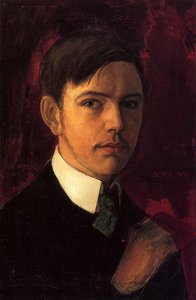
Expressionism
5. August Macke 1887–1914
1887–1914 Born in Meschede, Germany Expressionism 15 originals at Lenbachhaus
The story of August Macke begins in the town of Meschede, Germany, where he was born on January 3, 1887. His formal education in the arts began in earnest when he arrived at the Düsseldorf Academy, where he studied from 1904 to 1906. By 1911, Macke had become a leading member of the influential Expressionist group known as Der Blaue Reiter.
Originals at Lenbachhaus
-

Symbolism
6. Franz von Stuck 1863–1928
1863–1928 Born in Tettenweis, Germany Symbolism 4 originals at Lenbachhaus
Born in Tettenweis, initially destined for a life following his father as a forester, young Franz demonstrated an undeniable artistic inclination that would irrevocably alter his path. Stuck wasn't merely an artist; he was a cultural phenomenon, a “Prince of Art” as he became known during his lifetime, bridging the gap between 19th-century academic tradition and the burgeoning currents of modernism. Stuck’s ascent to prominence was remarkably swift.
Originals at Lenbachhaus
-

Expressionism
7. Alexej von Jawlensky 1864–1941
1864–1941 Born in Torzhok, Russia Expressionism 15 originals at Lenbachhaus
Alexej von Jawlensky was born on 13 March 1864 in Torzhok, Russia. By 1889, he had secured a position in Saint Petersburg, which allowed him to begin formal training at the art academy. As the years passed, Jawlensky became a central figure in the radical circles of Munich. Between 1917 and 1919, Jawlensky turned his attention to a series of works known as the Mystical Heads.
Originals at Lenbachhaus
-

Biedermeier
8. Carl Spitzweg 1808–1885
1808–1885 Born in Munich, Germany Biedermeier 3 originals at Lenbachhaus
Born in the Bavarian village of Unterpfaffenhofen near Munich on February 5, 1808, Carl Spitzweg’s path to artistic renown was anything but conventional. The early years were marked by a dutiful adherence to his father's plans, yet even within the confines of pharmaceutical study, Spitzweg’s artistic inclinations persisted, hinting at a spirit that yearned for creative expression.
Originals at Lenbachhaus
-

Expressionism
9. Lovis Corinth 1858–1925
1858–1925 Born in Gvardeysk, Russia Expressionism 13 originals at Lenbachhaus
Corinth's beginnings were rooted in the rural landscapes of his birthplace, Tapiau, where his father worked as a tanner. While Corinth explored various genres throughout his career – including biblical scenes and mythological subjects – he is perhaps best remembered for his portraits and landscapes.
Originals at Lenbachhaus
-

Academic Art
10. Hans Makart 1840–1884
1840–1884 Born in Salzburg, Austria Academic Art 2 originals at Lenbachhaus
Initially showing promise, he enrolled at the Vienna Academy between 1850 and 1851. Recognizing his passion for color, Makart studied under Karl Theodor von Piloty in Munich from 1861 to 1865. Despite criticisms from some academic circles regarding historical accuracy, Makart’s impact on Viennese culture and artistic trends remains undeniable.
Originals at Lenbachhaus


The masters, continued
No. 11 to No. 25: more masters of Lenbachhaus
-

11. William Merritt Chase
Impressionism
1849–1916 · born in Nineveh, United States · 2 originals at Lenbachhaus
American Impressionist known for luminous landscapes and still lifes of fish rendered with thick, rhythmic impasto brushwork.
- Self-Portrait (1875)
- Portrait of Hugo von Habermann (1875)
-

12. Marianne von Werefkin
Expressionism
1860–1938 · born in Tula, Russia · 6 originals at Lenbachhaus
Russian Expressionist known for dreamlike scenes and bold colors, often depicting psychological depth through flattened forms and vibrant hues.
- Ball Scene (1908)
- Washerwomen (1909)
- Selfportrait I (1910)
-

13. Franz Defregger
Realism
1835–1921 · born in Iselsberg-Stronach, Austria · 3 originals at Lenbachhaus
Austrian Munich School painter of realistic Tyrolean peasant life and dramatic historical scenes from the 1809 national uprising.
-

14. Wilhelm Busch
1832–1908 · born in Wiedensahl, Germany · 3 originals at Lenbachhaus
German humorist and illustrator known for satirical wood engravings and rhythmic verse, creating the anarchic tales of Max and Moritz.
-

15. Karl von Piloty
1826–1886 · born in Munich, Germany · 3 originals at Lenbachhaus
German Realist known for dramatic historical scenes and battle paintings, from the death of Alexander the Great to Nero dancing in Rome.
-

16. Franz von Lenbach
Academic Art
1836–1904 · born in Schrobenhausen, Germany · 37 originals at Lenbachhaus
German portraitist known as the Painter Prince, capturing nobility and elegance through a rich Venetian aesthetic and meticulous detail.
- The Painter Franz von Seitz (1878)
- Bismarck with hat (1890)
- Portrait of an Arab (1876)
-

17. Leo von Klenze
1784–1864 · born in Schladen, Germany · 2 originals at Lenbachhaus
German Neoclassical architect and painter who captured the grandeur of ancient ruins and the symmetry of Greek Revival temples on canvas.
-

18. Gabriel von Max
Romanticism
1840–1915 · born in Prague, Czech Republic · 6 originals at Lenbachhaus
Austrian-German painter of mystical allegories and dark palettes, known for psychological depth and depictions of monkeys as human-like figures.
- The Court Actor Alois Wohlmuth (1893)
- Saint Elizabeth as a Child (1881)
- Ernestine von Max (1896)
-

German Romantic landscape painter of mythic vistas and heroic scenes, known for encaustic Greek landscapes and sweeping Bavarian scenery.
- Deer Hunt at Hintersee near Berchtesgaden (1823)
- River Landscape with Church Ruin (1826)
- Delos (1849)
-

Austrian Romantic painter of Germanic legends and folklore, known for lyrical scenes of chivalry and musical themes like the Singers' Contest.
-

21. Eduard von Grützner
1846–1925 · born in Gross-Karolwitz, Poland · 2 originals at Lenbachhaus
German genre painter of jovial monks and Shakespearean Falstaff, known for meticulous realism and dramatic chiaroscuro lighting.
- Siesta in the Monastery (1880)
- Peasant Theater (1882)
-

22. Albert Weisgerber
1878–1915 · 3 originals at Lenbachhaus
- Parisian Restaurant (1906)
- In the Munich Hofgarden (1911)
- Summer Day (1907)
-

23. Hans Thoma
Romanticism
1839–1924 · born in Bernau im Schwarzwald, Germany · 2 originals at Lenbachhaus
German Symbolist known for idyllic Black Forest landscapes and portraits rendered with Pre-Raphaelite precision and luminous color palettes.
- The Sculptor Erwin Kurz (1887)
- The Painter Albert Lang (1887)
-

24. Albert Von Keller
1844–1920 · born in Gais, Switzerland · 4 originals at Lenbachhaus
German painter of the Munich Secession who blended psychological realism with symbolism in intimate portraits and haunting indoor scenes.
- The Actress Mimi Cramer (1874)
- The Judgment of Paris (1891)
- Irene von Keller with Son Balthasar (1888)
-

German Impressionist known for vibrant plein air landscapes and evocative depictions of Egypt and the harrowing realities of World War I.
- Luise Papenhagen (1897)
- Danae (1895)
- Nina and Wolfgang Slevogt (1917)
Famous artists in Lenbachhaus, No. 26 to 50
 Wilhelm Leibl1844–1900 · 4 originals at Lenbachhaus
 Christian Ernst Bernhard Morgenstern1805–1867 · 3 originals at Lenbachhaus
 Alexander Kanoldt1881–1939 · 3 originals at Lenbachhaus
 Wilhelm von Diez1839–1907 · 2 originals at Lenbachhaus
 Wilhelm Trübner1851–1917 · 4 originals at Lenbachhaus
 Eduard Schleich the Elder1812–1874 · 3 originals at Lenbachhaus
 Thomas Theodor Heine1867–1948 · 7 originals at Lenbachhaus
 Wilhelm Von Kobell1766–1853 · 2 originals at Lenbachhaus
 Hugo von Habermann1849–1929 · 3 originals at Lenbachhaus
 Ludwig von Löfftz1845–1910 · 2 originals at Lenbachhaus
 Georg Schrimpf1889–1938 · 2 originals at Lenbachhaus
 Heinrich Bürkel1802–1869 · 4 originals at Lenbachhaus
 Friedrich August von Kaulbach1850–1920 · 2 originals at Lenbachhaus
 Adolf Heinrich Lier1826–1882 · 2 originals at Lenbachhaus
 Johann Georg von Dillis1759–1841 · 8 originals at Lenbachhaus
 Gotthardt Kuehl1850–1915 · 2 originals at Lenbachhaus
 Carl Wilhelm von Heideck1788–1861 · 5 originals at Lenbachhaus
 Wilhelm Lindenschmit the Elder1806–1848 · 2 originals at Lenbachhaus
 Max Joseph Wagenbauer1774–1829 · 2 originals at Lenbachhaus
 Michael Neher1798–1876 · 2 originals at Lenbachhaus
 Arthur von Ramberg1819–1875 · 3 originals at Lenbachhaus
 Max Feldbauer1869–1948 · 2 originals at Lenbachhaus
 Leo Putz1869–1940 · 4 originals at Lenbachhaus
 Peter Jacob Horemans1700–1776 · 2 originals at Lenbachhaus
 Hans Olde1855–1917 · 2 originals at Lenbachhaus
The house in figures
The masters of Lenbachhaus, in figures
The masters with the most originals at Lenbachhaus
Masters with two originals or more, by century of birth
Masters with two originals or more, by country of birth
Masters with two originals or more, by movement
Women masters
The women whose originals hang in Lenbachhaus
4 women masters, 9 originals, in our catalogue of Lenbachhaus.
-
Marianne von Werefkin
1860–1938 · born in Tula, Russia · 6 originals at Lenbachhaus
- Ball Scene (1908)
- Washerwomen (1909)
- Selfportrait I (1910)
-

-

Gabriele Münter
1877–1962 · born in Berlin, Germany · 1 originals at Lenbachhaus
- View of the Mountains (1934)
-

Maria Elektrine von Freyberg
1797–1847 · born in Strasbourg, France · 1 originals at Lenbachhaus
- Child Portrait (1826)
Two houses
Lenbachhaus or the Alte Pinakothek: whose originals are where
Lenbachhaus
- Masters in our catalogue
- 135
- Originals
- 399
- The masters to know
- Wassily Kandinsky, Paul Klee, Franz Marc, Robert Delaunay
- Most originals by
- Wassily Kandinsky (57), Franz von Lenbach (37), Franz Marc (21)
The Alte Pinakothek
- Masters in our catalogue
- 160
- Originals
- 341
- The masters to know
- Leonardo da Vinci, Rembrandt, Albrecht Dürer, Raphael
- Most originals by
- Albrecht Dürer (24), Peter Paul Rubens (21), Rembrandt (13)
Asked of us
Questions on the masters of Lenbachhaus
Open a question to read the answer.
Who is the best-known artist of Lenbachhaus?
Wassily Kandinsky, with 57 works at Lenbachhaus in our catalogue (Gabriele Münter painting in Kallmunz, Murnau with a church and Munich - English Garden (also known as English Garden in Munich)); then Paul Klee and Franz Marc.
How many Wassily Kandinsky paintings are in Lenbachhaus?
57 works by Wassily Kandinsky at Lenbachhaus are in our catalogue: Gabriele Münter painting in Kallmunz (1903), Murnau with a church, Munich - English Garden (also known as English Garden in Munich) (1901) and Kochel - Straight road (1909) among them.
What did Paul Klee paint that hangs in Lenbachhaus?
6 works by Paul Klee at Lenbachhaus are in our catalogue: Rose Garden (1920), Botanical Theater (1934), Fruits on Red (1930) and Cliffs by the sea (1931) among them.
Which Franz Marc works are in Lenbachhaus?
21 works by Franz Marc at Lenbachhaus are in our catalogue: Blue Horse I (1911), Deer in a Monastery Garden (1912), Birds (1914) and Mandrill (1913) among them.
Who are the top 10 artists in Lenbachhaus?
The ten best-known artists with works in Lenbachhaus are Wassily Kandinsky (57), Paul Klee (6), Franz Marc (21), Robert Delaunay (2), August Macke (15), Franz von Stuck (4), Alexej von Jawlensky (15), Carl Spitzweg (3), Lovis Corinth (13) and Hans Makart (2).
Which painter is most represented in Lenbachhaus?
Our catalogue holds 57 works by Wassily Kandinsky at Lenbachhaus; next come Franz von Lenbach (37), Franz Marc (21) and August Macke (15).
Does Lenbachhaus have any Leonardo da Vinci paintings?
No: Lenbachhaus holds no work by Leonardo da Vinci in our catalogue. For Leonardo da Vinci, see the Alte Pinakothek: 2 works there.
Is Pablo Picasso in Lenbachhaus?
No: Lenbachhaus holds no work by Pablo Picasso in our catalogue.
Are there any women painters in Lenbachhaus?
4 women artists have works of Lenbachhaus in our catalogue, among them Marianne von Werefkin (6), Tina Blau (1), Gabriele Münter (1) and Maria Elektrine von Freyberg (1).
Should I visit Lenbachhaus or the Alte Pinakothek for the painters?
Lenbachhaus holds works by 135 artists of our catalogue, the Alte Pinakothek by 160. The best-known artists of Lenbachhaus are Wassily Kandinsky, Paul Klee and Franz Marc; of the Alte Pinakothek, Leonardo da Vinci, Rembrandt and Albrecht Dürer.
Are the artists in Lenbachhaus mostly French, Italian or Dutch?
Counting the artists with two works or more, Lenbachhaus holds painters born mostly in Germany (37), Austria (5), Russia (4), Switzerland (2) and France (2).
Who is the earliest artist in Lenbachhaus?
Most of the artists with two works or more at Lenbachhaus were born in the 19th century (49 artists); the earliest in this ranking is Leo von Klenze (1784–1864), the latest August Macke (1887–1914).
The house
Lenbachhaus, Munich, in a few lines
The History and Origins of Lenbachhaus
The Lenbachhaus is located in Munich, Germany, within the Kunstareal district. The building was established in 1887. Originally designed as a private residence, the structure was built for the painter Franz von Lenbach. It functioned as a villa before its transition into a public institution. The city of Munich acquired the property in 1924. Following this acquisition, the museum opened to the public in 1929. The institution's development is tied to the evolution of the building from a domestic space to a municipal gallery. The site has undergone several stages of expansion and renovation to accommodate its growing collections. These changes have allowed the museum to house works from the 19th century through to contemporary art. The history of the site reflects the broader cultural shifts in Munich during the early 20th century.
The Architecture of the Historic Villa
The building originated as a Florentine-style villa for the painter Franz von Lenbach. Gabriel von Seidl designed the structure between 1887 and 1891. The architecture reflects the specific tastes of a successful portrait painter, maintaining an intimate scale that distinguishes it from larger public institutions. The museum underwent several structural changes over the decades. Hans Grässel managed expansions between 1927 and 1929. Later, the 1972 extension was demolished to make way for a new building. In 2009, the latest wing was closed to the public to facilitate a significant expansion and restoration project led by Norman Foster. This modern addition features a facade clad in metal tubes that subtly shift in color over time, creating a dialogue between the historical villa and contemporary design.
The famous originals of LenbachhausLenbachhaus: the full page, 408 originalsThe museums of Munich
How the masters of the originals are ranked
The masters with two originals or more of Lenbachhaus in our catalogue are ranked by fame: the Wikipedia language editions that describe them, the visits to their OriginalUniqueArt.com page and our studio's ranking. Originals are counted in our catalogue — one entry per work, without details, studies or copies — not in the museum's inventory. Every date, birthplace and movement is the catalogue's; the notes are drawn from the master's biography.
Go on