The Soul of the Bavarian Landscape
Born in the quiet town hall of Grafing at the close of July 1775, Maximilian Joseph Wagenbauer was a man whose destiny was inextricably linked to the earth and sky of his beloved Bavaria. His early years were marked by an undeniable spark of creative brilliance; even as a student at the Wilhelmsgymnasium in Munich, his artistic inclinations began to outshine his formal academic pursuits. Under the tutelage of the esteemed Johann Jakob Dorner the Elder, Wagenbauer immersed himself in the delicate nuances of Dutch genre and landscape painting. This formative period instilled in him a profound respect for the meticulous observation of nature, a trait that would later become the very heartbeat of his oeuvre.
However, the path of an artist is rarely a smooth ascent. Financial hardships shadowed his early career, leading to a brief but impactful departure from the studio to the battlefield. Serving in a Bavarian cavalry regiment from 1797 to 1801, Wagenbauer experienced the raw, unvarnished reality of life during the Napoleonic era, even participating in the Battle of Hohenlinden. Yet, it was this very period of struggle that paved the way for his ultimate triumph. Through the grace of royal patronage and the influence of influential figures like Johann Christian von Mannlich, he secured a royal artist's annuity, a lifeline that allowed him to return to his true calling with renewed vigor and purpose.
A Mastery of Light and Life
As the nineteenth century unfolded, Wagenbauer’s artistic language underwent a magnificent evolution. While his early works were characterized by the refined, controlled elegance of Neo-Classical watercolours, his later years saw a bold transition toward the rich, textured depths of oil painting. This shift was not merely technical but spiritual, as he moved away from rigid traditions to embrace a methodology rooted in the intimate study of the natural world. He possessed a rare genius for capturing the ephemeral—the way light dances across a mountain peak or the subtle movement of an animal in a meadow.
His fascination with the fauna of his homeland was profound, drawing inspiration from the masters of the Dutch tradition, such as Adriaen van de Velde and Paulus Potter. In his hands, animal studies became more than mere depictions; they were soulful portraits that breathed with life. Whether painting a grazing herd or a solitary creature, Wagenbauer infused his subjects with a dignity that mirrored the grandeur of the landscapes they inhabited. His ability to blend these detailed biological observations with sweeping, atmospheric vistas created a unique aesthetic that was entirely his own, never allowing the influence of his predecessors to eclipse his personal vision.
Legacy and Royal Recognition
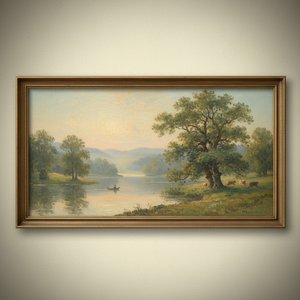
The significance of Wagenbauer’s contribution to German art is etched into the very architecture of Bavarian history. His career was marked by prestigious appointments that spoke to his standing within the cultural elite, serving as the artist to the court and cabinet in 1802 and later as the Inspector of the Royal Paintings Gallery in 1815. One of his most enduring achievements remains his monumental commission for the banquet hall at Schloss Nymphenburg. Tasked with decorating this regal space, he produced large-scale paintings of Bavarian lakes that captured the serene majesty of the region, a feat that solidified his reputation as a premier chronicler of the Bavarian landscape.
Wagenbauer’s life was a testament to the power of perseverance and the enduring beauty of the natural world. Through his travels across Upper Bavaria and his membership in the prestigious academies of Hanau, Berlin, and Munich, he spread a love for the local terrain that continues to resonate today. He did not merely paint landscapes; he celebrated the identity of a land. His works remain vital windows into a bygone era, reminding us of a time when the careful observation of a single leaf or the steady gaze of an animal could reveal the profound mysteries of the universe.
Questions & Answers
What are the birth city and country of Max Joseph Wagenbauer?
Max Joseph Wagenbauer was born in Öxing, in Germany.
How do I find works by Max Joseph Wagenbauer in a specific palette?
Max Joseph Wagenbauer's works can be browsed by color palette on the artist's By Palettes page.
What are the birthplace and birth year of Max Joseph Wagenbauer?
Max Joseph Wagenbauer was born in Öxing in 1774.
Where can I see the color profile of Max Joseph Wagenbauer's work?
The color profile of Max Joseph Wagenbauer's work is shown on the artist's Palette Genome page.