Portrait of Walter Sickert

Walter Sickert Paintings: The 100 Most Famous, Through a Gallery's Eye

Updated November 2026 · ranked by our popularity score (searches, visits and orders for each work) · 292 works by Walter Sickert in our catalogue

In short

To the gallery's eye, Walter Sickert's most famous painting is The Idyll (1931), whose original hangs in the Ferens Art Gallery, Kingston upon Hull. The Cigarette (Jeanne Daurmont) (1906) and Chagford, Devon, across Fields (1915) complete the trio every eye recognises. Of the 292 works by Walter Sickert in our catalog, the gallery presents the 100 most famous below, each original with its year, its museum and what makes it unique.

1860 – 1942, Munich Post-impressionism Most works: Tate Gallery

The gallery's top 10 Walter Sickert paintings

1
The Idyll (1931) by Walter Sickert

The Idyll

1931 · Oil On Canvas · Ferens Art Gallery, Kingston upon Hull

In the quietude of 1931, Walter Richard Sickert captured a scene that transcends mere landscape, offering instead a profound meditation on connection and stillness. The Idyll is not simply a depiction of a lakeside retreat; it is a psychological threshold where the boundaries between the external world and internal emotion blur. The painting presents two figures poised before a tranquil expanse of water, their presence anchored by a shared, silent…

2
The Cigarette (Jeanne Daurmont) (1906) by Walter Sickert

The Cigarette (Jeanne Daurmont)

1906 · Oil On Canvas · Metropolitan Museum of Art, New York

A monochromatic portrait captures Jeanne Daurmont in profile, her form emerging from a dark, indistinct background through a careful application of chiaroscuro. The composition focuses on the head and shoulders, positioned slightly off-center to create a sense of quiet intimacy. A light source from the front-left illuminates the subject's face and neck, while deep shadows swallow much of her hair and the brim of her wide hat.

3
Chagford, Devon, across Fields (1915) by Walter Sickert

Chagford, Devon, across Fields

1915 · Oil On Canvas

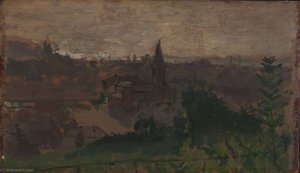
The landscape unfolds from an elevated vantage point, looking out over the rolling terrain of Devon. In the distance, a church steeple rises against the horizon, anchoring the composition amidst the sprawling greenery. The scene is populated by the quiet movements of rural life: birds drift through the air above the fields, while two horses occupy the middle ground, one positioned near the center and the other toward the right…

4
The Laundry Shop, Dieppe, France (1885) by Walter Sickert

The Laundry Shop, Dieppe, France

1885

The scene unfolds within the walls of The Laundry Shop, Dieppe, France. This work, titled The Laundry Shop, Dieppe, France, captures a specific moment in time through the eyes of the artist Walter Sickert. The air seems to hold the quiet, industrious energy of a workspace caught in mid-motion. It is a glimpse into a localized existence, far removed from the grander spectacles of the era.

5
The Red Shop (The October Sun) (1888) by Walter Sickert

The Red Shop (The October Sun)

1888 · Oil On Panel

The sun hangs low, casting a long, slanted glow across a quiet urban street. It is a scene caught in the amber of an October afternoon, where the warmth of the light struggles against the encroaching shadows of the buildings. At the heart of this stillness sits a small shop, its facade a striking vermillion that pulls the eye away from the muted, earthy tones of the surrounding architecture. A…

7
The Honourable Lady Fry (1935) by Walter Sickert

The Honourable Lady Fry

1935 · Oil On Panel

The room is bathed in a soft, warm glow, a sanctuary of pink hues that wraps around the central figure like a gentle embrace. A woman lies reclined upon a bed, her head resting against a plush pillow as she loses herself in the pages of a book. There is a profound sense of stillness here, a moment of private repose captured in 1935. The light seems to settle heavily…

8
Cicely Hey (1923) by Walter Sickert

Cicely Hey

1923 · Oil On Canvas · British Council Collection, London

In the quiet intensity of Walter Richard Sickert’s 1923 masterpiece, “Cicely Hey,” we encounter more than just a portrait; we step into a profound psychological landscape. The painting captures a young woman in a moment of suspended animation, where her outward serenity is subtly undercut by an unmistakable sense of inner distress. As the viewer approaches this canvas, the subject's gaze pulls us into a state of deep contemplation, inviting…

9
Mrs Swinton (1905) by Walter Sickert

Mrs Swinton

1905 · Oil On Canvas

A Glimpse into the Life of Mrs. Swinton The painting Mrs Swinton by Walter Richard Sickert, created in 1905, is a captivating portrait that invites viewers to ponder the life and character of its subject. Located at the Fitzwilliam Museum in Cambridge, United Kingdom, this oil on canvas piece is a testament to Sickert's skill in capturing the essence of his subjects. The Composition and Symbolism The painting depicts Mrs.…

Walter Sickert paintings, ranked 11 to 100

11The Camden Town Murder, or What Shall We Do For the Rent. (1909) by Walter SickertThe Camden Town Murder, or What Shall We Do For the Rent.1909 12Portrait of the artist's first wife, née Ellen Cobden (1893) by Walter SickertPortrait of the artist's first wife, née Ellen Cobden1893 · Art Gallery of New South Wales 13Tipperary (1914) by Walter SickertTipperary1914 14The Miner (1935) by Walter SickertThe Miner1935 · Birmingham Museum and Art Gallery 15George Moore (1890) by Walter SickertGeorge Moore1890 16The Brighton Pierrots (1915) by Walter SickertThe Brighton Pierrots1915 · The Ashmolean Museum of Art And Archaeology 17Minnie Cunningham at the Old Bedford (1892) by Walter SickertMinnie Cunningham at the Old Bedford1892 18Aubrey Beardsley (1894) by Walter SickertAubrey Beardsley1894 19A Cup of Tea (Une Tasse de Thé) (1905) by Walter SickertA Cup of Tea (Une Tasse de Thé)1905 · Auckland Art Gallery Toi o Tāmaki 20Sketch for `The Statue of Duquesne, Dieppe' (1902) by Walter SickertSketch for `The Statue of Duquesne, Dieppe'1902 21La Nera (1903) by Walter SickertLa Nera1903 22Les arcades de la poissonerie, quai Duguesne, Dieppe, France (1900) by Walter SickertLes arcades de la poissonerie, quai Duguesne, Dieppe, France1900 23Easter Monday-Hélène Daurmont (1906) by Walter SickertEaster Monday-Hélène Daurmont1906 · Cleveland Museum of Art 24La ci Darem la Mano (Don Giovanni) (1911) by Walter SickertLa ci Darem la Mano (Don Giovanni)1911 · Fenton House 25Les Petites Belges (Young Belgian Women) (1906) by Walter SickertLes Petites Belges (Young Belgian Women)1906 · Museum of Fine Arts 26Mamma Mia Poveretta (1906) by Walter SickertMamma Mia Poveretta1906 27Noctes ambrosianae (1906) by Walter SickertNoctes ambrosianae1906 28The Poet and His Muse (1907) by Walter SickertThe Poet and His Muse1907 · Towner 29The Mantelpiece (1907) by Walter SickertThe Mantelpiece1907 30La Vallée de l'Eaulne (1913) by Walter SickertLa Vallée de l'Eaulne1913 · Fenton House 31Ennui (1914) by Walter SickertEnnui1914 32Jack Ashore (1912) by Walter SickertJack Ashore1912 33George Moore (1890) by Walter SickertGeorge Moore1890 · Tate Gallery 34O nuit d'amour (1922) by Walter SickertO nuit d'amour1922 35Winston Churchill (1927) by Walter SickertWinston Churchill1927 · National Portrait Gallery 36Victor Lecour (1924) by Walter SickertVictor Lecour1924 37The Third Republic, View of Porte St Denis, Paris, France (1932) by Walter SickertThe Third Republic, View of Porte St Denis, Paris, France1932 · Peterborough Museum - Art Gallery 38Mrs Van Beuren and Child (1930) by Walter SickertMrs Van Beuren and Child1930 39Mrs Swinton (1906) by Walter SickertMrs Swinton1906 · Fitzwilliam College 40Pimlico (1937) by Walter SickertPimlico1937 41William Maxwell Aitken, 1st Baron Beaverbrook (1935) by Walter SickertWilliam Maxwell Aitken, 1st Baron Beaverbrook1935 42L'Hotel Royal, Dieppe, France (1894) by Walter SickertL'Hotel Royal, Dieppe, France1894 43Miss Hudson at Rowlandson House by Walter SickertMiss Hudson at Rowlandson HouseThe Phillips Collection 44The Sisters Lloyd (1889) by Walter SickertThe Sisters Lloyd1889 · Government Art Collection 45Jacques-Emile Blanche (1910) by Walter SickertJacques-Emile Blanche1910 · Tate Gallery 46Israel Zangwill (1898) by Walter SickertIsrael Zangwill1898 47Baccarat, Dieppe (1920) by Walter SickertBaccarat, Dieppe1920 · Auckland Art Gallery Toi o Tāmaki 48Mrs Barrett (1905) by Walter SickertMrs Barrett1905 · Tate Gallery 49Miss Gwen Frangcon-Davies as Isabella of France (1932) by Walter SickertMiss Gwen Frangcon-Davies as Isabella of France1932 · Tate Gallery 50Portrait of an Afghan Gentleman (1895) by Walter SickertPortrait of an Afghan Gentleman1895 · Jerwood Gallery 51The Yellow Sleeve (1904) by Walter SickertThe Yellow Sleeve1904 · New Walk Museum - Art Gallery 52Minnie Cunningham at the Old Bedford (1892) by Walter SickertMinnie Cunningham at the Old Bedford1892 · Tate Gallery 53L'église Saint Jacques, portail sud by Walter SickertL'église Saint Jacques, portail sud 54L'église Saint Jacques, façade au soleil couchant L'église Saint Jacques, façade au soleil couchant by Walter SickertL'église Saint Jacques, façade au soleil couchant L'église Saint Jacques, façade au soleil couchant 55Camden Town Portrait (1915) by Walter SickertCamden Town Portrait1915 · Amgueddfa Cymru - National Museum of Wales 56The Bar Parlour (1922) by Walter SickertThe Bar Parlour1922 · Fitzwilliam College 57The Horses of St Mark's, Venice (1905) by Walter SickertThe Horses of St Mark's, Venice1905 · Birmingham Museum and Art Gallery 58The Old Bedford Music Hall (1895) by Walter SickertThe Old Bedford Music Hall1895 · Fitzwilliam College 59Harold Gilman (1912) by Walter SickertHarold Gilman1912 · Tate Gallery 60Miss Earhart's Arrival (1932) by Walter SickertMiss Earhart's Arrival1932 · Tate Gallery 61Reclining Nude (Thin Adeline) (1906) by Walter SickertReclining Nude (Thin Adeline)1906 · Metropolitan Museum of Art 62Leslie Banks as Petruchio and Edith Evans as Katherine in 'The Taming of the Shrew' (1937) by Walter SickertLeslie Banks as Petruchio and Edith Evans as Katherine in 'The Taming of the Shrew'1937 63The Front at Hove (1930) by Walter SickertThe Front at Hove1930 · Tate Gallery 64Santa Maria del Carmelo, Venice (1900) by Walter SickertSanta Maria del Carmelo, Venice1900 · The Ashmolean Museum of Art And Archaeology 65Ennui (1917) by Walter SickertEnnui1917 · Ashmolean Museum 66View of Dieppe with Eglise du Pollet (1890) by Walter SickertView of Dieppe with Eglise du Pollet1890 · Courtauld Gallery 67A Marengo (1903) by Walter SickertA Marengo1903 · Tate Gallery 68Girl at a Window, Little Rachel (1907) by Walter SickertGirl at a Window, Little Rachel1907 · Tate Gallery 69The Oxford Music Hall by Walter SickertThe Oxford Music HallArt Gallery of New South Wales 70Her Majesty's (1934) by Walter SickertHer Majesty's1934 · Ashmolean Museum 71Wellington House Academy (1914) by Walter SickertWellington House Academy1914 72Interior of St Mark's, Venice (1895) by Walter SickertInterior of St Mark's, Venice1895 · Tate Gallery 73Gaieté Montparnasse, dernière galerie de gauche (1906) by Walter SickertGaieté Montparnasse, dernière galerie de gauche1906 · Ashmolean Museum 74Head of a Woman (The Belgian Cocotte) (1906) by Walter SickertHead of a Woman (The Belgian Cocotte)1906 · Arts Council Collection 75Clodgy Point, Cornwall (1883) by Walter SickertClodgy Point, Cornwall1883 76The Grey Dress (1884) by Walter SickertThe Grey Dress1884 77Dieppe Harbour, France (1885) by Walter SickertDieppe Harbour, France1885 78The Laundry Shop (1885) by Walter SickertThe Laundry Shop1885 79Bathing Huts, Dieppe (1890) by Walter SickertBathing Huts, Dieppe1890 · Courtauld Gallery 80Violets (1880) by Walter SickertViolets1880 · Victoria Art Gallery 81The Little Tea Party: Nina Hamnett and Roald Kristian (1915) by Walter SickertThe Little Tea Party: Nina Hamnett and Roald Kristian1915 · Tate Gallery 82Café des Tribunaux, Dieppe (1890) by Walter SickertCafé des Tribunaux, Dieppe1890 · National Gallery of Canada 83The Old Bedford: Cupid in the Gallery (1890) by Walter SickertThe Old Bedford: Cupid in the Gallery1890 · National Gallery of Canada 84Gaite Rochechouart (1890) by Walter SickertGaite Rochechouart1890 85Le Lion Comique (1887) by Walter SickertLe Lion Comique1887 86The Music Hall (1889) by Walter SickertThe Music Hall1889 · Musée des Beaux-Arts de Rouen 87Gaîté Rochechouart (1891) by Walter SickertGaîté Rochechouart1891 88Lion Comique (1887) by Walter SickertLion Comique1887 89The Little Trianon (1890) by Walter SickertThe Little Trianon1890 90Seascape (1887) by Walter SickertSeascape1887 · Scottish National Gallery of Modern Art 91Sketch of a female figure (1888) by Walter SickertSketch of a female figure1888 92Minnie Cunningham at the Old Bedford (1892) by Walter SickertMinnie Cunningham at the Old Bedford1892 93Gatti's Hungerford Pallace of Varieties Second Turn of Katie Lawrence (1888) by Walter SickertGatti's Hungerford Pallace of Varieties Second Turn of Katie Lawrence1888 94Philip Wilson Steer (1890) by Walter SickertPhilip Wilson Steer1890 95Café des Tribunaux, Dieppe (1890) by Walter SickertCafé des Tribunaux, Dieppe1890 96The Façade of St  Mark's, Venice (1896) by Walter SickertThe Façade of St Mark's, Venice1896 · Coleton Fishacre 97The Antique Shop (1906) by Walter SickertThe Antique Shop1906 · Metropolitan Museum of Art 98The Façade of San Marco, Venice (1896) by Walter SickertThe Façade of San Marco, Venice1896 99Charles Bradlaugh at the Bar of the House of Commons (1893) by Walter SickertCharles Bradlaugh at the Bar of the House of Commons1893 100La Hollandaise (1906) by Walter SickertLa Hollandaise1906 · Tate Gallery

Walter Sickert's famous paintings, period by period

The subjects that held Walter Sickert's eye

The four subjects that come back most often in these originals, each with its finest example.

The museums that keep Walter Sickert's originals

The 8 museums that hold the most of the paintings on this page.

Museum City Works by Walter Sickert Paintings from this list
Tate Gallery, LondonTate Gallery London 19 George Moore, Jacques-Emile Blanche, Mrs Barrett
Metropolitan Museum of Art, New YorkMetropolitan Museum of Art New York 4 The Cigarette (Jeanne Daurmont), Reclining Nude (Thin Adeline), The Antique Shop
Fitzwilliam College, CambridgeFitzwilliam College Cambridge 4 Mrs Swinton, The Bar Parlour, The Old Bedford Music Hall
Ashmolean Museum, OxfordAshmolean Museum Oxford 4 Ennui, Her Majesty's, Gaieté Montparnasse, dernière galerie de gauche
Birmingham Museum and Art Gallery, BirminghamBirmingham Museum and Art Gallery Birmingham 7 The Miner, The Horses of St Mark's, Venice
Art Gallery of New South Wales, SydneyArt Gallery of New South Wales Sydney 5 Portrait of the artist's first wife, née Ellen Cobden, The Oxford Music Hall
The Ashmolean Museum of Art And Archaeology, OxfordThe Ashmolean Museum of Art And Archaeology Oxford 5 The Brighton Pierrots, Santa Maria del Carmelo, Venice
Courtauld Gallery, LondonCourtauld Gallery London 3 View of Dieppe with Eglise du Pollet, Bathing Huts, Dieppe

Walter Sickert, one signature painting per decade

Works per decade

Pick a decade to see the original that defines it.

Walter Sickert's paintings: the gallery answers

Which Walter Sickert painting is the most famous of all?Reveal the answer

The Idyll (1931), Ferens Art Gallery, Kingston upon Hull. The Cigarette (Jeanne Daurmont) (1906) and Chagford, Devon, across Fields (1915) come next.

How old was Walter Sickert on completing The Idyll?Reveal the answer

71 years old: The Idyll dates from 1931, and Walter Sickert was born in 1860.

Which are Walter Sickert's top 10 paintings?Reveal the answer

The Idyll, The Cigarette (Jeanne Daurmont), Chagford, Devon, across Fields, The Laundry Shop, Dieppe, France, The Red Shop (The October Sun), Portrait of Rear Admiral Walter Lumsden, C.I.E., C.V.O., The Honourable Lady Fry, Cicely Hey, Mrs Swinton and Gatti’s Hungerford Palace of Varieties. Second Turn of Katie Lawrence. The ranking above gives each one's year and museum.

How many works did Walter Sickert create?Reveal the answer

Our catalog holds 292 works by Walter Sickert, dated from 1880 to 1937.

Where do Walter Sickert's most famous originals hang?Reveal the answer

Mostly in Tate Gallery (London), Metropolitan Museum of Art (New York) and Fitzwilliam College (Cambridge). The museum table above lists them all.

When did Walter Sickert create the most famous paintings?Reveal the answer

In 1900s: 25 of the 100 works on this page were made then, The Cigarette (Jeanne Daurmont) among them.

Which are Walter Sickert's earliest and latest famous works?Reveal the answer

On this page, the earliest is Violets (1880) and the latest Pimlico (1937).

Which subjects did Walter Sickert return to most?Reveal the answer

Woman (17), Interior (15) and Portrait (13), across the 100 works on this page.

Which medium did Walter Sickert work in most?Reveal the answer

Oil On Canvas, for 55 of the 100 works on this page.

Which movement is Walter Sickert associated with?Reveal the answer

Post-impressionism and Impressionism, judging by the originals on this page.

Which Walter Sickert originals does the Tate Gallery hold?Reveal the answer

George Moore, Jacques-Emile Blanche and Mrs Barrett: the Tate Gallery, London holds 13 of the works on this page.

Walter Sickert: the artist

A Life Painted in Shadows and Light

Walter Richard Sickert, born in Munich in 1860, was a figure perpetually caught between worlds – German by birth, British by adoption, and an artist forever oscillating between the established traditions of painting and the burgeoning currents of modernism. His early life was marked by movement; the family’s relocation to England in 1868, prompted by political shifts in Europe, instilled within him a sense of displacement that perhaps fueled his lifelong fascination with outsiders and marginalized figures. Though descended from a lineage of artists – his father, Oswald Sickert, was a Danish painter – young Walter initially harbored ambitions for the stage, briefly treading the boards as an actor alongside the renowned Sir Henry Irving. This early exposure to performance, to the art of illusion and character, would profoundly shape his artistic vision, imbuing his paintings with a theatricality and psychological depth that set him apart from his contemporaries. However, the allure of visual expression proved stronger, leading him to enroll at the Slade School in 1881 and subsequently become a devoted pupil of James Abbott McNeill Whistler. This mentorship was formative, instilling in Sickert a preference for tonal studies painted *alla prima*, directly from nature, and a refined aesthetic sensibility that would underpin his early work. The influence of Whistler wasn’t merely technical; it fostered an appreciation for artistic independence and a willingness to challenge conventional norms.

London's Underbelly and the Allure of Modern Life

Sickert’s artistic compass quickly gravitated towards the vibrant, often gritty realities of London life. He became captivated by the atmosphere of the city’s music halls – spaces teeming with energy, spectacle, and a diverse cross-section of society. His paintings from this period, such as Katie Lawrence at Gatti's, are remarkable for their unflinching portrayal of these environments and their inhabitants. These weren't simply depictions; they were explorations of modern urban existence, capturing the fleeting moments and raw emotions experienced within those walls. He sought to paint life as it was lived, not as it was idealized, a radical departure from Victorian artistic conventions. This commitment to realism sparked controversy. Critics deemed his subjects “ugly” and “vulgar,” challenging sensibilities that favored idealized representations. Sickert’s willingness to depict ordinary people, particularly female performers, with honesty and without romanticization was a provocative act, foreshadowing the shift towards social realism in 20th-century art. His time spent in Dieppe, France, from 1894 onwards also proved crucial, offering new perspectives on light, color, and composition, while his subsequent visits to Venice further refined his approach to depicting interior spaces and complex arrangements of figures. He wasn’t merely recording what he saw; he was interpreting it through a distinctly personal lens, imbuing even the most mundane scenes with a sense of mystery and psychological tension.

A Catalyst for Change: The Camden Town Group and Beyond

As the 20th century dawned, Sickert became a central figure in the burgeoning British avant-garde movement. He joined the New English Art Club in 1888, aligning himself with artists who embraced French Impressionist principles. Later, he played a pivotal role in establishing the Camden Town Group in 1911 – a collective of artists dedicated to portraying modern life with unflinching honesty and stylistic innovation. Sickert’s influence on this group was profound, encouraging them to break away from traditional academic constraints and explore new forms of expression. He championed an unromanticized vision of the urban landscape, focusing on everyday scenes and ordinary people. His paintings during this period often featured unsettling subject matter, such as his Camden Town Murder series, reflecting a growing fascination with crime and psychological tension. This willingness to confront difficult themes cemented his reputation as a provocative and challenging artist. He wasn’t simply interested in depicting the surface of things; he wanted to delve into the darker recesses of the human psyche, exploring themes of alienation, anxiety, and moral ambiguity.

Legacy and Lingering Mysteries

Walter Richard Sickert’s legacy extends far beyond his prolific output. He was a catalyst for change in British art, paving the way for subsequent generations of artists to embrace modernism and explore new avenues of expression. His influence can be seen in the work of numerous painters who followed, particularly those associated with the London Group and other avant-garde movements. Sickert’s pioneering spirit, his commitment to realism, and his willingness to challenge societal norms continue to resonate with artists today. While controversies surrounding his life – including speculation about his potential involvement in the Jack the Ripper murders – have added layers of intrigue to his story, they do not diminish his artistic achievements. These theories, though largely dismissed by scholars, speak to the unsettling quality of his work and its preoccupation with themes of violence and urban decay. His paintings remain powerful testaments to a changing world, offering glimpses into the lives and experiences of those often overlooked by traditional art history. He was an artist who dared to look beyond the surface, to confront the uncomfortable truths of modern life, and to capture them on canvas with unflinching honesty.

Key Details & Influences

  • Born: May 31, 1860, Munich, Bavaria
  • Died: January 22, 1942, Bathampton, England
  • Key Influences: James Abbott McNeill Whistler, Edgar Degas
  • Associated Groups: New English Art Club, Camden Town Group
Sickert’s work can be found in major museums worldwide, ensuring that his vision continues to inspire and provoke audiences for years to come. He remains a pivotal figure in the history of British art, an artist who dared to challenge conventions and to paint the world as he saw it – in all its beauty, ugliness, and complexity.