Portrait of Vincent van Gogh

The 100 Most Famous Vincent van Gogh Paintings, a Gallery Selection

Updated November 2026 · ranked by our popularity score (searches, visits and orders for each work) · 2,857 works by Vincent van Gogh in our catalogue

In short

Of all the originals Vincent van Gogh left, the most famous is Starry Night (New York, MoMA) (1889), in the collection of the MOMA - Museum of Modern Art, New York City. Close behind it come Sunflowers (1888) and Cafe Terrace on the Place du Forum, Arles, at Night (1888). Our catalog holds 2,857 works by Vincent van Gogh; the gallery has kept the 100 the world admires most, each shown with its date, its museum and its story.

1853 – 1890, Zundert Post-impressionism Most works: Van Gogh Museum

Vincent van Gogh's top 10 paintings: the gallery's choice

1
Starry Night (New York, MoMA) (1889) by Vincent van Gogh

Starry Night (New York, MoMA)

1889 · Oil On Canvas · MOMA - Museum of Modern Art, New York City

In 1889, Vincent van Gogh produced Starry Night (New York, MoMA) while staying at the Saint-Paul-de-Mausole asylum in Saint-Rémy-de-Provence, France. This period of his life was marked by significant personal struggle. The oil on canvas captures a specific moment of observation and memory, specifically the view from his east-facing window just before the sun rose.

2
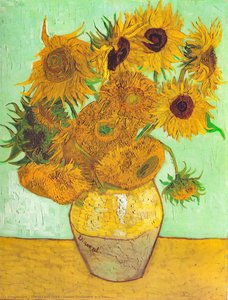
Sunflowers (1888) by Vincent van Gogh

Sunflowers

1888 · Oil On Canvas · Bayerische Staatsgemaldesammlungen, Munich

Painted in Arles, France, in 1888, this breathtaking still life embodies Vincent van Gogh's unique vision and masterful technique. More than just a depiction of flowers, it is an exploration of color, texture, and the fleeting beauty of existence – a testament to his profound emotional connection with nature.

3
Cafe Terrace on the Place du Forum, Arles, at Night (1888) by Vincent van Gogh

Cafe Terrace on the Place du Forum, Arles, at Night

1888 · Oil On Canvas · Kröller-Müller Museum, Otterlo

Painted in September 1888 during Vincent van Gogh’s prolific stay in Arles, France, this iconic artwork captures a seemingly simple scene – an outdoor café at night – and transforms it into a vibrant exploration of color, light, and human connection. More than just a depiction of a place, it's a powerful expression of Van Gogh’s emotional response to the world around him.

4
The Potato Eaters (1885) by Vincent van Gogh

The Potato Eaters

1885 · Oil On Canvas · Van Gogh Museum, Amsterdam

Painted in 1885 during his time in Nuenen, Netherlands, this profoundly moving artwork offers a stark and unflinching portrayal of peasant life. More than just a depiction of a family meal, it is a powerful statement about labor, poverty, and the dignity found within simple existence. This painting stands as a cornerstone of Van Gogh’s early work and foreshadows his later explorations of emotional intensity and expressive brushwork.

5
Van Gogh's Bedroom in Arles (First version) (1888) by Vincent van Gogh

Van Gogh's Bedroom in Arles (First version)

1888 · Oil On Canvas · Van Gogh Museum, Amsterdam

Painted in October 1888 during a period of both intense creativity and personal struggle, “Van Gogh's Bedroom in Arles (First version)” is far more than a simple depiction of a room. It offers an extraordinarily intimate glimpse into the artist’s private world – a space conceived as a haven, yet imbued with underlying emotional currents. This iconic work stands as a powerful expression of Van Gogh’s yearning for peace and…

6
Wheatfield with Crows (1890) by Vincent van Gogh

Wheatfield with Crows

1890 · Oil On Canvas · Van Gogh Museum, Amsterdam

Vincent van Gogh’s Wheatfield with Crows (1890) stands as a profoundly moving culmination of his artistic vision, painted in the final weeks of his life at Auvers-sur-Oise. More than just a depiction of a rural scene, it's an intensely personal expression of emotion, vulnerability, and perhaps, a premonition of mortality.

7
Starry Night Over the Rhone (1888) by Vincent van Gogh

Starry Night Over the Rhone

1888 · Oil On Canvas · Musée d'Orsay, Paris

Vincent van Gogh's *Starry Night Over the Rhone* is a mesmerizing masterpiece that captures the enchanting allure of a night scene over the Rhône River in Arles, France. Painted in September 1888, this Post-Impressionist work is a testament to Van Gogh's unique ability to transform ordinary landscapes into extraordinary visions of light and color.

8
Portrait of Dr. Gachet (1890) by Vincent van Gogh

Portrait of Dr. Gachet

1890 · Oil On Canvas

Vincent van Gogh's "Portrait of Dr. Gachet" is a profound exploration of human emotion and psychological depth. Painted in June 1890 during Van Gogh's stay in Auvers-sur-Oise, this iconic work captures the likeness of Dr. Paul Gachet, the homeopathic physician who cared for the artist in his final months. The portrait is celebrated for its intense emotional resonance and masterful use of color and texture, making it a cornerstone of…

9
Irises (1889) by Vincent van Gogh

Irises

1889 · Oil On Canvas · J. Paul Getty Museum, Los Angeles

Painted in 1889 during Vincent van Gogh's stay at the Saint-Paul-de-Mausole asylum in Saint-Rémy, this captivating artwork transcends a simple floral study. Measuring 71 x 93 cm, “Irises” is a powerful expression of beauty found amidst personal turmoil, and remains one of his most beloved and recognizable works.

10
The Red Vineyard [1888] (1888) by Vincent van Gogh

The Red Vineyard [1888]

1888 · Oil On Canvas · Pushkin State Museum, Moscow

Vincent van Gogh's "The Red Vineyard," painted in November 1888 during his time in Arles, is far more than just a depiction of agricultural labor; it’s a profound exploration of light, color, and the human connection to the land. This oil on burlap canvas, now residing within the Pushkin State Museum in Moscow, offers a rare glimpse into the artist's intensely personal vision – a vision forged from observation, emotion,…

The Vincent van Gogh selection continues, 11 to 100

11Sorrowing old man ( (1890) by Vincent van GoghSorrowing old man (1890 · Kröller-Müller Museum 12The Church at Auvers (1890) by Vincent van GoghThe Church at Auvers1890 · Musée d'Orsay 13Vincent's House in Arles (The Yellow House) (1888) by Vincent van GoghVincent's House in Arles (The Yellow House)1888 14The Night Cafe (1888) by Vincent van GoghThe Night Cafe1888 · Yale University Art Gallery 15Skull with Burning Cigarette (1886) by Vincent van GoghSkull with Burning Cigarette1886 · Van Gogh Museum 16Self Portrait (1889) by Vincent van GoghSelf Portrait1889 17Almond Tree in Blossom (1888) by Vincent van GoghAlmond Tree in Blossom1888 · Van Gogh Museum 18Portrait du pere Tanguy by Vincent van GoghPortrait du pere TanguyMusée Rodin 19Self Portrait with Bandaged Ear (1889) by Vincent van GoghSelf Portrait with Bandaged Ear1889 · Courtauld Gallery 20Vincent's Chair with His Pipe by Vincent van GoghVincent's Chair with His PipeNational Gallery 21Poppy Flowers (1887) by Vincent van GoghPoppy Flowers1887 · Mohamed Mahmoud Khalil Museum 22The exercise of prisoners (after Gustav Dore) by Vincent van GoghThe exercise of prisoners (after Gustav Dore)Pushkin State Museum 23Tree roots (1890) by Vincent van GoghTree roots1890 · Van Gogh Museum 24Sunset at Montmajour (1888) by Vincent van GoghSunset at Montmajour1888 25Nuenen presbytery garden in Spring (1884) by Vincent van GoghNuenen presbytery garden in Spring1884 · Groninger Museum 26Branches with Almond Blossom (1890) by Vincent van GoghBranches with Almond Blossom1890 · Van Gogh Museum 27Self Portrait with Bandaged Ear and Pipe (1889) by Vincent van GoghSelf Portrait with Bandaged Ear and Pipe1889 · Tate Gallery 28White House at Night (1890) by Vincent van GoghWhite House at Night1890 · Hermitage Museum 29Agostina Segatori in the Café du Tambourin by Vincent van GoghAgostina Segatori in the Café du TambourinVan Gogh Museum 30Memory of the Garden at Etten (1888) by Vincent van GoghMemory of the Garden at Etten1888 · Hermitage Museum 31A Pair of Shoes (1887) by Vincent van GoghA Pair of Shoes1887 · Baltimore Museum of Art 32Cypresses (1889) by Vincent van GoghCypresses1889 · Metropolitan Museum of Art 33Self-Portrait (1889) by Vincent van GoghSelf-Portrait1889 34Noon Rest (After Millet). Saint-Rémy by Vincent van GoghNoon Rest (After Millet). Saint-RémyMusée d'Orsay 35Haystacks in Provence (1888) by Vincent van GoghHaystacks in Provence1888 · Kröller-Müller Museum 36Portrait of Patience Escalier (1888) by Vincent van GoghPortrait of Patience Escalier1888 · The Norton Simon Museum of Art 37The Street, the Yellow House (1888) by Vincent van GoghThe Street, the Yellow House1888 · Van Gogh Museum 38Young Man with Cornflower (1890) by Vincent van GoghYoung Man with Cornflower1890 39Twelve Sunflowers in a Vase (1888) by Vincent van GoghTwelve Sunflowers in a Vase1888 · Philadelphia Museum of Art 40Flowering Garden (1888) by Vincent van GoghFlowering Garden1888 41Self Portrait with a Grey Felt Hat (1887) by Vincent van GoghSelf Portrait with a Grey Felt Hat1887 · Rijksmuseum 42Portrait of the Postman Joseph Roulin (1889) by Vincent van GoghPortrait of the Postman Joseph Roulin1889 · MOMA - Museum of Modern Art 43Willows at Sunset (1888) by Vincent van GoghWillows at Sunset1888 · Kröller-Müller Museum 44Daubigny's Garden (1890) by Vincent van GoghDaubigny's Garden1890 · Kunstmuseum Basel 45Rosebush i Blossom (1899) by Vincent van GoghRosebush i Blossom1899 · National Museum of Western Art 46Trees and Undergrowth 2 (1887) by Vincent van GoghTrees and Undergrowth 21887 47First Steps (after Millet) (1890) by Vincent van GoghFirst Steps (after Millet)1890 · Metropolitan Museum of Art 48The Courtyard of the Hospital at Arles (1899) by Vincent van GoghThe Courtyard of the Hospital at Arles1899 49The Sower (Sower with Setting Sun) (1888) by Vincent van GoghThe Sower (Sower with Setting Sun)1888 · Kröller-Müller Museum 50Lane with poplars near Nuenen (1885) by Vincent van GoghLane with poplars near Nuenen1885 · Museum Boijmans Van Beuningen 51Still Life: Vase with Fourteen Sunflowers (1889) by Vincent van GoghStill Life: Vase with Fourteen Sunflowers1889 · National Gallery 52Orchard in Blossom with View of Arles (1889) by Vincent van GoghOrchard in Blossom with View of Arles1889 53Still Life with Bible (1885) by Vincent van GoghStill Life with Bible1885 · Van Gogh Museum 54Le Moulin de la Galette (1886) by Vincent van GoghLe Moulin de la Galette1886 · Metropolitan Museum of Art 55Old Man in Sorrow (1890) by Vincent van GoghOld Man in Sorrow1890 · Kröller-Müller Museum 56Peach Trees in Blossom (1888) by Vincent van GoghPeach Trees in Blossom1888 · Kröller-Müller Museum 57The Langlois Bridge at Arles (1888) by Vincent van GoghThe Langlois Bridge at Arles1888 58Street in Saintes-Maries (1888) by Vincent van GoghStreet in Saintes-Maries1888 · Hermitage Museum 59Olive Trees with Yellow Sky and Sun (1889) by Vincent van GoghOlive Trees with Yellow Sky and Sun1889 · Minneapolis Institute of Art 60Apricot Trees in Blossom 2 (1888) by Vincent van GoghApricot Trees in Blossom 21888 61Branches with Almond Blossom (1890) by Vincent van GoghBranches with Almond Blossom1890 · Van Gogh Museum 62The Mulberry Tree (1889) by Vincent van GoghThe Mulberry Tree1889 · Norton Simon Museum 63A Group of Cottages (1890) by Vincent van GoghA Group of Cottages1890 64Fishing boats on the Beach at Les Saintes-Maries-de-la-Mer (1888) by Vincent van GoghFishing boats on the Beach at Les Saintes-Maries-de-la-Mer1888 · Van Gogh Museum 65Roses and Beetle (1890) by Vincent van GoghRoses and Beetle1890 · Van Gogh Museum 66Crab on Its Back (1889) by Vincent van GoghCrab on Its Back1889 · Van Gogh Museum 67Bowl with Peonies and Roses (1886) by Vincent van GoghBowl with Peonies and Roses1886 · Kröller-Müller Museum 68Noon Rest from Work after Millet (1890) by Vincent van GoghNoon Rest from Work after Millet1890 · Musée d'Orsay 69Farmhouse in Provence (1888) by Vincent van GoghFarmhouse in Provence1888 · National Gallery of Art 70Green Wheat Field with Cypress (1889) by Vincent van GoghGreen Wheat Field with Cypress1889 · National Gallery 71Peach Tree in Blossom (1888) by Vincent van GoghPeach Tree in Blossom1888 · Kröller-Müller Museum 72Young Peasant Woman with Straw Hat Sitting in the Wheat (1890) by Vincent van GoghYoung Peasant Woman with Straw Hat Sitting in the Wheat1890 73Cypress against a Starry Sky (also known as Road with Cypresses) (1890) by Vincent van GoghCypress against a Starry Sky (also known as Road with Cypresses)1890 · Kröller-Müller Museum 74Les Alyscamps (1888) by Vincent van GoghLes Alyscamps1888 75Still Life with Sunflowers (1888) by Vincent van GoghStill Life with Sunflowers1888 · Philadelphia Museum of Art 76The Sower (1888) by Vincent van GoghThe Sower1888 · Van Gogh Museum 77Blossoming Almond Branch in a Glass with a Book (1888) by Vincent van GoghBlossoming Almond Branch in a Glass with a Book1888 78Starry Night over the Rhône (Letter Sketch) (1888) by Vincent van GoghStarry Night over the Rhône (Letter Sketch)1888 79The Starry Night, Pen and Ink Drawing (1889) (1889) by Vincent van GoghThe Starry Night, Pen and Ink Drawing (1889)1889 80The Mulberry Tree (1889) by Vincent van GoghThe Mulberry Tree1889 81The Langlois Bridge (1888) by Vincent van GoghThe Langlois Bridge1888 · Wallraf-Richartz-Museum 82Landscape with Snow (1888) by Vincent van GoghLandscape with Snow1888 · Solomon R. Guggenheim Museum 83Wheat Field with Cypresses (1889) by Vincent van GoghWheat Field with Cypresses1889 · Metropolitan Museum of Art 84The Public Soup Kitchen (1883) by Vincent van GoghThe Public Soup Kitchen1883 85Seascape at Saintes-Maries (1888) by Vincent van GoghSeascape at Saintes-Maries1888 · Van Gogh Museum 86The Little Stream (1890) by Vincent van GoghThe Little Stream1890 87Trees and Undergrowth (1887) by Vincent van GoghTrees and Undergrowth1887 · Van Gogh Museum 88Postman Joseph Roulin (1888) by Vincent van GoghPostman Joseph Roulin1888 · Museum of Fine Arts 89Chestnut Tree in Blossom (1887) by Vincent van GoghChestnut Tree in Blossom1887 · Van Gogh Museum 90Sunflowers (1888) by Vincent van GoghSunflowers1888 91Still life with potatoes (1889) by Vincent van GoghStill life with potatoes1889 · Kröller-Müller Museum 92Cypresses with Two Women (1889) by Vincent van GoghCypresses with Two Women1889 · Kröller-Müller Museum 93The Grounds of the Asylum (1889) by Vincent van GoghThe Grounds of the Asylum1889 · Hammer Museum 94Sien, Sewing, Half-Figure (1883) by Vincent van GoghSien, Sewing, Half-Figure1883 95The Langlois Bridge at Arles (1888) by Vincent van GoghThe Langlois Bridge at Arles1888 96Self-Portrait with Straw Hat (1887) by Vincent van GoghSelf-Portrait with Straw Hat1887 97Gauguin's Chair (1888) by Vincent van GoghGauguin's Chair1888 98Still life with meadow flowers and roses (1886) by Vincent van GoghStill life with meadow flowers and roses1886 99Olive Grove: Bright Blue Sky (1889) by Vincent van GoghOlive Grove: Bright Blue Sky1889 · Nelson-Atkins Museum of Art 100Cart with Red and White Ox (1884) by Vincent van GoghCart with Red and White Ox1884

Vincent van Gogh's famous paintings, period by period

The subjects that held Vincent van Gogh's eye

The four subjects that come back most often in these originals, each with its finest example.

The museums that keep Vincent van Gogh's originals

The 8 museums that hold the most of the paintings on this page.

Museum City Works by Vincent van Gogh Paintings from this list
Van Gogh Museum, AmsterdamVan Gogh Museum Amsterdam 282 The Potato Eaters, Van Gogh's Bedroom in Arles (First version), Wheatfield with Crows
Kröller-Müller Museum, OtterloKröller-Müller Museum Otterlo 168 Cafe Terrace on the Place du Forum, Arles, at Night, Sorrowing old man (, Haystacks in Provence
Musée d'Orsay, ParisMusée d'Orsay Paris 29 Starry Night Over the Rhone, The Church at Auvers, Noon Rest (After Millet). Saint-Rémy
Metropolitan Museum of Art, New YorkMetropolitan Museum of Art New York 22 Cypresses, First Steps (after Millet), Le Moulin de la Galette
Hermitage Museum, Saint PetersburgHermitage Museum Saint Petersburg 8 White House at Night, Memory of the Garden at Etten, Street in Saintes-Maries
National Gallery, LondonNational Gallery London 9 Vincent's Chair with His Pipe, Still Life: Vase with Fourteen Sunflowers
Philadelphia Museum of Art, PhiladelphiaPhiladelphia Museum of Art Philadelphia 8 Twelve Sunflowers in a Vase, Still Life with Sunflowers
Pushkin State Museum, MoscowPushkin State Museum Moscow 7 The Red Vineyard [1888], The exercise of prisoners (after Gustav Dore)

Vincent van Gogh year by year: the originals that define each

Barely a decade, 1883 to 1890, gave the world every dated Vincent van Gogh original in this selection: here it is, year by year.

Works per year

Pick a year to see its originals.

Collectors' questions about Vincent van Gogh's paintings

Which work is Vincent van Gogh most famous for?Reveal the answer

Starry Night (New York, MoMA) (1889), MOMA - Museum of Modern Art, New York City. Sunflowers (1888) and Cafe Terrace on the Place du Forum, Arles, at Night (1888) come next.

What age was Vincent van Gogh when Starry Night (New York, MoMA) was made?Reveal the answer

36 years old: Starry Night (New York, MoMA) dates from 1889, and Vincent van Gogh was born in 1853.

What are the ten most famous Vincent van Gogh paintings?Reveal the answer

Starry Night (New York, MoMA), Sunflowers, Cafe Terrace on the Place du Forum, Arles, at Night, The Potato Eaters, Van Gogh's Bedroom in Arles (First version), Wheatfield with Crows, Starry Night Over the Rhone, Portrait of Dr. Gachet, Irises and The Red Vineyard [1888]. The ranking above gives each one's year and museum.

How many paintings did Vincent van Gogh leave?Reveal the answer

Our catalog holds 2,857 works by Vincent van Gogh, dated from 1883 to 1890.

In which museums do Vincent van Gogh's masterpieces hang?Reveal the answer

Mostly in Van Gogh Museum (Amsterdam), Kröller-Müller Museum (Otterlo) and Musée d'Orsay (Paris). The museum table above lists them all.

In which years did Vincent van Gogh paint the most famous works?Reveal the answer

In 1888: 36 of the 100 works on this page were made then, Sunflowers among them.

What are the first and the last famous originals of Vincent van Gogh?Reveal the answer

On this page, the earliest is The Public Soup Kitchen (1883) and the latest Wheatfield with Crows (1890).

Which subjects did Vincent van Gogh choose most often?Reveal the answer

Landscape (29), Still life (11) and Arles (11), across the 100 works on this page.

Which technique did Vincent van Gogh use most?Reveal the answer

Oil On Canvas, for 88 of the 100 works on this page.

To which art movement does Vincent van Gogh belong?Reveal the answer

Post-impressionism, judging by the originals on this page.

Which Vincent van Gogh works hang at the Van Gogh Museum?Reveal the answer

The Potato Eaters, Van Gogh's Bedroom in Arles (First version) and Wheatfield with Crows: the Van Gogh Museum, Amsterdam holds 18 of the works on this page.

Vincent van Gogh: life and work

The Life of Vincent Willem Van Gogh

Vincent Willem Van Gogh was born on March 30, 1853, in Zundert, Netherlands. He was the eldest of six children born to Theodorus and Anna Carbentus. His arrival followed a stillborn brother named Vincent, born exactly one year earlier. The family lived in the Brabant region, where the landscape and the quiet rhythms of rural life left a mark on his early years. His brother Theo was born on 1 May 1857, and their connection would remain a constant through the many letters they exchanged over the years.

His life was marked by a search for a place to belong. He moved through various roles, from working in art galleries to serving as a missionary, before finally turning to the canvas. This path was not easy. He faced periods of deep isolation and mental struggle that shadowed his work. He eventually moved through the light of southern France and the quiet of Saint-Rémy before his life ended in Auvers-sur-Oise, France. He died on July 29, 1890, at the age of 37, following a self-inflicted gunshot wound to the chest.

Early Life, Family and Training

The quiet village of Zundert in the Brabant region was where Vincent Willem Van Gogh was born. He was the second son of Theodorus van Gogh, a Protestant minister, and Anna Carbentus. His family life was shaped by the rhythms of the village and the frequent walks taken through the surrounding countryside. At age eleven, he was sent away to a boarding school in Zevenbergen. He found the experience there difficult and unhappy. By thirteen, he had moved to Tilburg to attend secondary school, though he left the institution halfway through his second academic year for reasons that remain unknown.

His professional life began through his uncle's connections. At sixteen, he started as a trainee at the Goupil & Cie branch in The Hague. This role brought him into constant contact with the works of others. In 1873, he moved to the London branch of Goupil & Cie, where he remained until May 1875. His work took him further into the heart of the art trade when he moved to the Paris branch of the same firm in May 1875. He stayed in Paris until April 1876. During these years, he maintained a growing correspondence with his younger brother, Theo, who was also working within the Goupil & Cie network.

The Search for a Purpose

Before the brushes and the heavy oils, there was a long period of trying to find a place in the world. He moved through different lives, testing various roles to see which one might hold. He spent time as an art dealer, working within the trade, and later tried his hand at teaching. These years were marked by a restless movement from one vocation to another, searching for a sense of direction that remained out of reach.

In England, he worked as a language teacher and a lay preacher. This period of religious seeking led him to the Borinage region in Belgium during the winter of 1879–80. There, he lived among the people as an evangelist, attempting to serve a community through his faith. He lived a life of solitude and struggle during these years, often facing the weight of his own convictions and the difficulty of his surroundings.

It was not until he was 27 that he finally turned his focus entirely to painting. This decision came after years of searching through other professions, including his time as a missionary. He began to pick up the tools of his craft with a late start, moving away from the roles of teacher and preacher to settle into the life of an artist.

The Paris Period and Artistic Awakening

In 1886, the move to Paris changed the way he saw light and color. The city brought him into contact with the Impressionist and Post-Impressionist movements, shifting his focus away from the dark, heavy tones of his earlier years. He spent time absorbing the techniques of masters like Monet, Renoir, and Pissarro. His palette began to brighten. The somber, earthy colors of his time in the Netherlands gave way to a new way of seeing the world through light and brushwork.

He moved through the circles of the avant-garde, meeting figures such as Émile Bernard and Paul Gauguin. These encounters were not merely social; they were part of a constant exchange of ideas regarding how to represent the world on a flat surface. He studied the bold outlines and flat planes of color found in Japanese prints, which he collected alongside his brother Theo. This period was a time of rapid technical change, where his brushwork became looser and his colors more direct.

The Creative Explosion in Arles

The move to Arles in 1888 brought a change in light. The southern French sun seemed to ignite the palette, leading to a period of intense output. He applied paint thickly, using an impasto technique that created a textured surface, making the canvas feel almost sculptural. This was the time of the sunflowers, where he worked on several versions of the flowers in a vase, and the studies of the night cafe. The colors became more saturated, moving away from the somber tones of his earlier years.

He sought a shared space for artists, inviting Paul Gauguin to join him in Arles. His hope was to establish a utopian colony where painters could live and work together. This period of collaboration was marked by tension. A dramatic confrontation between the two men eventually resulted in Van Gogh mutilating his own ear. This event marked a shift in his mental state and led to a period of institutionalization.

The Later Years in Saint-Rémy and Auvers

Following his time in Arles, Vincent Willem Van Gogh entered an asylum at Saint-Rémy. During this period, he turned his attention to the surrounding landscapes, capturing the movement of the sky and the earth in works like Starry Night. The brushwork here carries a rhythmic, swirling energy, reflecting the environment he observed from his window. He continued to paint prolifically, finding a way to translate the tension of his surroundings onto the canvas.

He eventually moved to Auvers-sur-Oise, staying under the care of Dr. Paul Gachet. This period was marked by a continued effort to capture the light and the fields of the French countryside. However, his internal struggles remained constant. On July 29, 1890, at the age of 37, he died in Auvers-sur-Oise, France, from a self-inflicted gunshot wound to the chest.

Technique and Artistic Style

The paint on the canvas often sits in thick, heavy ridges. This impasto technique means the brushstrokes are not merely marks of color but physical layers that catch the light. He applied the oil paint with a sense of urgency, creating a textured surface that feels restless. These marks are often impulsive and dramatic, following the movement of the subject rather than the strict lines of a sketch. He did not aim for a photographic likeness of the world. Instead, he used color and form to communicate a subjective experience, prioritizing the intensity of a feeling over the objective reality of a scene.

His palette changed as his methods evolved. He moved away from the muted, earthy tones of his early years toward a use of bold, saturated colors. This was partly driven by his interest in Japanese woodblock prints, such as those by Hiroshige. From these prints, he learned to use flat planes of color and distinctive cropping. He also adopted the use of bold outlines and unusual perspectives. This influence helped him move toward a style where color was used to express internal states rather than just describing the natural light of a landscape.

Key Works and Masterpieces

In 1885, he sat with the heavy, dark tones of the Dutch countryside, producing The Potato Eaters. The paint here is thick, capturing the coarse textures of the earthenware and the weary faces of those gathered around the table. It is a study of earth and shadow, where the light seems to struggle against the gloom of the room. This period shows a man looking closely at the grit of manual labor, using a somber palette to reflect the lives of the working class.

The light changed when he moved south. In 1888, he turned his attention to the Sunflowers series, working on several versions to decorate a room in Arles. These canvases use a heavy impasto technique, where the paint is applied so thickly it creates its own physical relief. The yellows are bright and direct, applied with a rhythmic energy that makes the petals feel as though they are still moving. This was a time of intense color, moving away from the muted browns of his earlier years.

By 1889, his brushwork had taken on a swirling, restless quality. Starry Night shows this movement through deep blues and pulsing yellows, creating a sky that feels alive with motion. Later, in 1890, he painted The Church at Auvers, capturing the architecture of the village under a wide, open sky. His final works often reflected the landscape around him, whether it was the wheatfields or the quiet corners of a village, always marked by that same visible, heavy application of oil.

Legacy and Enduring Influence

The weight of his influence became clear in the early 20th century. His approach to color and form helped clear a path for Expressionism, moving art away from the need to mirror the physical world. Instead, the focus shifted toward the internal, using the canvas to communicate what is felt rather than just what is seen. This shift changed how many artists approached their work, prioritizing the subjective experience of the individual.

Much of what is known about his work today is due to the persistence of Johanna van Gogh-Bonger. After his death, she worked to ensure his paintings were seen and understood. She managed his estate and promoted his art, helping his reputation grow beyond the small circle of those who knew him during his life. Without her efforts, the breadth of his output might have remained hidden in private collections or forgotten in the shadows of his personal struggles.

He is often remembered as a tragic figure, a man whose life was marked by mental illness and poverty. This perception has become part of his history, often overshadowing the technical discipline he applied to his canvases. His story remains tied to the tension between his personal suffering and the intense, rhythmic energy he left behind in his oils. His presence in art history is defined by this intersection of a difficult life and a prolific, transformative output.

Where to See the Works Today

To see the physical traces of his brushwork, one can travel to several specific collections. The Kröller-Müller Museum in Otterlo holds the largest concentration of his work, with 143 pieces kept there. The Van Gogh Museum in Amsterdam follows with 100 works. These collections allow for a close look at how his style changed from the somber tones of his early years to the thick impasto of his later life.

Other significant groups of his paintings are held in major international museums. The Musée d'Orsay in Paris contains 22 works. Across the Atlantic, the Metropolitan Museum of Art in New York holds 15 pieces. These locations offer different perspectives on his development, from his early depictions of peasant life to the swirling skies of his final years.