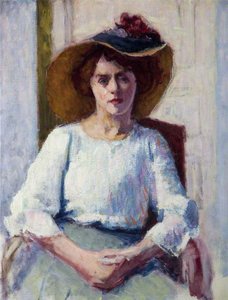
Portrait of Roderic O'Conor

The 38 Most Famous Roderic O'Conor Paintings, Each One of a Kind

Updated November 2026 · ranked by our popularity score (searches, visits and orders for each work) · 38 works by Roderic O'Conor in our catalogue

In short

Yellow Landscape (1892) is the Roderic O'Conor painting that draws the most eyes; the original belongs to the Tate Gallery, London. After it, the eye goes to Rest (1904) and La Jeune Bretonne (1895). Among the 38 works of Roderic O'Conor in our catalog, these 38 are the most famous, each a unique original presented with its year, its museum and the reason it endures.

1860 – 1940, Castleknock Post-impressionism Most works: National Gallery of Ireland

Top 10 paintings by Roderic O'Conor, through the gallery's eye

1
Yellow Landscape (1892) by Roderic O'Conor

Yellow Landscape

1892 · Oil On Canvas · Tate Gallery, London

To stand before this depiction of a rolling hillside is to step into a moment suspended between dream and vibrant reality. Yellow Landscape, painted in 1892 by Roderic O'Conor, is not merely a view; it is an orchestrated experience of light filtered through the meticulous discipline of color theory. The scene unfolds with a profound sense of pastoral tranquility, capturing the essence of rural life under what appears to be…

2
Rest (1904) by Roderic O'Conor

Rest

1904 · Oil On Canvas · Hermitage Museum, Saint Petersburg

In this oil on canvas, titled Rest, we encounter a quiet moment captured by the Irish artist Roderic O'Conor. The work dates to about 1904 or 1905, a period when the artist was refining his unique approach to form and color. It is a painting that invites a closer, more personal inspection of its surface and the stillness it portrays.

3
La Jeune Bretonne (1895) by Roderic O'Conor

La Jeune Bretonne

1895 · Oil On Canvas · National Gallery of Ireland, Dublin City

In 1895, Roderic O'Conor turned his gaze toward a young Breton woman, capturing her in a medium close-up that begins at the waist. This portrait, titled La Jeune Bretonne, presents the subject in profile. She is a solitary figure set against a luminous, textured backdrop of pale yellows and creams. A bright red shawl rests against her dark garment, creating a sharp point of focus amidst the soft, painterly lines…

4
Bretonne (1903) by Roderic O'Conor

Bretonne

1903 · Oil On Canvas · National Gallery of Ireland, Dublin City

The portrait titled Bretonne is a work by the Irish painter Roderic O'Conor. Created about 1903, the painting captures a Breton woman in a moment of quietude. The subject is presented in a medium close-up, her presence defined by the weight of her gaze and the stillness of her posture.

5
Self-Portrait (1903) by Roderic O'Conor

Self-Portrait

1903 · Oil On Canvas · National Gallery of Ireland, Dublin City

This work is a Self-Portrait by the Irish painter Roderic O'Conor. Created about 1903, the oil on canvas depicts the artist himself. O'Conor was born in 1860, making him a middle-aged man at the time this portrait was rendered.

6
Landscape (1895) by Roderic O'Conor

Landscape

1895 · Oil On Canvas · Tate Gallery, London

To gaze upon this landscape by Roderic O'Conor is to step across the threshold of time and into a moment suspended in perfect, aqueous calm. Painted in 1895, this work captures more than mere scenery; it encapsulates a profound sense of pastoral repose. The composition draws the eye along the gentle curve of the river, a liquid ribbon mirroring the soft light of an idealized day. On the left bank,…

7
Iris (1913) by Roderic O'Conor

Iris

1913 · Oil On Canvas · Tate Gallery, London

To gaze upon Roderic O'Conor's "Iris" is to step into a sun-drenched moment suspended in time. This painting captures the ephemeral beauty of purple irises, rendered with a delicate yet confident hand. The composition centers around a magnificent arrangement, where three primary blooms command attention, each boasting a unique shade of regal purple—one deep and saturated, others whispering in lighter hues. These central beauties are complemented by smaller, supporting vases…

8
Seated Breton woman (1893) by Roderic O'Conor

Seated Breton woman

1893 · Acrylic On Canvas · Musée de Pont-Aven, Hastenparck

This exquisite hand-painted reproduction captures the quiet dignity and enigmatic charm of Roderic O’Conor’s “Seated Breton Woman,” a remarkably intimate study created in 1893. Measuring 28 x 23 cm, this artwork transcends a simple depiction of a seated woman; it's a poignant meditation on identity, solitude, and the subtle beauty found within everyday moments. O’Conor, a pivotal figure in the Irish Revival movement, masterfully employed his signature style – characterized…

Roderic O'Conor's famous paintings, numbers 11 to 38

The subjects that held Roderic O'Conor's eye

The four subjects that come back most often in these originals, each with its finest example.

The museums that keep Roderic O'Conor's originals

The 8 museums that hold the most of the paintings on this page.

Museum City Works by Roderic O'Conor Paintings from this list
National Gallery of Ireland, Dublin CityNational Gallery of Ireland Dublin City 10 La Jeune Bretonne, Bretonne, Self-Portrait
Tate Gallery, LondonTate Gallery London 5 Yellow Landscape, Landscape, Iris
Musée de Pont-Aven, HastenparckMusée de Pont-Aven Hastenparck 3 Seated Breton woman, Peasant woman and her cow, Tree landscape
Hermitage Museum, Saint PetersburgHermitage Museum Saint Petersburg 1 Rest
Auckland Art Gallery Toi o Tāmaki, AucklandAuckland Art Gallery Toi o Tāmaki Auckland 1 La Ferme (The Farm)
MOMA - Museum of Modern Art, New York CityMOMA - Museum of Modern Art New York City 1 Glade
Scottish National Gallery of Modern Art, EdinburghScottish National Gallery of Modern Art Edinburgh 1 The Balustrade
Te Papa, WellingtonTe Papa Wellington 1 Mixed flowers on pink cloth

Roderic O'Conor across the decades: one unique original for each

Works per decade

Pick a decade to see the original that defines it.

Roderic O'Conor's paintings: questions for the gallery

What is the single most famous work of Roderic O'Conor?Reveal the answer

Yellow Landscape (1892), Tate Gallery, London. Rest (1904) and La Jeune Bretonne (1895) come next.

At what age did Roderic O'Conor create Yellow Landscape?Reveal the answer

32 years old: Yellow Landscape dates from 1892, and Roderic O'Conor was born in 1860.

Which ten paintings by Roderic O'Conor are the most famous?Reveal the answer

Yellow Landscape, Rest, La Jeune Bretonne, Bretonne, Self-Portrait, Landscape, Iris, Seated Breton woman, La Ferme (The Farm) and Glade. The ranking above gives each one's year and museum.

How many works by Roderic O'Conor are known?Reveal the answer

Our catalog holds 38 works by Roderic O'Conor, dated from 1892 to 1923.

Where can the most famous Roderic O'Conor originals be seen?Reveal the answer

Mostly in National Gallery of Ireland (Dublin City), Tate Gallery (London) and Musée de Pont-Aven (Hastenparck). The museum table above lists them all.

During which period did Roderic O'Conor create the best-known paintings?Reveal the answer

In 1890s: 16 of the 38 works on this page were made then, Yellow Landscape among them.

Which famous Roderic O'Conor painting is the earliest, and which the latest?Reveal the answer

On this page, the earliest is Yellow Landscape (1892) and the latest Self Portrait (1923).

What subjects did Roderic O'Conor favour?Reveal the answer

Landscape (4), Woman (4) and Tranquility (3), across the 38 works on this page.

What materials did Roderic O'Conor paint with most?Reveal the answer

Oil On Canvas, for 10 of the 38 works on this page.

Which movement does the work of Roderic O'Conor belong to?Reveal the answer

Post-impressionism and Impressionism, judging by the originals on this page.

What Roderic O'Conor originals can I see at the National Gallery of Ireland?Reveal the answer

La Jeune Bretonne, Bretonne and Self-Portrait: the National Gallery of Ireland, Dublin City holds 10 of the works on this page.

Roderic O'Conor: a portrait of the artist

A Life Immersed in Color and Light: The World of Roderic O'Conor

Roderic O’Conor, born October 17, 1860, in Milltown, County Roscommon, Ireland, was a painter who navigated the shifting currents of late 19th and early 20th-century art with a quiet determination. Descended from the kings of Connacht, his lineage hinted at a certain inherent nobility, yet it was not through inherited titles but through dedicated artistic pursuit that O’Conor carved his place in history. His father, Roderic Joseph O'Conor, a barrister and high sheriff, provided a stable upbringing and an education—first at Ampleforth College in Yorkshire, where he demonstrated academic prowess—that laid the foundation for a life of intellectual curiosity. This early exposure to rigorous learning would subtly inform his artistic approach, even as he embraced the more intuitive realms of color and form. Subsequent studies at the Metropolitan School of Art and the Royal Hibernian Academy in Dublin provided formal training, but it was his journey to Antwerp under Charles Verlat that truly ignited his passion and set him on a path toward Paris, the epicenter of artistic innovation.

Paris, Pont-Aven, and the Embrace of Modernity

The year 1883 marked a pivotal moment: O’Conor's relocation to Paris. He arrived in a city brimming with new ideas, where Impressionism was challenging traditional academic painting. While he absorbed the lessons of Monet, Renoir, and Degas—the emphasis on capturing fleeting moments of light and atmosphere—he wasn’t content merely to replicate their style. A deeper transformation awaited him in Brittany, specifically at Pont-Aven during the 1890s. This artistic community, a haven for those seeking alternatives to Parisian conventions, proved crucial to his development. It was here that he forged a profound friendship with Paul Gauguin, an encounter that would irrevocably alter his artistic trajectory. Gauguin’s bold use of color, flattened forms, and symbolic imagery resonated deeply with O'Conor, encouraging him to move beyond the purely optical concerns of Impressionism. The influence of Van Gogh, also present in the Pont-Aven circle, further fueled this exploration of expressive brushwork and emotional intensity. He began to experiment with textured surfaces and contrasting hues, building layers of paint that conveyed not just what he *saw*, but how he *felt*.

The Evolution of a Post-Impressionist Vision

O’Conor's work is firmly situated within the realm of Post-Impressionism, a movement characterized by its subjective interpretation of reality. He wasn’t interested in simply mirroring nature; instead, he sought to convey his personal response to it. His paintings are immediately recognizable for their vibrant color palettes—often featuring bold reds, yellows, and blues—and their dynamic brushwork. Early works still bear the imprint of Impressionistic techniques, but they gradually evolve into a more individual style incorporating elements of Pointillism and expressive mark-making. Initially, his subject matter centered on Breton life – peasants, landscapes, and scenes of rural existence. However, as he matured, his focus shifted towards nudes, female figures, portraits, and still lifes. These later works reveal a growing interest in formal concerns—the interplay of light and shadow, the arrangement of shapes, and the expressive potential of paint itself. Yellow Landscape (1892), La Jeune Bretonne (1895), Mixed Flowers on Pink Cloth (circa 1916), and Landscape, Cassis (1913) stand as testaments to this artistic evolution.

Recognition and Legacy

Despite his significant contributions to the development of Post-Impressionism, O’Conor remained largely unrecognized in Ireland and Britain during his lifetime. He exhibited at the Paris Salon and the Salon des Indépendants, gaining some recognition within Parisian art circles, but widespread acclaim eluded him. It wasn't until after his death on March 18, 1940, in Nueil-sur-Layon, France, that his work began to receive the attention it deserved. The posthumous sale of Landscape, Cassis for £337,250 in 2011 served as a dramatic confirmation of his artistic value and enduring appeal. Today, Roderic O’Conor is celebrated as a pioneer of Post-Impressionism among English-speaking artists—a bridge between the traditions of Irish painting and the innovations of the European avant-garde. His association with prominent figures like Somerset Maugham, Gerald Kelly, and Aleister Crowley further underscores his involvement in the vibrant intellectual life of Paris. He was a man who lived fully within the artistic currents of his time, leaving behind a body of work that continues to captivate and inspire.

A Lasting Influence

O’Conor's legacy extends beyond his individual paintings. He demonstrated an ability to synthesize diverse influences—Impressionism, Pointillism, the lessons of Gauguin and Van Gogh—into a uniquely personal style. His willingness to experiment with color, texture, and form paved the way for future generations of artists. While he may not be as widely known as some of his contemporaries, Roderic O’Conor occupies a vital position in the history of modern art, representing a crucial link between the artistic traditions of Ireland and the revolutionary movements that transformed painting in Europe. His life serves as a reminder that true artistic innovation often requires courage, independence, and an unwavering commitment to one's own vision.