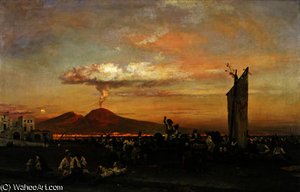
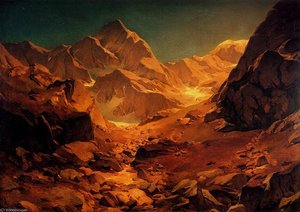
Portrait of Oswald Achenbach

The 57 Most Famous Oswald Achenbach Paintings, a Gallery Selection

Updated November 2026 · ranked by our popularity score (searches, visits and orders for each work) · 60 works by Oswald Achenbach in our catalogue

In short

Of all the originals Oswald Achenbach left, the most famous is View of Capri (1884), in the collection of the Von der Heydt Museum, Wuppertal. Close behind it come Landscape at Posilipp (1887) and Venice, a view of the Piazzetta, with the Biblioteca Marciana, Santa Maria della Salute and the Dogana (1905). Our catalog holds 60 works by Oswald Achenbach; the gallery has kept the 57 the world admires most, each shown with its date, its museum and its story.

1827 – 1905, Düsseldorf Romanticism Most works: Bavarian State Painting Collections

Oswald Achenbach's top 10 paintings: the gallery's choice

1
View of Capri (1884) by Oswald Achenbach

View of Capri

1884 · Oil On Canvas · Von der Heydt Museum, Wuppertal

In "View of Capri" by Oswald Achenbach, the rugged coastline of Capri unfolds under a soft, atmospheric light. The scene captures a coastal view where the land meets the sea in a quiet, dramatic encounter. Created about 1884, the work presents a landscape that feels alive with the warmth of a low sun, perhaps at the break of day or the close of evening. The light casts a gentle glow…

2
Landscape at Posilipp (1887) by Oswald Achenbach

Landscape at Posilipp

1887 · Black and White Photography · Bavarian State Painting Collections, Munich

In "Landscape at Posilipp" by Oswald Achenbach, the eye is drawn to a steep, sloped roof under renovation. The perspective is held from an elevated position, looking down upon the immediate work site. Several men move across the rooftop, engaged in the heavy, rhythmic labor of construction and architectural maintenance. Their presence grounds the scene in a moment of manual toil, likely within a rural or semi-rural setting. The composition…

3
Venice, a view of the Piazzetta, with the Biblioteca Marciana, Santa Maria della Salute and the Dogana (1905) by Oswald Achenbach

Venice, a view of the Piazzetta, with the Biblioteca Marciana, Santa Maria della Salute and the Dogana

1905 · Oil On Canvas

In Venice, a view of the Piazzetta, with the Biblioteca Marciana, Santa Maria della Salute and the Dogana, Oswald Achenbach captures a wide-angle perspective of the Venetian urban environment. Painted about 1905, the scene presents a panoramic view of the Piazzetta. The scale of the city unfolds through the presence of numerous figures and the rhythmic movement of gondolas and boats upon the water. It is a moment of daily…

4
Norwegian Landscape with Sawmill (1839) by Oswald Achenbach

Norwegian Landscape with Sawmill

1839 · Acrylic On Canvas · Staatliche Kunsthalle Karlsruhe, Carlsruhe

Oswald Achenbach’s Norwegian Landscape with Sawmill transports the viewer to a place suspended in time—a quintessential vision of Norwegian life carved out by the gentle persistence of nature. The scene unfolds with breathtaking realism, dominated by the rhythmic flow of a river that carves its path through verdant banks. It is more than just a depiction of scenery; it is an immersion into a pastoral idyll where human industry coexists…

5
Park of an Italian Villa (1860) by Oswald Achenbach

Park of an Italian Villa

1860 · Oil On Canvas · Bavarian State Painting Collections, Munich

In Oswald Achenbach's Park of an Italian Villa, a sense of profound grandeur and enclosure settles over the viewer. Massive, towering trees dominate the upper two-thirds of the canvas, their heavy canopies reaching upward to frame the scene. This verticality creates a sheltered sanctuary, a private world tucked away within a lush Italian landscape. The composition relies on a careful layering of trees, stretching from the immediate foreground into the…

6
Market Square of Amalfi (1876) by Oswald Achenbach

Market Square of Amalfi

1876 · Oil On Canvas · Alte Nationalgalerie, Berlin

Market Square of Amalfi is a landscape oil painting by Oswald Achenbach. Created in 1876, this work captures a specific moment in the life of a Mediterranean setting. The scene focuses on a market square located in Amalfi, situated along the Gulf of Salerno, near Naples, Italy.

8
Fireworks in Naples (1875) by Oswald Achenbach

Fireworks in Naples

1875 · Oil On Canvas · Hermitage Museum, Saint Petersburg

In this 1875 oil on canvas, we encounter Fireworks in Naples, a work by the German landscape painter Oswald Achenbach. The scene captures a nocturnal celebration, focusing on the dramatic interplay between the dark coastal atmosphere and the sudden bursts of light over the water. It is a piece that reflects the artist's deep interest in the shifting states of nature and the way light interacts with the environment.

9
Market Day in an Italian Town (1887) by Oswald Achenbach

Market Day in an Italian Town

1887 · Oil On Canvas · Rijksmuseum, Amsterdam

The scene unfolds in Market Day in an Italian Town, a work that captures a bustling moment of commerce and community. This oil painting is the creation of Oswald Achenbach, an artist who brought the spirit of the Düsseldorf school to the sun-drenched landscapes of the south. He was born in Düsseldorf, Germany, in 1827 and continued to observe the world through his brush until his passing in 1905. In…

The Oswald Achenbach selection continues, 11 to 57

11italian landscape (1853) by Oswald Achenbachitalian landscape1853 · National Museum of Art, Architecture and Design 12Evening (1852) by Oswald AchenbachEvening1852 · Royal Collection 13Morning (1852) by Oswald AchenbachMorning1852 · Royal Collection 14Roman landscape (1852) by Oswald AchenbachRoman landscape1852 15Landscape : Shepherd with sheeps (1852) by Oswald AchenbachLandscape : Shepherd with sheeps1852 16Naples (1852) by Oswald AchenbachNaples1852 17Scene in the port of Naples (1852) by Oswald AchenbachScene in the port of Naples1852 18Landscape near Pompeii (1863) by Oswald AchenbachLandscape near Pompeii1863 · Staatliche Kunsthalle Karlsruhe 19Garden in a Monastery (1857) by Oswald AchenbachGarden in a Monastery1857 · Hermitage Museum 20Before the Porta Capuana in Naples (1875) by Oswald AchenbachBefore the Porta Capuana in Naples1875 · Bavarian State Painting Collections 21Southern Landscape, Arriccia with Viaduct (with rising moon) (1873) by Oswald AchenbachSouthern Landscape, Arriccia with Viaduct (with rising moon)1873 22beach of maples (1877) by Oswald Achenbachbeach of maples1877 23storm over an Italian landscape (1873) by Oswald Achenbachstorm over an Italian landscape1873 24Montain-scenery with figures (1873) by Oswald AchenbachMontain-scenery with figures1873 25Landscape park with ladys by fountain (1881) by Oswald AchenbachLandscape park with ladys by fountain1881 26Italien church in the moonlight + figures (1882) by Oswald AchenbachItalien church in the moonlight + figures1882 27Nighttime Festival near Florenz (1889) by Oswald AchenbachNighttime Festival near Florenz1889 · Alte Nationalgalerie 28Constantine's Triumphal Arch in Rome (1886) by Oswald AchenbachConstantine's Triumphal Arch in Rome1886 · Alte Nationalgalerie 29lake Nemi with view on Castel Gandolfo and the Campagna (1887) by Oswald Achenbachlake Nemi with view on Castel Gandolfo and the Campagna1887 30Golf of Naples with rainbow (1891) by Oswald AchenbachGolf of Naples with rainbow1891 31At Lake Nemi (1890) by Oswald AchenbachAt Lake Nemi1890 · Reading Public Museum 32Ruins Landscape with Shepherds around a Campfire (1893) by Oswald AchenbachRuins Landscape with Shepherds around a Campfire1893 33Southern Park Landscape with Folk Scene (1899) by Oswald AchenbachSouthern Park Landscape with Folk Scene1899 34Italian scenery near Sorrent by Oswald AchenbachItalian scenery near Sorrent 35Quayside at Naples by Oswald AchenbachQuayside at Naples 36The bay of naples by Oswald AchenbachThe bay of naples 37LE MOLE DE NAPLES by Oswald AchenbachLE MOLE DE NAPLESMusée d'Orsay 38UNE FETE A GENAZZANO by Oswald AchenbachUNE FETE A GENAZZANO 39DANS LES ABRUZZES by Oswald AchenbachDANS LES ABRUZZESCondé Museum 40Funeral in Palestrina (1857) by Oswald AchenbachFuneral in Palestrina1857 · Kunstpalast 41Fireworks at Torre dell Annunziata in Naples by Oswald AchenbachFireworks at Torre dell Annunziata in Naples 42Roman Landscape by Oswald AchenbachRoman LandscapeMusée Des Beaux 43Everning- landscape with windmill by Oswald AchenbachEverning- landscape with windmill 44Italian landscape + town and people by Oswald AchenbachItalian landscape + town and people 45Southern Landscape with the sea in distance and figures by Oswald AchenbachSouthern Landscape with the sea in distance and figures 46Highway in an Oakwood near Albano by Oswald AchenbachHighway in an Oakwood near Albano 47Campo Santo in Poggioreale, the Vesuvius Beyond by Oswald AchenbachCampo Santo in Poggioreale, the Vesuvius Beyond 48Ischia - by Oswald AchenbachIschia - 49Entering the Grotto by Oswald AchenbachEntering the Grotto 50Moonlit Scene of the Bay of Naples by Oswald AchenbachMoonlit Scene of the Bay of Naples 51Castel Sant' Angelo at Dusk by Oswald AchenbachCastel Sant' Angelo at Dusk 52Sunset on the Shore by Oswald AchenbachSunset on the Shore 53Clearing Thunderstorm in the Countryside by Oswald AchenbachClearing Thunderstorm in the Countryside 54Fishermen with the bay of naples and vesuvius beyond by Oswald AchenbachFishermen with the bay of naples and vesuvius beyond 55San Pietro in Vincoli by Oswald AchenbachSan Pietro in Vincoli 56A mountainous landscape by Oswald AchenbachA mountainous landscape 57In the Park of the Villa Borghese (1886) by Oswald AchenbachIn the Park of the Villa Borghese1886 · Kunstpalast

The subjects that held Oswald Achenbach's eye

The four subjects that come back most often in these originals, each with its finest example.

The museums that keep Oswald Achenbach's originals

The 8 museums that hold the most of the paintings on this page.

Museum City Works by Oswald Achenbach Paintings from this list
Bavarian State Painting Collections, MunichBavarian State Painting Collections Munich 3 Landscape at Posilipp, Park of an Italian Villa, Before the Porta Capuana in Naples
Alte Nationalgalerie, BerlinAlte Nationalgalerie Berlin 3 Market Square of Amalfi, Nighttime Festival near Florenz, Constantine's Triumphal Arch in Rome
Staatliche Kunsthalle Karlsruhe, CarlsruheStaatliche Kunsthalle Karlsruhe Carlsruhe 2 Norwegian Landscape with Sawmill, Landscape near Pompeii
Hermitage Museum, Saint PetersburgHermitage Museum Saint Petersburg 2 Fireworks in Naples, Garden in a Monastery
Royal Collection, LondonRoyal Collection London 2 Evening, Morning
Kunstpalast, DuesseldorfKunstpalast Duesseldorf 2 Funeral in Palestrina, In the Park of the Villa Borghese
Von der Heydt Museum, WuppertalVon der Heydt Museum Wuppertal 1 View of Capri
Rijksmuseum, AmsterdamRijksmuseum Amsterdam 1 Market Day in an Italian Town

Oswald Achenbach decade by decade: the original that defines each

Works per decade

Pick a decade to see the original that defines it.

Collectors' questions about Oswald Achenbach's paintings

Which work is Oswald Achenbach most famous for?Reveal the answer

View of Capri (1884), Von der Heydt Museum, Wuppertal. Landscape at Posilipp (1887) and Venice, a view of the Piazzetta, with the Biblioteca Marciana, Santa Maria della Salute and the Dogana (1905) come next.

What age was Oswald Achenbach when View of Capri was made?Reveal the answer

57 years old: View of Capri dates from 1884, and Oswald Achenbach was born in 1827.

What are the ten most famous Oswald Achenbach paintings?Reveal the answer

View of Capri, Landscape at Posilipp, Venice, a view of the Piazzetta, with the Biblioteca Marciana, Santa Maria della Salute and the Dogana, Norwegian Landscape with Sawmill, Park of an Italian Villa, Market Square of Amalfi, Festival Of Our Lady At Gennazzano, Roman, Fireworks in Naples, Market Day in an Italian Town and Study of the summits of northern Italy. The ranking above gives each one's year and museum.

How many paintings did Oswald Achenbach leave?Reveal the answer

Our catalog holds 60 works by Oswald Achenbach, dated from 1839 to 1905.

In which museums do Oswald Achenbach's masterpieces hang?Reveal the answer

Mostly in Bavarian State Painting Collections (Munich), Alte Nationalgalerie (Berlin) and Staatliche Kunsthalle Karlsruhe (Carlsruhe). The museum table above lists them all.

In which years did Oswald Achenbach paint the most famous works?Reveal the answer

In 1850s: 9 of the 57 works on this page were made then, italian landscape among them.

What are the first and the last famous originals of Oswald Achenbach?Reveal the answer

On this page, the earliest is Norwegian Landscape with Sawmill (1839) and the latest Venice, a view of the Piazzetta, with the Biblioteca Marciana, Santa Maria della Salute and the Dogana (1905).

Which subjects did Oswald Achenbach choose most often?Reveal the answer

People (5), Figures (4) and Architecture (4), across the 57 works on this page.

Which technique did Oswald Achenbach use most?Reveal the answer

Oil On Canvas, for 8 of the 57 works on this page.

To which art movement does Oswald Achenbach belong?Reveal the answer

Romanticism, judging by the originals on this page.

Which Oswald Achenbach works hang at the Bavarian State Painting Collections?Reveal the answer

Landscape at Posilipp, Park of an Italian Villa and Before the Porta Capuana in Naples: the Bavarian State Painting Collections, Munich holds 3 of the works on this page.

Oswald Achenbach: life and work

A Life Immersed in Landscape: The World of Oswald Achenbach

Oswald Achenbach, a name perhaps less immediately recognized today than some of his contemporaries, nevertheless occupied a prominent position within the 19th-century European art landscape. Born in Düsseldorf in 1827 and passing in 1905, Achenbach’s life was deeply interwoven with the artistic currents of the Düsseldorf School, a movement renowned for its dedication to realistic depictions of nature and atmospheric effects. He wasn't merely a painter of landscapes; he was an interpreter of light, color, and emotion within those scenes, particularly captivated by the allure of Italy. His story is one of both academic grounding and rebellious spirit, of familial artistic influence and individual stylistic evolution. Achenbach’s legacy extends beyond his canvases, influencing generations through his teaching at the prestigious Kunstakademie Düsseldorf. He and his brother, Andreas, were affectionately dubbed “the A and O of landscapes,” a testament to their combined dominance in the field—a playful nod to their initials mirroring the symbolic beginning and end.

Early Influences and Artistic Formation

Achenbach’s path toward becoming a celebrated landscape artist wasn't predetermined by family tradition, though his brother Andreas would also achieve significant recognition. His father navigated various professions—brewer, guesthouse owner, bookkeeper—offering little indication of the artistic prominence to come. The family’s movements between Munich and Düsseldorf during Oswald’s childhood likely instilled in him a sense of place and observation, qualities that would later define his work. Remarkably, Achenbach entered the elementary class of the Kunstakademie Düsseldorf at the tender age of eight, circumventing the academy's usual age requirements—a clear indication of his precocious talent. His initial studies focused on foundational drawing skills and a brief foray into architecture, but it was his departure from formal instruction around 1841 that proved pivotal. This decision allowed him to immerse himself directly in nature, undertaking intensive independent study of the landscapes surrounding Düsseldorf. These early explorations laid the groundwork for his future artistic endeavors.

The Italian Awakening and Developing Style

A turning point in Achenbach’s artistic journey arrived with his travels throughout Bavaria and Tyrol in 1843, followed by a transformative trip to northern Italy with friend Albert Flamm in 1845. These experiences ignited a lifelong passion for Italian landscapes, which would become a recurring theme throughout his oeuvre. His early paintings from this period, while demonstrating technical skill, initially reflected the influence of established artists like Johann Wilhelm Schirmer and Carl Rottmann—adhering to academic principles with detailed depictions of vegetation. However, Achenbach soon began to forge his own path, moving away from rigid adherence to convention. He developed a distinctive style characterized by an emphasis on atmospheric effects, vibrant color palettes, and a prioritization of capturing the *impression* of light rather than meticulous detail. This shift marked a departure toward a more emotive and subjective interpretation of nature.

Challenging Conventions and Artistic Independence

Like many artists of his era, Achenbach found himself at odds with the rigid constraints of the Kunstakademie Düsseldorf. He actively sought alternative avenues for artistic expression, becoming an early member of two influential Düsseldorf associations: the “Association of Düsseldorf Artists for Mutual Support and Help” and the “Malkasten” (paintbox), founded in 1848. These groups provided a vital platform for artists operating outside the academy’s control, fostering collaboration through exhibitions, theatrical performances, and musical events. Achenbach's active participation demonstrated his commitment to an independent artistic community—a space where innovation could flourish free from institutional constraints. His career gained significant momentum with exhibitions at Eduard Schulte's Düsseldorf gallery from 1850 onwards, a crucial venue for showcasing work that challenged the established norms. Further travels, including a particularly impactful trip to Italy in 1850 alongside Arnold Böcklin and others, solidified his artistic vision. He focused on capturing color impressions and light effects through layered paint application, prioritizing atmosphere over precise representation.

Legacy and Lasting Influence

Achenbach’s mature work is celebrated for its ability to evoke emotion and atmosphere through masterful use of color and light. His depictions of Italian landscapes—the Bay of Naples, Roman scenes, and Venetian vistas—are particularly renowned. He became known for his vibrant canvases that captured the essence of these locations, imbuing them with a sense of warmth, serenity, and dramatic beauty. From 1863 to 1872, Achenbach served as a professor at the Düsseldorf Art Academy, passing on his knowledge and influencing subsequent generations of artists. While his fame may have waned somewhat over time, Oswald Achenbach’s contribution to 19th-century landscape painting remains significant. He stands as a testament to the power of artistic independence, the allure of Italian light, and the enduring appeal of capturing the beauty and emotion inherent in the natural world. His works continue to resonate with viewers today, offering a glimpse into a bygone era and a celebration of the timeless artistry of landscape painting. He truly captured the soul of the landscapes he painted.