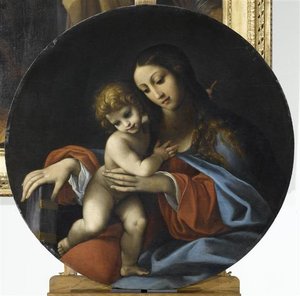
Portrait of Ludovico Carracci

The 67 Most Famous Ludovico Carracci Paintings, Each One of a Kind

Updated October 2026 · ranked by our popularity score (searches, visits and orders for each work) · 67 works by Ludovico Carracci in our catalogue

In short

The Dream of Saint Catherine of Alexandria (1593) is the Ludovico Carracci painting that draws the most eyes; the original belongs to the National Gallery of Art, Washington. After it, the eye goes to Madonna and Child with Saints (1607) and The Lamentation (1582). Among the 67 works of Ludovico Carracci in our catalog, these 67 are the most famous, each a unique original presented with its year, its museum and the reason it endures.

1555 – 1619, Bologna Baroque Most works: Bavarian State Painting Collections

Top 10 paintings by Ludovico Carracci, through the gallery's eye

1
The Dream of Saint Catherine of Alexandria (1593) by Ludovico Carracci

The Dream of Saint Catherine of Alexandria

1593 · Oil On Canvas · National Gallery of Art, Washington

To gaze upon this depiction of The Dream of Saint Catherine of Alexandria is to step directly into the heart of Baroque devotion. It is an artwork that does not merely hang on a wall; it envelops the viewer in a palpable atmosphere of sacred serenity and profound familial love. The composition immediately draws the eye into a pyramidal embrace, centering the Virgin Mary with the infant Jesus at its…

2
Madonna and Child with Saints (1607) by Ludovico Carracci

Madonna and Child with Saints

1607 · Oil On Copper · Metropolitan Museum of Art, New York

To gaze upon this depiction of the Madonna and Child with Saints is to step directly into the heart of Bologna's artistic fervor during the early seventeenth century. Ludovico Carracci, a master whose hand guided art through a period of profound transition, has gifted us a scene that is both deeply devotional and exquisitely sophisticated. The composition immediately draws the eye into a moment suspended between earthly celebration and heavenly…

3
The Lamentation (1582) by Ludovico Carracci

The Lamentation

1582 · Oil On Canvas · Metropolitan Museum of Art, New York

To stand before The Lamentation by Ludovico Carracci is to be enveloped in an atmosphere so thick with palpable sorrow that it feels almost breathable. This is not the polished, idealized grief often depicted in later art; rather, it is a raw, visceral outpouring of human emotion captured at its most agonizing peak. The scene presents a profound tableau of loss, centering on figures whose poses and expressions reject classical…

4
The Dream of Saint Catherine of Alexandria (detail) (1593) by Ludovico Carracci

The Dream of Saint Catherine of Alexandria (detail)

1593 · Oil On Canvas · National Gallery of Art, Washington

To gaze upon this detail from Ludovico Carracci’s The Dream of Saint Catherine of Alexandria is to step directly into the heart of the Bolognese Baroque—a moment where profound spirituality met breathtaking artistic realism. The scene unfolds with an almost palpable sense of devotion, capturing a sacred narrative rich with human emotion and divine mystery. At its core, we find Mary cradling the infant Jesus, their forms rendered with a…

5
An Angel Frees the Souls of Purgatory (1610) by Ludovico Carracci

An Angel Frees the Souls of Purgatory

1610 · Oil · Vatican Pinacoteca, Vatican City

Completed in 1610, this work reflects the religious fervor of the Counter-Reformation. As the Catholic Church sought to reaffirm its doctrines against Protestant critiques, artists in Bologna moved away from the artificiality of Mannerism toward a more visceral, emotive naturalism. This piece likely originated as a sketch for an altarpiece within the Carracci workshop. It captures a pivotal theological moment: the transition of souls from the state of purification to…

6
The Trinity with the Dead Christ (1590) by Ludovico Carracci

The Trinity with the Dead Christ

1590 · Oil On Canvas · Vatican Pinacoteca, Vatican City

A Dramatic Testament of Faith: Ludovico Carracci’s “The Trinity with the Dead Christ” Ludovico Carracci's "The Trinity with the Dead Christ," painted around 1590, stands as a monumental achievement in Bolognese Baroque art—a testament to its profound spiritual ambition and masterful execution. More than just a depiction of biblical sorrow, it’s an immersive experience designed to evoke contemplation and convey the sublime beauty inherent within Christian iconography. This artwork immediately…

7
The Transfiguration (1590) by Ludovico Carracci

The Transfiguration

1590 · Oil On Canvas · Scottish National Gallery, Edinburgh

The air seems to thicken with a sudden, celestial weight as Jesus Christ stands at the center of this unfolding miracle. He is not a distant figure of stone, but a presence felt in the very movement of his outstretched arms. Light does not merely strike his form; it seems to emanate from within him, carving his silhouette against a world caught in a moment of profound spiritual upheaval. Around…

8
Saint Francis of Assisi in the Portiuncula (1601) by Ludovico Carracci

Saint Francis of Assisi in the Portiuncula

1601 · Oil · Museo del Prado, Madrid

The air in the Portiuncula feels heavy, thick with the scent of damp earth and the weight of a profound, sudden silence. Below, in the dimness of the earthly realm, Saint Francis of Assisi kneels. He is a figure of deep humility, his body pressed toward the ground in a gesture of total surrender. His arms cross over his chest, a physical manifestation of a soul caught in a moment…

9
The Vision of Saint Francis (1602) by Ludovico Carracci

The Vision of Saint Francis

1602 · Oil On Canvas · Art Institute of Chicago, Chicago

The canvas splits into two distinct realms, divided by a diagonal surge of clouds. On the lower left, Saint Francis kneels in the heavy shadows of the earthly plane, his form solid and grounded. Above him, the darkness of the night is pierced by a sudden, divine light. The Virgin Mary and the infant Christ emerge from this celestial glow, surrounded by the soft, rounded shapes of cherubs. A moon…

10
The Agony in the Garden (1590) by Ludovico Carracci

The Agony in the Garden

1590 · Oil On Canvas · Museo del Prado, Madrid

The Agony in the Garden emerges from the shadows of history as a profound oil on canvas by Ludovico Carracci. This specific work, known in collections as Prado P00074, captures a moment of intense spiritual weight. The paint clings to the fabric, holding the tension of a scene that feels as though it is unfolding right before our eyes. It is a work that breathes with the heavy atmosphere of…

Ludovico Carracci's famous paintings, numbers 11 to 67

11The Vision of St Jerome (1594) by Ludovico CarracciThe Vision of St Jerome1594 · Statens Museum For Kunst 12Bacchus and Ariadne (1591) by Ludovico CarracciBacchus and Ariadne1591 13Portrait of a Widow (1585) by Ludovico CarracciPortrait of a Widow1585 · Dayton Art Institute 14St Sebastian (1590) by Ludovico CarracciSt Sebastian1590 · Fitzwilliam Museum 15Portrait of a Young Man (1583) by Ludovico CarracciPortrait of a Young Man1583 · Capitoline Museums 16Saint Francis in Meditation (1580) by Ludovico CarracciSaint Francis in Meditation1580 · Dulwich Picture Gallery 17Sacrifice of Isaac (1586) by Ludovico CarracciSacrifice of Isaac1586 18Holy Family (1600) by Ludovico CarracciHoly Family1600 · Slovak National Gallery 19Annunciation (1603) by Ludovico CarracciAnnunciation1603 · Musei di Strada Nuova 20Allegory of Providence (1604) by Ludovico CarracciAllegory of Providence1604 · Capitoline Museums 21Singing angels (1605) by Ludovico CarracciSinging angels1605 · Museo Cerralbo 22Hercules and the Hydra (1594) by Ludovico CarracciHercules and the Hydra1594 23The Adoration of the Shepherds (1613) by Ludovico CarracciThe Adoration of the Shepherds1613 24Three angels visiting Abraham (1610) by Ludovico CarracciThree angels visiting Abraham1610 · Pinacoteca Nazionale di Bologna 25The Stories of Jason (detail) (1584) by Ludovico CarracciThe Stories of Jason (detail)1584 · Palazzo Fava 26The Virgin Appearing to St Hyacinth (1594) by Ludovico CarracciThe Virgin Appearing to St Hyacinth1594 · The Louvre 27Ludovico ) (1555) by Ludovico CarracciLudovico )1555 28Male Nude (Hercules ?) (1588) by Ludovico CarracciMale Nude (Hercules ?)1588 · Kunstpalast 29The Agony in the Garden (1590) by Ludovico CarracciThe Agony in the Garden1590 · National Gallery 30The Marriage of the Virgin (1590) by Ludovico CarracciThe Marriage of the Virgin1590 · National Gallery 31Portrait of Carlo Alberto Rati Opizzoni in Armour (1597) by Ludovico CarracciPortrait of Carlo Alberto Rati Opizzoni in Armour1597 32Christ in the Wilderness, Served by Angels (1608) by Ludovico CarracciChrist in the Wilderness, Served by Angels1608 · Gemäldegalerie 33The Martyrdom of St Margaret (1616) by Ludovico CarracciThe Martyrdom of St Margaret1616 34Susannah and the Elders (1616) by Ludovico CarracciSusannah and the Elders1616 35Annunciation (1616) by Ludovico CarracciAnnunciation1616 · Kunstpalast 36The Denial of Saint Peter (1616) by Ludovico CarracciThe Denial of Saint Peter1616 · Metropolitan Museum of Art 37The Dream of Saint Catherine of Alexandria (1593) by Ludovico CarracciThe Dream of Saint Catherine of Alexandria1593 38Bargellini Madonna (1588) by Ludovico CarracciBargellini Madonna1588 · Pinacoteca Nazionale 39Saint Francis by Ludovico CarracciSaint FrancisBavarian State Painting Collections 40Presentation in the Temple (1605) by Ludovico CarracciPresentation in the Temple1605 · Thyssen-Bornemisza Museum 41Preaching of John the Baptist by Ludovico CarracciPreaching of John the BaptistBavarian State Painting Collections 42Portrait of a Young Man by Ludovico CarracciPortrait of a Young ManBavarian State Painting Collections 43Saint Francis Seraphic by Ludovico CarracciSaint Francis SeraphicBavarian State Painting Collections 44Entombment of Christ by Ludovico CarracciEntombment of ChristBavarian State Painting Collections 45The Agony in the Garden of Gethsemane by Ludovico CarracciThe Agony in the Garden of Gethsemane 46St. John the Baptist at the Fontain by Ludovico CarracciSt. John the Baptist at the FontainMusée Fesch 47Saint Mary Magdalene by Ludovico CarracciSaint Mary MagdaleneNational Museum of Fine Arts 48Antonio The Rape of Europa by Ludovico CarracciAntonio The Rape of EuropaPinacoteca Nazionale di Bologna 49Le martyre de saint Pierre et saint Paul by Ludovico CarracciLe martyre de saint Pierre et saint Paul 50LE BAPTEME DE JESUS by Ludovico CarracciLE BAPTEME DE JESUSMuseum of Fine Arts of Lyon 51The Baptism of Christ by Ludovico CarracciThe Baptism of ChristBavarian State Painting Collections 52Christ Served by Angels in the Wilderness (1608) by Ludovico CarracciChrist Served by Angels in the Wilderness1608 · Staatliche Museen zu Berlin 53The Vision of Saint Francis of Assisi, Ludovico Carracci, 1583 - 1585 (1585) by Ludovico CarracciThe Vision of Saint Francis of Assisi, Ludovico Carracci, 1583 - 15851585 54Madonna Enthroned, with the Child, St John, the Archangel Michael, St Francis, St Lucia, St Joseph (1616) by Ludovico CarracciMadonna Enthroned, with the Child, St John, the Archangel Michael, St Francis, St Lucia, St Joseph1616 · Royal Łazienki Museum 55L'apparition de la Vierge et de l'enfant Jésus à saint Hyacinthe by Ludovico CarracciL'apparition de la Vierge et de l'enfant Jésus à saint HyacintheThe Louvre 56Antonio Landscape with Bathers by Ludovico CarracciAntonio Landscape with Bathers 57The Vision of Saint Francis by Ludovico CarracciThe Vision of Saint Francis 58L'Adoration des bergers La Nativité de Jésus Christ by Ludovico CarracciL'Adoration des bergers La Nativité de Jésus Christ 59Susannah and the Elders by Ludovico CarracciSusannah and the EldersNational Gallery 60The Marriage of the Virgin by Ludovico CarracciThe Marriage of the Virgin 61The Assumption of the Virgin by Ludovico CarracciThe Assumption of the Virgin 62Orlando Delivering Olympia from the Sea Monster by Ludovico CarracciOrlando Delivering Olympia from the Sea MonsterNational Trust 63La Vierge à l'enfant by Ludovico CarracciLa Vierge à l'enfantThe Louvre 64St. Sebastian Thrown into the Cloaca Maxima (1612) by Ludovico CarracciSt. Sebastian Thrown into the Cloaca Maxima1612 · J. Paul Getty Museum 65Chess players (1590) by Ludovico CarracciChess players1590 · Gemäldegalerie 66The Funeral of the Virgin Mary (1605) by Ludovico CarracciThe Funeral of the Virgin Mary1605 · Galleria Nazionale 67La Flagellation by Ludovico CarracciLa FlagellationMusée de la Chartreuse de Douai

The subjects that held Ludovico Carracci's eye

The four subjects that come back most often in these originals, each with its finest example.

The museums that keep Ludovico Carracci's originals

The 8 museums that hold the most of the paintings on this page.

Museum City Works by Ludovico Carracci Paintings from this list
Bavarian State Painting Collections, MunichBavarian State Painting Collections Munich 6 Saint Francis, Preaching of John the Baptist, Portrait of a Young Man
Metropolitan Museum of Art, New YorkMetropolitan Museum of Art New York 3 Madonna and Child with Saints, The Lamentation, The Denial of Saint Peter
The Louvre, ParisThe Louvre Paris 3 The Virgin Appearing to St Hyacinth, L'apparition de la Vierge et de l'enfant Jésus à saint Hyacinthe, La Vierge à l'enfant
National Gallery, LondonNational Gallery London 3 The Agony in the Garden, The Marriage of the Virgin, Susannah and the Elders
National Gallery of Art, WashingtonNational Gallery of Art Washington 2 The Dream of Saint Catherine of Alexandria, The Dream of Saint Catherine of Alexandria (detail)
Vatican Pinacoteca, Vatican CityVatican Pinacoteca Vatican City 2 An Angel Frees the Souls of Purgatory, The Trinity with the Dead Christ
Museo del Prado, MadridMuseo del Prado Madrid 2 Saint Francis of Assisi in the Portiuncula, The Agony in the Garden
Capitoline Museums, RomeCapitoline Museums Rome 2 Portrait of a Young Man, Allegory of Providence

Ludovico Carracci across the decades: one unique original for each

Works per decade

Pick a decade to see the original that defines it.

Ludovico Carracci's paintings: questions for the gallery

What is the single most famous work of Ludovico Carracci?Reveal the answer

The Dream of Saint Catherine of Alexandria (1593), National Gallery of Art, Washington. Madonna and Child with Saints (1607) and The Lamentation (1582) come next.

At what age did Ludovico Carracci create The Dream of Saint Catherine of Alexandria?Reveal the answer

38 years old: The Dream of Saint Catherine of Alexandria dates from 1593, and Ludovico Carracci was born in 1555.

Which ten paintings by Ludovico Carracci are the most famous?Reveal the answer

The Dream of Saint Catherine of Alexandria, Madonna and Child with Saints, The Lamentation, The Dream of Saint Catherine of Alexandria (detail), An Angel Frees the Souls of Purgatory, The Trinity with the Dead Christ, The Transfiguration, Saint Francis of Assisi in the Portiuncula, The Vision of Saint Francis and The Agony in the Garden. The ranking above gives each one's year and museum.

How many works by Ludovico Carracci are known?Reveal the answer

Our catalog holds 67 works by Ludovico Carracci, dated from 1580 to 1616.

Where can the most famous Ludovico Carracci originals be seen?Reveal the answer

Mostly in Bavarian State Painting Collections (Munich), Metropolitan Museum of Art (New York) and The Louvre (Paris). The museum table above lists them all.

During which period did Ludovico Carracci create the best-known paintings?Reveal the answer

In 1590s: 15 of the 67 works on this page were made then, The Dream of Saint Catherine of Alexandria among them.

Which famous Ludovico Carracci painting is the earliest, and which the latest?Reveal the answer

On this page, the earliest is Saint Francis in Meditation (1580) and the latest The Martyrdom of St Margaret (1616).

What subjects did Ludovico Carracci favour?Reveal the answer

Angels (7), Virgin mary (6) and Religious scene (5), across the 67 works on this page.

What materials did Ludovico Carracci paint with most?Reveal the answer

Oil On Canvas, for 16 of the 67 works on this page.

Which movement does the work of Ludovico Carracci belong to?Reveal the answer

Baroque, judging by the originals on this page.

What Ludovico Carracci originals can I see at the Bavarian State Painting Collections?Reveal the answer

Saint Francis, Preaching of John the Baptist and Portrait of a Young Man: the Bavarian State Painting Collections, Munich holds 6 of the works on this page.

Where can I order a hand-painted Ludovico Carracci reproduction?Reveal the answer

Yes, as a reproduction: the original stays in its museum, but any painting on this page can be painted by hand for you, made to order one at a time, from the painting's own page.

Ludovico Carracci: a portrait of the artist

The Architect of Bolognese Baroque

In the vibrant, intellectual heart of Bologna, a city where Renaissance tradition met the burgeoning spirit of a new era, Ludovico Carracci emerged as a transformative force in European art. Born in 1555, his life was inextricably linked to the very foundations of the Bolognese School. As part of the illustrious Carracci family, alongside his cousins Annibale and Agostino, Ludovico did not merely participate in an artistic movement; he helped architect the transition from the stylized, often artificial elegance of Mannerism to the profound, emotive naturalism of the Baroque. His early years were shaped by the workshop of his father, Prospero Carracci, a setting that served as a crucible for experimentation and a sanctuary for the study of disegno—the meticulous observation of form and anatomy that would become a hallmark of his legacy.

While his cousins often sought fame in the grand courts of Rome, Ludovico remained deeply rooted in his native Bologna. This steadfast connection allowed him to cultivate a unique artistic sanctuary, running an academy that became a beacon for the next generation of masters, including Guido Reni and Domenichino. His work represents a masterful synthesis of historical influences; he drew upon the divine grace of Raphael, the soft luminosity of Correggio, and the rich colorism of Titian, yet he infused these classical elements with a new, dramatic vitality. By rejecting the attenuated and often strained poses of late Mannerist painters like Parmigianino, Ludovico embraced a more visceral reality, utilizing bold gestures and a flickering, atmospheric light to stir the souls of his viewers.

Light, Shadow, and Spiritual Intensity

The true genius of Ludovico Carracci lies in his ability to manipulate chiaroscuro—the dramatic interplay of light and shadow—to serve as a conduit for spiritual contemplation. His canvases are rarely mere depictions of biblical events; they are immersive experiences designed to evoke religious fervor. In works such as An Angel Frees the Souls of Purgatory, one can witness how his use of light does not simply illuminate a scene but actively participates in its narrative, carving figures out of the darkness to highlight moments of divine compassion and grace. This technique, reminiscent of the burgeoning naturalism seen in Caravaggio, allowed him to imbue even the most sacred subjects with a palpable, human emotion.

His mastery extended across various mediums, from the monumental scale of frescoes to the delicate precision of etchings and prints. Whether he was capturing the serene sanctity of the Presentation in the Temple or the muscular, heroic tension found in his Male Nude (Hercules ?), there is a consistent thread of emotional depth running through his oeuvre. His religious paintings, such as the Bargellini Madonna, showcase an ability to organize complex groups of saints and angels into harmonious yet dynamic compositions, where every fold of drapery and every tilt of a head contributes to a larger sense of celestial movement.

A Lasting Legacy in the Italian Canon

The historical significance of Ludovico Carracci cannot be overstated. He was a pivotal figure who helped reinvigorate Italian art at a time when it risked becoming stagnant under the weight of its own formalistic traditions. By championing a style that prioritized emotional truth and naturalistic observation, he provided the blueprint for the Baroque era's most celebrated achievements. His influence radiated outward from Bologna, shaping the aesthetic language of much of Europe and providing a foundation for the classical naturalism that would dominate the 17th century.

As we reflect on his life and work, we see an artist who successfully bridged two worlds: the structured perfection of the Renaissance and the dramatic, theatrical energy of the Baroque. His ability to marry the intellectual rigor of disegno with a profound sense of colore and emotional resonance ensures his place as one of the most vital painters of his age. Through his devotion to his craft and his commitment to the spiritual power of art, Ludovico Carracci left an indelible mark on the history of Western painting, reminding us that true beauty lies in the intersection of technical mastery and the human heart.

All 67 works by Ludovico Carracci →