Portrait of Guercino

Guercino Paintings: The 100 Most Famous, Through a Gallery's Eye

Updated October 2026 · ranked by our popularity score (searches, visits and orders for each work) · 367 works by Guercino in our catalogue

In short

To the gallery's eye, Guercino's most famous painting is Pietà (1638), whose original hangs in the Condé Museum, Chantilly. St Peter and the angel (1650) and David with the Head of Goliath (1657) complete the trio every eye recognises. Of the 367 works by Guercino in our catalog, the gallery presents the 100 most famous below, each original with its year, its museum and what makes it unique.

1591 – 1666, Cento Baroque Most works: Bavarian State Painting Collections

The gallery's top 10 Guercino paintings

1
Pietà (1638) by Guercino

Pietà

1638 · Oil On Canvas · Condé Museum, Chantilly

This painting, titled Pietà (or La Pietà), is a significant work by the Italian artist Giovanni Francesco Barbieri, known to history by his nickname Guercino. Created between 1635 and 1640, the work reflects the artist's profound command over the dramatic language of the Baroque period. It is an oil on canvas that captures a moment of intense human sorrow through a highly controlled use of light and shadow.

2
St Peter and the angel (1650) by Guercino

St Peter and the angel

1650 · Acrylic On Canvas · Art Gallery of South Australia, Adelaide

Guercino’s “St Peter and the Angel” is not merely a depiction of biblical figures; it's an intensely felt moment of solace, rendered with a raw emotionalism that distinguishes the artist from his more polished contemporaries. Painted in 1650, this work, measuring a modest 30 x 21 cm, embodies the turbulent spirit of Baroque Italy – a world grappling with religious fervor and social upheaval, yet simultaneously yearning for moments of…

3
David with the Head of Goliath (1657) by Guercino

David with the Head of Goliath

1657 · Oil On Canvas · Museum Boijmans Van Beuningen, Rotterdam

A single, heavy silence hangs in the air. David lunges forward, his muscular torso caught in a sudden, sharp light that carves his anatomy from the surrounding shadows. He does not wear the triumphant grin of a conqueror; instead, his face holds a quiet, introspective gravity. His golden cloak, lined with white fur, sweeps across the composition in a diagonal arc, pulling the eye toward the severed head of Goliath.…

4
The Samian Sibyl with a Putto (1651) by Guercino

The Samian Sibyl with a Putto

1651 · Oil On Canvas · National Gallery, London

The room is heavy with silence and the weight of unseen truths. A woman, the Samian Sibyl, sits anchored beside a weathered wooden desk, her body forming a stable, pyramidal shape that commands the center of this shadowed space. She is lost in deep introspection, perhaps mourning or contemplating a future only she can perceive. Her face and chest catch a sudden, directional light emerging from the upper left, pulling…

5
Saint-Jean-Baptiste (1661) by Guercino

Saint-Jean-Baptiste

1661 · Oil On Canvas · Musée Fabre, Montpellier

The oil on canvas titled SAINT JEAN-BAPTISTE A LA SOURCE depicts the figure of Saint-Jean-Baptiste. This work was executed by the Italian artist Giovanni Francesco Barbieri, known as Guercino. The painting emerged from his brush about 1661, during the later years of his creative life. It captures a moment of quietude through the depiction of the saint at a spring.

6
La Madonna del passero by Guercino

La Madonna del passero

Oil

In this intimate composition, we find a moment of profound stillness between a mother and her child. The Virgin Mary, draped in a deep red garment, holds the infant Jesus with a tenderness that feels both sacred and deeply human. A small sparrow rests near them, its presence drawing the gaze of both figures. This bird is not merely a casual addition to the scene; it acts as a focal…

7
Painting and Drawing (1656) by Guercino

Painting and Drawing

1656 · Oil On Canvas · Staatliche Kunstsammlungen Dresden, Dresden

The oil on canvas titled Painting and Drawing was executed by the artist Guercino in 1656. This allegorical work captures a quiet moment of creative exchange between two figures. A woman sits at the center, her hands engaged in the act of creation, while an older man observes the progress of a sketch. The scene functions as a visual metaphor for the relationship between different modes of artistic expression.

8
Portrait of a Woman (1628) by Guercino

Portrait of a Woman

Guercino’s Portrait of a Woman, created about 1628, presents a close-up bust portrait of a young woman. The subject is positioned with her body slightly turned to her right, while her gaze is directed downward and toward the viewer's left. This orientation creates a sense of quiet introspection. The monochromatic color palette of this specific image emphasizes tonal range and the interplay of light rather than hue.

9
Christ and the Moneylender (1628) by Guercino

Christ and the Moneylender

The composition presents a close-up profile view of two male figures positioned against a dark, indistinct background. On the left, a figure with long dark hair and a beard looks downward, his expression settled into a contemplative or sorrowful state. He is dressed in a reddish-brown garment. To the right, a second figure is shown in profile, wearing a white turban accented with blue stripes. This man possesses a weathered…

10
St Anthony of Padua with the Infant Christ by Guercino

St Anthony of Padua with the Infant Christ

Oil On Canvas

In this intimate composition, we find St. Anthony of Padua cradling the Infant Christ. The scene is stripped of grandiosity, focusing instead on the profound connection between the Franciscan friar and the child. There is a palpable tenderness in the way the figures interact, a moment of stillness that invites the viewer into a private space of devotion. The light falls softly upon the figures, pulling them from the shadows…

Guercino paintings, ranked 11 to 100

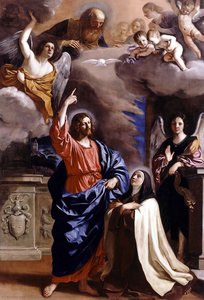
11Lot and His Daughters (1651) by GuercinoLot and His Daughters1651 · Toledo Museum of Art 12God the Father (1630) by GuercinoGod the Father1630 · National Museum in Warsaw 13Saint Francis with an angel playing violin (1620) by GuercinoSaint Francis with an angel playing violin1620 · National Museum in Warsaw 14Study of Saint Matthew turned to his right, reading a book by GuercinoStudy of Saint Matthew turned to his right, reading a book 15The Glory of All the Saints. Fragment (1613) by GuercinoThe Glory of All the Saints. Fragment1613 16The Glory of All the Saints. Fragment (1613) by GuercinoThe Glory of All the Saints. Fragment1613 17Jael and Sisera (1616) by GuercinoJael and Sisera1616 18Madonna and Child with Saint John The Baptist (1616) by GuercinoMadonna and Child with Saint John The Baptist1616 · Museum of Fine Arts 19Abraham and Hagar (1616) by GuercinoAbraham and Hagar1616 · Statens Museum For Kunst 20St. Francis in Ecstasy with St. Benedict and an Angel (1620) by GuercinoSt. Francis in Ecstasy with St. Benedict and an Angel1620 21The Persian Sybil (1628) by GuercinoThe Persian Sybil1628 · Bavarian State Painting Collections 22St Sebastian (1628) by GuercinoSt Sebastian1628 · Bavarian State Painting Collections 23Martyrdom of Saints John and Paul (1632) by GuercinoMartyrdom of Saints John and Paul1632 · Musée des Augustins 24Saint Joseph with the Christ Child (1637) by GuercinoSaint Joseph with the Christ Child1637 · National Gallery of Ireland 25Circé (1637) by GuercinoCircé1637 26Mary Magdalene (1645) by GuercinoMary Magdalene1645 27The Sick Child (1660) by GuercinoThe Sick Child1660 28St. Paul the Hermit Fed by the Raven (1660) by GuercinoSt. Paul the Hermit Fed by the Raven1660 · Dayton Art Institute 29Absalom and Tamar (1655) by GuercinoAbsalom and Tamar1655 30The Virgin and Child appearing to Saint Jerome (1650) by GuercinoThe Virgin and Child appearing to Saint Jerome1650 31Santa Palazia (1658) by GuercinoSanta Palazia1658 · Museo Civico 32Virtuous Love (1666) by GuercinoVirtuous Love1666 33Assumption of the Virgin (1650) by GuercinoAssumption of the Virgin1650 · Detroit Institute of Arts 34Saint Paul (1700) by GuercinoSaint Paul1700 · Slovak National Gallery 35Cleopatra (1621) by GuercinoCleopatra1621 · National Gallery of Armenia 36La Madonna del Carmine con San Giuseppe e Santa Teresa e Gloria d' Angeli by GuercinoLa Madonna del Carmine con San Giuseppe e Santa Teresa e Gloria d' Angeli 37The Vocation of Saint Aloysius (Luigi) Gonzaga by GuercinoThe Vocation of Saint Aloysius (Luigi) GonzagaMetropolitan Museum of Art 38Saint Margaret of Cortona by GuercinoSaint Margaret of Cortona 39Apparition of Christ to Saint Therese by GuercinoApparition of Christ to Saint Therese 40The Holy Family (1620) by GuercinoThe Holy Family1620 41Fame, Honor and Virtue by GuercinoFame, Honor and Virtue 42Stilleben mit Melonen + Papagei (1616) by GuercinoStilleben mit Melonen + Papagei1616 43Amnon and Tamar by GuercinoAmnon and TamarNational Gallery of Art 44The Flagellation of Christ (1642) by GuercinoThe Flagellation of Christ1642 · Szépművészeti Múzeum 45Madonna and Child by GuercinoMadonna and ChildFinnish National Gallery 46Saint Paul by GuercinoSaint Paul 47Child seen from behind, standing between its mother's knees by GuercinoChild seen from behind, standing between its mother's knees 48BAPTISM OF CHRIST by GuercinoBAPTISM OF CHRIST 49St. Hieronymus by GuercinoSt. Hieronymus 50San Filippo Neri by GuercinoSan Filippo Neri 51Esther before Ahasuerus (1750) by GuercinoEsther before Ahasuerus1750 · University of Michigan Museum of Art 52The Pensive Muse by GuercinoThe Pensive MuseNational Gallery of Ireland 53Saint Agatha by GuercinoSaint AgathaNational Gallery of Ireland 54The Triumph of David by GuercinoThe Triumph of DavidNational Gallery of Ireland 55Study for St. William of Aquitaine by GuercinoStudy for St. William of AquitaineRhode Island School of Design Museum of Art 56Bust of a Soldier in Armor by GuercinoBust of a Soldier in ArmorRhode Island School of Design Museum of Art 57The Holy Family on the Flight meets the infant St John by GuercinoThe Holy Family on the Flight meets the infant St JohnFitzwilliam Museum 58Primavera by GuercinoPrimaveraMuseum of Fine Arts 59David with the head of Goliath by GuercinoDavid with the head of Goliath 60Saint Alexius in a brown wrap, holding a staff by GuercinoSaint Alexius in a brown wrap, holding a staff 61Man Kneeling by GuercinoMan Kneeling 62Landscape with a Fisherman by GuercinoLandscape with a Fisherman 63Landscape with Figures and a Wel by GuercinoLandscape with Figures and a Wel 64Landscape with Figures and Trees by GuercinoLandscape with Figures and Trees 65Landscape with Figures and a Tent by GuercinoLandscape with Figures and a Tent 66Landscape with Figures and a Bridge by GuercinoLandscape with Figures and a Bridge 67Landscape with Figures and a Bridge 1 by GuercinoLandscape with Figures and a Bridge 1 68Saint Francis in Adoration by GuercinoSaint Francis in Adoration 69St. John the Baptist in the Wilderness by GuercinoSt. John the Baptist in the Wilderness 70Portrait of a Man by GuercinoPortrait of a Man 71An Old Man by GuercinoAn Old Man 72A Woman Drinking from a Cup by GuercinoA Woman Drinking from a Cup 73St. John the Baptist in the Wilderness 1 by GuercinoSt. John the Baptist in the Wilderness 1 74A Woman Outstretched Arms by GuercinoA Woman Outstretched ArmsBavarian State Painting Collections 75The Flaying of Marsyas by GuercinoThe Flaying of Marsyas 76God the Father by GuercinoGod the Father 77Saint Jerome by GuercinoSaint Jerome 78Two Women and an Infant by GuercinoTwo Women and an Infant 79HEAD OF A GIRL, SEEN FROM BEHIND by GuercinoHEAD OF A GIRL, SEEN FROM BEHIND 80A seated man training a dog by GuercinoA seated man training a dog 81Cupid holding a vase of flowers by GuercinoCupid holding a vase of flowers 82Study of a woman holding a sieve by GuercinoStudy of a woman holding a sieve 83Susanna and the Elders 1 by GuercinoSusanna and the Elders 1 84The Martyrdom of St Peter by GuercinoThe Martyrdom of St Peter 85A study of Christ by GuercinoA study of Christ 86Madonna of the Swallow by GuercinoMadonna of the Swallow 87Landscape with tree in the foreground by GuercinoLandscape with tree in the foreground 88Annunciation by GuercinoAnnunciation 89Warrior Kneeling with Arms Outstretched by GuercinoWarrior Kneeling with Arms Outstretched 90Putto in the Clouds by GuercinoPutto in the Clouds 91Saint John the Evangelist in Meditation by GuercinoSaint John the Evangelist in Meditation 92The Resurrected Christ Appears to the Virgin by GuercinoThe Resurrected Christ Appears to the Virgin 93Saint Peter by GuercinoSaint Peter 94Nude figure of a woman, seen from the side by GuercinoNude figure of a woman, seen from the side 95STUDIES FOR THE VISION OF SAINT PHILIP NERI by GuercinoSTUDIES FOR THE VISION OF SAINT PHILIP NERI 96The Virgin and Child with the Infant Saint John the Baptist by GuercinoThe Virgin and Child with the Infant Saint John the BaptistScottish National Gallery 97David the violonist by GuercinoDavid the violonist 98Self-Portrait before a Painting of Amor Fedele by GuercinoSelf-Portrait before a Painting of Amor Fedele 99St Augustine by GuercinoSt Augustine 100Study of the God Almighty by GuercinoStudy of the God Almighty

Guercino's famous paintings, period by period

The subjects that held Guercino's eye

The four subjects that come back most often in these originals, each with its finest example.

The museums that keep Guercino's originals

The 8 museums that hold the most of the paintings on this page.

Museum City Works by Guercino Paintings from this list
Bavarian State Painting Collections, MunichBavarian State Painting Collections Munich 8 Portrait of a Woman, Christ and the Moneylender, The Persian Sybil
National Gallery of Ireland, Dublin CityNational Gallery of Ireland Dublin City 6 Saint Joseph with the Christ Child, The Pensive Muse, Saint Agatha
National Museum in Warsaw, WarsawNational Museum in Warsaw Warsaw 2 God the Father, Saint Francis with an angel playing violin
Rhode Island School of Design Museum of Art, ProvidenceRhode Island School of Design Museum of Art Providence 2 Study for St. William of Aquitaine, Bust of a Soldier in Armor
National Gallery, LondonNational Gallery London 8 The Samian Sibyl with a Putto
Staatliche Kunstsammlungen Dresden, DresdenStaatliche Kunstsammlungen Dresden Dresden 4 Painting and Drawing
Fitzwilliam MuseumFitzwilliam Museum 3 The Holy Family on the Flight meets the infant St John
Scottish National Gallery, EdinburghScottish National Gallery Edinburgh 3 The Virgin and Child with the Infant Saint John the Baptist

Guercino, one signature painting per decade

Works per decade

Pick a decade to see the original that defines it.

Guercino's paintings: the gallery answers

Which Guercino painting is the most famous of all?Reveal the answer

Pietà (1638), Condé Museum, Chantilly. St Peter and the angel (1650) and David with the Head of Goliath (1657) come next.

How old was Guercino on completing Pietà?Reveal the answer

47 years old: Pietà dates from 1638, and Guercino was born in 1591.

Which are Guercino's top 10 paintings?Reveal the answer

Pietà, St Peter and the angel, David with the Head of Goliath, The Samian Sibyl with a Putto, Saint-Jean-Baptiste, La Madonna del passero, Painting and Drawing, Portrait of a Woman, Christ and the Moneylender and St Anthony of Padua with the Infant Christ. The ranking above gives each one's year and museum.

How many works did Guercino create?Reveal the answer

Our catalog holds 367 works by Guercino, dated from 1613 to 1666.

Where do Guercino's most famous originals hang?Reveal the answer

Mostly in Bavarian State Painting Collections (Munich), National Gallery of Ireland (Dublin City) and National Museum in Warsaw (Warsaw). The museum table above lists them all.

When did Guercino create the most famous paintings?Reveal the answer

In 1650s: 9 of the 100 works on this page were made then, St Peter and the angel among them.

Which are Guercino's earliest and latest famous works?Reveal the answer

On this page, the earliest is The Glory of All the Saints. Fragment (1613) and the latest Virtuous Love (1666).

Which subjects did Guercino return to most?Reveal the answer

Woman (11), Man (10) and Religious (9), across the 100 works on this page.

Which medium did Guercino work in most?Reveal the answer

Oil On Canvas, for 15 of the 100 works on this page.

Which movement is Guercino associated with?Reveal the answer

Baroque, judging by the originals on this page.

Which Guercino originals does the Bavarian State Painting Collections hold?Reveal the answer

Portrait of a Woman, Christ and the Moneylender and The Persian Sybil: the Bavarian State Painting Collections, Munich holds 5 of the works on this page.

Can I have a Guercino painting reproduced by hand?Reveal the answer

Yes, as a reproduction: the original stays in its museum, but any painting on this page can be painted by hand for you, made to order one at a time, from the painting's own page.

Guercino: the artist

A Life Illuminated by Shadow: The World of Guercino

Giovanni Francesco Barbieri, known to the world as Il Guercino – “the squinter” – was a name born from a physical characteristic but destined to represent an artistic vision that dramatically reshaped Baroque painting. Born in 1591 in Cento, a small town nestled between Ferrara and Bologna, Guercino’s journey began not within the hallowed halls of formal academies, but through self-discovery and early apprenticeship with Ludovico Carracci. This formative period laid the groundwork for a style that would become synonymous with intense emotionality, dramatic chiaroscuro, and a profound engagement with both realism and idealism. Unlike many of his contemporaries who sought classical perfection, Guercino’s art pulsed with a raw, human energy, reflecting the turbulent spiritual climate of 17th-century Italy. His early life was marked by a natural talent that quickly outstripped conventional training; he wasn't merely replicating styles but forging his own path, one illuminated by an innate understanding of light and shadow.

From Caravaggism to Classical Grace: A Shifting Palette

Guercino’s artistic development was not a linear progression, but rather a fascinating dialogue between different influences and stylistic explorations. His initial works were deeply indebted to the revolutionary naturalism of Caravaggio, embracing stark contrasts and a gritty realism that shocked and captivated audiences. Paintings like *Amnon and Tamar* exemplify this early period – a poignant depiction of a biblical narrative rendered with unflinching honesty and psychological depth. However, Guercino was not content to remain solely within the orbit of Caravaggism. A pivotal shift occurred in his style during the 1630s, prompted by both artistic curiosity and the demands of discerning patrons. He began to soften his palette, moving away from the harsh tenebrism towards a more luminous and balanced approach. This transition wasn’t simply a stylistic whim; it reflected a deeper engagement with classical ideals and a desire to create works that were not only emotionally powerful but also aesthetically refined. This period saw him embrace a greater sense of spatial depth and a more harmonious composition, as evidenced in masterpieces like *The Return of the Prodigal Son*.

Biblical Narratives and Emotional Resonance

Throughout his career, Guercino consistently turned to biblical narratives for inspiration. However, he didn’t simply illustrate these stories; he imbued them with a profound sense of human drama and emotional resonance. His figures are not idealized saints but flawed individuals grappling with faith, doubt, remorse, and redemption. *The Vocation of Saint Aloysius Gonzaga* is a prime example – a powerful depiction of religious awakening rendered with breathtaking skill and sensitivity. Guercino’s ability to capture the inner lives of his subjects set him apart from many of his contemporaries. He understood that true piety wasn't about outward displays of devotion but about the internal struggles and sacrifices that defined a life dedicated to faith. This psychological depth, combined with his masterful use of light and shadow, created paintings that were both visually stunning and emotionally compelling. He didn’t shy away from portraying difficult or unsettling moments, believing that these were essential to understanding the complexities of the human condition.

A Lasting Legacy: Influence and Rediscovery

Guercino's influence extended far beyond his lifetime. His dramatic use of light and shadow, coupled with his ability to evoke powerful emotions, inspired generations of artists across Europe. Though his reputation waned somewhat in the 18th and 19th centuries, a renewed appreciation for his work emerged in the 20th century, largely thanks to the tireless efforts of art historian Sir Denis Mahon. Mahon’s meticulous research and passionate advocacy helped to restore Guercino to his rightful place among the masters of the Baroque period. Today, his paintings are celebrated in prestigious museums around the world – from the Pinacoteca Nazionale in Ferrara to the National Gallery of Art in Washington D.C. – serving as a testament to his enduring artistic genius.
  • Museums and Collections: Guercino’s works grace the halls of institutions like the Pinacoteca Nazionale (Ferrara), the Palazzo Brignole-Sale (Genoa), and the Galleria Spada (Rome).
  • Chiaroscuro Master: His dramatic use of light and shadow remains a defining characteristic of his style.
  • Biblical Storyteller: He brought biblical narratives to life with unparalleled emotional depth and psychological insight.
Guercino’s legacy is not merely about technical skill or stylistic innovation; it's about the power of art to connect us to our shared humanity, to explore the complexities of faith and doubt, and to illuminate the enduring mysteries of the human heart.

All 367 works by Guercino →