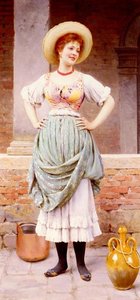
Portrait of Eugene de Blaas

Eugene de Blaas Paintings: The 100 Most Famous, Through a Gallery's Eye

Updated November 2026 · ranked by our popularity score (searches, visits and orders for each work) · 137 works by Eugene de Blaas in our catalogue

In short

To the gallery's eye, Eugene de Blaas's most famous painting is The Serenade. The Friendly Gossips (1901) and Gathering Shells complete the trio every eye recognises. Of the 137 works by Eugene de Blaas in our catalog, the gallery presents the 100 most famous below, each original with its year, its museum and what makes it unique.

1843 – 1931, Albano Laziale Academic art Most works: Szépművészeti Múzeum

The gallery's top 10 Eugene de Blaas paintings

1
The Serenade by Eugene de Blaas

The Serenade

Oil

In the tender embrace of The Serenade, we are transported to a sun-drenched corner of nineteenth-century Venice, where the air seems to vibrate with the soft strumming of a guitar. Eugen von Blaas, a master of Academic Classicism, captures more than just a musical performance; he captures a fleeting moment of communal intimacy. The scene unfolds around a central figure—a musician perched upon a stone wall, his instrument serving as…

2
The Friendly Gossips (1901) by Eugene de Blaas

The Friendly Gossips

1901 · Oil

The painting depicts a domestic interior within a modest Italian dwelling. Three women sit together on a bench, their bodies oriented toward one another in a state of active conversation. They wear dresses consistent with the turn of the twentieth century. To the right, a chair sits near the edge of the frame, while a vase occupies the left side. The composition is divided into two distinct zones. In the…

3
Gathering Shells by Eugene de Blaas

Gathering Shells

Oil On Canvas

In Gathering Shells, Eugene de Blaas captures a quiet moment of labor on a sandy beach. Two women occupy the foreground, their bodies anchored to the earth. One woman kneels in the sand, her hands busy sorting shells into a wooden bucket. Beside her, another woman stands upright, her gaze drifting toward the horizon. They are immersed in the simple, repetitive rhythm of their task.

4
Gathering Cockles at the Seashore by Eugene de Blaas

Gathering Cockles at the Seashore

Watercolor

Gathering Cockles at the Seashore is a work by the Italian painter Eugene de Blaas, executed before 1932. The painting captures a scene of everyday life, focusing on the quiet labor of a woman collecting shellfish along a sandy beach. Through this subject, the artist explores the intersection of human activity and the natural coastal environment.

5
Which Came First by Eugene de Blaas

Which Came First

Oil On Canvas

In this work, titled Which Came First, we encounter the quiet, observational hand of Eugene de Blaas. The painting presents a woman carrying two baskets, a scene that captures a fleeting moment of daily life. It is a composition that relies on the presence of the figure to anchor the viewer's attention.

7
A Pensive Moment by Eugene de Blaas

A Pensive Moment

Oil On Canvas

A young woman sits upon a weathered brick wall, her body positioned slightly off-center within the frame. She is oriented toward a body of water that recedes into a hazy background, creating a sense of depth through atmospheric perspective. Her pose is one of stillness, with her gaze directed away from the viewer in a manner that suggests introspection. The scene is set under a pale, overcast sky, which provides…

8
A Young Fishwife by Eugene de Blaas

A Young Fishwife

Oil

We are looking at A Young Fishwife, a work by the Italian painter Eugene de Blaas. This piece offers a quiet glimpse into a specific way of life, captured through the artist's particular lens. Eugene de Blaas was born in 1843 in Albano Laziale, Italy, and his life's work continued until his death in 1931.

9
Female portrait (1863) by Eugene de Blaas

Female portrait

1863 · Oil On Canvas

In the bust-length portrait titled "Female portrait" by Eugene de Blaas, a young woman occupies the center of a quiet, shadowed space. She is positioned slightly off-center, her presence anchored against a background of deep browns. Her gaze is direct and calm, meeting the viewer with a steady, unblinking stillness. A dark navy blue garment covers her shoulders, absorbing the light and grounding the composition in heavy, muted tones. A…

10
Young Woman with Children on the Beach (1868) by Eugene de Blaas

Young Woman with Children on the Beach

1868 · Oil On Canvas

Young Woman with Children on the Beach is a work by Eugene de Blaas, executed about 1868. This piece belongs to the tradition of Academic Classicism, a style that emphasizes formal precision and a refined approach to composition. The artist, born in Albano Laziale, Italy, in 1843, brought a disciplined technical foundation to his depictions of human figures and natural settings. He remained active in his craft until his death…

Eugene de Blaas paintings, ranked 11 to 100

11The bingo game (1871) by Eugene de BlaasThe bingo game1871 12A Venetian beauty (1865) by Eugene de BlaasA Venetian beauty1865 13Feeding the ducks (1874) by Eugene de BlaasFeeding the ducks1874 14The Secret (1876) by Eugene de BlaasThe Secret1876 15Portrait of a Woman at a Window (1885) by Eugene de BlaasPortrait of a Woman at a Window1885 16Girl with fish (1879) by Eugene de BlaasGirl with fish1879 17Hesitancy (1885) by Eugene de BlaasHesitancy1885 · Szépművészeti Múzeum 18Venetians at the balcony (1881) by Eugene de BlaasVenetians at the balcony1881 19Head of a boy (1880) by Eugene de BlaasHead of a boy1880 · Victoria and Albert Museum 20Festival day, Venice (1879) by Eugene de BlaasFestival day, Venice1879 21At the Carnival (1879) by Eugene de BlaasAt the Carnival1879 · Wolverhampton Art Gallery 22Singing Group of Women on the Seashore (1888) by Eugene de BlaasSinging Group of Women on the Seashore1888 23The young woman called 'Ninetta' (1887) by Eugene de BlaasThe young woman called 'Ninetta'1887 24Curiosity (1891) by Eugene de BlaasCuriosity1891 · Te Whare O Rehua Sarjeant Gallery 25The Work by Eugene de BlaasThe Work 26The Suitor (1887) by Eugene de BlaasThe Suitor1887 27Young lady with red fan (1897) by Eugene de BlaasYoung lady with red fan1897 28A Good Catch (1894) by Eugene de BlaasA Good Catch1894 29The Unseen Suitor (1898) by Eugene de BlaasThe Unseen Suitor1898 30Love's Labor Lost (1903) by Eugene de BlaasLove's Labor Lost1903 31Mother's Little Helper (1884) by Eugene de BlaasMother's Little Helper1884 32The Flower Girl (1911) by Eugene de BlaasThe Flower Girl1911 33Catch of the Day by Eugene de BlaasCatch of the Day 34The Seamstress by Eugene de BlaasThe Seamstress 35In the Sacristy (1877) by Eugene de BlaasIn the Sacristy1877 36Philip Richard Morris (1865) by Eugene de BlaasPhilip Richard Morris1865 37The Love Letter (1887) by Eugene de BlaasThe Love Letter1887 38The Offer (1887) by Eugene de BlaasThe Offer1887 39Accepted (1887) by Eugene de BlaasAccepted1887 40The Italian Flower Girl (1887) by Eugene de BlaasThe Italian Flower Girl1887 41A Venetian Water Carrier (1890) by Eugene de BlaasA Venetian Water Carrier1890 42A Venetian Courtship (1891) by Eugene de BlaasA Venetian Courtship1891 · New Walk Museum - Art Gallery 43The Fruit Seller by Eugene de BlaasThe Fruit Seller 44Portrait of a Boy (1900) by Eugene de BlaasPortrait of a Boy1900 45Baroness von Scholl by Eugene de BlaasBaroness von Scholl 46Daydreaming 1 by Eugene de BlaasDaydreaming 1 47Musette by Eugene de BlaasMusette 48God's Creatures by Eugene de BlaasGod's Creatures 49Fruit Vendor by Eugene de BlaasFruit Vendor 50An Affectionate Glance by Eugene de BlaasAn Affectionate Glance 51Madchenbildnis by Eugene de BlaasMadchenbildnis 52Unknown by Eugene de BlaasUnknown 53Madchen mit Granatapfeln by Eugene de BlaasMadchen mit Granatapfeln 54Daydreaming by Eugene de BlaasDaydreaming 55Am Brunnen by Eugene de BlaasAm Brunnen 56Lisa by Eugene de BlaasLisa 57The Flower Seller by Eugene de BlaasThe Flower Seller 58The Farewell by Eugene de BlaasThe Farewell 59Portrait of a Woman by Eugene de BlaasPortrait of a Woman 60Die Lauscherin by Eugene de BlaasDie Lauscherin 61A Pensive Beauty by Eugene de BlaasA Pensive Beauty 62Balcony by Eugene de BlaasBalcony 63The Days Catch by Eugene de BlaasThe Days Catch 64Young Italian Beauty by Eugene de BlaasYoung Italian Beauty 65An Interesting Story by Eugene de BlaasAn Interesting Story 66A Young Beauty by Eugene de BlaasA Young Beauty 67Elegant Lady by Eugene de BlaasElegant Lady 68Flirtation at the Well by Eugene de BlaasFlirtation at the Well 69A Viennese Beauty by Eugene de BlaasA Viennese Beauty 70The Flirtation by Eugene de BlaasThe Flirtation 71On the Balcony by Eugene de BlaasOn the Balcony 72Shared Correspondance by Eugene de BlaasShared Correspondance 73The Flirtation 1 by Eugene de BlaasThe Flirtation 1 74The Yellow Shawl by Eugene de BlaasThe Yellow Shawl 75The Grape Picker by Eugene de BlaasThe Grape Picker 76The Pearl Necklace by Eugene de BlaasThe Pearl Necklace 77Portrait of a Venetian Lady by Eugene de BlaasPortrait of a Venetian Lady 78Zwei Kinder by Eugene de BlaasZwei Kinder 79Die Wassertragerin by Eugene de BlaasDie Wassertragerin 80Young Beauty by Eugene de BlaasYoung Beauty 81The Knitting Lesson by Eugene de BlaasThe Knitting Lesson 82Le Plaisir by Eugene de BlaasLe Plaisir 83On The Balcony 1 by Eugene de BlaasOn The Balcony 1 84Head of a Young Boy by Eugene de BlaasHead of a Young Boy 85The Eavesdropper by Eugene de BlaasThe Eavesdropper 86Good News by Eugene de BlaasGood News 87Venetian Beauty on Balcony by Eugene de BlaasVenetian Beauty on Balcony 88Venetian Flower Seller by Eugene de BlaasVenetian Flower Seller 89Meeting in the Square by Eugene de BlaasMeeting in the Square 90Portrait of a Lady by Eugene de BlaasPortrait of a Lady 91La lavandière (1912) by Eugene de BlaasLa lavandière1912 92Untitled (AQTQMF) (1931) by Eugene de BlaasUntitled (AQTQMF)1931 · National Portrait Gallery 93Dressing for the Masquerade (1885) by Eugene de BlaasDressing for the Masquerade1885 94Young italian girl by Eugene de BlaasYoung italian girl 95The Laundress by Eugene de BlaasThe Laundress 96the rose by Eugene de Blaasthe rose 97Eugen von The Eavesdropper by Eugene de BlaasEugen von The Eavesdropper 98Gethering Shells by Eugene de BlaasGethering Shells 99A Venetian Beauty by Eugene de BlaasA Venetian Beauty 100A Venetian Beauty by Eugene de BlaasA Venetian Beauty

Eugene de Blaas's famous paintings, period by period

The subjects that held Eugene de Blaas's eye

The four subjects that come back most often in these originals, each with its finest example.

The museums that keep Eugene de Blaas's originals

The 6 museums that hold the most of the paintings on this page.

Museum City Works by Eugene de Blaas Paintings from this list
Szépművészeti Múzeum, BudapestSzépművészeti Múzeum Budapest 1 Hesitancy
Victoria and Albert Museum, LondonVictoria and Albert Museum London 1 Head of a boy
Wolverhampton Art Gallery, WolverhamptonWolverhampton Art Gallery Wolverhampton 1 At the Carnival
Te Whare O Rehua Sarjeant GalleryTe Whare O Rehua Sarjeant Gallery 1 Curiosity
New Walk Museum - Art Gallery, LeicesterNew Walk Museum - Art Gallery Leicester 1 A Venetian Courtship
National Portrait Gallery, LondonNational Portrait Gallery London 1 Untitled (AQTQMF)

Eugene de Blaas, one signature painting per decade

Works per decade

Pick a decade to see the original that defines it.

Eugene de Blaas's paintings: the gallery answers

Which Eugene de Blaas painting is the most famous of all?Reveal the answer

The Serenade. The Friendly Gossips (1901) and Gathering Shells come next.

Which are Eugene de Blaas's top 10 paintings?Reveal the answer

The Serenade, The Friendly Gossips, Gathering Shells, Gathering Cockles at the Seashore, Which Came First, Portrait of a Boy, A Pensive Moment, A Young Fishwife, Female portrait and Young Woman with Children on the Beach. The ranking above gives each one's year and museum.

How many works did Eugene de Blaas create?Reveal the answer

Our catalog holds 137 works by Eugene de Blaas, dated from 1863 to 1931.

Where do Eugene de Blaas's most famous originals hang?Reveal the answer

Mostly in Szépművészeti Múzeum (Budapest), Victoria and Albert Museum (London) and Wolverhampton Art Gallery (Wolverhampton). The museum table above lists them all.

When did Eugene de Blaas create the most famous paintings?Reveal the answer

In 1880s: 13 of the 100 works on this page were made then, Portrait of a Woman at a Window among them.

Which are Eugene de Blaas's earliest and latest famous works?Reveal the answer

On this page, the earliest is Female portrait (1863) and the latest Untitled (AQTQMF) (1931).

Which subjects did Eugene de Blaas return to most?Reveal the answer

Women (25), Woman (21) and Portraits (13), across the 100 works on this page.

Which medium did Eugene de Blaas work in most?Reveal the answer

Oil On Canvas, for 20 of the 100 works on this page.

Which movement is Eugene de Blaas associated with?Reveal the answer

Academic art, judging by the originals on this page.

Eugene de Blaas: the artist

Eugen von Blaas: A Venetian Master of Academic Classicism

Born in Albano, near Rome, in 1843, Eugen de Blaas (later known as Eugene von Blaas) emerged from a family steeped in artistic tradition. His father, Karl von Blaas, was himself a respected painter and professor at the Academy of Venice, providing young Eugen with an unparalleled foundation in art history, fresco techniques, and the principles of classical composition. This familial influence profoundly shaped his artistic trajectory, leading him to embrace the tenets of Academic Classicism – a style characterized by meticulous detail, idealized forms, and a reverence for historical and mythological subjects.

Eugen’s early years were spent immersed in the vibrant atmosphere of Venice, a city he would come to both paint and deeply admire. Moving with his family to the lagoon city as a child, he absorbed its unique culture, architecture, and social customs. This intimate connection to Venice became the cornerstone of his artistic output, informing his choice of subject matter and his distinctive visual language. Unlike many of his contemporaries who sought to capture fleeting moments or contemporary scenes, Blaas consistently returned to depictions of Venetian life – particularly the elegant women of its aristocratic circles – offering a carefully constructed and idealized vision of this captivating city.

The Art of Venetian Genre Scenes

Blaas’s artistic career blossomed in the late 19th century, a period marked by significant shifts in European art. While Impressionism was gaining momentum elsewhere, Blaas remained firmly rooted in Academic Classicism, producing a body of work that is both meticulously detailed and imbued with a sense of romantic nostalgia. His most celebrated works fall into the category of “genre scenes,” which capture everyday moments within Venetian society. These aren’t raw depictions of life; rather, they are carefully staged vignettes, often featuring wealthy women in elaborate costumes, engaging in leisurely activities like shopping, attending social gatherings, or simply enjoying the beauty of their surroundings.

His paintings frequently showcase a remarkable attention to detail – from the shimmering fabrics and intricate jewelry worn by his subjects to the meticulously rendered architecture and atmospheric lighting. Blaas’s use of color is particularly noteworthy; he employs rich, saturated hues to evoke the warmth and luminosity of the Venetian sun, creating scenes that are both visually stunning and emotionally resonant. He was a master of capturing the essence of aristocratic Venice, presenting an idealized image of wealth, beauty, and social grace.

Key Works and Artistic Style

Among Blaas’s most iconic paintings are “Mother’s Little Helper” (1884), which offers a charming glimpse into a rustic Venetian kitchen scene, and “On the Balcony” (1877), a vibrant depiction of a fashionable gathering on a balcony overlooking the canals. “La forma nuziale in sacrestia” is another notable example, portraying a bridal ceremony within a church sacristy with remarkable precision and elegance. These works exemplify his signature style – characterized by its meticulous realism, balanced composition, and subtle emotional depth.

His artistic development can be traced through a progression from more overtly classical subjects to increasingly intimate depictions of Venetian life. While he continued to paint portraits throughout his career, it was his genre scenes that ultimately cemented his reputation as one of the most accomplished artists of his generation. He skillfully blended historical influences with contemporary observation, creating works that are both timeless and deeply rooted in their specific context.

Legacy and Historical Significance

Eugen von Blaas’s work represents a fascinating intersection of artistic tradition and cultural identity. His commitment to Academic Classicism provided him with the technical skills and formal training necessary to excel as a painter, while his deep affection for Venice infused his art with a unique sense of place and atmosphere. His paintings offer valuable insights into the social customs, fashion trends, and aesthetic sensibilities of 19th-century Venetian society.

Despite not achieving widespread fame during his lifetime, Blaas’s work has since been recognized for its artistic merit and historical significance. His paintings are now housed in prestigious museums and private collections around the world, serving as a testament to his enduring legacy as one of Venice's most celebrated artists. His meticulous attention to detail, coupled with his evocative depictions of Venetian life, continue to captivate audiences today.