1887
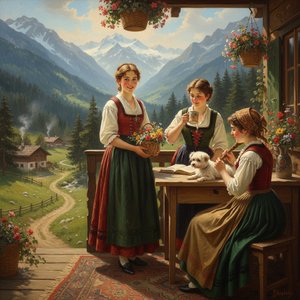
Accepted (Eugene de Blaas, 1887)
Eugene de Blaas (1843–1931) made Accepted. It dates from 1887. It measures 93 × 61 cm.
- 1887
- 93 × 61 cm

 Preview

 Hand Made Oil Painting
 Send
 Share
 Fact sheet


 Download
 Similars
 X-Ray
 Diaporama
 Q&A

 Stats
Accepted, in brief
- Title
- Accepted
- Artist
- Eugene de Blaas (1843–1931)
- Artist born in
- Albano Laziale, Italy
- Date
- 1887
- Dimensions
- 93 × 61 cm
High-resolution images of Accepted
Eugene de Blaas, Accepted (1887). Public domain.
Colours matched to the original by a digital expert, the file finely retouched, faithful to the artist's brushwork.
Own the high-resolution fileQuestions on Accepted, answered
When was "Accepted" made?
"Accepted" dates from 1887. The date places the work within Eugene de Blaas's career and its era.
How big is the original "Accepted"?
The recorded dimensions of "Accepted" by Eugene de Blaas are 93 x 61 cm. Reproductions can be ordered in other sizes while keeping the same proportions.
Is "Accepted" free of copyright?
"Accepted" by Eugene de Blaas is in the public domain - its copyright has expired. This status governs how the image of the work may be reproduced.
Who is the artist behind "Accepted"?
"Accepted" was created by Eugene de Blaas. The information on this page describes Eugene de Blaas's original work.
At what age did Eugene de Blaas make "Accepted"?
Eugene de Blaas was 44 years old when creating "Accepted" in 1887. The age is computed from the artist's birth year, 1843.
Is "Accepted" by Eugene de Blaas in the public domain, and why?
"Accepted" by Eugene de Blaas is in the public domain - its copyright has expired. Copyright duration runs from the artist's death, which occurred in 1931.
About the artist, Eugene de Blaas

1843–1931, Italy
Eugene de Blaas
Eugen von Blaas: A Venetian Master of Academic Classicism Born in Albano, near Rome, in 1843, Eugen de Blaas (later known as Eugene von Blaas) emerged from a family steeped in artistic tradition. His father, Karl von Blaas, was himself a respected painter and professor at the Academy of Venice, providing young Eugen with an unparalleled foundation in art history, fresco techniques, and the principles of classical composition. This familial influence profoundly shaped his artistic trajectory, leading him to embrace the tenets of Academic Classicism – a style characterized by meticulous detail, idealized forms, and a reverence for historical and mythological subjects. Eugen’s early years were spent immersed in the vibrant atmosphere of Venice, a city he would come to both paint and deeply admire.
Also by Eugene de Blaas
 The Serenade
 The Friendly Gossips1901
 Gathering Cockles at the Seashore
 Gathering Shells
Essays around Accepted
 Eugen von Blaas: Capturing Alpine Life & Sentiment in 19th-Century Austrian PaintingDiscover the captivating world of Eugen von Blaas! Explore his exquisite 19th-century paintings capturing Venetian life & Alpine beauty. Le…
 25 Must-See Masterpieces at the Royal Museums of Fine Arts of BelgiumExplore 25 iconic masterpieces from Brussels' Royal Museums. From Old Masters to Surrealism, discover them all on OriginalUniqueArt.com.
 25 Masterpieces by Édouard Manet: The Rebel Who Redefined Modern ArtJourney through the rebellious soul of French Impressionism with our curated list of Édouard Manet's top 25 masterpieces. From iconic scand…