Portrait of Ambrogio Lorenzetti

The 53 Most Famous Ambrogio Lorenzetti Paintings, a Gallery Selection

Updated November 2026 · ranked by our popularity score (searches, visits and orders for each work) · 54 works by Ambrogio Lorenzetti in our catalogue

In short

Of all the originals Ambrogio Lorenzetti left, the most famous is Bad Government and the Effects of Bad Government on the City Life (1338), in the collection of the Palazzo Pubblico, Siena. Close behind it come Allegory of the Good Government (detail) (1338) and Good and Bad-Effects of Good Government on the City Life (detail)5. Our catalog holds 54 works by Ambrogio Lorenzetti; the gallery has kept the 53 the world admires most, each shown with its date, its museum and its story.

1290 – 1348, Siena Proto-renaissance Most works: Palazzo Pubblico

Ambrogio Lorenzetti's top 10 paintings: the gallery's choice

1
Bad Government and the Effects of Bad Government on the City Life (1338) by Ambrogio Lorenzetti

Bad Government and the Effects of Bad Government on the City Life

1338 · Fresco · Palazzo Pubblico, Siena

The fresco cycle titled Bad Government and the Effects of Bad Government on the City Life was created by Ambrogio Lorenzetti in 1338. This work is part of a larger series known as the Allegory of Good and Bad Government. The paintings occupy the walls of the Sala dei Nove, also referred to as the Council Room, within the Palazzo Pubblico in Siena, Italy. The commission for these murals originated…

2
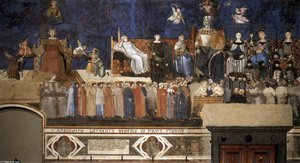
Allegory of the Good Government (detail) (1338) by Ambrogio Lorenzetti

Allegory of the Good Government (detail)

1338 · Fresco · Palazzo Pubblico, Siena

Within the hallowed, quiet halls of the Palazzo Pubblico in Siena, Italy, the Allegory of the Good Government (detail) unfolds. Created by the Sienese painter Ambrogio Lorenzetti, this work emerges from the year 1338. It breathes with the spirit of the Sienese School, capturing a moment where the rigid traditions of the medieval era begin to meet the fresh, burgeoning light of the Early Renaissance. The scene focuses on the…

3
Good and Bad-Effects of Good Government on the City Life (detail)5 by Ambrogio Lorenzetti

Good and Bad-Effects of Good Government on the City Life (detail)5

Fresco

In the heart of Siena, within the hallowed walls of the Palazzo Pubblico, lies a fragment of a much larger, breathtaking vision: Ambrogio Lorenzetti’s Good and Bad-Effects of Good Government on the City Life. This particular detail serves as a mesmerizing portal into the 14th century, capturing a moment of ceremonial grandeur that transcends time. As we gaze upon this fresco, we are not merely looking at paint on plaster;…

5
Effects of Good Government on the City Life (detail) (1338) by Ambrogio Lorenzetti

Effects of Good Government on the City Life (detail)

1338 · Fresco · Palazzo Pubblico, Siena

To gaze upon this exquisite detail from Ambrogio Lorenzetti’s 1338 masterpiece, Effects of Good Government on the City Life, is to step through a portal into the vibrant, beating heart of medieval Siena. This fragment of the monumental fresco cycle, housed within the Palazzo Pubblico, transcends mere decoration; it serves as a breathtakingly vivid chronicle of a civilization at its zenith. The scene unfolds with an extraordinary sense of movement…

6
The Effects of Good Government in the Countryside (detail) (1338) by Ambrogio Lorenzetti

The Effects of Good Government in the Countryside (detail)

1338 · Acrylic On Canvas · Palazzo Pubblico, Siena

Ambrogio Lorenzetti's “The Effects of Good and Bad Government” – specifically, the panel depicting “The Effects of Good Government in the Countryside” – is more than just a beautiful fresco; it’s a meticulously crafted visual argument for civic virtue. Painted between 1338 and 1340 for Siena’s Palazzo Pubblico, this monumental work offers a rare glimpse into the political philosophy of a thriving medieval republic. Lorenzetti, a pivotal figure bridging the…

7
Effects of Good Government on the City Life (detail) (1338) by Ambrogio Lorenzetti

Effects of Good Government on the City Life (detail)

1338 · Fresco · Palazzo Pubblico, Siena

The fresco titled Effects of Good Government on the City Life (detail) emerged from the brush of Ambrogio Lorenzetti in 1338. This work occupies a place within the Palazzo Pubblico in Siena. It was commissioned by the Council of Nine to decorate the halls of power. The artist, Ambrogio Lorenzetti, captured a specific vision of civic order through this medium.

8
The Effects of Good Government in the Countryside (detail) (1338) by Ambrogio Lorenzetti

The Effects of Good Government in the Countryside (detail)

1338 · Fresco · Palazzo Pubblico, Siena

Ambrogio Lorenzetti's “The Effects of Good and Bad Government” – a monumental fresco cycle executed between 1338 and 1340 within the Palazzo Pubblico in Siena, Italy – isn’t merely a depiction of a rural landscape; it’s a meticulously crafted allegory of civic virtue and its consequences. Commissioned by the Council of Nine, the governing body of the Republic of Siena, this artwork served as a potent visual reminder to its…

10
Allegory of the Good Government (left view, detail) (1338) by Ambrogio Lorenzetti

Allegory of the Good Government (left view, detail)

1338 · Fresco · Palazzo Pubblico, Siena

Within the quiet, hallowed halls of the Palazzo Pubblico in Siena, Italy, the Allegory of the Good Government (left view, detail) unfolds before the eyes. This work, created in 1338, emerges from the Sala della Pace. It is a monumental achievement of Sienese Gothic art. The frescoes were commissioned by the Consiglio dei Nove, also known as the Council of Nine, to decorate their civic space. Ambrogio Lorenzetti, the artist…

The Ambrogio Lorenzetti selection continues, 11 to 53

11The Crucifixion, the Nativity and Saints (1322) by Ambrogio LorenzettiThe Crucifixion, the Nativity and Saints1322 · Städel Museum 12Saint Martin of Tours Dividing His Cloak with a Beggar (1340) by Ambrogio LorenzettiSaint Martin of Tours Dividing His Cloak with a Beggar1340 · Yale University Art Gallery 13St. John the Baptist (1337) by Ambrogio LorenzettiSt. John the Baptist1337 · Statens Museum For Kunst 14Madonna and Child (1330) by Ambrogio LorenzettiMadonna and Child1330 15Saint Agnes (1330) by Ambrogio LorenzettiSaint Agnes1330 · Harvard Art Museums 16Saint Elizabeth of Hungary (1333) by Ambrogio LorenzettiSaint Elizabeth of Hungary1333 · Isabella Stewart Gardner Museum 17Madonna and Child Enthroned (fragment of an altarpiece) (1341) by Ambrogio LorenzettiMadonna and Child Enthroned (fragment of an altarpiece)1341 · Szépművészeti Múzeum 18Madonna and Child Enthroned (fragment of an altarpiece) (1340) by Ambrogio LorenzettiMadonna and Child Enthroned (fragment of an altarpiece)1340 · Szépművészeti Múzeum 19Madonna and Child (1333) by Ambrogio LorenzettiMadonna and Child1333 · Metropolitan Museum of Art 20Effect of Good Government on the City (1 by Ambrogio LorenzettiEffect of Good Government on the City (1 21Madonna and Child with Mary Magdalene and St Dorothea (1325) by Ambrogio LorenzettiMadonna and Child with Mary Magdalene and St Dorothea1325 · Pinacoteca Nazionale 22The Presentation in the Temple (1342) by Ambrogio LorenzettiThe Presentation in the Temple1342 · Galleria degli Uffizi 23The Oath of St Louis of Toulouse (1324) by Ambrogio LorenzettiThe Oath of St Louis of Toulouse1324 · San Francesco 24The Effects of Good Government in the Countryside (detail) (1338) by Ambrogio LorenzettiThe Effects of Good Government in the Countryside (detail)1338 · Palazzo Pubblico 25Scenes of the Life of St Nicholas (1332) by Ambrogio LorenzettiScenes of the Life of St Nicholas1332 · Galleria degli Uffizi 26Allegory of the Good Government (detail) (1338) by Ambrogio LorenzettiAllegory of the Good Government (detail)1338 · Palazzo Pubblico 27Scenes of the Life of St Nicholas (1332) by Ambrogio LorenzettiScenes of the Life of St Nicholas1332 · Galleria degli Uffizi 28The Effects of Good Government in the Countryside (detail) (1338) by Ambrogio LorenzettiThe Effects of Good Government in the Countryside (detail)1338 · Palazzo Pubblico 29St Michael (1330) by Ambrogio LorenzettiSt Michael1330 · Museo d'Arte Sacra 30Scenes of the Life of St Nicholas (10) (1332) by Ambrogio LorenzettiScenes of the Life of St Nicholas (10)1332 · Galleria degli Uffizi 31Scenes of the Life of St Nicholas (12) (1332) by Ambrogio LorenzettiScenes of the Life of St Nicholas (12)1332 · Galleria degli Uffizi 32Allegory of the Good Government (1338) by Ambrogio LorenzettiAllegory of the Good Government1338 · Palazzo Pubblico 33Scenes of the Life of St Nicholas (1332) by Ambrogio LorenzettiScenes of the Life of St Nicholas1332 · Galleria degli Uffizi 34Virgin and Child by Ambrogio LorenzettiVirgin and ChildMuseum of Fine Arts 35Good and Bad-View of the frescoes by Ambrogio LorenzettiGood and Bad-View of the frescoes 36Scenes of the Life of St Nicholas (11) (1332) by Ambrogio LorenzettiScenes of the Life of St Nicholas (11)1332 · Galleria degli Uffizi 37Suckling Madonna (1330) by Ambrogio LorenzettiSuckling Madonna1330 · Palazzo Arcivescovile 38Small Maestà (1335) by Ambrogio LorenzettiSmall Maestà1335 · Pinacoteca Nazionale 39Allegory of the Good Government, Palazzo by Ambrogio LorenzettiAllegory of the Good Government, Palazzo 40Good and Bad-Allegory of Bad Government (detail) by Ambrogio LorenzettiGood and Bad-Allegory of Bad Government (detail) 41Good and Bad-Effects of Bad Government on the Countryside (detail) by Ambrogio LorenzettiGood and Bad-Effects of Bad Government on the Countryside (detail) 42The Effects of Bad Government (detail), by Ambrogio LorenzettiThe Effects of Bad Government (detail), 43Good and Bad-Effects of Good Government on the City Life (detail)2 by Ambrogio LorenzettiGood and Bad-Effects of Good Government on the City Life (detail)2 44A Group of Poor Clares by Ambrogio LorenzettiA Group of Poor ClaresNational Gallery 45Madonna and Child (1340) by Ambrogio LorenzettiMadonna and Child1340 · Pinacoteca di Brera 46Annunciation (1344) by Ambrogio LorenzettiAnnunciation1344 · Pinacoteca Nazionale 47Stories of Saint Nicholas (1330) by Ambrogio LorenzettiStories of Saint Nicholas1330 48Madonna with Angels and Saints (Maestà) (1335) by Ambrogio LorenzettiMadonna with Angels and Saints (Maestà)1335 · Municipio 49Madonna of Vico l'Abate (1319) by Ambrogio LorenzettiMadonna of Vico l'Abate1319 · Museo di Arte Sacra 50Altarpiece of St Proculus (1332) by Ambrogio LorenzettiAltarpiece of St Proculus1332 · Galleria degli Uffizi 51Maestà of Sant'Agostino (1337) by Ambrogio LorenzettiMaestà of Sant'Agostino1337 · Sant'Agostino 52The Charity of St. Nicholas of Bari (1330) by Ambrogio LorenzettiThe Charity of St. Nicholas of Bari1330 53Painted crucifix by Ambrogio LorenzettiPainted crucifixPinacoteca Nazionale

Ambrogio Lorenzetti's famous paintings, period by period

The subjects that held Ambrogio Lorenzetti's eye

The four subjects that come back most often in these originals, each with its finest example.

The museums that keep Ambrogio Lorenzetti's originals

The 8 museums that hold the most of the paintings on this page.

Museum City Works by Ambrogio Lorenzetti Paintings from this list
Palazzo Pubblico, SienaPalazzo Pubblico Siena 13 Bad Government and the Effects of Bad Government on the City Life, Allegory of the Good Government (detail), Effects of Good Government on the City Life (detail)
Galleria degli Uffizi, FlorenceGalleria degli Uffizi Florence 8 The Presentation in the Temple, Scenes of the Life of St Nicholas, Scenes of the Life of St Nicholas
Pinacoteca Nazionale, SienaPinacoteca Nazionale Siena 4 Madonna and Child with Mary Magdalene and St Dorothea, Small Maestà, Annunciation
Szépművészeti Múzeum, BudapestSzépművészeti Múzeum Budapest 2 Madonna and Child Enthroned (fragment of an altarpiece), Madonna and Child Enthroned (fragment of an altarpiece)
Städel Museum, FrankfurtStädel Museum Frankfurt 1 The Crucifixion, the Nativity and Saints
Yale University Art Gallery, New HavenYale University Art Gallery New Haven 1 Saint Martin of Tours Dividing His Cloak with a Beggar
Statens Museum For Kunst, CopenhagenStatens Museum For Kunst Copenhagen 1 St. John the Baptist
Harvard Art Museums, CambridgeHarvard Art Museums Cambridge 1 Saint Agnes

Ambrogio Lorenzetti decade by decade: the original that defines each

Works per decade

Pick a decade to see the original that defines it.

Collectors' questions about Ambrogio Lorenzetti's paintings

Which work is Ambrogio Lorenzetti most famous for?Reveal the answer

Bad Government and the Effects of Bad Government on the City Life (1338), Palazzo Pubblico, Siena. Allegory of the Good Government (detail) (1338) and Good and Bad-Effects of Good Government on the City Life (detail)5 come next.

What age was Ambrogio Lorenzetti when Bad Government and the Effects of Bad Government on the City Life was made?Reveal the answer

48 years old: Bad Government and the Effects of Bad Government on the City Life dates from 1338, and Ambrogio Lorenzetti was born in 1290.

What are the ten most famous Ambrogio Lorenzetti paintings?Reveal the answer

Bad Government and the Effects of Bad Government on the City Life, Allegory of the Good Government (detail), Good and Bad-Effects of Good Government on the City Life (detail)5, Effects of Good Government on the City Life (detail), Effects of Good Government on the City Life (detail), The Effects of Good Government in the Countryside (detail), Effects of Good Government on the City Life (detail), The Effects of Good Government in the Countryside (detail), Effects of Good Government on the City Life (detail) and Allegory of the Good Government (left view, detail). The ranking above gives each one's year and museum.

How many paintings did Ambrogio Lorenzetti leave?Reveal the answer

Our catalog holds 54 works by Ambrogio Lorenzetti, dated from 1319 to 1344.

In which museums do Ambrogio Lorenzetti's masterpieces hang?Reveal the answer

Mostly in Palazzo Pubblico (Siena), Galleria degli Uffizi (Florence) and Pinacoteca Nazionale (Siena). The museum table above lists them all.

In which years did Ambrogio Lorenzetti paint the most famous works?Reveal the answer

In 1330s: 32 of the 53 works on this page were made then, Bad Government and the Effects of Bad Government on the City Life among them.

What are the first and the last famous originals of Ambrogio Lorenzetti?Reveal the answer

On this page, the earliest is Madonna of Vico l'Abate (1319) and the latest Annunciation (1344).

Which subjects did Ambrogio Lorenzetti choose most often?Reveal the answer

Medieval art (14), Siena (8) and Allegory (7), across the 53 works on this page.

Which technique did Ambrogio Lorenzetti use most?Reveal the answer

Fresco, for 14 of the 53 works on this page.

To which art movement does Ambrogio Lorenzetti belong?Reveal the answer

Proto-renaissance, judging by the originals on this page.

Which Ambrogio Lorenzetti works hang at the Palazzo Pubblico?Reveal the answer

Bad Government and the Effects of Bad Government on the City Life, Allegory of the Good Government (detail) and Effects of Good Government on the City Life (detail): the Palazzo Pubblico, Siena holds 13 of the works on this page.

Ambrogio Lorenzetti: life and work

A Sienese Visionary: The Life and Art of Ambrogio Lorenzetti

Ambrogio Lorenzetti, born around 1290 in the heart of Siena, Italy, emerged as a pivotal figure in the transition from the medieval artistic traditions to the burgeoning Renaissance. Though overshadowed for periods by contemporaries like Duccio and Simone Martini, and often discussed alongside his brother, the painter Pietro Lorenzetti, Ambrogio carved out a unique path, one marked by an innovative spirit and a profound engagement with the world around him. Details of his early life remain scarce; artistic training in Siena likely provided the foundation upon which he would build a style that blended Byzantine elegance with a growing naturalism—a hallmark of his evolving vision. The Sienese school, renowned for its refined aesthetic, offered a fertile ground for Ambrogio’s talents to blossom, yet he wasn't content merely to replicate established conventions. He possessed an inquisitive mind, drawn to both the spiritual depths of Italo-Byzantine art and the classical ideals that were beginning to resurface in Italian thought.

Breaking with Tradition: Style and Innovation

Ambrogio’s artistic journey was one of continual experimentation. Early works, such as the *Madonna and Child* from 1319, reveal a clear debt to the Byzantine tradition—the iconic frontality, the use of gold backgrounds, and the stylized rendering of figures all speak to this influence. However, even in these early pieces, hints of a new direction emerge: a subtle softening of forms, a nascent interest in depicting volume, and an attempt to imbue his subjects with a more human quality. This trajectory accelerated as Ambrogio matured, fueled by a fascination with classical antiquity and a desire to represent the world with greater accuracy. He studied perspective—though not always achieving perfect results—and demonstrated a keen eye for physiognomy, seeking to capture the individual characteristics of those he portrayed. The influence of Simone Martini, another leading Sienese painter, is evident in Ambrogio’s elegant compositions and refined color palettes, while some scholars suggest a connection to Giotto's more naturalistic approach, particularly in his depiction of human emotion. But it was Ambrogio who synthesized these influences into something distinctly his own—a style that balanced decorative grace with an unprecedented level of realism.

The Palazzo Pubblico: A Monumental Achievement

Ambrogio Lorenzetti’s most enduring legacy lies within the walls of Siena's Palazzo Pubblico, specifically in the Sala dei Nove – the Council Room. Here, between 1337 and 1339, he embarked on a monumental cycle of frescoes depicting *The Allegory of Good and Bad Government*. This work is not merely a collection of beautiful images; it’s a profound meditation on civic virtue, social order, and the consequences of political choices. *Effects of Good Government on Town and Country* is an unparalleled pictorial encyclopedia of medieval life—a vibrant panorama teeming with activity: merchants trading, laborers working the land, dancers celebrating in the piazza. It's a vision of harmony and prosperity, where every element contributes to the well-being of the community. The contrasting *Allegory of Bad Government and its Effects on Town and Country* presents a starkly different scene—a landscape ravaged by tyranny, corruption, and discord. Within this cycle, Ambrogio achieved several groundbreaking feats: he pioneered the use of realistic landscapes as backdrops for his figures, experimented with perspective to create a sense of depth, and imbued his characters with a range of emotions that were remarkably expressive for the time. Notably, *Effects of Good Government* contains what is believed to be the first documented depiction of an hourglass—a symbol of time’s relentless passage and the importance of responsible governance.

A Lasting Influence: Legacy and Historical Significance

Ambrogio Lorenzetti's untimely death in 1348, likely a victim of the Black Death that swept across Europe, cut short a career brimming with potential. Yet, his innovations left an indelible mark on the course of Italian art. He was a precursor to the Renaissance, anticipating many of the artistic concerns that would define the era—a renewed interest in naturalism, a mastery of perspective, and a focus on human emotion. His frescoes in the Palazzo Pubblico stand as masterpieces of early Renaissance secular painting, reflecting a growing emphasis on civic life and the responsibilities of leadership. Beyond their aesthetic beauty, these works offer invaluable insights into medieval society, providing a detailed glimpse into the daily lives, customs, and values of 14th-century Siena. Ambrogio’s influence extended to subsequent generations of Sienese and Italian painters, inspiring them to push the boundaries of artistic expression and explore new ways of representing the world around them. He remains a testament to the power of art to not only reflect society but also to shape it—a visionary whose work continues to resonate with audiences centuries later.