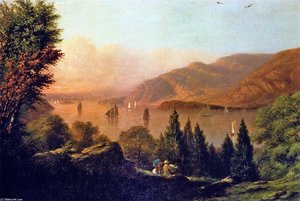
Portrait of Robert Walter Weir

The 32 Most Famous Robert Walter Weir Paintings, a Gallery Selection

Updated November 2026 · ranked by our popularity score (searches, visits and orders for each work) · 33 works by Robert Walter Weir in our catalogue

In short

Of all the originals Robert Walter Weir left, the most famous is Embarkation of the Pilgrims (1837), in the collection of the Brooklyn Museum, Brooklyn. Close behind it come The Duke of Bourbon's Halt at La Riccia, on His March to the Assau Rome, May 3d, 1527 (1834) and The Merry Wives of Windsor: Dr. Caius, Simple and Dame Quickly (1830). Our catalog holds 33 works by Robert Walter Weir; the gallery has kept the 32 the world admires most, each shown with its date, its museum and its story.

1803 – 1889, New Rochelle Hudson river school Most works: New York Historical Society

Robert Walter Weir's top 10 paintings: the gallery's choice

1
Embarkation of the Pilgrims (1837) by Robert Walter Weir

Embarkation of the Pilgrims

1837 · Oil On Canvas · Brooklyn Museum, Brooklyn

The air feels heavy with the salt spray of the sea and the weight of an uncertain future. On the deck of the ship Speedwell, a group of travelers gathers, their faces etched with a mixture of solemnity and quiet determination. They stand at the threshold of the unknown, poised between the lives they are leaving behind and the vast, Atlantic expanse that awaits them. The scene captures a pause…

2
The Duke of Bourbon's Halt at La Riccia, on His March to the Assau Rome, May 3d, 1527 (1834) by Robert Walter Weir

The Duke of Bourbon's Halt at La Riccia, on His March to the Assau Rome, May 3d, 1527

1834 · Oil · Los Angeles County Museum of Art, Los Angeles

The painting titled The Duke of Bourbon's Halt at La Riccia, on His March to the Assau Rome, May 3d, 1527 was executed by the artist Robert Walter Weir. Created in 1834, this oil on wood work depicts a specific moment during a military movement. The subject matter focuses on the Duke of Bourbon's halt during his march toward the Assau in Rome.

3
The Merry Wives of Windsor: Dr. Caius, Simple and Dame Quickly (1830) by Robert Walter Weir

The Merry Wives of Windsor: Dr. Caius, Simple and Dame Quickly

1830 · Oil On Canvas · Smithsonian American Art Museum, Washington, D.C.

The scene unfolds within the dramatic world of Shakespeare, specifically capturing a moment from The Merry Wives of Windsor. This oil on canvas painting, titled The Merry Wives of Windsor: Dr. Caius, Simple and Dame Quickly, brings a theatrical tension to life. The figures appear caught in a sudden, startling encounter that feels as though it is happening right before our eyes. It is a work that breathes with the…

4
Mrs. Bradford Ripley Alden and her Children (1852) by Robert Walter Weir

Mrs. Bradford Ripley Alden and her Children

1852 · Oil · Detroit Institute of Arts, Detroit

The portrait titled Mrs. Bradford Ripley Alden and her Children was painted by Robert Walter Weir. This work, dating to about 1852, captures a quiet domestic scene within an elegantly appointed interior. The subject of the painting is Mrs. Bradford Ripley Alden and her Children, presented in a moment of familial stillness.

8
Winfield Scott (1855) by Robert Walter Weir

Winfield Scott

1855 · Oil On Canvas · National Portrait Gallery, Washington, D.C.

The oil painting titled General Winfield Scott features the likeness of the military leader Winfield Scott. Painted by Robert Walter Weir about 1855, the work captures a man defined by his service. Scott’s history is etched into the fabric of American conflict, having served in the War of 1812 and the Indian Wars. He held the rank of brevetted major general in 1814 and eventually rose to the position of…

The Robert Walter Weir selection continues, 11 to 32

Robert Walter Weir's famous paintings, period by period

The subjects that held Robert Walter Weir's eye

The four subjects that come back most often in these originals, each with its finest example.

The museums that keep Robert Walter Weir's originals

The 8 museums that hold the most of the paintings on this page.

Museum City Works by Robert Walter Weir Paintings from this list
New York Historical Society, New York CityNew York Historical Society New York City 5 Sagoyewatha, or "Red Jacket" (ca. 1758–1830), Self-Portrait, Robert Walter Weir (1803-1889)
Smithsonian American Art Museum, Washington, D.C.Smithsonian American Art Museum Washington, D.C. 3 The Merry Wives of Windsor: Dr. Caius, Simple and Dame Quickly, (Moses Viewing the Promised Land), St. Nicholas
Detroit Institute of Arts, DetroitDetroit Institute of Arts Detroit 3 Mrs. Bradford Ripley Alden and her Children, The Hudson River from Hoboken, Landscape
Museum of Fine Arts, BostonMuseum of Fine Arts Boston 2 Bianca, Bay of Naples
Yale University Art Gallery, HartfordYale University Art Gallery Hartford 2 The Microscope, Taking the Veil
Brooklyn Museum, BrooklynBrooklyn Museum Brooklyn 1 Embarkation of the Pilgrims
Los Angeles County Museum of Art, Los AngelesLos Angeles County Museum of Art Los Angeles 1 The Duke of Bourbon's Halt at La Riccia, on His March to the Assau Rome, May 3d, 1527
National Portrait Gallery, Washington, D.C.National Portrait Gallery Washington, D.C. 1 Winfield Scott

Robert Walter Weir decade by decade: the original that defines each

Works per decade

Pick a decade to see the original that defines it.

Collectors' questions about Robert Walter Weir's paintings

Which work is Robert Walter Weir most famous for?Reveal the answer

Embarkation of the Pilgrims (1837), Brooklyn Museum, Brooklyn. The Duke of Bourbon's Halt at La Riccia, on His March to the Assau Rome, May 3d, 1527 (1834) and The Merry Wives of Windsor: Dr. Caius, Simple and Dame Quickly (1830) come next.

What age was Robert Walter Weir when Embarkation of the Pilgrims was made?Reveal the answer

34 years old: Embarkation of the Pilgrims dates from 1837, and Robert Walter Weir was born in 1803.

What are the ten most famous Robert Walter Weir paintings?Reveal the answer

Embarkation of the Pilgrims, The Duke of Bourbon's Halt at La Riccia, on His March to the Assau Rome, May 3d, 1527, The Merry Wives of Windsor: Dr. Caius, Simple and Dame Quickly, Mrs. Bradford Ripley Alden and her Children, Sagoyewatha, or "Red Jacket" (ca. 1758–1830), Self-Portrait, Bianca, Winfield Scott, Robed Man in an Archway and (Moses Viewing the Promised Land). The ranking above gives each one's year and museum.

How many paintings did Robert Walter Weir leave?Reveal the answer

Our catalog holds 33 works by Robert Walter Weir, dated from 1824 to 1881.

In which museums do Robert Walter Weir's masterpieces hang?Reveal the answer

Mostly in New York Historical Society (New York City), Smithsonian American Art Museum (Washington, D.C.) and Detroit Institute of Arts (Detroit). The museum table above lists them all.

In which years did Robert Walter Weir paint the most famous works?Reveal the answer

In 1830s: 10 of the 32 works on this page were made then, Embarkation of the Pilgrims among them.

What are the first and the last famous originals of Robert Walter Weir?Reveal the answer

On this page, the earliest is Self-Portrait (1824) and the latest Picnic along the Hudson (1881).

Which subjects did Robert Walter Weir choose most often?Reveal the answer

Sky (3), Man (3) and Woman (2), across the 32 works on this page.

Which technique did Robert Walter Weir use most?Reveal the answer

Oil On Canvas, for 5 of the 32 works on this page.

To which art movement does Robert Walter Weir belong?Reveal the answer

Hudson river school, judging by the originals on this page.

Which Robert Walter Weir works hang at the New York Historical Society?Reveal the answer

Sagoyewatha, or "Red Jacket" (ca. 1758–1830), Self-Portrait and Robert Walter Weir (1803-1889): the New York Historical Society, New York City holds 5 of the works on this page.

Robert Walter Weir: life and work

A Life Etched in History: The World of Robert Walter Weir

Robert Walter Weir, born in New York City on June 18, 1803, was a figure deeply interwoven with the artistic and educational fabric of 19th-century America. His life story is one of self-driven dedication, a thirst for classical knowledge, and an enduring commitment to fostering creativity in others. The early years saw the Weir family move between New York City and New Rochelle before settling back in the city by 1817. Though initially engaged in mercantile work, young Robert felt the pull of artistic expression, abandoning commerce at eighteen in 1821 to wholeheartedly pursue painting. This decision marked the beginning of a journey that would see him become not only a respected artist but also a pivotal educator who shaped the minds of future leaders. Weir’s initial training was largely self-directed, honed through diligent study within New York City from 1822 to 1824. However, it was his subsequent sojourn to Italy – Florence (1824-1825) and Rome (1825-1827) – that truly ignited his artistic sensibilities. Immersed in the masterpieces of Michelangelo and Raphael, he absorbed the principles of Renaissance composition and detail, influences that would resonate throughout his career.

From Canvas to Classroom: A Dual Legacy

Upon returning to New York in 1827, Weir quickly integrated into the burgeoning artistic community. He exhibited regularly at the National Academy of Design, achieving associate membership in 1829 and full academician status by 1831 – testaments to his growing skill and recognition. However, it was a different path that would define much of his life’s work: education. In 1834, he accepted the position of Teacher of Drawing at the United States Military Academy at West Point, New York. This appointment wasn't merely a job; it was a calling. He rose to become Professor of Drawing in 1846 and remained dedicated to this role for an extraordinary forty-two years, until 1876. The impact of his tenure is almost immeasurable. Weir didn’t just teach drawing; he instilled an appreciation for art, observation, and visual thinking within a generation of future military officers. Among his students were names that would become synonymous with the Civil War: Ulysses S. Grant, Robert E. Lee, Jefferson Davis, and James Abbott McNeill Whistler – a remarkable roster demonstrating the breadth of his influence. He also mentored Seth Eastman, another notable artist who documented Native American life. His pedagogical approach wasn’t simply about technical skill; it was about cultivating a discerning eye and fostering creative problem-solving abilities that would serve these men well in their future endeavors.

The Hudson River School & Historical Narratives

Weir is rightfully considered a member of the Hudson River School, an American art movement celebrated for its romantic depictions of the nation’s landscapes. While his canvases often featured historical subjects, they were imbued with the same sense of grandeur and reverence for nature characteristic of the school. His artistic style was deeply rooted in classical principles gleaned from his Italian studies – a meticulous attention to detail, balanced compositions, and a dramatic use of light and shadow. However, he wasn’t merely replicating Renaissance techniques; he adapted them to American themes and narratives. Perhaps his most iconic work is The Embarkation of the Pilgrims, commissioned by the United States Congress in 1837 and installed within the rotunda of the U.S. Capitol in 1843. This monumental painting isn’t just a historical depiction; it's a powerful allegory of courage, faith, and the founding principles of America. Other significant works include *Bourbons Last March*, *Landing of Hendrik Hudson*, *Our Lord on the Mount of Olives* and *Columbus before the Council of Salamanca*. These paintings demonstrate his versatility and commitment to capturing pivotal moments in history with both accuracy and emotional resonance.

Family, Influence & Enduring Recognition

Robert Walter Weir’s legacy extends far beyond his own artistic achievements. He established a family tradition of artistic excellence; two of his sons followed in his footsteps. John Ferguson Weir became a respected painter and sculptor, while Julian Alden Weir distinguished himself as a prominent portrait, figure, and landscape artist – further solidifying the Weir name within American art history. Robert Walter Weir married twice and fathered sixteen children, creating a vibrant family life alongside his professional pursuits. He passed away in 1889, leaving behind a rich artistic heritage and an enduring impact on American education. Today, his works continue to be displayed in prominent museums and collections, ensuring that his contributions remain visible and appreciated by generations to come. His influence can still be felt through the countless artists he inspired, both directly as students and indirectly through his dedication to fostering creativity and critical thinking.

A Lasting Impression

  • Hudson River School Connection: Weir’s membership in this influential movement cemented his place within the canon of American landscape painting.
  • West Point Legacy: His four decades at West Point profoundly shaped the artistic sensibilities of numerous future military leaders, demonstrating the power of art education.
  • Historical Painting Mastery: Works like *The Embarkation of the Pilgrims* exemplify his ability to capture significant historical events with dramatic effect and symbolic depth.
  • Family Artistic Dynasty: The success of his sons, John Ferguson Weir and Julian Alden Weir, further amplified the family’s contribution to American art.
Robert Walter Weir was more than just a painter; he was an educator, a mentor, and a cultural force. His life serves as a testament to the enduring power of artistic expression and the importance of nurturing creativity in all its forms. He remains a significant figure in American art history, whose work continues to inspire and resonate with audiences today.