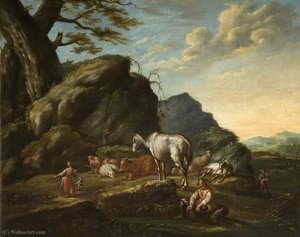
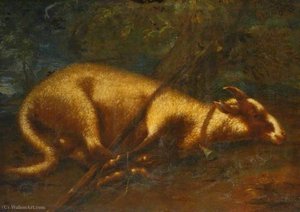
Goats and Flock of Sheep
Goats and Flock of Sheep is an oil painting by Philipp Peter Roos. The artist, who was also known by the moniker Rosa di Tivoli, produced this work about 1681. He was a German Baroque painter born in Sankt Goar, Germany.
In short
Of all the originals Philipp Peter Roos left, the most famous is Goats and Flock of Sheep (1681), in the collection of the Bavarian State Painting Collections, Munich. Close behind it come Piece of Livestock (1681) and Landscape with Cattle and Shepherd (1681). Our catalog holds 93 works by Philipp Peter Roos; the gallery has kept the 92 the world admires most, each shown with its date, its museum and its story.
Goats and Flock of Sheep is an oil painting by Philipp Peter Roos. The artist, who was also known by the moniker Rosa di Tivoli, produced this work about 1681. He was a German Baroque painter born in Sankt Goar, Germany.
Piece of Livestock is an oil painting by Philipp Peter Roos, executed in 1681. The work originates from the Baroque period, a time when the artist was establishing his presence within the Italianate landscape tradition.
Landscape with Cattle and Shepherd is a work by the German Baroque painter Philipp Peter Roos. Created about 1681, the painting reflects the artist's specialized focus on pastoral scenes and animal subjects. Roos was a significant figure in the development of Italianate landscapes, often characterized by his intimate study of livestock and the natural environment.
In Piece of Livestock, Philipp Peter Roos organizes a pastoral scene through a close-up, ground-level perspective that establishes an immediate intimacy with the subjects. The composition is dominated by a large, seated cow positioned slightly to the right of the center. To the left, a smaller lamb or calf provides a sense of scale, while a woman interacts with a dog in the space behind the primary subject. This arrangement…
Resting Flock with Shepherds is an oil painting by the German Baroque artist Philipp Peter Roos. Created about 1681, this work captures a quiet moment within a rugged landscape. The composition focuses on a group of livestock and a shepherd, rendered with a sense of immediate presence that draws the viewer into the scene.
Resting Flock with Shepherds is an oil painting by Philipp Peter Roos. The canvas captures a heavy stillness among livestock and their guardian. This work was created about 1681. It presents a scene of animals and men gathered in a quiet, layered space under a turbulent sky.
In this Baroque-style oil painting, the mythological drama of the Liberation of Io unfolds with a sudden, heavy intensity. Created by Philipp Peter Roos about 1681, the scene captures a moment of profound tension between the divine and the mortal. A massive, powerful bull dominates the foreground, its muscular form rendered with a weight that feels almost tangible. This central figure looms over the landscape, its presence commanding the space…
This oil on canvas painting, dated 1681, presents a monochromatic scene rendered in various shades of gray. In the foreground, a young woman is positioned amidst a group of livestock, including sheep or goats. The composition is a medium shot, placing the human subject and the animals in the immediate front and middle ground. The terrain is undulating, forming rolling hills that recede into a background of hazy mountains and…
Returning Flock with Shepherds is an oil painting by Philipp Peter Roos. Created about 1681, the work captures a quiet moment of pastoral movement. The artist, a German Baroque painter, was born in Sankt Goar. He would later become known by the moniker Rosa di Tivoli.
The scene unfolds in Shepherd with Cow, Sheep and Goats in Italian Mountain Landscape, a work that captures a quiet moment of pastoral life. This painting, created about 1680, brings together a shepherd and his diverse herd amidst a rugged, mountainous setting. The figures and animals exist within a landscape that feels both immediate and deeply rooted in the natural world.
The four subjects that come back most often in these originals, each with its finest example.
The 8 museums that hold the most of the paintings on this page.
| Museum | City | Works by Philipp Peter Roos | Paintings from this list |
|---|---|---|---|
| Munich | 15 | Goats and Flock of Sheep, Piece of Livestock, Landscape with Cattle and Shepherd | |
| Copenhagen | 5 | Cattle Piece, Landscape with a Bull, Sheep and Goats, A Shepherd with his Herd | |
| Buenos Aires | 4 | Landscape with shepherd and animals, Landscape with figures and animals, Shepherd and animals in a landscape | |
| Bratislava | 3 | Goat Herd with a Goatherd, Shepherd's Idyl in a Romantic Landscape with Ruins, Herd by an Ancient Well | |
| Prague | 3 | Ravine with a Stream, a Shepherd and His Herd, Horse and Goats Grazing, Shepherd with a Herd of Sheep and Goats | |
| Vienna | 3 | Herd with Sleeping Shepherds, Rider Meeting, Landscape with Flock of Sheep | |
| Saint Petersburg | 3 | Landscape with a Grotto, Landscape with a Waterfall, Landscape with a Herd | |
| Stockholm | 3 | Dead Hare, Landskap med hjord, A Goat Resting |
Pick a decade to see the original that defines it.
This large-scale oil painting, dated 1669, presents a crowded, maximalist composition of diverse animal species. The arrangement is packed, with various animals overlapping to create a sense of density and movement. The color palette relies on deep, earthy tones, including rich browns, blacks, and dark ochres. These dark shades are interrupted by specific highlights of white and cream, alongside splashes of red from a rooster and parrots. The lighting follows…
Goats and Flock of Sheep is an oil painting by Philipp Peter Roos. The artist, who was also known by the moniker Rosa di Tivoli, produced this work about 1681. He was a German Baroque painter born in Sankt Goar, Germany.
A heavy, dark-colored cow anchors the center of this scene, its presence felt in the weight of its silhouette. To the left, two goats rest upon the ground, one a pale contrast of white and light tan against the shadows. A man sits nearby, leaning back in a moment of stillness, his gaze directed toward the animals or perhaps the viewer. The air in the enclosure feels thick and dim,…
In this work, titled Shepherd's Idyl in a Romantic Landscape with Ruins, the artist Philipp Peter Roos presents a quiet moment of rural existence. Created about 1700, the painting captures a shepherd tending to his flock amidst a landscape of rolling hills and weathered stone structures. There is a sense of stillness in the way the figures and animals occupy the space, suggesting a life governed by the rhythms of…
Goats and Flock of Sheep (1681), Bavarian State Painting Collections, Munich. Piece of Livestock (1681) and Landscape with Cattle and Shepherd (1681) come next.
24 years old: Goats and Flock of Sheep dates from 1681, and Philipp Peter Roos was born in 1657.
Goats and Flock of Sheep, Piece of Livestock, Landscape with Cattle and Shepherd, Piece of Livestock, Resting Flock with Shepherds, Resting Flock with Shepherds, Liberation of Io, Piece of Cattle, Returning Flock with Shepherds and Shepherd with Cow, Sheep and Goats in Italian Mountain Landscape. The ranking above gives each one's year and museum.
Our catalog holds 93 works by Philipp Peter Roos, dated from 1669 to 1700.
Mostly in Bavarian State Painting Collections (Munich), Statens Museum For Kunst (Copenhagen) and National Museum of Fine Arts (Buenos Aires). The museum table above lists them all.
In 1680s: 21 of the 92 works on this page were made then, Goats and Flock of Sheep among them.
On this page, the earliest is Various animals gathered before Noah's Ark (1669) and the latest Shepherd's Idyl in a Romantic Landscape with Ruins (1700).
Landscape (34), Animals (30) and Goats (19), across the 92 works on this page.
Oil On Canvas, for 18 of the 92 works on this page.
Baroque, judging by the originals on this page.
Goats and Flock of Sheep, Piece of Livestock and Landscape with Cattle and Shepherd: the Bavarian State Painting Collections, Munich holds 15 of the works on this page.
In the golden light of the Italian Baroque, few names evoke the pastoral serenity of the countryside quite like Philipp Peter Roos. Known to history by his evocative moniker, Rosa di Tivoli, this German-born master transformed the landscape genre through a profound, almost visceral connection to the natural world. Born in 1655 in the Rhineland region—specifically near Sankt Goar—Roos was destined for the brush from his earliest years. He was the son of Johann Heinrich Roos, a respected landscape painter who provided the foundational lessons in tonal harmony and compositional balance that would later define the artist's mature style. This early apprenticeship was not merely about technique; it was an immersion into a way of seeing the world through the lens of light, shadow, and the quiet dignity of the earth.
The trajectory of Roos’s life shifted dramatically in 1677, a moment precipitated by the generosity of Charles I, Landgrave of Hesse-Kassel. Recognizing the burgeoning talent within the young painter, the Landgrave provided the financial means for Roos to embark on a transformative journey to Rome. This migration from the Germanic traditions to the heart of the Italian Baroque allowed Roos to absorb the vibrant energy of Roman art. It was here that he sought mentorship under the celebrated Giacinto Brandi, whose influence helped refine Roos’s ability to blend classical structure with a more spontaneous, atmospheric realism. This period in Rome was also deeply personal; it was during these years that Roos fell in love with Isabella Brandi, the daughter of his mentor. Their union would eventually lead him to settle in Tivoli, a move that would forever link his identity to the landscape he so loved.
What truly distinguishes the oeuvre of Rosa di Tivoli is the unparalleled authenticity of his animal subjects. Unlike many of his contemporaries who used animals as mere decorative afterthoughts in a landscape, Roos treated every creature—from the heavy-set bull to the nimble goat—with the reverence of a portraitist. His residence in Tivoli was famously designed around a concept akin to a living studio; he maintained a sprawling collection of exotic and domestic animals, effectively turning his surroundings into a continuous study of movement, anatomy, and temperament. This intimate proximity allowed him to capture the subtle twitch of an ear or the muscular tension of a beast under duress, lending his canvases a breathtaking vitality.
His technical mastery is evident in the way he navigated the complexities of the Baroque aesthetic. While his compositions often draw upon the serene, atmospheric qualities of the Dutch Golden Age, they are infused with a dramatic intensity characteristic of the Italian school. His works frequently feature:
The historical importance of Philipp Peter Roos lies in his ability to bridge the gap between the structured landscape traditions of Northern Europe and the emotive, light-filled drama of Italy. He emerged at a time when the scientific inquiry of the era was beginning to demand more precise observations of the natural world, even as religious and mythological themes still dominated the artistic consciousness. In his paintings, one finds both the meticulous detail of a naturalist and the poetic soul of a romantic. By documenting the flora and fauna of the Roman countryside with such devotion, he created a visual record that is as much about the spirit of the age as it is about the subjects themselves.
Though he passed away in 1706, leaving behind a legacy etched into the very soil of Tivoli, his influence endured. He remains a pivotal figure for anyone studying the evolution of animalier painting and the development of the Italianate landscape. Through his eyes, we do not merely see a collection of livestock; we witness a profound celebration of life in its most fundamental, unadorned forms. His work continues to resonate as a testament to the power of observation and the enduring beauty of the pastoral ideal.