Early Life and Background
- Born: September 27, 1859, Bridgeport, Ohio
- Died: August 29, 1953
- Parents: Irish immigrant parents; father was a merchant.
- Early Fascination: Developed a strong interest in American Indians from a young age.
- Hearing Loss: Nearly drowned as a boy, resulting in permanent hearing loss which significantly impacted his education and communication. He learned to read lips and carried a writing pad.
- Early Work: Worked in a nail factory at the age of 12 to support his family after his father's death.
Education and Artistic Training
- McMicken School of Design, Cincinnati: Briefly attended before financial constraints forced him to leave school.
- European Studies (1881-1886): Traveled to Europe where he studied at the Royal Academy of Fine Arts in Antwerp, Belgium.
- Return to Cincinnati & Mentorship: Returned to Cincinnati and worked alongside Henry Farny, though Farny discouraged painting Native Americans.
- Royal Academy of Munich: Studied at the Royal Academy of Fine Arts (Munich) and later with Frank Duveneck in Italy.
- Académie Julian, Paris: Furthered his studies at the Académie Julian in Paris, influenced by Barbizon painters and Impressionists.
Artistic Style and Subject Matter
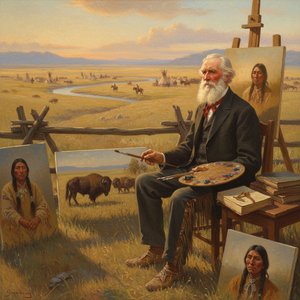
- Realism & Portraiture: Known for realistic portrayals of American Indians, focusing on their cultural life and individual characteristics.
- Influences: Influenced by the Barbizon school and Impressionism, evident in his use of light and shadow and broad brushstrokes.
- Key Subjects: Primarily painted portraits of Native American warriors, chiefs, and everyday people, as well as Western landscapes.
- Commissioned Work: Received a significant commission from President Theodore Roosevelt to paint 200 portraits of Native American warriors who survived the Battle of Little Bighorn.
- Absarokee Hut: Built a cabin (Absarokee Hut) on Crow Agency land in Montana, allowing him extended time to study and depict Native American life.
Major Achievements and Recognition
- Taos Society of Artists Founding Member: A founding member of the Taos Society of Artists, considered its "spiritual father."
- Smithsonian Institution Acquisition: The Smithsonian Institution purchased eleven of his portraits in 1901.
- Phoebe Hearst Patronage: Received significant support from Phoebe Hearst, who acquired over 150 of his works.
- Thomas Gilcrease Collection: A large portion of his work and personal collection were purchased by Thomas Gilcrease, now housed at the Gilcrease Institute.
- Recognition for Ethnographic Value: Recognized by curator W.H. Holmes for the accuracy with which he portrayed Native American physiognomy and costumes.
Historical Significance
- Documenting Native American Culture: Sharp's work provides valuable documentation of Native American life during a period of significant cultural change and displacement.
- Early Western Artist in Taos: One of the earliest European-American artists to establish a presence in Taos, New Mexico, contributing to its artistic development.
- Influence on Southwestern Art: His focus on Native American subjects helped shape the direction of Southwestern art and influenced subsequent generations of artists.
- Preservation of Portraiture: Created a significant body of portraiture that captures the likenesses and dignity of individuals from various Native American tribes, preserving their memory for posterity.
Questions & Answers
How is Joseph Henry Sharp's career divided into periods?
A chronological account of Joseph Henry Sharp's work is available on the artist's Chronicle page, where the artworks pass in order of creation, chapter by chapter.
How do I find works by Joseph Henry Sharp in a specific palette?
The By Palettes page groups Joseph Henry Sharp's artworks by their color palettes.
How many artworks by Joseph Henry Sharp are available to browse?
You can browse 98 artworks by Joseph Henry Sharp on the All Artworks page.