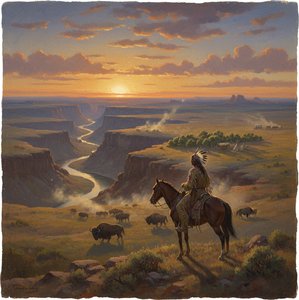
The Painter of the Vanishing Race
Henry François Farny, known to many as H.F. Farny, remains one of the most evocative voices in nineteenth-century American art. Born in 1847 in Ribeauville, France, his journey eventually led him to the heart of the American frontier, where he would develop a style that became synonymous with the "vanishing race" movement. His life was a tapestry woven from European training and an intimate, early connection to the indigenous cultures of the United States. After emigrating to Pennsylvania as a child, Farny found himself near the Seneca Reservation, an experience that planted the seeds of a lifelong fascination with Native American life. As a young boy, he practiced his craft by etching sketches of animals and warriors onto the walls of his father’s boarding house, using nothing more than nails and burnt sticks—a primitive yet profound beginning to a career defined by meticulous observation.
The evolution of Farny’s technique was marked by a sophisticated blend of American subject matter and European academic rigor. Moving to Cincinnati in 1859, he quickly demonstrated a talent for illustration that secured him early professional success. However, it was his pursuit of formal training in Germany that truly refined his hand. Under the influence of the Düsseldorf School of Painting, Farny adopted a realist aesthetic characterized by a subdued palette and an extraordinary attention to texture. This period allowed him to master the ability to render the subtle play of light across a desert landscape or the intricate details of traditional Native American regalia, lending his work a sense of historical weight and dignity.
A Legacy of Realism and Symbolism
Farny’s body of work serves as a poignant window into a transformative era of American history. His paintings are rarely mere illustrations; they are deeply atmospheric compositions that capture the tension, beauty, and perceived tragedy of the frontier. Through works such as "Sketch for The Challenge", one can witness his ability to use a single figure—a Native American warrior—to represent larger themes of confrontation and cultural shift. His mastery of the landscape allowed him to create settings that were not just backdrops, but active participants in the narrative, often utilizing the vastness of the plains or the starkness of the desert to mirror the emotional gravity of his subjects.
The significance of Farny’s contribution to the Cincinnati School of Painting lies in his ability to balance romanticism with unflinching realism. While his work participated in the era's romanticized vision of the West, his technical precision prevented it from descending into mere caricature. His paintings often explored themes of daily survival and communal life, as seen in pieces like "Toilers of the Plains" and "A Lucky Shot," which highlight the grit and reality of existence on the edge of a changing world. By documenting these scenes with such care, Farny created a visual archive that continues to resonate with historians and art lovers alike, preserving the spirit of a culture and a landscape that were undergoing profound and permanent change.
Questions & Answers
How did Henry Farny's art evolve over time?
Henry Farny's career unfolds period by period on the artist's Chronicle page: a horizontal timeline of the artworks, grouped into career-period chapters.
How can I see every artwork made by Henry Farny?
Every work by Henry Farny on this website can be browsed from the artist's All Artworks page.
Can I study Henry Farny's use of color across all works?
Henry Farny's use of color across the works listed on this website can be studied on the artist's Palette Genome page.
Which artworks by Henry Farny are the most viewed?
Statistics about Henry Farny's works are available on the artist's Stats page.