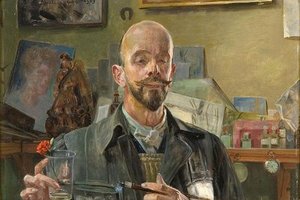
Portrait of Jacek Malczewski

The 100 Most Famous Jacek Malczewski Paintings, Each One of a Kind

Updated October 2026 · ranked by our popularity score (searches, visits and orders for each work) · 568 works by Jacek Malczewski in our catalogue

In short

Self-portrait in armor with violin. (1908) is the Jacek Malczewski painting that draws the most eyes; the original belongs to the National Museum in Warsaw, Warsaw. After it, the eye goes to Madonna and Children (1897) and Portrait of artist's sister Helene with lute (1906). Among the 568 works of Jacek Malczewski in our catalog, these 100 are the most famous, each a unique original presented with its year, its museum and the reason it endures.

1854 – 1929, Radom Symbolism Most works: National Museum in Warsaw

Top 10 paintings by Jacek Malczewski, through the gallery's eye

1
Self-portrait in armor with violin. (1908) by Jacek Malczewski

Self-portrait in armor with violin.

1908 · Oil · National Museum in Warsaw, Warsaw

A man sits encased in polished plate armor, his form a heavy silhouette against a forest of burning autumn colors. He is bald, his face framed by a coarse, well-groomed beard that catches the light. In his right hand, he grips a violin bow; in his left, the neck of a violin. A small religious icon hangs from his chest, resting against the cold steel of his breastplate. The metal…

2
Madonna and Children (1897) by Jacek Malczewski

Madonna and Children

1897 · Oil On Canvas · National Museum in Kraków, Krakow

This oil on canvas painting, created in 1897, presents a classically composed scene centered on a maternal figure, likely a Madonna. The composition follows a pyramidal structure, with the seated woman forming the apex of the group, flanked symmetrically by several children. The figure is draped in a vibrant blue mantle over a warm, earthy red gown, creating a striking contrast against the muted browns, greens, and flesh tones of…

3
Portrait of artist's sister Helene with lute (1906) by Jacek Malczewski

Portrait of artist's sister Helene with lute

1906 · Oil On Canvas · National Museum in Warsaw, Warsaw

A woman sits in a contemplative pose, her hands poised over a lute. The composition follows a sharp diagonal, drawing the eye from the instrument in the lower left toward the upper right. Through a window behind her, a wintry landscape unfolds, revealing snow-dusted hills and rooftops under an overcast sky. The scene is quiet, marked by a sense of solitude and the stillness of a cold afternoon.

5
Eloe by Jacek Malczewski

Eloe

Oil On Canvas

In Eloe, Jacek Malczewski presents a complex pair of intertwined figures. Created about 1909, the work draws from the artist's recurring theme of winged angels. A female figure occupies the foreground, her form defined by the presence of wings. She exists in a state of quiet tension against the backdrop of the composition.

6
Self-Portrait in a Studio by Jacek Malczewski

Self-Portrait in a Studio

Oil On Canvas

In Self-Portrait in a Studio, the artist Jacek Malczewski places himself within the quiet confines of his own workspace. This is a direct encounter with the man behind the brush, captured amidst the tools of his trade. He sits surrounded by the artifacts of his daily labor, from cluttered tables laden with art supplies to the presence of unfinished canvases. The studio becomes a vessel for his presence, a space…

7
Gardener by Jacek Malczewski

Gardener

Oil On Canvas

In the quietude of this scene, we find the Gardener, a work by the Polish symbolist painter Jacek Malczewski. The woman sits motionless upon a simple wooden chair, her presence anchored within a classical architectural frame. Large, fluted columns rise to meet the sky, creating a threshold between the structured porch and the wild, lush greenery that waits just beyond. A soft, diffused light washes over the scene from the…

8
Old man at a water well (1903) by Jacek Malczewski

Old man at a water well

1903 · Oil · National Museum in Warsaw, Warsaw

In this 1903 oil painting, we find ourselves drawn into a private, somber moment of reflection. An elderly man sits alone, his head bowed and resting heavily upon his hand, a posture that speaks of profound thought or perhaps a deep-seated weariness. The composition is intimate, pulling the viewer close to the subject to witness this quiet, internal struggle. He is framed by a textured, mottled green background that suggests…

9
Portrait of Michał Gorstkin-Wywiórski (1892) by Jacek Malczewski

Portrait of Michał Gorstkin-Wywiórski

1892 · Oil On Canvas · National Museum in Warsaw, Warsaw

The gaze of the sitter meets us in the Portrait of Michał Gorstkin-Wywiórski, a work that captures a specific moment of quiet dignity. Jacek Malczewski, the hand behind this composition, renders the subject with a focus that feels immediate and present. This oil on canvas portrait presents Michał Gorstkin-Wywiórski as he exists within the frame, a man whose presence occupies the space with a steady, thoughtful energy.

Jacek Malczewski's famous paintings, numbers 11 to 100

11Polonia by Jacek MalczewskiPolonia 12Shepherd and Chimera by Jacek MalczewskiShepherd and Chimera 13Portrait of Stanisław Tondos (1893) by Jacek MalczewskiPortrait of Stanisław Tondos1893 · National Museum in Kraków 14Portrait of Julia, the artist's daughter with a doll. (1893) by Jacek MalczewskiPortrait of Julia, the artist's daughter with a doll.1893 · National Museum in Warsaw 15Funeral of a painter's apprentice (1911) by Jacek MalczewskiFuneral of a painter's apprentice1911 · National Museum in Warsaw 16Two girls with a pitcher (1885) by Jacek MalczewskiTwo girls with a pitcher1885 · National Museum in Warsaw 17Portrait of artist’s mother (1880) by Jacek MalczewskiPortrait of artist’s mother1880 · National Museum in Warsaw 18Drowned Man in the Embraces of a Wild Woman (Rusalka Cycle) (1888) by Jacek MalczewskiDrowned Man in the Embraces of a Wild Woman (Rusalka Cycle)1888 19Students exile (1891) by Jacek MalczewskiStudents exile1891 20Woman Slaughtering Hens (1890) by Jacek MalczewskiWoman Slaughtering Hens1890 · National Museum in Kraków 21Exiles (1891) by Jacek MalczewskiExiles1891 · National Museum in Kraków 22In Autumn (1890) by Jacek MalczewskiIn Autumn1890 · National Museum in Kraków 23On the way to exile (Convicts on the way to Siberia) (1890) by Jacek MalczewskiOn the way to exile (Convicts on the way to Siberia)1890 · National Museum in Warsaw 24Foot washing (Siberian scene) (1886) by Jacek MalczewskiFoot washing (Siberian scene)1886 · National Museum in Warsaw 25Edward and Roger Raczyński (1897) by Jacek MalczewskiEdward and Roger Raczyński1897 · The National Museum in Poznań 26Portrait of Leon Wyczółkowski (1895) by Jacek MalczewskiPortrait of Leon Wyczółkowski1895 · National Museum in Kraków 27Artist and Muse (1898) by Jacek MalczewskiArtist and Muse1898 28Spring (1898) by Jacek MalczewskiSpring1898 · National Museum in Kraków 29Christ in Emmaus (1897) by Jacek MalczewskiChrist in Emmaus1897 · National Museum in Warsaw 30In front of the houe – artist’s wife and daughter (1896) by Jacek MalczewskiIn front of the houe – artist’s wife and daughter1896 · National Museum in Warsaw 31The Artist's Wife (1905) by Jacek MalczewskiThe Artist's Wife1905 32Law. (Triptych Law, Country, Art). (1903) by Jacek MalczewskiLaw. (Triptych Law, Country, Art).1903 · National Museum in Wrocław 33Portrait of Ludwik Stasiak (1900) by Jacek MalczewskiPortrait of Ludwik Stasiak1900 34A Lark. Portrait of the Painter Antoni Zembaczyński (1902) by Jacek MalczewskiA Lark. Portrait of the Painter Antoni Zembaczyński1902 · The National Museum in Poznań 35Portrait of Tadeusza Błotnickiego (1901) by Jacek MalczewskiPortrait of Tadeusza Błotnickiego1901 36Angels with Tobias. (1900) by Jacek MalczewskiAngels with Tobias.1900 37Portrait of Wacław Karczewski and Helena Karczewska (1900) by Jacek MalczewskiPortrait of Wacław Karczewski and Helena Karczewska1900 · National Museum in Warsaw 38Portrait of actress Helena Sulima (1903) by Jacek MalczewskiPortrait of actress Helena Sulima1903 · National Museum in Warsaw 39Portrait of Helena Sulima, actress, as Gorgon (1903) by Jacek MalczewskiPortrait of Helena Sulima, actress, as Gorgon1903 · National Museum in Warsaw 40Portrait of Adolf Dygasiński (1905) by Jacek MalczewskiPortrait of Adolf Dygasiński1905 · National Museum in Warsaw 41Portrait of Adolf Dygasiński with birds (1905) by Jacek MalczewskiPortrait of Adolf Dygasiński with birds1905 · National Museum in Warsaw 42Primrose – Self-portrait with wife (1905) by Jacek MalczewskiPrimrose – Self-portrait with wife1905 · National Museum in Warsaw 43Two heads of old men (1901) by Jacek MalczewskiTwo heads of old men1901 · National Museum in Warsaw 44Soap bubbles (Woman with a cup) (1901) by Jacek MalczewskiSoap bubbles (Woman with a cup)1901 · National Museum in Warsaw 45Angel, I will follow you (1901) by Jacek MalczewskiAngel, I will follow you1901 · National Museum in Warsaw 46Spring. (1900) by Jacek MalczewskiSpring.1900 · National Museum in Warsaw 47Derwid (1902) by Jacek MalczewskiDerwid1902 · National Museum in Kraków 48Angel with Tobias (1902) by Jacek MalczewskiAngel with Tobias1902 · National Museum in Kraków 49Portrait of Aleksander Mroczkowski (1902) by Jacek MalczewskiPortrait of Aleksander Mroczkowski1902 · National Museum in Kraków 50Portrait of Alfred Stepek (1901) by Jacek MalczewskiPortrait of Alfred Stepek1901 · National Museum in Kraków 51Following the Angel – Triptych (Central Part) (1901) by Jacek MalczewskiFollowing the Angel – Triptych (Central Part)1901 · National Museum in Kraków 52Embankments of the Vistula (1900) by Jacek MalczewskiEmbankments of the Vistula1900 · National Museum in Kraków 53Portrait of Artist's Daughter Julia (1902) by Jacek MalczewskiPortrait of Artist's Daughter Julia1902 · National Museum in Kraków 54Portrait of Adolf Dygasiński (1905) by Jacek MalczewskiPortrait of Adolf Dygasiński1905 · National Museum in Warsaw 55Shepherd boy and a harpy (1905) by Jacek MalczewskiShepherd boy and a harpy1905 · National Museum in Warsaw 56Moses (1904) by Jacek MalczewskiMoses1904 · National Museum in Warsaw 57Praying man (1903) by Jacek MalczewskiPraying man1903 · National Museum in Warsaw 58Boy in the garden, sketch (Rafał, artist’s son) (1904) by Jacek MalczewskiBoy in the garden, sketch (Rafał, artist’s son)1904 · National Museum in Warsaw 59Country (1903) by Jacek MalczewskiCountry1903 · National Museum in Wrocław 60Art (1903) by Jacek MalczewskiArt1903 · National Museum in Wrocław 61Fencer (1908) by Jacek MalczewskiFencer1908 62St John with Salome, detail (1911) by Jacek MalczewskiSt John with Salome, detail1911 · The National Museum in Poznań 63Portrait of Xawery Branicki (1908) by Jacek MalczewskiPortrait of Xawery Branicki1908 64Portrait of Leon Piniński (1906) by Jacek MalczewskiPortrait of Leon Piniński1906 · Wawel Royal Castle 65Portrait of Zofia Atteslander (1908) by Jacek MalczewskiPortrait of Zofia Atteslander1908 · National Museum in Kraków 66Allegory of experience and youth (1911) by Jacek MalczewskiAllegory of experience and youth1911 67Dish washing. Wielgie (1910) by Jacek MalczewskiDish washing. Wielgie1910 · National Museum in Warsaw 68Exile – right section of the triptych (1909) by Jacek MalczewskiExile – right section of the triptych1909 · National Museum in Warsaw 69Exile – left section of the triptych (1909) by Jacek MalczewskiExile – left section of the triptych1909 · National Museum in Warsaw 70Portrait of Maria Bal (Maria Balowa) (1907) by Jacek MalczewskiPortrait of Maria Bal (Maria Balowa)1907 · National Museum in Warsaw 71Portrait of J. Armółowicz (1911) by Jacek MalczewskiPortrait of J. Armółowicz1911 · National Museum in Warsaw 72Winter landscape (1908) by Jacek MalczewskiWinter landscape1908 · National Museum in Warsaw 73Music – central section of the triptych (1906) by Jacek MalczewskiMusic – central section of the triptych1906 · National Museum in Warsaw 74Music –triptych (1906) by Jacek MalczewskiMusic –triptych1906 · National Museum in Warsaw 75Music, the right part of the triptych (1906) by Jacek MalczewskiMusic, the right part of the triptych1906 · National Museum in Warsaw 76Jacek Malczewski - Music, the left part of the triptych (1906) by Jacek MalczewskiJacek Malczewski - Music, the left part of the triptych1906 · National Museum in Warsaw 77My life - the right part of the triptych (1911) by Jacek MalczewskiMy life - the right part of the triptych1911 · National Museum in Warsaw 78Ellenai (1908) by Jacek MalczewskiEllenai1908 · National Museum in Warsaw 79John the Baptist (1911) by Jacek MalczewskiJohn the Baptist1911 · National Museum in Warsaw 80Adoration of the Madonna (1910) by Jacek MalczewskiAdoration of the Madonna1910 · National Museum in Warsaw 81Landscape with rowan trees (1909) by Jacek MalczewskiLandscape with rowan trees1909 · National Museum in Warsaw 82Landscape with rowan trees. (1909) by Jacek MalczewskiLandscape with rowan trees.1909 · National Museum in Warsaw 83The Postwoman (1908) by Jacek MalczewskiThe Postwoman1908 84Landscape with the Artist's Son on a Path (1910) by Jacek MalczewskiLandscape with the Artist's Son on a Path1910 · National Museum in Kraków 85Portrait of Adam Łada-Cybulski (1911) by Jacek MalczewskiPortrait of Adam Łada-Cybulski1911 · National Museum in Kraków 86Tobias with a Harpy (1909) by Jacek MalczewskiTobias with a Harpy1909 · National Museum in Kraków 87My Models – Triptych (Right Part) (1909) by Jacek MalczewskiMy Models – Triptych (Right Part)1909 · National Museum in Kraków 88My Models – Triptych (Central Part) (1909) by Jacek MalczewskiMy Models – Triptych (Central Part)1909 · National Museum in Kraków 89Self-Portrait (1911) by Jacek MalczewskiSelf-Portrait1911 · National Museum in Kraków 90Portrait of Leon Schenrich (1907) by Jacek MalczewskiPortrait of Leon Schenrich1907 · National Museum in Kraków 91Landscape with a Palace (1907) by Jacek MalczewskiLandscape with a Palace1907 · National Museum in Kraków 92Portrait of a Young Lady (1906) by Jacek MalczewskiPortrait of a Young Lady1906 · National Museum in Kraków 93Autumn Song (1906) by Jacek MalczewskiAutumn Song1906 · National Museum in Kraków 94At the hill of the Norbertines’ monastery (1910) by Jacek MalczewskiAt the hill of the Norbertines’ monastery1910 · National Museum in Warsaw 95My life – central section of the triptych (1911) by Jacek MalczewskiMy life – central section of the triptych1911 · National Museum in Warsaw 96In springtime (In autumn) (1908) by Jacek MalczewskiIn springtime (In autumn)1908 · National Museum in Warsaw 97Poisoned water well, sketch (1909) by Jacek MalczewskiPoisoned water well, sketch1909 · National Museum in Warsaw 98Portrait of sister Helena (1906) by Jacek MalczewskiPortrait of sister Helena1906 · National Museum in Warsaw 99Nike of the Legions (1916) by Jacek MalczewskiNike of the Legions1916 100Resignation (1913) by Jacek MalczewskiResignation1913

The subjects that held Jacek Malczewski's eye

The four subjects that come back most often in these originals, each with its finest example.

The museums that keep Jacek Malczewski's originals

The 5 museums that hold the most of the paintings on this page.

Museum City Works by Jacek Malczewski Paintings from this list
National Museum in Warsaw, WarsawNational Museum in Warsaw Warsaw 102 Self-portrait in armor with violin., Portrait of artist's sister Helene with lute, The Artist's death
National Museum in Kraków, KrakowNational Museum in Kraków Krakow 72 Madonna and Children, Portrait of Stanisław Tondos, Woman Slaughtering Hens
The National Museum in Poznań, PoznańThe National Museum in Poznań Poznań 15 Edward and Roger Raczyński, A Lark. Portrait of the Painter Antoni Zembaczyński, St John with Salome, detail
National Museum in Wrocław, WrocławNational Museum in Wrocław Wrocław 6 Law. (Triptych Law, Country, Art)., Country, Art
Wawel Royal Castle, KrakowWawel Royal Castle Krakow 2 Portrait of Leon Piniński

Jacek Malczewski across the decades: one unique original for each

Works per decade

Pick a decade to see the original that defines it.

Jacek Malczewski's paintings: questions for the gallery

What is the single most famous work of Jacek Malczewski?Reveal the answer

Self-portrait in armor with violin. (1908), National Museum in Warsaw, Warsaw. Madonna and Children (1897) and Portrait of artist's sister Helene with lute (1906) come next.

At what age did Jacek Malczewski create Self-portrait in armor with violin.?Reveal the answer

54 years old: Self-portrait in armor with violin. dates from 1908, and Jacek Malczewski was born in 1854.

Which ten paintings by Jacek Malczewski are the most famous?Reveal the answer

Self-portrait in armor with violin., Madonna and Children, Portrait of artist's sister Helene with lute, The Artist's death, Eloe, Self-Portrait in a Studio, Gardener, Old man at a water well, Portrait of Michał Gorstkin-Wywiórski and In the Dust Storm. The ranking above gives each one's year and museum.

How many works by Jacek Malczewski are known?Reveal the answer

Our catalog holds 568 works by Jacek Malczewski, dated from 1880 to 1916.

Where can the most famous Jacek Malczewski originals be seen?Reveal the answer

Mostly in National Museum in Warsaw (Warsaw), National Museum in Kraków (Krakow) and The National Museum in Poznań (Poznań). The museum table above lists them all.

During which period did Jacek Malczewski create the best-known paintings?Reveal the answer

In 1900s: 60 of the 100 works on this page were made then, Self-portrait in armor with violin. among them.

Which famous Jacek Malczewski painting is the earliest, and which the latest?Reveal the answer

On this page, the earliest is Portrait of artist’s mother (1880) and the latest Nike of the Legions (1916).

What subjects did Jacek Malczewski favour?Reveal the answer

Man (6), Woman (6) and Trees (2), across the 100 works on this page.

What materials did Jacek Malczewski paint with most?Reveal the answer

Oil On Canvas, for 8 of the 100 works on this page.

Which movement does the work of Jacek Malczewski belong to?Reveal the answer

Symbolism, judging by the originals on this page.

What Jacek Malczewski originals can I see at the National Museum in Warsaw?Reveal the answer

Self-portrait in armor with violin., Portrait of artist's sister Helene with lute and The Artist's death: the National Museum in Warsaw, Warsaw holds 49 of the works on this page.

Jacek Malczewski: a portrait of the artist

A Life Imbued with Polish Longing

Jacek Malczewski, born in 1854 in Radom, a city then nestled within the Russian-controlled Congress Poland, was more than simply a painter; he was a visual embodiment of Polish national identity and a profound voice for a nation yearning for self-determination. His life’s trajectory and artistic vision were inextricably linked to the romantic ideals of independence, deeply instilled by his father, Julian Malczewski—a dedicated patriot who cultivated in young Jacek an unwavering love for Polish culture, literature, and history. This early influence became the bedrock of his creative expression, shaping him into the leading figure of Polish Symbolism and earning him the esteemed title of “father of Polish Symbolism.” His formative years were steeped in tales of heroism, sacrifice, and a poignant awareness of Poland’s troubled past—themes that would resonate throughout his entire *oeuvre*. The family's relocation to Wielgiem, and the guidance he received from Adolf Dygasiński, further cemented this connection to Poland’s rich folklore and evocative landscapes, providing an inexhaustible wellspring of inspiration for his future artistic endeavors.

From Academic Training to Symbolic Revelation

Malczewski's artistic journey began in Kraków in 1872, where he studied under Leon Piccard at the Academy of Fine Arts, benefiting from the mentorship of Władysław Łuszczkiewicz and Feliks Szynalewski. A pivotal moment arrived with his time at the École des Beaux-Arts in Paris, exposing him to a diverse range of European artistic currents while simultaneously solidifying his commitment to a distinctly Polish aesthetic sensibility. While absorbing international influences, Malczewski never strayed far from the patriotic fervor that defined his upbringing. This unique synthesis is readily apparent in his early works, which gradually evolved from historical narratives influenced by Jan Matejko—whose dramatic style and exploration of Polish history left an indelible mark—to more complex symbolic compositions. He completed master classes with Matejko in 1879, a period where he honed his technical skills while absorbing the neo-romantic metaphors that would later characterize his own work. The influence of Artur Grottger’s dramatic art also played a crucial role in shaping Malczewski's artistic vision, particularly its emotional intensity and focus on themes of suffering and resilience.

The Language of Symbolism: A Nation’s Soul Unveiled

Malczewski’s mature style is characterized by an evocative blend of historical motifs, Christian iconography, mythological allusions, and the haunting beauty of the Polish landscape. He wasn't merely depicting scenes; he was crafting visual allegories that spoke directly to the soul of a nation—a nation burdened by oppression yet sustained by enduring hope. Works like Melancholia (1890-1894), widely considered a masterpiece of Polish Symbolism, capture the profound sense of national sorrow and introspection prevalent during a time of political subjugation. Błędne koło (The Mad Circle, 1895–97) stands as a poignant reflection on the human condition, its cyclical imagery mirroring the seemingly endless struggles for freedom and self-determination. Natchnienie malarza (Painter's Muse, 1897) showcases his unique style and explores the role of the artist in society, often portraying himself within his paintings as a symbolic figure grappling with artistic inspiration and national identity. The *Thanatos* Series delves into profound themes of mortality and the afterlife, reflecting a philosophical depth that permeated his work. His collection of Bajki (Fables) draws upon folklore and mythology, imbuing these traditional narratives with layers of symbolic meaning and offering subtle critiques of contemporary society.

Legacy and Enduring Influence on Polish Art

Beyond his remarkable artistic achievements, Malczewski dedicated himself to education, serving as a professor and later rector of the Academy of Fine Arts in Kraków. He nurtured generations of artists, imparting not only technical skills but also a deep sense of national pride and unwavering artistic integrity. His works were exhibited internationally, gaining recognition for their unique blend of Polish identity and European artistic trends. The preservation of his legacy was largely due to the tireless efforts of his son, Rafał Malczewski, who ensured that many of his father’s paintings found their way into the National Museum in Warsaw. Jacek Malczewski's influence on Polish art is undeniable; he remains a pivotal figure in the nation’s cultural heritage, forever celebrated as the “father of Polish Symbolism.” His ability to weave together personal emotion, national longing, and universal themes continues to resonate with audiences today, solidifying his place among the great masters of European painting. He left behind not just paintings, but a visual language that spoke volumes about the Polish spirit—a spirit of resilience, faith, and an enduring hope for a brighter future.

Key Characteristics of His Work

  • Symbolism: Malczewski’s work is deeply rooted in symbolism, using allegorical figures and motifs to convey complex ideas about Polish identity, history, and spirituality.
  • Patriotism: A strong sense of patriotism permeates his art, reflecting Poland's struggles for independence and the longing for national revival.
  • Mythology & Folklore: He frequently drew inspiration from Polish folklore, mythology, and religious themes, blending them with historical narratives.
  • Psychological Depth: His paintings often explore psychological states of melancholy, introspection, and existential questioning.
  • Unique Style: Malczewski developed a distinctive style characterized by muted colors, ethereal atmospheres, and dreamlike imagery.