Hugh Douglas Hamilton

1740 - 1808

Essentials

  • Top 3 works:
    • Frederick Hervey, Bishop of Derry and 4th Earl of Bristol (1730-1803), with his Granddaughter Lady Caroline Crichton (1779-1856), in the Gardens of the Villa Borghese, Rome
    • Portrait of Cardinal Henry Benedict Maria Clement Stuart, Duke of York (1725-1807)
    • Cupid and Psyche in the Nuptial Bower
  • Corpus themes: neoclassical influence
  • Creative periods:
    • mature period
    • late medieval
  • Museums on this site:
    • National Portrait Gallery
    • Museum of Fine Arts
    • Scottish National Portrait Gallery
    • Mount Stewart
    • Nostell Priory
  • Also known as:
    • H. Hamilton
    • هيو دوغلاس هاميلتون
    • ヒュー・ダグラス・ハミルトン
    • Хью Дуглас Гамильтон
  • Movements: neoclassicism
  • Art period: Early Modern
  • Typical colors: espresso

A Dubliner’s Grace: The Life and Art of Hugh Douglas Hamilton

Born in the bustling heart of 18th-century Dublin around 1740, Hugh Douglas Hamilton emerged as a pivotal figure in portraiture, bridging the Rococo elegance of his early career with the burgeoning Neoclassical sensibilities that would define an era. The son of a peruke maker – a trade demanding precision and artistry in its own right – young Hamilton was steered towards the visual arts, receiving foundational training at the Dublin Society House under Robert West and James Mannin. Even in these formative years, his talent shone brightly, earning him premiums for drawings as early as 1756, hinting at the skill that would soon captivate both Irish and British society. Crucially, Hamilton cultivated relationships with influential patrons like the La Touche banking family, a network that proved invaluable in establishing his career. These connections weren’t merely financial; they were gateways into the world he would so adeptly capture on canvas and pastel.

From London’s Salons to Roman Reverie

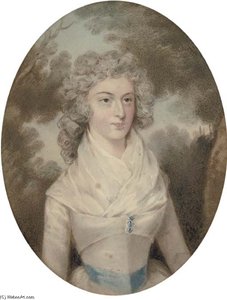
Hamilton's ambition led him to London in the early 1760s, where he quickly found success with his distinctive oval pastel portraits. These weren’t grand, imposing statements of power; rather, they were lively, affordable representations that resonated with a growing middle class eager to possess images of themselves and their loved ones. His talent didn't go unnoticed by the highest echelons of society either – he received commissions from the British royal family, including a portrait of Queen Charlotte in 1764, solidifying his reputation. He exhibited regularly at both the Society of Artists and the Free Society of Artists, steadily building his clientele. Around the mid-1770s, Hamilton began experimenting with a unique “fresco” pastel technique, blending crayons and chalk to achieve a richer texture and depth in his work. This innovation marked a turning point, showcasing his willingness to push boundaries and refine his artistic approach. In 1779, seeking further inspiration and honing his skills, he embarked on a twelve-year sojourn in Rome. It was there that he encountered the intellectual circles of the time, befriending figures like Antonio Canova and receiving guidance from John Flaxman, who encouraged him to transition to oil painting – a medium that would allow for even greater nuance and detail.

A Master of Likeness: Style and Technique

Hamilton’s artistic signature lay in his ability to capture not just the *likeness* of his sitters, but also their character and social standing. While he initially gained renown for his pastel portraits – particularly those charming oval compositions – his later work in oils demonstrated a growing mastery of technique. He favored handmade cream or off-white paper for his pastels, providing a subtle warmth to the finished pieces. Remarkably efficient, many of his portraits were completed in a single sitting from life, testament to his observational skills and confident hand. His pastel process involved a meticulous layering: outlining with light tones, building features with carmine shades, blending delicately with his fingers, establishing broad backgrounds, and finally adding precise details using both pastel sticks and graphite. This careful approach allowed him to create portraits that were both realistic and flattering. He was acutely attuned to the demands of the market, balancing artistic expression with the expectations of his patrons. His style reflects a fascinating interplay between European artistic traditions – particularly French Rococo influences – and the evolving tastes of 18th-century society.

Echoes of an Era: Major Works and Legacy

Throughout his career, Hamilton’s brush (or pastel stick) immortalized many prominent figures. Beyond the celebrated portrait of Queen Charlotte, he depicted Charles Edward Stuart and his family between 1785 and 1788, capturing a poignant moment in Jacobite history. His portrait of Dean Kirwan remains a treasured piece at the Royal Dublin Society, while other notable works include portraits of George John, 2nd Earl Spencer, and Countess Cowper. “Diana and Endymion” (1783) represents an early foray into large-scale oil painting, showcasing his ambition to tackle more complex compositions. However, it was perhaps the rediscovery of a sketchbook containing sixty-six drawings of Dublin street hawkers that truly cemented Hamilton’s historical significance. These sketches offer a rare and invaluable glimpse into the everyday life of 18th-century Dublin, providing social historians with rich visual documentation of a bygone era. Returning to Dublin in 1791, he continued to paint portraits, including one of Lord Edward Fitzgerald, the Irish revolutionary, in 1796 – a work imbued with both artistic skill and historical weight. Hugh Douglas Hamilton passed away in 1808, leaving behind a legacy as a versatile and insightful portraitist whose work continues to resonate with its blend of Rococo elegance and Neoclassical refinement. His portraits remain not merely images, but windows into the lives and times of those who shaped his world.

Quiz

There is only one correct answer for each question.

Question 1:
In what city was Hugh Douglas Hamilton born?
Question 2:
What medium did Hamilton primarily work with until the 1790s?
Question 3:
Which royal figure did Hamilton portray in a portrait commissioned by the British Royal Family?
Question 4:
Who advised Hamilton to transition from pastel to oil painting?
Question 5:
What notable discovery in 2002 provided insight into 18th-century Dublin life and Hamilton's early work?

Questions & Answers

Which paintings is Hugh Douglas Hamilton known for?

Hugh Douglas Hamilton is known for the works listed in the most famous paintings by Hugh Douglas Hamilton.

What aliases or alternate names does Hugh Douglas Hamilton have?

Hugh Douglas Hamilton appears under the alternate names H. Hamilton, هيو دوغلاس هاميلتون, ヒュー・ダグラス・ハミルトン, Хью Дуглас Гамильтон.

What art movement did Hugh Douglas Hamilton belong to?

Hugh Douglas Hamilton is one of the famous Neoclassicism artists.

When did Hugh Douglas Hamilton die?

Hugh Douglas Hamilton died in 1808, at about 68 years old.

Can I browse Hugh Douglas Hamilton's works by mood?

See Hugh Douglas Hamilton's artworks arranged by mood: each work is placed by its atmosphere.

Which museums hold Hugh Douglas Hamilton's paintings?

Paintings by Hugh Douglas Hamilton are held at National Gallery of Ireland, Scottish National Portrait Gallery and Mount Stewart.

In which historical period did Hugh Douglas Hamilton work?

Hugh Douglas Hamilton worked in the Early-Modern period. The period situates the artist's activity in history.

What are the birthplace and birth year of Hugh Douglas Hamilton?

Hugh Douglas Hamilton was born in Dublin in 1740.

Where can I find facts about Frederick Hervey, Bishop of Derry and 4th Earl of Bristol (1730-1803), with his Granddaughter Lady Caroline Crichton (1779-1856), in the Gardens of the Villa Borghese, Rome by Hugh Douglas Hamilton?