

Introduction
To embark on a journey through the top 25 artworks of James Abbott McNeill Whistler is to enter a realm where color whispers, form dissolves into atmosphere, and beauty reigns supreme. These paintings aren’t merely depictions; they are distillations of mood, echoes of experience, and testaments to an artist who dared to prioritize aesthetic harmony above all else.
Born in 1834, Whistler lived during a period of rapid societal change—the Victorian era—yet he resolutely turned his back on its moralizing tendencies. While the art world often demanded narrative and social commentary, Whistler championed “art for art’s sake,” believing that a painting's value lay solely in its aesthetic qualities. This radical stance positioned him as a key figure in the Aesthetic movement, which sought to liberate art from didactic purposes and elevate it to the status of pure sensory experience.
His early training was diverse, spanning military school, topographical surveying, and ultimately, the vibrant artistic landscape of Paris. It was in France that Whistler found his voice—a delicate balance between Realism and abstraction, characterized by subtle tonal harmonies and evocative atmospheric effects. He wasn’t interested in *what* he painted so much as *how* he painted it.
The works you are about to encounter – from the iconic “Nocturnes” that blurred the line between painting and music, to his penetrating portraits that capture not just likeness but also a sense of inner life – represent Whistler’s unwavering commitment to this aesthetic vision. They offer a glimpse into a world where beauty is found in nuance, suggestion, and the evocative power of color and form.
Today, these paintings continue to resonate because they speak to something fundamental within us—a longing for tranquility, an appreciation for subtle beauty, and a desire to escape the clamor of the everyday. They remind us that art can be a refuge, a source of contemplation, and a celebration of pure sensory experience. Prepare to be transported by the delicate grace and enduring power of James Abbott McNeill Whistler’s masterpieces.
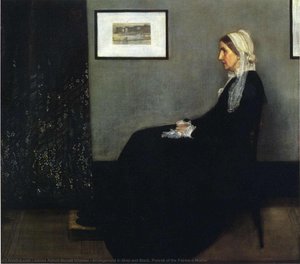
Arrangement in Grey and Black. Portrait of the Painter's Mother - James Abbott McNeill Whistler
Before us hangs a study in quietude, an exercise in restraint that transcends portraiture to become something profoundly universal. This is “Arrangement in Grey and Black No. 1,” more familiarly known as “Whistler’s Mother” by James Abbott McNeill Whistler, completed in 1871.
Emerging from a period of Victorian excess, this painting embodies the Aesthetic movement's core tenet: art for art’s sake. Whistler wasn’t interested in telling a story; he sought to create a harmonious arrangement of color and form, prioritizing visual experience above narrative detail. The limited palette – subtle gradations of grey, black, and white – evokes a sense of melancholy and dignified solitude.
Anna McNeill Whistler, the artist's mother, is presented in profile, her composed expression radiating resilience. The geometric harmony of the composition—the balanced curtain, the subtly placed framed picture—underscores this deliberate focus on aesthetic principles. Initially controversial for its perceived lack of sentimentality, “Whistler’s Mother” ultimately became an icon, celebrated for its formal innovation and emotional resonance.
Its inclusion among Whistler's top 25 artworks is not merely a matter of recognition; it represents the artist at his most radical—a painter who dared to challenge convention and elevate beauty as the ultimate artistic goal. Today, “Whistler’s Mother” continues to captivate with its timeless elegance, reminding us that art can be a sanctuary for contemplation and a powerful expression of human dignity.
Gold and Brown (also known as Self Portrait) - James Abbott McNeill Whistler
 Gold and Brown (also known as Self Portrait) - James Abbott McNeill Whistler
There is a profound stillness within “Gold and Brown,” often referred to as James Abbott McNeill Whistler’s self-portrait, painted in 1896. It isn't a declaration of ego, but rather an intimate meditation on the artist himself—a quiet exploration of identity and artistic sensibility.
This work stands among Whistler’s top 25 for its masterful distillation of his aesthetic philosophy: “art for art’s sake.” Rejecting Victorian narrative conventions, he sought to capture not a likeness, but an *essence*. The rich, earthy palette—deep browns, ochres, and golds—creates a velvety texture and luminous quality. Notice the subtle layering of color, the ‘broken color’ technique that allows tones to blend optically, creating a shimmering effect.
Whistler eschews overt symbolism or dramatic gesture. Instead, he presents himself with understated dignity, his gaze directed inward. The painting is a study in tonal harmony, where light and shadow play across his face and clothing, revealing the artist’s profound understanding of form and texture. It's a rejection of sentimentality, replaced by an elegant restraint that speaks volumes.
“Gold and Brown” reminds us that true artistry lies not in replication but in evocation—in capturing a mood, a feeling, a fleeting moment of introspection. At AllPaintingsStore, we strive to preserve this very essence in our faithful reproductions, allowing you to experience the quiet power and enduring beauty of Whistler’s masterpiece within your own space.
Nocturne in Blue and Silver - James Abbott McNeill Whistler
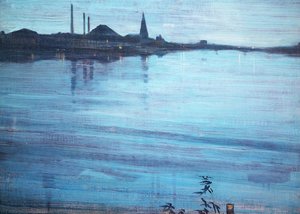 Nocturne in Blue and Silver - James Abbott McNeill Whistler
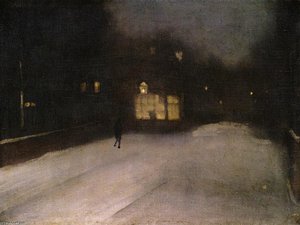
Close your eyes and imagine a Venetian twilight—the gentle lapping of water, the distant glow of lights reflecting on the lagoon. This is the essence captured in James Abbott McNeill Whistler’s “Nocturne in Blue and Silver,” completed in 1871.
More than just a depiction of a nighttime scene, this painting embodies Whistler’s revolutionary philosophy: art for art’s sake. He wasn't interested in narrative; he sought to evoke an emotional response through subtle tonal harmonies and masterful brushwork. The loose, sketchy style—influenced by Japanese prints—prioritizes suggestion over detailed representation, creating a dreamlike ambiance.
The painting’s muted palette of blues and silvers creates a mesmerizing interplay between light and shadow, drawing the viewer into a realm of serene stillness. Visible brushstrokes contribute to its textural richness, conveying a sense of immediacy while maintaining an overall calmness. This work is a testament to Whistler's ability to distill visual experience into its purest essence.
“Nocturne in Blue and Silver” rightfully holds its place among Whistler’s top 25 artworks—a groundbreaking exploration of atmosphere and emotion that continues to inspire. Today, its calming palette and elegant simplicity resonate with contemporary design sensibilities, finding echoes in modern interiors and a desire for tranquil spaces.
peacock room - James Abbott McNeill Whistler
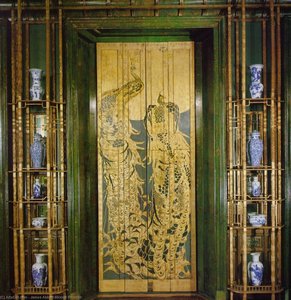 peacock room - James Abbott McNeill Whistler
Step into a world where art transcends canvas—where walls themselves become masterpieces. The Peacock Room , by James Abbott McNeill Whistler, is not merely a room; it’s an immersive experience, a symphony of Aestheticism brought to life.
Originally commissioned as a dining room, this project evolved into a holistic work of art—a *Gesamtkunstwerk*—where every surface contributes to an opulent and harmonious whole. The iconic mural depicting battling peacocks is more than decoration; it’s believed to represent Whistler's fraught relationship with the homeowner, Frederick Leyland.
The room embodies Whistler’s “art for art’s sake” philosophy, prioritizing beauty over narrative. Lavish gold leaf detailing—reminiscent of Byzantine mosaics—creates a shimmering atmosphere, while the arrangement of Leyland’s blue-and-white porcelain adds layers of visual richness. The interplay of deep teal and radiant gold evokes a sense of tranquility and refined elegance.
Its inclusion among Whistler's top 25 artworks speaks to his innovative spirit—his ability to transform an entire space into a work of art. Today, the Peacock Room continues to inspire interior design, reminding us that beauty can be found in every detail and that art has the power to elevate our surroundings.
The Artist's Mother (detail) - James Abbott McNeill Whistler
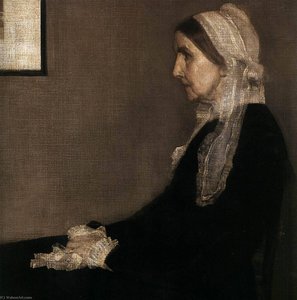 The Artist's Mother (detail) - James Abbott McNeill Whistler
A quiet dignity radiates from “The Artist’s Mother,” James Abbott McNeill Whistler’s 1871 masterpiece—a stillness that transcends portraiture to become an enduring symbol of motherhood and aesthetic contemplation.
More than a likeness, this painting is a carefully constructed arrangement of form and color, embodying Whistler’s belief in “art for art’s sake.” The subdued palette—a masterful interplay of greys, blacks, and whites—creates an atmosphere of serene stillness. Anna McNeill Whistler, seated in profile against a plain wall, is rendered with delicate brushstrokes that emphasize the play of light and shadow.
Initially met with mixed reactions, “The Artist’s Mother” ultimately became an icon for its innovative approach to portraiture—a rejection of Victorian sentimentality in favor of formal harmony. The painting's austere setting evokes a sense of quiet propriety, while the subject’s reserved pose speaks to inner strength and resilience.
Its place among Whistler’s top 25 artworks is assured not only for its historical significance but also for its enduring emotional resonance. Today, “The Artist’s Mother” continues to inspire a sense of calm and sophistication—a testament to the power of art to elevate our surroundings and touch our souls.
White and Grey, The Hotel Courtyard, Dieppe - James Abbott McNeill Whistler
 White and Grey, The Hotel Courtyard, Dieppe - James Abbott McNeill Whistler
Imagine a quiet afternoon in Dieppe—the gentle murmur of conversation, sunlight dappling through the leaves, and a sense of tranquil repose. This is the atmosphere James Abbott McNeill Whistler captures in “White and Grey, The Hotel Courtyard, Dieppe.”
Painted between 1885-1886, this work exemplifies Whistler’s mastery of Tonalism—an art movement that prioritized mood and atmospheric effects over detailed representation. The limited palette—soft whites, greys, and subtle washes of color—creates a sense of serenity and invites contemplation.
Whistler wasn't interested in depicting a specific scene; he sought to evoke an emotional response through the harmonious interplay of light and shadow. The figures within the courtyard are rendered with delicate brushstrokes, almost dissolving into the surrounding atmosphere. This painting is a testament to his belief in “art for art’s sake,” prioritizing aesthetic beauty above narrative content.
“White and Grey” offers a calming presence—a visual sanctuary that can elevate any space. Its subtle harmonies and refined elegance remind us of the power of art to inspire tranquility and evoke a sense of timeless grace, making it a cherished addition to any collection of James Abbott McNeill Whistler artworks.
The forge. - James Abbott McNeill Whistler
 The forge. - James Abbott McNeill Whistler
There’s a quiet energy within James Abbott McNeill Whistler’s “The Forge,” created in 1861—a fleeting moment captured with understated elegance in charcoal.
This work offers a glimpse into everyday life, rendered not as a grand narrative but as an intimate observation. The loose, expressive lines and subtle gradations of tone exemplify Whistler’s evolving style and his growing interest in printmaking techniques. It's a testament to his belief that art should capture the essence of a scene—the interplay of light and shadow, the feeling of a space—rather than simply replicating reality.
“The Forge” stands among Whistler’s top 25 artworks for its ability to evoke emotion through simplicity. The shallow perspective draws you into the scene, while the grainy texture adds a sense of immediacy. It's a reminder that beauty can be found in the ordinary—in the quiet moments of human connection.
At AllPaintingsStore, we believe in making such timeless artistry accessible to all. A reproduction of “The Forge” can bring this same sense of tranquility and refined elegance into your home—a subtle yet powerful addition that elevates any space.
Head of an Old Man Smoking - James Abbott McNeill Whistler
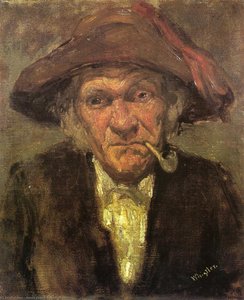 Head of an Old Man Smoking - James Abbott McNeill Whistler
There’s a profound stillness within James Abbott McNeill Whistler’s “Head of an Old Man Smoking,” painted around 1859—a quiet contemplation that transcends mere portraiture.
This deceptively simple canvas embodies Whistler’s philosophical convictions: art for art’s sake. He wasn't interested in telling a story, but rather in capturing the essence of a moment through subtle tonal harmonies and masterful brushwork. The muted palette—browns, creams, and blacks—creates an atmosphere of serene introspection.
The old man, gazing directly at the viewer with his pipe delicately held between his fingers, is not merely a subject but a symbol of quiet reflection. Whistler’s rejection of conventional compositional rules and his unwavering commitment to subjective experience resonated powerfully within the Aesthetic movement—a rebellion against Victorian materialism.
“Head of an Old Man Smoking” rightfully holds its place among Whistler’s top 25 artworks, reminding us that beauty can be found in simplicity and that art has the power to evoke emotion through color, light, and a deliberate pause for contemplation. A reproduction of this work invites a similar sense of tranquility into your own space—a timeless conversation between culture and decor.
Symphony in White, No. 1: The White Girl - James Abbott McNeill Whistler
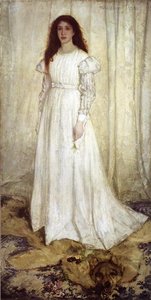 Symphony in White, No. 1: The White Girl - James Abbott McNeill Whistler
There’s a haunting stillness within James Abbott McNeill Whistler’s “Symphony in White, No. 1: The White Girl,” painted in 1862—a delicate balance of form and emotion that continues to captivate.
More than just a portrait, this work embodies the core tenets of Aestheticism—art for art’s sake. Whistler sought not to tell a story but to evoke an emotional resonance through subtle tonal harmonies and masterful brushwork. The luminous washes of white create an ethereal effect, prioritizing mood over precise depiction.
Joanna Hiffernan, Whistler's mistress, stands gracefully beside a window, her gaze hinting at contemplation. The painting’s simplicity—its deliberate avoidance of narrative detail—is its strength. It invites introspection and allows the viewer to connect with the work on a purely sensory level.
“Symphony in White” rightfully holds its place among Whistler’s top 25 artworks, representing his revolutionary approach to portraiture and his unwavering commitment to beauty. At AllPaintingsStore, we strive to preserve this very essence in our faithful reproductions, allowing you to experience the quiet power and enduring elegance of this masterpiece within your own space.
Bibi Lalouette - James Abbott McNeill Whistler
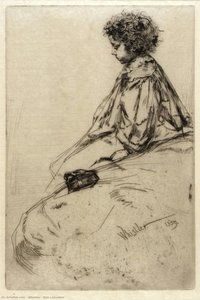 Bibi Lalouette - James Abbott McNeill Whistler
A whisper of quiet contemplation—that’s what lingers with James Abbott McNeill Whistler’s “Bibi Lalouette,” created in 1859.
This delicate etching isn't merely a portrait; it’s a distillation of aesthetic ideals, a poignant glimpse into the sensibilities of mid-19th century Europe. The masterful control over line and tone captures a young girl lost in her own world, speaking volumes through restraint and subtle power.
Whistler’s rejection of Victorian narrative in favor of beauty and harmony—a core tenet of Aestheticism—is beautifully embodied here. Influences from Japonisme add to the work's elegant simplicity, mirroring the flattened perspective often found in Japanese prints. The intimate scale invites a close examination, revealing a profound sense of serenity.
“Bibi Lalouette” stands as an irreplaceable part of Whistler’s top 25 artworks, reminding us that true beauty lies not in grand gestures but in quiet moments and the delicate language of line—a sensibility that continues to inspire refined interiors and a slower pace of life today.
Photomechanical reproduction in halftone, after Whistler - James Abbott McNeill Whistler
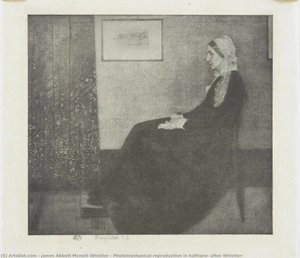 Photomechanical reproduction in halftone, after Whistler - James Abbott McNeill Whistler
A rare echo of domestic tranquility—this photomechanical reproduction of James Abbott McNeill Whistler’s “Arrangement in Grey and Black No.2” offers a glimpse into the artist's unwavering pursuit of aesthetic beauty.
Created in 1893, this halftone print transcends mere representation; it embodies the core tenets of Aestheticism—a deliberate rejection of narrative storytelling in favor of formal harmony and tonal nuance. The subtle gradations of grey faithfully replicate Whistler’s original painting, capturing a moment of profound stillness within an interior space.
The woman—likely Whistler’s mother—is positioned with quiet dignity, her downward gaze hinting at introspection. This deliberate avoidance of explicit emotion allows the viewer to connect with the work on a purely sensory level, appreciating the delicate balance of form and texture. The inclusion of a picture frame reinforces the theme of observation and memory.
This reproduction stands as an irreplaceable part of Whistler’s top 25 artworks, reminding us that true beauty lies not in grand gestures but in quiet moments—a sensibility that continues to inspire refined interiors and a timeless appreciation for elegance today.
Whistler - James Abbott McNeill Whistler
 Whistler - James Abbott McNeill Whistler
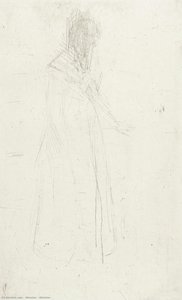
Imagine a quiet studio, bathed in soft, diffused light—a moment suspended between observation and reflection. That’s the essence of James Abbott McNeill Whistler’s self-portrait sketch, simply titled ‘Whistler.’
More than just an image, this delicate work embodies the artist's unwavering belief in “art for art’s sake,” a rejection of Victorian narrative in favor of pure aesthetic expression. The loose lines and subtle tonal variations capture not merely a likeness but a fleeting mood—a sense of introspection and quiet dignity.
Whistler’s mastery of tonalism, prioritizing atmosphere over detail, is beautifully evident here. He achieves an ethereal effect through rapid sketching with graphite on cream-colored paper, utilizing hatching and crosshatching to build up volume and suggest form. The minimalist composition—the figure occupying the majority of the frame against a deliberately empty background—underscores his belief that art should exist independently of moral or didactic concerns.
This sketch stands as an irreplaceable part of Whistler’s top 25 artworks, reminding us that true beauty lies not in grand gestures but in quiet moments—a sensibility that continues to inspire serene interiors and a timeless appreciation for the power of observation today.
Nocturne: Grey and Gold - Westminster Bridge - James Abbott McNeill Whistler
 Nocturne: Grey and Gold - Westminster Bridge - James Abbott McNeill Whistler
Imagine a London night—a gentle mist rising from the Thames, the soft glow of gas lamps reflecting on the water’s surface. That's the world James Abbott McNeill Whistler invites us into with “Nocturne: Grey and Gold – Westminster Bridge.”
More than just a cityscape, this painting is an embodiment of Whistler’s philosophy—a defiant assertion of “art for art’s sake,” prioritizing aesthetic contemplation over narrative detail. He wasn't interested in documenting London; he sought to capture its *essence*, its fleeting moods and subtle harmonies.
Whistler’s signature luminism eschews dramatic contrasts, favoring a diffused glow that evokes emotion rather than precise representation. Thin layers of oil paint applied in horizontal brushstrokes create an ethereal quality, capturing the magic of moonlight reflecting on the water. The muted palette—predominantly greys and golds—fosters a sense of serenity and quiet introspection.
“Nocturne: Grey and Gold – Westminster Bridge” rightfully belongs among Whistler’s top 25 artworks for its capacity to transport us—to evoke a feeling of peaceful contemplation that resonates deeply even today. It reminds us that beauty can be found in the simplest moments, enriching our daily lives with a sense of calm and wonder.
Violet and Siilver: A Deep Sea - James Abbott McNeill Whistler
 Violet and Siilver: A Deep Sea - James Abbott McNeill Whistler
A hush descends—a twilight sea shimmering with violet and silver, a moment suspended between day and dream. James Abbott McNeill Whistler’s “Violet and Silver” isn't merely a seascape; it’s an invitation to lose oneself in pure aesthetic sensation.
Painted in 1893, this work embodies the artist’s unwavering commitment to “art for art’s sake,” rejecting narrative detail in favor of mood and atmosphere. Whistler meticulously crafted an illusionistic surface through careful layering of thin glazes—a technique reminiscent of Japanese prints—prioritizing tonal harmony over precise representation.
The muted palette, dominated by violet hues accented with shimmering silver, evokes a sense of tranquility and contemplation. Gentle waves roll onto the shore, distant sailboats hint at exploration, and two birds soar gracefully across the horizon—symbols of freedom and aspiration. Whistler’s deliberate simplification of form invites viewers to immerse themselves in its serene atmosphere.
“Violet and Silver” rightfully belongs among Whistler’s top 25 artworks for its capacity to transport us—to evoke a feeling of peaceful introspection that resonates deeply even today. It reminds us that beauty can be found in the simplest moments, enriching our daily lives with a sense of calm and sophistication.
Self-portrait - James Abbott McNeill Whistler
 Self-portrait - James Abbott McNeill Whistler
A quiet gaze, a subtle melancholy—a moment captured not with vibrant color but with the delicate precision of etched lines. James Abbott McNeill Whistler’s “Self-portrait” from 1858 isn't simply an image *of* the artist; it’s a window into his evolving aesthetic sensibility.
This deceptively simple work, rendered in stark black and white, immediately draws us into a world of quiet contemplation. Whistler meticulously controlled every line and tonal value, creating an astonishingly detailed surface that prioritizes mood over mere likeness. The subject—a man with short hair gazing downward—is anchored within ample negative space, inviting the viewer to focus entirely on his presence.
The portrait embodies Whistler’s burgeoning belief in “art for art’s sake,” rejecting Victorian narrative conventions in favor of pure visual experience. It's not a story being told, but rather an invitation to contemplate beauty itself—a fleeting moment of introspection captured with remarkable subtlety and restraint.
“Self-portrait” stands as a pivotal work in Whistler’s artistic journey, foreshadowing the tonal harmonies and atmospheric effects that would define his signature style. Its presence in any space evokes a sense of calm and quiet dignity—a reminder to pause, reflect, and appreciate the beauty of simplicity.
Purple and Rose: The Lang Leizen of the Six Marks - James Abbott McNeill Whistler
 Purple and Rose: The Lang Leizen of the Six Marks - James Abbott McNeill Whistler
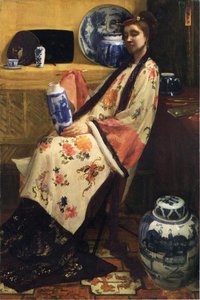
A whisper of lavender and rose—a portrait not of a person, but of an *atmosphere*, a mood of serene composure captured with breathtaking subtlety. James Abbott McNeill Whistler’s “Purple and Rose: The Lang Leizen of the Six Marks” from 1864 embodies the core tenets of Aestheticism, prioritizing beauty and sensory experience above all else.
The painting depicts a woman seated gracefully, her legs crossed with an air of quiet elegance. Whistler’s deliberate choice of muted hues establishes a mood of refined tranquility, while his meticulous layering of thin glazes creates surfaces shimmering with subtle variations of color—a technique reminiscent of Japanese prints he greatly admired.
More than just a likeness, “Purple and Rose” is an exploration of femininity through gesture and posture. The woman’s stillness speaks volumes about inner peace and contemplation, reflecting the Aesthetic ideal of observing beauty without imposing judgment. Whistler wasn't interested in telling a story; he sought to create a harmonious visual experience—a world unto itself.
This work rightfully belongs among Whistler’s top 25 for its capacity to transport us—to evoke a feeling of peaceful introspection that resonates deeply even today. Its presence in any space fosters a sense of calm and sophistication, reminding us of the enduring power of beauty and the importance of slowing down to appreciate life's quiet moments.
San Giorgio - James Abbott McNeill Whistler
 San Giorgio - James Abbott McNeill Whistler
A hush falls over the Giudecca Canal—a world rendered not in vibrant color but in a symphony of grays, a dreamlike vision of Venice captured with breathtaking subtlety. James Abbott McNeill Whistler’s “San Giorgio,” created around 1880, transcends mere landscape painting; it's an immersion into a carefully constructed atmosphere.
Part of a series commissioned by the Fine Art Society, this work embodies Whistler’s pioneering approach to etching and his unwavering belief in “art for art’s sake.” The iconic basilica of San Giorgio Maggiore dominates the left side, softened by distance, beckoning us into a world of quiet contemplation. Numerous boats with tall masts dot the waterway, adding texture yet contributing to the overall sense of stillness.
Whistler didn't strive for photographic realism; instead, he employed a radical technique known as “biting out”—carefully acid-bathing areas of the plate to create delicate, brittle lines that shimmer and dissolve into the surrounding tones. Printing on fibrous Japanese paper amplified this effect, lending an ethereal quality to the image.
“San Giorgio” stands among Whistler’s top 25 for its masterful manipulation of light, shadow, and texture—a testament to his artistic vision and a reminder that beauty can be found in the most subtle of moments. Its presence transforms any space, inviting us to pause, reflect, and lose ourselves in the timeless allure of Venice.
En plein soleil - James Abbott McNeill Whistler
 En plein soleil - James Abbott McNeill Whistler
A moment suspended in sunlight—a quiet scene imbued with a sense of contemplative repose. James Abbott McNeill Whistler’s “En plein soleil,” etched in 1858, isn't simply an image *of* a woman beneath an umbrella; it embodies the very spirit of Aestheticism—a movement that championed beauty and sensory experience above all else.
Within this tranquil tableau lies a wealth of artistic consideration. Whistler’s masterful use of tonal gradation creates an atmosphere of diffused luminescence, mirroring the mood of Impressionism but rejecting its fleeting visual sensations. He seeks to convey a *feeling*, a state of internal dialogue suggested by the woman's posture and gaze.
This work stands among Whistler’s top 25 for his pioneering approach to etching—his ability to capture subtle gradations of light and shadow with remarkable delicacy. The inclusion of a bowl adds another layer of symbolic significance, representing both sustenance and contemplation. “En plein soleil” is a testament to the power of art to evoke emotion and invite introspection.
At AllPaintingsStore, we believe that great art should be accessible—a living presence in refined homes and personal sanctuaries. This etching, with its timeless beauty and quiet elegance, embodies our philosophy perfectly, offering a moment of serenity and contemplation for all who encounter it.
Harmony in Red, Lamplight - James Abbott McNeill Whistler
 Harmony in Red, Lamplight - James Abbott McNeill Whistler
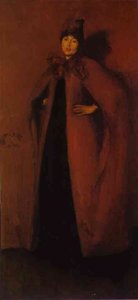
A rare luminescence—a study in crimson and shadow that transcends portraiture to become a pure expression of aesthetic harmony. James Abbott McNeill Whistler’s “Harmony in Red, Lamplight” (c. 1884-86) is not merely one of his most famous works; it's a cornerstone of the Aesthetic movement, securing its place among the world’s Top 25.
Whistler sought to liberate art from narrative constraints, focusing instead on the formal qualities of color and light. In this captivating oil painting, a woman draped in red is bathed in the warm glow of a lamplight, creating an atmosphere of tranquility and intimacy. The rich hues and subtle variations in tone are not accidental; they are meticulously orchestrated to evoke a specific emotional response.
“Harmony in Red, Lamplight” embodies Whistler’s belief that art should be judged solely on its aesthetic merits—a philosophy that resonated deeply with his contemporaries and continues to inspire artists today. The painting's enduring appeal lies in its ability to transport viewers to a world of quiet contemplation.
At AllPaintingsStore, we understand the power of art to transform spaces and elevate everyday life. This masterpiece, with its timeless beauty and refined elegance, is perfectly suited for discerning homes and offices—a testament to taste, legacy, and the enduring allure of artistic harmony.
Black Lion Wharf - James Abbott McNeill Whistler
 Black Lion Wharf - James Abbott McNeill Whistler
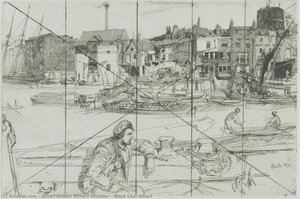
A whisper of industry—a meticulously observed glimpse into Victorian life that transcends mere documentation to become a study in atmosphere and form. James Abbott McNeill Whistler’s “Black Lion Wharf” (1859) is not simply a drawing of Whitby Harbour; it's a testament to his unwavering commitment to 'art for art’s sake,' securing its place among the world’s Top 25.
Whistler masterfully captures the bustling activity of unloading cargo, the imposing presence of warehouses, and the subtle nuances of light reflecting on water. His compositional strategy utilizes a grid-like structure to create depth, while thick, dark lines delineate form and texture—a technique characteristic of Realism but subtly infused with his distinctive aesthetic sensibilities.
The remarkable detail stems from Whistler’s command of line work and shading; cross-hatching and stippling simulate the roughness of wood and the wetness of water. This meticulous approach, combined with a heightened level of accuracy, aligns with Impressionistic principles while retaining a unique artistic vision.
At AllPaintingsStore, we believe that great art should resonate—a timeless presence in refined homes and personal sanctuaries. “Black Lion Wharf,” with its quiet dignity and evocative detail, embodies this philosophy perfectly, inviting us to connect with the past and appreciate the beauty of everyday life.
Little court. - James Abbott McNeill Whistler
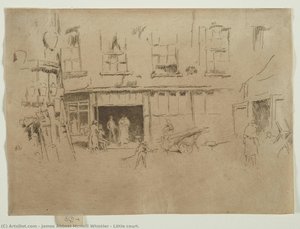 Little court. - James Abbott McNeill Whistler
A whisper of a moment—a carefully constructed tableau designed to evoke a specific mood and challenge artistic convention. James Abbott McNeill Whistler’s “Little Court” (1883) isn't merely a depiction of a street scene; it’s an exploration of light, leisure, and aesthetic rebellion, securing its place among the world’s Top 25.
Whistler masterfully employs a limited palette of muted browns, greys, and blues to create an atmosphere of diffused light and gentle melancholy. A small group of figures occupies the foreground, their postures suggesting quiet contemplation—a scene designed to be observed rather than analyzed. The inclusion of a dog adds a touch of domesticity and warmth.
Whistler was a revolutionary figure in printmaking, prioritizing tonal variation and atmospheric effects. “Little Court” exemplifies his unique approach to etching, utilizing drypoint – scratching into copper plate with a needle – to create rich, velvety lines and subtle gradations of tone. This meticulous technique lends depth and richness to the image.
At AllPaintingsStore, we believe that great art should resonate—a timeless presence in refined homes and personal sanctuaries. “Little Court,” with its quiet dignity and understated beauty, embodies this philosophy perfectly, inviting us to connect with a world of subtle elegance and enduring charm.
Rag Pickers, Quartier Mouffetard, Paris - James Abbott McNeill Whistler
 Rag Pickers, Quartier Mouffetard, Paris - James Abbott McNeill Whistler
A quiet dignity—a glimpse into Parisian life rendered with a profound sensitivity that transcends mere documentation. James Abbott McNeill Whistler’s “Rag Pickers, Quartier Mouffetard, Paris” (1858) is not simply an etching; it's a carefully constructed meditation on perception and the essence of art, securing its place among the world’s Top 25.
Whistler masterfully employs a limited palette of grays to create an atmosphere of diffused light and subtle melancholy. The two figures—a man and woman engaged in their humble task—are not judged or romanticized, but observed with quiet respect. Their focused interaction suggests a shared labor, a poignant intimacy born from necessity.
Whistler’s revolutionary approach to etching prioritized tonal variation and atmospheric effects. “Rag Pickers” exemplifies his unique technique, utilizing drypoint – scratching into copper plate with a needle – to create rich, velvety lines and subtle gradations of tone. This meticulous manipulation of line isn't merely representational; it’s a fundamental element of Whistler’s artistic language—a way to evoke feeling and atmosphere through purely visual means.
At AllPaintingsStore, we believe that great art should resonate—a timeless presence in refined homes and personal sanctuaries. “Rag Pickers,” with its understated beauty and quiet dignity, embodies this philosophy perfectly, inviting us to connect with the humanity of everyday life.
Annie Seated - James Abbott McNeill Whistler
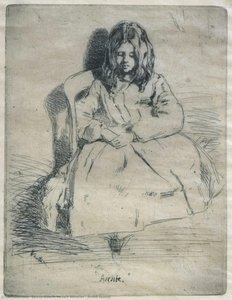 Annie Seated - James Abbott McNeill Whistler
A quiet afternoon—a moment frozen in graphite gray, imbued with a profound sense of serenity and introspection. James Abbott McNeill Whistler’s “Annie Seated” (1859) is not merely a portrait; it's an exploration of mood and atmosphere, securing its place among the world’s Top 25.
Whistler masterfully employs a restrained palette and loose sketching style to capture his daughter, Annie, seated quietly against a neutral wall. The drawing exemplifies Japonisme—the fascination with Japanese art that gripped European artists in the mid-19th century—through its emphasis on capturing fleeting impressions of light and color.
Drypoint etching with pencil allowed for nuanced tonal gradations achieved by layering hatching and crosshatching lines, resulting in a surface texture that mimics the grain of paper. This meticulous process lends an immediacy and vulnerability to the image. “Annie Seated” embodies Whistler’s defiant rejection of Victorian conventions—a passionate assertion that painting should exist solely for its aesthetic pleasure.
At AllPaintingsStore, we believe that great art should resonate—a timeless presence in refined homes and personal sanctuaries. “Annie Seated,” with its quiet dignity and understated beauty, embodies this philosophy perfectly, inviting us to connect with a moment of peaceful contemplation.
Upright Venice, from the - James Abbott McNeill Whistler
 Upright Venice, from the - James Abbott McNeill Whistler
Imagine a quiet evening on the Grand Canal—a gentle haze softening the edges of ancient palazzi, the subtle shimmer of water reflecting the last light of day. James Abbott McNeill Whistler’s “Upright Venice,” created around 1879-1880, isn't merely an etching; it’s a distillation of that very feeling—a testament to the Aesthetic movement’s core philosophy of ‘art for art’s sake.’
Rendered in a remarkably restrained palette of browns and beiges, this piece invites us to linger not on precise detail, but on the subtle interplay of light, shadow, and texture. Whistler deliberately eschews academic realism, embracing a tonalist style that prioritizes evocative power over meticulous representation. The composition—a hazy upper section suggesting distant grandeur, a bustling lower portion focused on canal life—creates depth without sharp outlines or dramatic contrasts.
Whistler’s mastery of etching is evident in the extensive vocabulary of lines—hatching, cross-hatching, and delicate contours—used to build form and texture. The limited tonal range amplifies this effect, creating an almost monochromatic dreamscape. “Upright Venice” embodies Whistler’s rebellion against Victorian conventions, a passionate assertion that painting should exist solely for its aesthetic pleasure.
At AllPaintingsStore, we believe that great art should elevate—a timeless presence in refined homes and personal sanctuaries. “Upright Venice,” with its quiet dignity and understated beauty, invites us to connect with a moment of peaceful contemplation, transforming any space into a haven of serenity.
Chelsea Bridge and church. - James Abbott McNeill Whistler
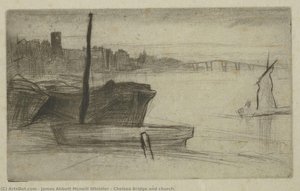 Chelsea Bridge and church. - James Abbott McNeill Whistler
Imagine a hushed evening along the Thames—a gentle mist rising from the water, softening the silhouette of Chelsea Bridge against the twilight sky. James Abbott McNeill Whistler’s “Chelsea Bridge and Church” (1870) isn't merely an etching; it’s a study in atmospheric impression—a testament to his belief in ‘art for art’s sake.’
Whistler, a pivotal figure in the Aesthetic movement, prioritized pure visual experience over narrative. This piece exemplifies his signature Tonalism style, prioritizing subtle gradations of tone and delicate textures. The etching showcases Whistler's meticulous technique—a combination of etching and drypoint—creating exceptional control over shading and contour lines.
The composition is deceptively simple: Chelsea Bridge alongside the Old Church. However, it transcends mere topographical depiction, capturing a fleeting moment of tranquility. His fascination with Japanese prints – specifically their use of tonal harmonies—is evident in the overall profile, echoing stylized forms characteristic of Ukiyo-e art.
At AllPaintingsStore, we believe that great art should resonate—a timeless presence in refined homes and personal sanctuaries. “Chelsea Bridge and Church,” with its quiet dignity and understated beauty, invites us to connect with a moment of peaceful contemplation, transforming any space into a haven of serenity.
Conclusion
As we conclude our journey through the world of James Abbott McNeill Whistler’s most celebrated works, it's not merely a collection of paintings and etchings that remains—but rather a constellation of moods, atmospheres, and quiet rebellions. These are artworks that whisper instead of shout, inviting us into moments of serene contemplation and aesthetic grace.
Whistler’s legacy extends far beyond the historical significance of his innovations; it resides in the enduring power of these images to move hearts, shape interiors, and inspire creativity across generations. To live with a Whistler—whether a delicate nocturne or a striking portrait—is to invite a daily reminder of beauty's inherent value, a testament to the human spirit’s capacity for profound expression.
At AllPaintingsStore, we believe that art should not be confined to museums and galleries but woven into the fabric of everyday life. Each reproduction is crafted with meticulous care by skilled artists, ensuring that the essence of Whistler's vision—the subtle textures, luminous light, and evocative harmonies—is faithfully preserved.
We invite you to explore our full collection and discover the artwork that resonates most deeply with your own soul. Allow Whistler’s masterpieces to transform your space, enriching your surroundings with a timeless elegance and quiet beauty.