Portrait of Giulio Clovio

The 9 Most Famous Giulio Clovio Paintings, a Gallery Selection

Updated October 2026 · ranked by our popularity score (searches, visits and orders for each work) · 9 works by Giulio Clovio in our catalogue

In short

Of all the originals Giulio Clovio left, the most famous is The Rape of Ganymede, in the collection of the Royal Collection, London. Close behind it come The Three Theological Virtues and Holy Family with Santa Isabel and San Juanito (1556). Our catalog holds 9 works by Giulio Clovio; the gallery has kept the 9 the world admires most, each shown with its date, its museum and its story.

1498 – 1578, Grižane-Belgrad High renaissance Most works: Royal Collection

Giulio Clovio's top 10 paintings: the gallery's choice

1
The Rape of Ganymede by Giulio Clovio

The Rape of Ganymede

Ink On Paper · Royal Collection, London

A Testament to Renaissance Precision: Giulio Clovio’s “The Rape of Ganymede” Giulio Clovio's "The Rape of Ganymede," executed around 1563, stands as a breathtaking achievement in High Renaissance drawing—a testament not only to artistic skill but also to the meticulous revival of classical ideals within European art. This monumental folio from the Farnese Hours manuscript resides within the Web Gallery of Art’s impressive collection, offering visitors an unparalleled opportunity to…

2
The Three Theological Virtues by Giulio Clovio

The Three Theological Virtues

Gold Leaf · The Louvre, Paris

In the heart of the High Renaissance, where the boundaries between the earthly and the divine often blurred through the tip of a master's brush, Giulio Clovio achieved something truly transcendent. His work, "The Three Theological Virtues," is not merely an illumination; it is a luminous window into the spiritual aspirations of the sixteenth century. Created around 1542 for the illustrious Cardinal Alessandro Farnese, this monumental folio from the Farnese…

4
Pages from the Farnese Hours (1538) by Giulio Clovio

Pages from the Farnese Hours

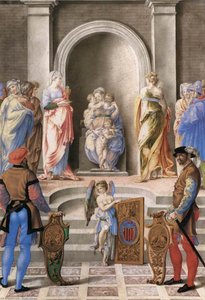
1538 · Fresco · The Morgan Library & Museum, New York City

To gaze upon these pages from the Farnese Hours is to step directly into the luminous heart of the Italian Renaissance, a time when devotion and artistry merged into an unparalleled spectacle. This work, executed around 1538 by Giulio Clovio, transcends mere illustration; it is a vibrant tableau vivant, capturing a moment of profound spiritual significance. The composition immediately draws the eye into a gathering of figures—some standing with solemn…

6
Pietà (1550) by Giulio Clovio

Pietà

1550 · Manuscript · Galleria degli Uffizi, Florence

In the quiet, hallowed corridors of art history, few images resonate with the profound emotional gravity found in Giulio Clovio’s Pietà. Created around 1550, this masterpiece serves as a breathtaking bridge between the fading echoes of the Gothic tradition and the luminous dawn of the High Renaissance. The scene captures the quintessential moment of Christian sorrow: the Virgin Mary cradling the lifeless body of Jesus Christ following his crucifixion. It…

8
Head of Minerva (1540) by Giulio Clovio

Head of Minerva

1540 · Acrylic On Canvas · Royal Collection, London

Within the meticulously preserved collection of the Royal Collection Trust resides a captivating miniature by Giulio Clovio, a work that transcends its diminutive scale to offer an extraordinary glimpse into the artistic sensibilities of the Italian High Renaissance. Known as “Head of Minerva,” this chalk drawing, created around 1540, is not merely a portrait; it’s a carefully constructed meditation on Roman mythology, classical ideals, and the very essence of wisdom…

9
Elymas Struck Blind by St Paul before the Proconsul Sergius Paulus by Giulio Clovio

Elymas Struck Blind by St Paul before the Proconsul Sergius Paulus

Painting · The Louvre, Paris

In the grand tapestry of the Italian High Renaissance, few moments possess the visceral tension found in Giulio Clovio’s Elymas Struck Blind by St Paul before the Proconsul Sergius Paulus. This masterpiece serves as a breathtaking window into a moment of profound spiritual upheaval, where the earthly and the divine collide with startling clarity. The scene captures the precise instant of a miracle: the sorcerer Elymas is overcome by sudden…

The subjects that held Giulio Clovio's eye

The four subjects that come back most often in these originals, each with its finest example.

The museums that keep Giulio Clovio's originals

The 7 museums that hold the most of the paintings on this page.

Museum City Works by Giulio Clovio Paintings from this list
Royal Collection, LondonRoyal Collection London 2 The Rape of Ganymede, Head of Minerva
The Louvre, ParisThe Louvre Paris 2 The Three Theological Virtues, Elymas Struck Blind by St Paul before the Proconsul Sergius Paulus
Museo Lázaro Galdiano, MadridMuseo Lázaro Galdiano Madrid 1 Holy Family with Santa Isabel and San Juanito
The Morgan Library & Museum, New York CityThe Morgan Library & Museum New York City 1 Pages from the Farnese Hours
John Rylands Library, ManchesterJohn Rylands Library Manchester 1 Page from the Colonna Missale
Galleria degli Uffizi, FlorenceGalleria degli Uffizi Florence 1 Pietà
Galleria Regionale di Palazzo Abatellis, PalermoGalleria Regionale di Palazzo Abatellis Palermo 1 The Rape of Ganymede

Giulio Clovio decade by decade: the original that defines each

Works per decade

Pick a decade to see the original that defines it.

Collectors' questions about Giulio Clovio's paintings

Which work is Giulio Clovio most famous for?Reveal the answer

The Rape of Ganymede, Royal Collection, London. The Three Theological Virtues and Holy Family with Santa Isabel and San Juanito (1556) come next.

How many paintings did Giulio Clovio leave?Reveal the answer

Our catalog holds 9 works by Giulio Clovio, dated from 1532 to 1556.

In which museums do Giulio Clovio's masterpieces hang?Reveal the answer

Mostly in Royal Collection (London), The Louvre (Paris) and Museo Lázaro Galdiano (Madrid). The museum table above lists them all.

In which years did Giulio Clovio paint the most famous works?Reveal the answer

In 1530s: 2 of the 9 works on this page were made then, Pages from the Farnese Hours among them.

What are the first and the last famous originals of Giulio Clovio?Reveal the answer

On this page, the earliest is Page from the Colonna Missale (1532) and the latest Holy Family with Santa Isabel and San Juanito (1556).

To which art movement does Giulio Clovio belong?Reveal the answer

High renaissance, judging by the originals on this page.

Which Giulio Clovio works hang at the Royal Collection?Reveal the answer

The Rape of Ganymede and Head of Minerva: the Royal Collection, London holds 2 of the works on this page.

Giulio Clovio: life and work

A Croatian Luminary of the Italian Renaissance

Giulio Clovio, born Juraj Julije Klović in 1498 amidst the rolling hills of Grižane, Croatia, stands as a pivotal figure bridging the late Gothic tradition of manuscript illumination with the burgeoning High Renaissance. Though his origins lay within the Kingdom of Croatia, it was in Italy that Clovio’s artistic genius truly blossomed, earning him renown as arguably the greatest illuminator of his era and the last significant master in a lineage stretching back centuries. His story is one of remarkable talent, astute patronage, and an unwavering dedication to transforming the miniature into a breathtakingly sophisticated art form.

The early years of Clovio’s life remain shrouded in some mystery. It's believed he may have received initial artistic training within monastic circles near Rijeka, but by the age of eighteen, his ambition led him to Italy. Entering the household of Cardinal Marino Grimani proved a turning point; here, under the cardinal’s guidance, Clovio honed his skills as a painter and began to develop the meticulous technique that would define his career. He absorbed influences from leading artists of the time—Giulio Romano and Girolamo dai Libri both played roles in shaping his style—but quickly forged his own path, demonstrating an exceptional aptitude for translating the grandeur of Renaissance painting onto a miniature scale.

The Art of Miniature: A Synthesis of Styles

Clovio’s artistry wasn't merely about replicating existing styles; it was about synthesizing them. He masterfully blended the delicate precision of Northern European illumination with the dynamic compositions and vibrant color palettes characteristic of Italian Renaissance masters like Raphael, Michelangelo, and Titian. This fusion is particularly evident in his illuminated manuscripts, where figures possess a sculptural quality, landscapes recede into atmospheric perspective, and every detail—from the folds of drapery to the glint of jewelry—is rendered with astonishing accuracy.

His work for Cardinal Domenico Grimani, including the exquisitely detailed commentary on St. Paul’s Epistle to the Romans (now housed in the Sir John Soane's Museum), showcased his burgeoning talent and secured his reputation. The miniatures within this manuscript are not simply illustrations; they are miniature paintings in their own right, brimming with narrative power and emotional depth. The conversion of Saint Paul is depicted with a dramatic intensity rarely seen in illuminated manuscripts.

Patronage, Travel, and Artistic Flourishing

Clovio’s career was inextricably linked to the powerful patrons who recognized his exceptional abilities. Following his time with the Grimani family, he served at the Hungarian court of King Louis II, creating works like “The Judgment of Paris” and “Lucretia.” The king's untimely death at the Battle of Mohács propelled Clovio back to Rome, where he continued to attract influential supporters.

His association with Cardinal Alessandro Farnese proved particularly fruitful. It was for Farnese that Clovio created his magnum opus: the Farnese Hours, a lavishly illuminated book of hours completed in 1546 after nine years of painstaking work. This masterpiece, now residing in the Morgan Library in New York, contains twenty-eight miniatures depicting scenes from both the Old and New Testaments, culminating in a spectacular double-page spread representing the Corpus Christi procession in Rome. The Farnese Hours is not only a testament to Clovio’s technical skill but also a reflection of his deep understanding of Renaissance iconography and theological themes.

A Legacy Illuminated

Clovio's influence extended beyond the realm of manuscript illumination. He was a respected figure in artistic circles, befriending artists like Pieter Bruegel the Elder—who even contributed a miniature to one of Clovio’s works—and El Greco, who painted several portraits of the master illuminator, placing him alongside Michelangelo, Raphael and Titian as his influences. These portraits serve as powerful visual statements about Clovio's standing within the artistic community.

Though he worked primarily in miniature, Clovio’s impact on Renaissance art was significant. He elevated the status of illumination from a craft to a fine art, demonstrating its potential for expressive power and technical virtuosity. His ability to capture the spirit of the High Renaissance within the confines of a small-scale format ensured his place as one of the most celebrated artists of his time—a Croatian luminary whose legacy continues to illuminate the world of art today.