Early Life & Training: Foundations of a Flemish Master
Pieter Bruegel the Elder, born sometime between 1525 and 1530 – the precise date remains elusive – emerged from the vibrant artistic milieu of the Low Countries during a period of profound transformation. While his origins are somewhat shrouded in mystery—accounts vary between Breda and a nearby village simply called “Brueghel”—what is certain is that he received his initial training under Pieter Coecke van Aelst, a respected Antwerp painter known for both his religious works and his designs for tapestries. This apprenticeship proved foundational, instilling in the young Bruegel not only technical proficiency but also an appreciation for intricate detail and narrative composition. However, it was Bruegel’s subsequent travels through Europe, particularly to Italy around 1551-1552, that truly ignited his artistic vision. The landscapes of Italy—the dramatic mountains, the sun-drenched vistas, the classical ruins—left an indelible mark on his imagination, though he would ultimately interpret these influences through a distinctly Northern lens.
The Revolutionary Genre Scenes: Peasant Life Elevated
Before Bruegel, peasant life was largely relegated to the margins of artistic representation – often depicted as comic relief or cautionary tales. Bruegel shattered this convention, elevating the everyday existence of rural folk to the level of high art. His paintings weren’t merely depictions *of* peasants; they were insightful studies *about* humanity, brimming with observation and a subtle, yet potent, moral undercurrent. Works like “The Peasant Wedding” (1567) are not simply festive celebrations but complex tableaux revealing the boisterous energy, earthy appetites, and social dynamics of village life. He eschewed idealization, portraying his subjects with a realism that bordered on unflinching—their faces etched with character, their actions imbued with both humor and a touch of melancholy. This commitment to depicting the world as he saw it, without romantic embellishment, was revolutionary for its time.
Landscapes with Narrative: Beyond Scenic Beauty
Bruegel’s landscapes are equally groundbreaking, but they are rarely *just* landscapes. They aren't serene backdrops; they are teeming with activity, populated by figures engaged in a multitude of tasks—harvesting crops, hunting game, or simply going about their daily routines. Consider “The Hunters in the Snow” (1565), perhaps his most iconic work. The scene is not merely a beautiful winter panorama but a meticulously detailed observation of rural life during the coldest months. The composition draws the eye deep into the landscape, revealing layers of activity and hinting at a larger narrative unfolding beyond the immediate foreground. This integration of human activity within expansive natural settings was unprecedented, establishing a new paradigm for landscape painting that would influence generations of artists to come.
Symbolism & Social Commentary: Decoding Bruegel’s World
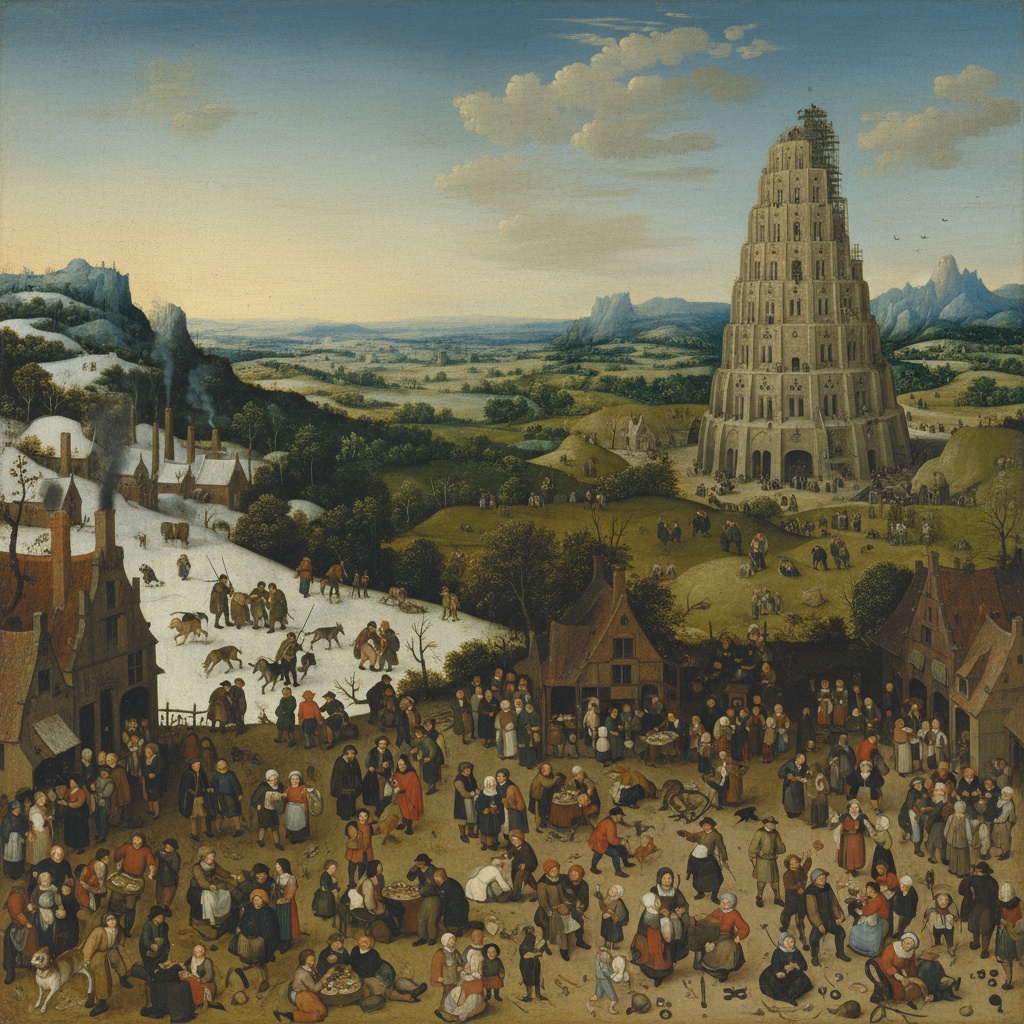
Beneath the surface realism of Bruegel's paintings lies a complex web of symbolism and social commentary. He wasn’t simply recording what he saw; he was offering pointed observations about human folly, greed, and the precariousness of existence. “The Dutch Proverbs” (1559) is a veritable encyclopedia of Flemish idioms, each proverb illustrated with often-absurd scenes that collectively serve as a moral indictment of societal vices. Similarly, “The Little Tower of Babel” (1563) isn’t just a depiction of the biblical construction project; it's a scathing critique of human ambition and the futility of collective endeavors driven by pride. Bruegel masterfully employed allegory and satire to expose the contradictions and absurdities of his world, inviting viewers to contemplate their own place within it. His use of chiaroscuro—the dramatic interplay of light and shadow—further enhances these symbolic layers, drawing attention to specific details and emphasizing the moral weight of his observations.
Bruegel's Legacy and Enduring Influence on Art History
Pieter Bruegel the Elder’s career was tragically cut short by his death in 1569 at the relatively young age of forty. Despite this brevity, his impact on art history is immeasurable. He pioneered a new approach to genre painting and landscape art, infusing both with narrative depth and social commentary. His influence can be seen in the works of later Dutch masters like Jan van Goyen and Jacob van Ruisdael, who continued to explore the beauty and complexity of the Northern landscape. Beyond his direct artistic descendants, Bruegel’s work has resonated across centuries, inspiring writers such as W.H. Auden (whose poem “Musée des Beaux Arts” famously references *Landscape with the Fall of Icarus*) and filmmakers like Andrei Tarkovsky, who incorporated visual motifs from Bruegel's paintings into his cinematic masterpieces. His ability to capture both the grandeur and the absurdity of human existence continues to captivate audiences today.
Key Works to Know: A Selection of Bruegel’s Masterpieces
- The Hunters in the Snow: An iconic winter landscape brimming with detail and narrative depth.
- The Peasant Wedding: A lively depiction of rural life, rich with social observation and subtle moral commentary.
- The Tower of Babel: A scathing critique of human ambition and the futility of collective endeavors.
- The Dutch Proverbs: An allegorical masterpiece illustrating a multitude of Flemish idioms and societal vices.
- Landscape with the Fall of Icarus: A poignant meditation on indifference and the everyday unfolding of tragedy.
Discover the timeless beauty and profound insights of Pieter Bruegel the Elder’s work. Explore a curated collection of his masterpieces, available as stunning handmade oil paintings and museum-quality prints at OriginalUniqueArt.