The Danube School: A Cradle of Northern Renaissance Landscape
Before the sweeping vistas of Romanticism, before even the meticulous observations of Dutch Masters, a quiet revolution unfolded along the banks of the Danube River. This was the birth of the Danube School, a loosely affiliated group of German and Austrian artists who dared to elevate landscape from mere backdrop to subject matter itself. While Italy basked in the High Renaissance’s focus on classical form and humanism, these northern painters turned their gaze inward, captivated by the dense forests, misty valleys, and dramatic peaks of their homeland. The School wasn't a formal academy but rather a shared sensibility—a fascination with nature imbued with a distinctly spiritual quality. It was within this fertile artistic climate that Albrecht Altdorfer emerged as its most compelling voice.
Altdorfer's Artistic Genesis: From Early Works to Regional Master
 Albrecht Altdorfer
Albrecht Altdorfer (1480-1538): Pioneer of German Renaissance landscape painting & key figure of the Danube School. Explore his engravings, religious works & innovative art.
Born around 1480 in Regensburg or nearby Altdorf, Bavaria, Albrecht Altdorfer’s early artistic training came from his father, Ulrich, a painter and miniaturist. His initial works were characterized by an intimacy and detail that hinted at the meticulous observation to come. These weren't grand pronouncements but rather modest explorations of form and subject—small-scale pieces executed with unconventional skill. Altdorfer settled in Regensburg in 1505, quickly establishing himself as a respected artist within the city’s vibrant artistic community. He rose through civic ranks, becoming town architect and eventually a member of the council, demonstrating a multifaceted talent that extended beyond the easel. His early signed works, dating from around 1506—engravings like “Stygmata of St. Francis” and “St. Jerome”—reveal an artist absorbing influences from Jacopo de Barbari and Albrecht Dürer’s masterful copper engravings, yet already hinting at a unique direction.
Nature as Subject: Pioneering the Independent Landscape Painting
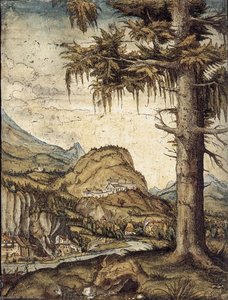 The Large Spruce
Discover Albrecht Altdorfer’s ‘The Large Spruce,’ a stunning 1522 etching showcasing Northern Renaissance landscape art. Intricate detail & serene beauty – a masterpiece by a pioneering artist.
Around 1511, Altdorfer embarked on a journey south into the Alps. This trip proved transformative. The sheer majesty of the mountains, the play of light and shadow across the valleys, ignited within him a passion for landscape that would define his career. He wasn’t simply depicting scenery; he was attempting to capture its essence—its emotional weight, its spiritual resonance. Before Altdorfer, landscapes were typically subordinate elements in larger compositions, serving as settings for biblical or mythological narratives. He broke with this tradition, creating paintings where the landscape *was* the narrative. “Landscape with Footbridge” (c. 1518-1520) is often cited as the first pure landscape painting in oil—a radical departure that signaled a new era in art history. The towering tree dominating the composition isn’t merely a botanical study; it feels imbued with life, its branches reaching and gesturing like human limbs.
Spirituality and Symbolism in Altdorfer’s Compositions
Altdorfer's landscapes weren’t devoid of figures, but their presence was often secondary to the overall atmospheric effect. His religious scenes, too, were deeply intertwined with nature. Biblical events unfolded within dramatic natural settings, imbued with a sense of mystery and awe. The forests became symbolic spaces—places of contemplation, spiritual struggle, and divine revelation. Even in his historical paintings, such as “The Battle of Alexander at Issus” (1529), the landscape plays a crucial role, not simply as a backdrop but as an active participant in the drama. The swirling clouds, the rugged terrain, contribute to the painting’s sense of chaos and grandeur. The artist often incorporated elements of fantasy into his work, creating scenes that were less about historical accuracy and more about conveying emotional truth. This tendency towards expressive color and dramatic lighting further enhanced the spiritual impact of his paintings.
Technical Innovation: Engraving, Color & the Altdorfer Style
Altdorfer was not only a painter but also a prolific engraver—a master of the “Nuremberg Little Masters” style. His small, intricate engravings allowed him to disseminate his artistic vision widely and explore complex compositions with remarkable precision. He experimented with color, employing vibrant hues and dramatic contrasts to create atmospheric effects that were unlike anything seen before. His brushwork was often loose and painterly, anticipating the techniques of later artists. The thick forests in his landscapes are rendered not as individual trees but as masses of interwoven forms, creating a sense of depth and texture. He believed that nature should not be disrupted by human intervention, allowing it to participate freely in its own processes—a philosophy reflected in his artistic style. His use of light is particularly noteworthy; he captured the subtle nuances of dawn and dusk, imbuing his landscapes with an ethereal quality.
Legacy and Influence: The Lasting Impact of a Renaissance Visionary
Altdorfer’s influence extended far beyond his immediate circle. As a leading figure of the Danube School, he paved the way for future generations of landscape painters. His emphasis on nature as an independent subject matter challenged conventional artistic norms and anticipated the Romantic movement centuries later. While largely overlooked during the height of the Italian Renaissance, Altdorfer’s work has been increasingly recognized in recent decades for its originality, emotional depth, and technical brilliance. His paintings continue to captivate viewers with their haunting beauty and spiritual resonance—a testament to the enduring power of a visionary artist who dared to see the divine within the natural world. Explore the masterpieces of Albrecht Altdorfer and discover the profound legacy of this Northern Renaissance pioneer at OriginalUniqueArt.com, where exceptional reproductions bring history’s greatest artworks into your home.