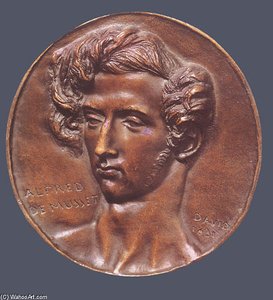
Portrait of David d'Angers

The 22 Most Famous David d'Angers Paintings, Each One of a Kind

Updated November 2026 · ranked by our popularity score (searches, visits and orders for each work) · 22 works by David d'Angers in our catalogue

In short

Marceline Valmore (1832) is the David d'Angers painting that draws the most eyes; the original belongs to the The Louvre, Paris. After it, the eye goes to Sorrow (1811) and General Bonchamps (1819). Among the 22 works of David d'Angers in our catalog, these 22 are the most famous, each a unique original presented with its year, its museum and the reason it endures.

1788 – 1856, Angers Neoclassicism Most works: The Louvre

Top 10 paintings by David d'Angers, through the gallery's eye

1
Marceline Valmore (1832) by David d'Angers

Marceline Valmore

1832 · Bronze · The Louvre, Paris

In the quiet, metallic sheen of Pierre-Jean David d’Angers' 1832 bronze medallion, one finds far more than a mere likeness of the poet Marceline Valmore; one encounters a profound meditation on character. This exquisite piece, a masterwork of neoclassical relief, captures the profile of the celebrated French Romantic poet with a dignity that transcends the physical. David d’Angers, a sculptor deeply rooted in the republican ideals of his era, famously…

2
Sorrow (1811) by David d'Angers

Sorrow

1811 · Marble

A single face emerges from the pale silence of marble. The eyes are closed, or perhaps they are simply looking inward, toward a place where light does not reach. This is a portrait of a man, yet the features belong to an ideal, a sculpted memory of strength and nobility. The brow is smooth, the nose straight and sharp, and the lips are set in a quiet, melancholic stillness. It…

3
General Bonchamps (1819) by David d'Angers

General Bonchamps

1819 · Stone · Church, Saint-Florent-le-Vieil

The heavy silence of the monument commands the space, drawing the eye upward toward a scene of profound movement and stillness. A reclining figure, carved with a sense of weary dignity, reaches a hand toward the heavens. Above, a winged female figure descends, her presence a soft counterpoint to the solid, grounded weight of the man below. This is the embodiment of Grace aux Prisonniers, a moment where the divine…

4
Nereid Bringing the Helmet of Achilles (1815) by David d'Angers

Nereid Bringing the Helmet of Achilles

1815 · Plaster

In this plaster relief sculpture, Nereid Bringing the Helmet of Achilles by David d'Angers captures a singular moment of divine intervention. Created about 1815, the work focuses on a Nereid, a sea nymph, as she emerges from the currents to perform a sacred duty. She holds up the helmet of Achilles, a heavy weight of bronze and destiny, presenting it with a sense of urgent purpose. The mythological narrative is…

5
The Actor Talma (1827) by David d'Angers

The Actor Talma

1827 · Photography · Musée Des Beaux, Angers

In this work, we encounter a seated figure that commands the space through a quiet, dignified repose. The sculpture, rendered in a grayscale palette, focuses entirely on the interplay of light and shadow across the form. One hand rests upon a thigh while the other supports a draped garment, creating a composition that feels both relaxed and profoundly composed. The lighting, coming from an unseen source, carves out the musculature…

6
François Arago (1832) by David d'Angers

François Arago

1832 · Bronze

This portrait of François Arago was executed by the sculptor David d'Angers in 1832. The work captures a man of significant intellectual and political standing in nineteenth-century France. As an astronomer, physician, and politician, Arago occupied a central position in the scientific and civic life of his era. He was a prominent member of the Arago clan at the Paris Observatory, a lineage of thinkers that included his siblings Jean,…

7
Niccolò Paganini (1834) by David d'Angers

Niccolò Paganini

1834 · Bronze

This bronze medallion presents a profile portrait of Niccolò Paganini, the Italian violinist, guitarist, and composer. Created by the French sculptor David d'Angers, the work is dated about 1834. The subject is depicted with long, curly hair and a beard, shown in a serious expression while gazing slightly off-center. The relief captures the facial features of the virtuoso, including the nose and chin, through sculpted details that define the contours…

8
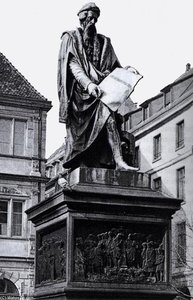
Gutenberg (1840) by David d'Angers

Gutenberg

1840 · Black and White Photography · Place Gutenberg, Strasbourg

In the heart of Strasbourg, the stone figure of Gutenberg rests. Created by the French sculptor David d'Angers, the monument was erected in 1840 to mark the 400th anniversary of the invention of printing. It was inaugurated in June 1840, a moment of public gathering and civic pride. The statue depicts Johannes Gutenberg, the man who changed the movement of ideas through the press.

9
Condé (1817) by David d'Angers

Condé

1817 · Bronze · The Louvre, Paris

Created in 1817, this bronze sculpture captures François Gérard, Marquis de Condé, a Huguenot noble who defended the Protestant faith during the Wars of Religion. The figure is seated upon a simple pedestal, projecting a sense of dignity and repose. One arm is raised in a gesture of authority or solace, while the other rests upon his thigh, suggesting a steadfast resilience. The work reflects the neoclassical pursuit of idealized…

10
The Death of Epaminondas (1811) by David d'Angers

The Death of Epaminondas

1811 · Sculpture

The scene captures a moment of profound vulnerability and mourning. A central figure lies on the ground, his head resting in the lap of a companion in an intimate gesture of care. Surrounding this core of grief are several individuals, their faces etched with intense concern and contemplation. The composition is framed by an elaborate border of decorative leaves and laurel wreaths, symbols of victory and honor that contrast sharply…

David d'Angers's famous paintings, numbers 11 to 22

The subjects that held David d'Angers's eye

The four subjects that come back most often in these originals, each with its finest example.

The museums that keep David d'Angers's originals

The 6 museums that hold the most of the paintings on this page.

Museum City Works by David d'Angers Paintings from this list
The Louvre, ParisThe Louvre Paris 3 Marceline Valmore, Condé, Philopoemen
Musée Des Beaux, AngersMusée Des Beaux Angers 3 The Actor Talma, Niccolò Paganini, Young Greek on the Tomb of Markos Botsaris
Place du Panthéon, ParisPlace du Panthéon Paris 2 Pediment relief of the Pantheon, Pediment relief of the Pantheon
Père-Lachaise Cemetery, ParisPère-Lachaise Cemetery Paris 2 Tomb of the Comte de Bourcke, Monument to General Gobert
Church, Saint-Florent-le-VieilChurch Saint-Florent-le-Vieil 1 General Bonchamps
Place Gutenberg, StrasbourgPlace Gutenberg Strasbourg 1 Gutenberg

David d'Angers across the decades: one unique original for each

Works per decade

Pick a decade to see the original that defines it.

David d'Angers's paintings: questions for the gallery

What is the single most famous work of David d'Angers?Reveal the answer

Marceline Valmore (1832), The Louvre, Paris. Sorrow (1811) and General Bonchamps (1819) come next.

At what age did David d'Angers create Marceline Valmore?Reveal the answer

44 years old: Marceline Valmore dates from 1832, and David d'Angers was born in 1788.

Which ten paintings by David d'Angers are the most famous?Reveal the answer

Marceline Valmore, Sorrow, General Bonchamps, Nereid Bringing the Helmet of Achilles, The Actor Talma, François Arago, Niccolò Paganini, Gutenberg, Condé and The Death of Epaminondas. The ranking above gives each one's year and museum.

How many works by David d'Angers are known?Reveal the answer

Our catalog holds 22 works by David d'Angers, dated from 1811 to 1847.

Where can the most famous David d'Angers originals be seen?Reveal the answer

Mostly in The Louvre (Paris), Musée Des Beaux (Angers) and Place du Panthéon (Paris). The museum table above lists them all.

During which period did David d'Angers create the best-known paintings?Reveal the answer

In 1830s: 9 of the 22 works on this page were made then, Marceline Valmore among them.

Which famous David d'Angers painting is the earliest, and which the latest?Reveal the answer

On this page, the earliest is Sorrow (1811) and the latest Monument to General Gobert (1847).

What subjects did David d'Angers favour?Reveal the answer

Sculpture (11), Man (9) and Profile (5), across the 22 works on this page.

What materials did David d'Angers paint with most?Reveal the answer

Bronze, for 7 of the 22 works on this page.

Which movement does the work of David d'Angers belong to?Reveal the answer

Neoclassicism, judging by the originals on this page.

What David d'Angers originals can I see at the The Louvre?Reveal the answer

Marceline Valmore, Condé and Philopoemen: the The Louvre, Paris holds 3 of the works on this page.

David d'Angers: a portrait of the artist

Pierre-Jean David d’Angers: The Sculptor of Heroic Idealism

Pierre-Jean David d’Angers (1788 – 1856) stands as a pivotal figure in the neoclassical artistic landscape of France, embodying the spirit of republican idealism and monumental sculptural achievement. Born in Angers, Loiret, his early life was marked by familial ties to the Republican army—his father, a wood carver and sculptor himself, participated valiantly against the Chouan rebellion—a formative experience that instilled within him a profound appreciation for civic duty and artistic expression as instruments of national pride. This heritage profoundly shaped his artistic trajectory, propelling him toward a distinguished career centered on sculpting and modeling, particularly during the influential period of Jacques-Louis David’s studio.
  • Early Training & Influences: David's formative years were spent honing his craft under Jean-Jacques Delusse and Philippe-Laurent Roland in Paris, absorbing the stylistic precepts of Romanticism alongside the enduring legacy of classical sculpture. Notably, he encountered Antonio Canova—a sculptor whose meticulous attention to anatomical detail and emotive portrayal captivated David’s imagination—establishing a crucial connection with the artistic traditions of Rome that would define his oeuvre.
  • The École des Beaux-Arts & The Prix de Rome: Recognizing his talent, David secured admission to the École des Beaux-Arts in 1808 where he excelled, culminating in victory at the École’s competition for *tête d'expression* and subsequently claiming the prestigious Prix de Rome in 1811. This scholarship afforded him unparalleled access to Roman artistic ideals and allowed him to develop his sculptural technique—characterized by a masterful command of marble and bronze—further refining his ability to capture human emotion and heroic grandeur.
  • Roman Period & Artistic Evolution: David’s five-year sojourn in Rome proved transformative, fostering collaborations with fellow artists and immersing himself in the artistic fervor of the era. He meticulously studied the works of Michelangelo Buonarroti and Bernini, absorbing their techniques and stylistic sensibilities—influences that would permeate his subsequent sculptures and etchings. During this time he undertook expeditions to Venice, Naples and Florence, broadening his artistic horizons and enriching his understanding of classical art history.
  • Monumental Sculpture & Notable Commissions: David’s reputation soared as a sculptor during the Restoration period, securing commissions for monumental works that cemented his place in French cultural history. Among his most celebrated achievements are the Pantheon frieze—a breathtaking depiction of Roman mythology commissioned to commemorate Napoleon Bonaparte's triumph—the equestrian statue of Marshal Jacques-Nicolas Gobert erected in Père Lachaise Cemetery—and the monumental sculpture commemorating the Greek liberator Markos Botsaris, a testament to David’s commitment to portraying heroic figures with unwavering conviction.
  • Legacy & Recognition: David’s prolific output encompassed over 500 medallions and busts, capturing portraits of luminaries from across Europe—including Voltaire, Rousseau, Goethe, Napoleon Bonaparte, and Friedrich Schiller—demonstrating his versatility as an artist and cementing his enduring influence on subsequent generations of sculptors. His unwavering dedication to classical ideals and his ability to convey profound emotion through sculptural form ensured that David d’Angers would remain a revered figure in the annals of French art history, securing his place among the foremost sculptors of his time.

Key Works & Artistic Style

David’s artistic style is characterized by an unwavering commitment to neoclassical principles—specifically anatomical accuracy, idealized beauty, and dramatic composition—reflecting the influence of Michelangelo Buonarroti and Bernini. He skillfully employed marble and bronze to convey emotion and grandeur, prioritizing clarity of form and expressive gesture above mere decorative embellishment. His sculptures are imbued with a palpable sense of pathos and nobility, capturing moments of profound human experience with meticulous detail and unwavering conviction. The Pantheon frieze exemplifies his mastery of monumental sculpture, presenting an ambitious undertaking that celebrates Roman mythology and commemorates Napoleon Bonaparte’s victory—a testament to David's ambition and artistic vision. Similarly, the equestrian statue of Marshal Gobert stands as a symbol of French military prowess and civic virtue, demonstrating David’s ability to elevate sculptural form into a vehicle for conveying complex narratives and emotional resonance.